
Chapter 15 · Topic 15.2 · Prelims + Mains2 of 3
Arab-Israel Conflict: Wars and Palestine
Key points
- The Six-Day War (1967) gave Israel Sinai, Gaza, the West Bank, East Jerusalem and the Golan; Resolution 242 set 'land for peace'.
- The Yom Kippur War (1973) led to the OAPEC oil embargo that quadrupled oil prices.
- Core Palestinian issues: borders, settlements, Jerusalem, refugees, security; India backs two states and recognised Palestine in 1988.
Prelims box: facts and traps
- PLO: 1964; Arafat from 1969; UN observer 1974.
- First Intifada: 1987–93; Hamas 1987.
- Gaza: Israel left 2005; Hamas took over 2007.
The Arab–Israeli wars
Think of two neighbours who keep fighting over a shared wall. Each fight moves the wall a bit, leaves more anger behind, and makes the next fight more likely. The wars below worked the same way.
| War | Outcome |
|---|---|
| Suez (1956) | Israel joined Britain and France against Egypt; withdrew under US pressure |
| Six-Day War (June 1967) | Israel took Sinai, Gaza, West Bank, East Jerusalem and the Golan Heights; UN Resolution 242 (land for peace) |
| Yom Kippur War (October 1973) | Egypt and Syria attacked; OAPEC oil embargo quadrupled prices |
| Lebanon (1982) | Israeli invasion to expel the PLO |
- Six-Day War: Israel struck first when Egypt moved troops and closed a key sea route. In six days it more than tripled the land it held. Resolution 242 asked Israel to give back land in return for Arab recognition and peace, an idea called “land for peace”.
- Yom Kippur War: named after the Jewish holy day on which Egypt and Syria attacked. OAPEC, the group of Arab oil-exporting countries, stopped oil sales to Israel’s backers. Oil prices rose about four times, hitting economies worldwide, including India’s.
- Lebanon 1982: Israel invaded to drive out PLO fighters based there.
The Palestinian question
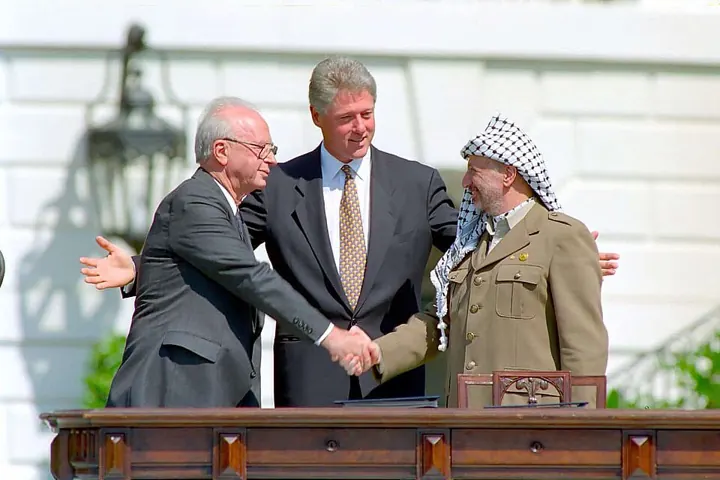
| Point | Detail |
|---|---|
| PLO (1964) | Yasser Arafat led it from 1969; UN observer status (1974) |
| First Intifada (1987–93) | Uprising in the occupied territories; Hamas founded (1987) |
| Second Intifada (2000–05) | After the collapse of Camp David talks |
| Core issues | Borders, settlements, Jerusalem, refugees, security |
| Gaza | Israel withdrew (2005); Hamas took control (2007); repeated wars, including after October 2023 |
| India’s stand | Supports a two-state solution; recognised the State of Palestine (1988) |
The PLO, or Palestine Liberation Organisation, is the main body speaking for Palestinians. Intifada is Arabic for “shaking off”: a mass uprising, often of stone-throwing youth, against Israeli rule. Hamas is an Islamist group that rejects Israel and later ran Gaza.
The core issues, in plain words:
- Borders: where Israel ends and Palestine begins.
- Settlements: Israeli towns built on land taken in 1967.
- Jerusalem: both sides want it as their capital.
- Refugees: whether Palestinians who fled in 1948 can return.
- Security: Israel wants safety from attacks.
A two-state solution means an independent Palestine living in peace beside Israel. India was among the first non-Arab countries to recognise Palestine in 1988, and today keeps close ties with both sides.
Common doubts
What are the “occupied territories”? The West Bank, East Jerusalem and Gaza, taken by Israel in 1967. Most of the world sees them as land for a future Palestinian state.
Why did the 1973 war matter so much to the world? It showed oil could be used as a weapon. Western economies slowed, prices soared, and countries such as India faced a heavy fuel bill.
What happened in Gaza after 2023? Hamas attacked Israel on 7 October 2023, and Israel launched a long war in Gaza that caused huge loss of life and destruction.
Timeline at a glance
| Year | Event |
|---|---|
| 1964 | PLO formed |
| 1967 | Six-Day War |
| 1973 | Yom Kippur War, oil shock |
| 1987 | First Intifada, Hamas founded |
| 1988 | India recognises Palestine |
| 2005 | Israel leaves Gaza |
What UPSC asks
Prelims: 1967 war, Resolution 242, OAPEC embargo 1973, PLO, Intifadas. Mains: the 1973 oil shock and the hurdles to a two-state solution.
Mains box: analysis and answer points
- 1973 oil shock: effects on the world and India.
- Two-state solution: hurdles and India's position.
Practice
Write an answer
In 150 words, explain the significance of Arab-Israel Conflict with one recent example.
Flashcards (8)
Six-Day War?
June 1967.
Land for peace resolution?
UN Resolution 242.
War that triggered the oil embargo?
Yom Kippur War (1973).
Heights taken from Syria in 1967?
Golan Heights.
PLO founded?
1964.
First Intifada?
1987–93.
Group controlling Gaza since 2007?
Hamas.
India recognised Palestine?
1988.
 Next topic · 15.3 →Arab-Israel Conflict: The peace process
Syllabus: GS-I · History of the world will include events from 18th century such as industrial re…