
Chapter 1 · Topic 1.1 · Prelims + Mains1 of 3
Industrial Revolution: Causes and the first wave
Key points
- Why Britain first.
- Textiles and iron.
- Steam and railways.
3 PYQs 2015–2024
Prelims box: facts and traps
| Factor | How it helped |
|---|---|
| Agricultural revolution | Enclosures, Jethro Tull's seed drill (1701), Townshend's turnip rotation: more food, and labour freed for towns |
| Capital | Profits of Atlantic and Asian trade, including plantations and the slave trade; Bank of England (1694) |
| Coal and iron | Large deposits close to each other and to the coast |
| Markets and navy | Colonies supplied raw cotton and bought finished goods; the Royal Navy guarded sea lanes |
| Politics and law | Stability after 1688, patent law, no internal tolls |
| Transport | Rivers, coastal shipping and a canal boom (Bridgewater Canal, 1761). |
- The Industrial Revolution (c. 1760–1840 in Britain) was the shift from hand tools and home production to machines, inanimate power and factories.
- Arnold Toynbee popularised the term in 1881.
- The Iron Bridge at Coalbrookdale (1779) showed what cheap cast iron could do.
The Industrial Revolution (c. 1760–1840 in Britain) was the shift from hand tools and home production to machines, inanimate power and factories. Arnold Toynbee popularised the term in 1881.
| Factor | How it helped |
|---|---|
| Agricultural revolution | Enclosures, Jethro Tull’s seed drill (1701), Townshend’s turnip rotation: more food, and labour freed for towns |
| Capital | Profits of Atlantic and Asian trade, including plantations and the slave trade; Bank of England (1694) |
| Coal and iron | Large deposits close to each other and to the coast |
| Markets and navy | Colonies supplied raw cotton and bought finished goods; the Royal Navy guarded sea lanes |
| Politics and law | Stability after 1688, patent law, no internal tolls |
| Transport | Rivers, coastal shipping and a canal boom (Bridgewater Canal, 1761) |
Mains 2015: ‘Why did the industrial revolution first occur in England? Mains 2015 Discuss the quality of life of the people there during the industrialization. How does it compare with that in India at present?’ Pair the factors above with the slums, long hours and child labour of early industrial towns, then compare with India’s informal workforce, urban slums and labour codes today.
Why did the industrial revolution first occur in England? Discuss the quality of life of the people there during the industrialization. How does it compare with that in India at present?
The first wave: textiles and iron
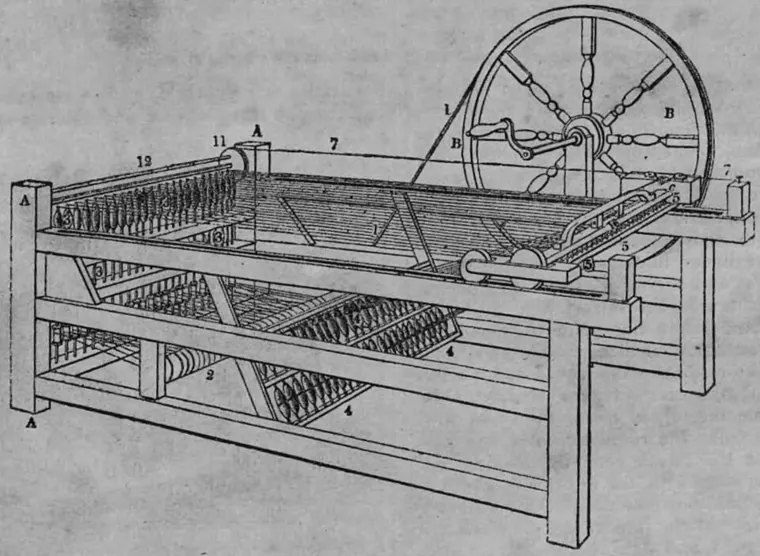
| Invention | Inventor and year |
|---|---|
| Flying shuttle | John Kay, 1733 (faster weaving) |
| Spinning jenny | James Hargreaves, 1764 |
| Water frame | Richard Arkwright, 1769; Cromford Mill (1771), the first water-powered cotton spinning mill |
| Spinning mule | Samuel Crompton, 1779 |
| Power loom | Edmund Cartwright, 1785 |
| Cotton gin | Eli Whitney, USA, 1793 |
| Coke smelting of iron | Abraham Darby, Coalbrookdale, 1709 |
| Puddling and rolling | Henry Cort, 1784 |
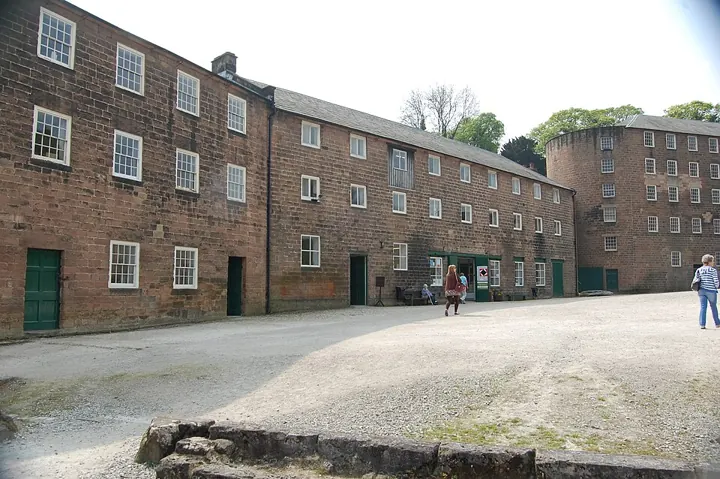
Cotton led because demand (long fed by Indian calicoes) was huge and each machine created a bottleneck the next one solved. The Iron Bridge at Coalbrookdale (1779) showed what cheap cast iron could do.
Steam, railways and communication
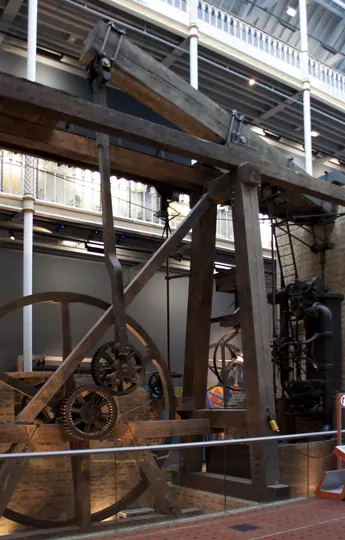
| Innovation | Marker |
|---|---|
| Newcomen engine (1712) | Pumped water from mines |
| Watt’s separate condenser (patent 1769) | Far more efficient; Boulton and Watt rotary engines drove mills from the 1780s |
| Stockton and Darlington Railway (1825) | First public steam railway |
| Stephenson’s Rocket (1829) | Won the Rainhill Trials; Liverpool and Manchester Railway opened 1830 |
| Steamships | Fulton’s Clermont (1807); iron, screw-driven ships later |
| Telegraph | Morse’s line, 1844; transatlantic cable, 1866 |
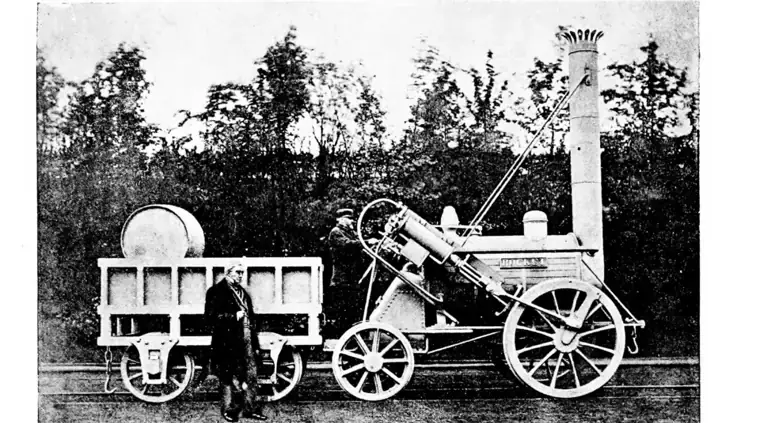
Steam freed factories from riverbanks, and railways cut freight costs, unified markets and needed huge amounts of iron and coal, deepening the whole revolution.
Mains box: analysis and answer points
- Cotton led because demand (long fed by Indian calicoes) was huge and each machine created a bottleneck the next one solved.
- Likely next angle: Capital and colonies
- Asked: Mains 2015 (GS Paper I, 12.5 marks): Why did the industrial revolution first occur in England? Discuss the quality of life of the people there during the industrialization. How does it compare with that in India at present?
Practice
Prelims PYQs on this topic (2)
Read the passage
We take it for granted now that science has a social responsibility. The idea would not have occurred to Newton or Galileo. They thought of science as an account of the world as it is, and the only responsibility that they acknowledged was to tell the truth. The idea that science is a social enterprise is modern, and it begins at the industrial revolution. We are surprised that we cannot trace a social sense further back, because we nurse the illusion that the industrial revolution ended a golden age.
Which one of the following statements best reflects the thinking of the author about the science?
Answer (d) & explanation
The author thinks science must pursue truth and also serve society (d). Step 1: the passage says Newton and Galileo saw science's only duty as "to tell the truth". Step 2: it adds that today "we take it for granted" that science has a social responsibility, an idea that began with the industrial revolution. Joining both gives (d). Step 3: option (c) reverses the link: the passage says the social sense began at the industrial revolution, not that science caused it. Options (a), scientists' commitment, and (b), scientific awareness, are not discussed.
Tip: when a passage moves from an old view to a new one, the best answer often joins both. India's Constitution (Article 51A) lists developing scientific temper as a fundamental duty.
Answer as per the official UPSC answer key.
Which of the following statements correctly explains the impact of Industrial Revolution on India during the first half of the nineteenth century ?
Answer (a) & explanation
Indian handicrafts were ruined (a). After the Charter Act of 1813 ended the Company's trade monopoly, cheap machine-made British cloth flooded India under one-way free trade. British goods entered India with very low duties, while Indian goods faced high duties in Britain. This ruined Indian handicrafts, especially weaving, and towns such as Dhaka, Murshidabad and Surat declined. This process is called deindustrialisation. Option (b) is wrong because the first cotton mill came only in 1854. Option (c) is wrong because railways began only in 1853. Option (d) is wrong because duties on British imports were very low.
Notice the result: millions of artisans moved to farming, adding to pressure on land. Dadabhai Naoroji's Drain Theory and R.C. Dutt described this.
Answer as per the official UPSC answer key.
Mains PYQs on this topic (1)
Write an answer
In 150 words, explain the significance of Industrial Revolution with one recent example.
Flashcards (12)
Who popularised the term Industrial
Revolution? Arnold Toynbee (1881).
Seed drill inventor?
Jethro Tull (1701).
Bank of England founded?
1694.
Flying shuttle?
John Kay, 1733.
Spinning jenny?
James Hargreaves, 1764.
Water frame and Cromford Mill?
Richard Arkwright (1769, 1771).
Power loom?
Edmund Cartwright, 1785.
Coke smelting of iron?
Abraham Darby, 1709.
Iron Bridge opened?
1779, Coalbrookdale.
Watt's key improvement?
Separate condenser (1769).
First public steam railway?
Stockton and Darlington, 1825.
Winner of the Rainhill Trials?
Stephenson's Rocket (1829).
Read more: related explainers
 Next topic · 1.2 →Industrial Revolution: Second wave and society
Syllabus: GS-I · History of the world will include events from 18th century such as industrial re…