
Chapter 17 · Topic 17.1 · Prelims + Mains1 of 3
International Organizations: UN and Bretton Woods
Key points
- The UN Charter was signed at San Francisco in June 1945 and came into force on 24 October 1945; India is a founding member.
- The Security Council has 5 veto-holding permanent members and 10 elected members; the G4 seek reform.
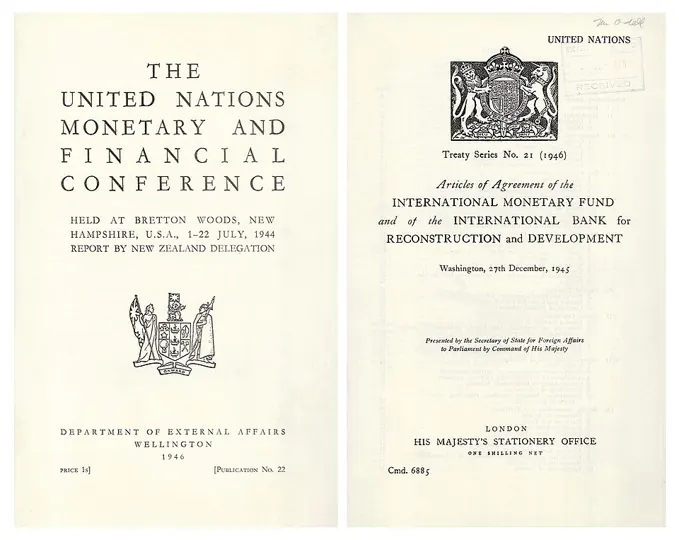
- The IMF (short-term balance-of-payments help) and World Bank (long-term loans) came from Bretton Woods, July 1944.
2 PYQs 2007–2016
Prelims box: facts and traps
- IMF lends to: only member countries, Prelims 2011, answer (c).
- IBRD: statements I and III only, Prelims 2025, answer (c).
- Trusteeship Council: suspended 1994.
The United Nations
| Point | Detail |
|---|---|
| Founded | Charter signed at San Francisco (June 1945); in force 24 October 1945; India a founding member |
| Principal organs | General Assembly, Security Council, ECOSOC, Trusteeship Council (suspended 1994), International Court of Justice, Secretariat |
| Security Council | 5 permanent members with veto (USA, UK, France, Russia, China) and 10 elected for two years |
| Agencies | UNESCO, WHO, FAO, ILO (1919), UNICEF, UNHCR |
| Achievements | Peacekeeping (India among the largest contributors), decolonisation, human rights (1948) |
| Limits | Veto paralysis; reform demand by the G4 (India, Brazil, Germany, Japan) |
A veto is the power to block a decision alone, like one friend cancelling a group plan.
The Bretton Woods twins: IMF and World Bank
| Point | IMF | World Bank (IBRD) |
|---|---|---|
| Created | Bretton Woods conference, July 1944; began work 1945–46 | Same conference |
| Purpose | Exchange-rate stability; short-term balance-of-payments help | Long-term reconstruction and development loans |
| Headquarters | Washington, DC | Washington, DC |
| Leadership convention | European head | American head |
| India | Founding member; 1991 loan with reforms | Largest IDA borrower historically |
A balance-of-payments problem means running short of foreign currency for imports. IDA gives cheap loans to the poorest countries.
The IMF lends only to member countries (Prelims 2011, answer c).
Regarding the International Monetary Fund, which one of the following statements is correct ?
- It can grant loans to any country
- It can grant loans to only developed countries
- It grants loans to only member countries
- It can grant loans to the central bank of a country
Show answer
Answer: (c) · UPSC official key
The IBRD lends to middle-income countries and was set up to rebuild Europe, but not single-handedly: I and III only (Prelims 2025, answer c).
Consider the following statements in respect of the International Bank for Reconstruction and Development (IBRD) : I. It provides loans and guarantees to middle income countries. II. It works single-handedly to help developing countries to reduce poverty. III. It was established to help Europe rebuild after the World War II. Which of the statements given above are correct?
- I and II only
- II and III only
- I and III only
- I, II and III
Show answer
Answer: (c) · UPSC official key
Mains box: analysis and answer points
- UNSC reform: veto paralysis and India's claim.
- Bretton Woods today: IMF and World Bank in a changing world.
Practice
Prelims PYQs on this topic (2)
‘Doctors Without Borders (Medecins Sans Frontieres)’, often in the news, is
Answer (b) & explanation
MSF is an independent international NGO (b). Médecins Sans Frontières was founded in France in 1971 by doctors and journalists. It gives emergency medical care in wars, epidemics and disasters, and won the Nobel Peace Prize in 1999. It is not a division of the WHO (a), it is not run by the European Union (c), and it is not a UN specialised agency (d). In fact, it guards its independence by taking most of its money from private donors.
It was in the news in 2015 after a US airstrike hit its hospital in Kunduz, Afghanistan. Notice the trap: famous humanitarian names tempt you towards "UN" options, but bodies like MSF, Amnesty and the ICRC (a private Swiss association with a special mandate) are not UN agencies.
Answer as per the official UPSC answer key.
Which one of the following is associated with the issue of control and phasing out of the use of ozone-depleting substances?
Answer (b) & explanation
The Montreal Protocol (1987), under the Vienna Convention (1985), phases out ozone-depleting substances such as CFCs and halons (b). It is the first UN treaty ratified by every country. Bretton Woods (a) created the IMF and World Bank in 1944. The Kyoto Protocol (c) dealt with greenhouse gases, and the Nagoya Protocol (d) with access and benefit-sharing of genetic resources.
Its Kigali Amendment (2016) adds HFCs, which do not harm ozone but are strong greenhouse gases. Notice how the ozone layer is healing, a rare success story of global cooperation.
Answer as per the official UPSC answer key.
Write an answer
In 150 words, explain the significance of International Organizations with one recent example.
Flashcards (10)
UN came into being?
24 October 1945.
Permanent members?
USA, UK, France, Russia, China.
Suspended UN organ?
Trusteeship Council (1994).
Seat of the ICJ?
The Hague.
G4 members?
India, Brazil, Germany, Japan.
Bretton Woods conference?
July 1944.
IMF lends to?
Member countries.
IBRD lends mainly to?
Middle-income countries.
World Bank soft-loan arm?
IDA.
WTO headquarters?
Geneva.
 Next topic · 17.2 →International Organizations: WTO and EU
Syllabus: GS-I · History of the world will include events from 18th century such as industrial re…