
Chapter 16 · Topic 16.3 · Prelims + Mains3 of 3
South Africa: Transition to democracy
Key points
- Apartheid ended due to mass protest, sanctions, economic decline and the end of the Cold War.
- De Klerk unbanned the ANC and freed Mandela in 1990; CODESA talks ran 1991–93.
- The first free election was on 27 April 1994 (ANC about 62%); the 1996 Constitution has a Bill of Rights.
3 PYQs 2014–2024
Prelims box: facts and traps
- Freedom Day: 27 April.
- BRICS: South Africa joined 2010.
- 'Rainbow nation': Tutu's phrase.
Transition to democracy
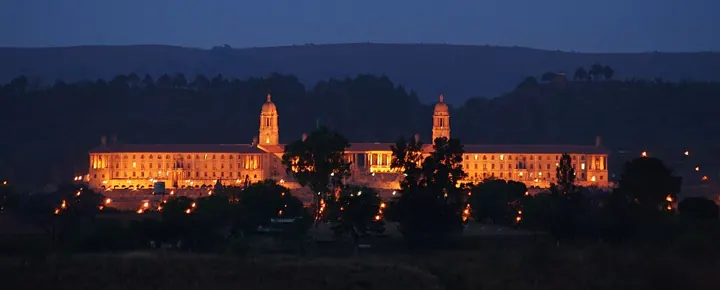
Think of a building with a cracked foundation. Protesters inside, neighbours refusing to trade, falling income and the loss of an old protector all add pressure until the owner agrees to rebuild. That is how apartheid came down.
| Step | Detail |
|---|---|
| Why apartheid ended | Mass protest, sanctions, economic decline, end of the Cold War |
| De Klerk’s reforms (1990) | ANC unbanned; Mandela freed |
| Negotiations | CODESA talks (1991–93) amid violence |
| First free election | 27 April 1994 (Freedom Day); ANC won about 62% |
| Constitution (1996) | Bill of Rights; ‘rainbow nation’ |
| Legacy | Political equality won; economic inequality persists; South Africa joined BRICS (2010) |
Why apartheid ended, simply
- Mass protest: strikes, school boycotts and township uprisings in the 1980s made the country hard to govern.
- Sanctions: sanctions are penalties one country puts on another, like stopping trade or loans. Many countries and banks cut ties, and South Africa was banned from world sport.
- Economic decline: growth slowed, money left the country and skilled jobs went unfilled because Black workers were held back.
- End of the Cold War: the white government had sold itself to the West as a shield against communism. Once the Soviet Union weakened around 1989–91, that excuse vanished.
From talks to the vote
CODESA stands for the Convention for a Democratic South Africa, the talks between the government, the ANC and other parties. They were shaken by violence, including the murder of popular ANC leader Chris Hani in 1993, but they held. In 1994 people of all races voted for the first time, many queuing for hours. South Africa now marks 27 April as Freedom Day.
The 1996 Constitution has a strong Bill of Rights, a list of rights every person has, such as equality and free speech. Archbishop Desmond Tutu called the new nation a “rainbow nation”, a country of many colours living together.
What changed and what did not
| Changed | Still a problem |
|---|---|
| Equal vote for all | Wide gap between rich and poor |
| Race laws removed | High unemployment |
| Strong courts and rights | Crime and corruption |
India and the new South Africa
India restored full ties once apartheid ended. Today both work together in groups such as BRICS and IBSA (India, Brazil, South Africa).
Key people
- F. W. de Klerk: the last apartheid-era president, who chose to negotiate.
- Nelson Mandela: ANC leader, freed in 1990, president from 1994 to 1999.
- Desmond Tutu: archbishop who led the Truth and Reconciliation Commission.
- Chris Hani: ANC leader whose 1993 murder nearly derailed the talks.
Common doubts
Why did de Klerk agree to give up power? He saw that apartheid could not last. Talking early gave whites a say in the new rules, while fighting on risked civil war and ruin.
Did the end of apartheid end inequality? No. Legal equality came fast, but land and wealth are still mostly in few hands, so the struggle for economic justice goes on.
Is South Africa a model for others? Many see its peaceful transfer of power and the TRC as lessons for countries leaving conflict, though its economic gaps are a warning too.
What UPSC asks
Prelims: de Klerk, CODESA, 27 April 1994, Constitution 1996, BRICS 2010. Mains: why apartheid ended and the unfinished tasks of South African democracy.
Mains box: analysis and answer points
- Why apartheid ended: internal and external pressure.
- Unfinished tasks: inequality, jobs, land.
Practice
Prelims PYQs on this topic (3)
Consider the following countries :
- 1. Italy
- 2. Japan
- 3. Nigeria
- 4. South Korea
- 5. South Africa
Which of the above countries are frequently mentioned in the media for their low birth rates, or ageing population or declining population ?
Answer (a) & explanation
Italy, Japan and South Korea face low births and ageing (a). Item 4 is right: South Korea has the world's lowest fertility rate, below 0.8 children per woman. Item 2 is right: Japan has one of the oldest populations, and it has been shrinking for over a decade. Item 1 is right: Italy has very low births and an ageing population. Item 3 is wrong: Nigeria has one of the fastest-growing, youngest populations. Item 5 is wrong: South Africa is also young and still growing.
Notice the term: a replacement fertility rate is about 2.1. China's population has also fallen since 2022. India's fertility rate has dropped to about 2.0, below replacement, while its demographic dividend continues for now.
Answer as per the official UPSC answer key.
In which one of the following groups are all the four countries members of G20 ?
Answer (a) & explanation
Argentina, Mexico, South Africa and Turkey are all G20 members (a). The G20 has 19 countries plus the European Union, and the African Union joined in 2023 at India's New Delhi summit. The 19 are Argentina, Australia, Brazil, Canada, China, France, Germany, India, Indonesia, Italy, Japan, Mexico, Russia, Saudi Arabia, South Africa, South Korea, Turkey, the UK and the USA. Option (b) fails because of Malaysia and New Zealand. Option (c) fails because of Iran and Vietnam. Option (d) fails because of Singapore.
Notice that the G20 began in 1999 as a meeting of finance ministers after the Asian financial crisis and became a leaders' summit in 2008. It has no permanent secretariat; the troika of past, present and next presidencies guides it.
each wrong option has three members and one outsider. Find the outsider: Malaysia, Iran, Singapore.
Answer as per the official UPSC answer key.
With reference to a grouping of countries known as BRICS, consider the following statements :
- 1. The First Summit of BRICS was held in Rio de Janeiro in 2009.
- 2. South Africa was the last to join the BRICS grouping.
Which of the statements given above is/are correct?
Answer (b) & explanation
Statement 1 is wrong: the first BRIC summit was held at Yekaterinburg, Russia, in 2009, not Rio. Brazil hosted the second, in Brasília in 2010. Statement 2 was correct in 2014: South Africa joined in 2010–11 and turned BRIC into BRICS.
The group has since grown: Egypt, Ethiopia, Iran and the UAE joined in 2024 and Indonesia in 2025. Its New Development Bank (Shanghai) and Contingent Reserve Arrangement were agreed at the Fortaleza summit in 2014. Notice how a question set in one year can age; always read membership questions in the year they were asked.
Answer as of 2014. The expansion from 2024 came after this question was set.
Answer as per the official UPSC answer key.
Write an answer
In 150 words, explain the significance of South Africa with one recent example.
Flashcards (2)
First free election?
27 April 1994.
Post-apartheid constitution?
1996.
 Next chapter · 17. International Organizations →International Organizations: UN and Bretton Woods
Syllabus: GS-I · History of the world will include events from 18th century such as industrial re…