
Chapter 7 · Topic 7.1 · Prelims + Mains1 of 3
Russian Revolution: Causes, 1905 and February
Key points
- Causes: autocracy, land-hungry peasants, overworked workers, angry nationalities and Marxist ideas.
- 1905: defeat by Japan and Bloody Sunday forced a Duma, but the Tsar kept power.
- February 1917: war losses and bread shortages led to the Tsar's abdication and 'dual power'.
Prelims box: facts and traps
- Bolshevik–Menshevik split: 1903.
- Bloody Sunday: 22 January 1905 (Father Gapon). October Manifesto promised a Duma.
- Trap: 'February' and 'October' are old-calendar dates; by our calendar, 8 March and 7 November 1917.
- Abdication: 15 March 1917, end of the Romanovs.
Causes and the 1905 Revolution
Picture a pressure cooker on full flame with the whistle blocked. Anger built up for decades, and the war was the extra heat that made it burst.
| Cause | In simple words |
|---|---|
| Autocracy | Tsar Nicholas II (1894–1917) ruled with no real parliament; secret police (Okhrana) |
| Peasants | Serfs freed in 1861 but burdened with redemption payments and land hunger |
| Workers | Rapid industrialisation under Witte; long hours, crowded barracks in Petrograd and Moscow |
| Nationalities | Russification angered Poles, Finns, Ukrainians |
| Ideas | Marxism: Russian Social Democratic Labour Party split (1903) into Bolsheviks (Lenin) and Mensheviks; Socialist Revolutionaries for peasants |
- Autocracy means one person holds all power, answerable to no one.
- Serfs were peasants tied to a lord’s land. Freed in 1861, they had to pay for their land in yearly “redemption payments” for decades.
- Russification meant forcing non-Russian peoples to use the Russian language and customs.
- Bolsheviks (“majority”) wanted a small, disciplined party of full-time revolutionaries. Mensheviks (“minority”) wanted a broader, open party.
| 1905 Revolution | What happened |
|---|---|
| Trigger | Defeat by Japan (1904–05) |
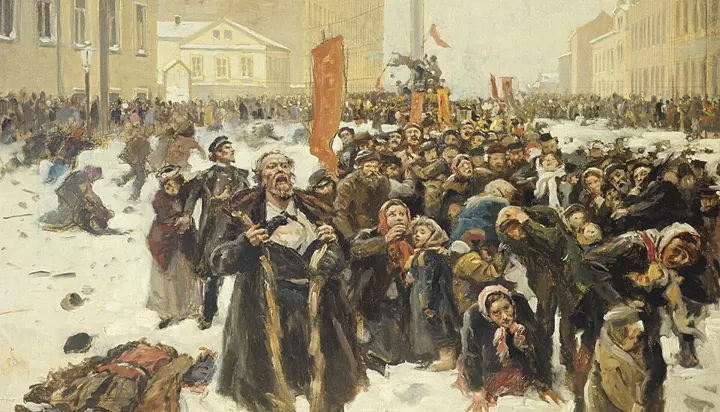
| Bloody Sunday (22 January 1905) | Troops fired on Father Gapon’s peaceful petition march to the Winter Palace |
| Spread | Strikes, Potemkin mutiny, first soviets (councils), St Petersburg Soviet with Trotsky |
| October Manifesto | Elected Duma promised; Stolypin’s reforms and repression followed |
A soviet is a council of elected workers or soldiers. The Duma was Russia’s parliament, but the Tsar kept the power to dismiss it. That is why 1905 is called a “dress rehearsal” for 1917. Anger flared again in 1912, when troops shot striking miners at the Lena goldfields in Siberia.
The February Revolution (1917)
| Point | Detail |
|---|---|
| War | Huge losses in the First World War; Nicholas took personal command (1915); Rasputin’s influence at court |
| Crisis | Food and fuel shortages in Petrograd |
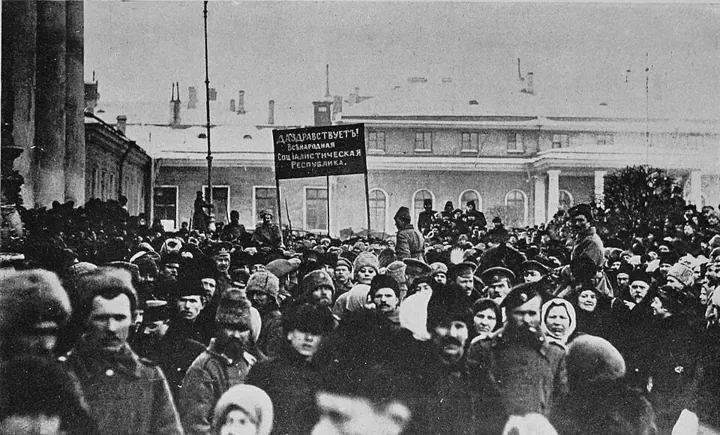
| February–March 1917 | Women’s Day bread strikes (8 March, new style) spread; soldiers joined the crowds |
| Abdication | Nicholas II abdicated (15 March 1917): end of the 300-year Romanov dynasty |
| Dual power | Provisional Government (Lvov, then Kerensky) shared power with the Petrograd Soviet |
Why “February” if it happened in March?
Russia then used the old Julian calendar, which ran 13 days behind the calendar we use. So 8 March in our calendar was 23 February in Russia. The same is true of the “October” Revolution, which fell on 7 November by our calendar.
Dual power, explained
After the Tsar fell, two bodies claimed to lead Russia. The Provisional Government, a temporary cabinet of liberals and moderate socialists, ran the ministries. The Petrograd Soviet had the loyalty of workers and soldiers. It was like a school with two principals, one with the office keys and the other with the students.
The Provisional Government kept fighting the war and delayed land reform, so it steadily lost support. That opened the door for Lenin.
Common doubts
Did the Bolsheviks make the February Revolution? No. It was largely spontaneous, led by hungry women workers and mutinying soldiers. Lenin was still in exile in Switzerland.
Why did the army not save the Tsar? Soldiers were mostly peasants who were tired of losing the war, and many had families in the bread queues.
What UPSC asks
Prelims: Bloody Sunday 1905, the October Manifesto, the 1903 split, dual power. Mains: causes of the Russian Revolution and why the Tsar fell.
Mains box: analysis and answer points
- Long-term vs short-term causes: autocracy, peasants, workers and ideas vs the war, food crisis and army mutiny.
- Why February was spontaneous: led by women workers and soldiers, not the Bolsheviks.
Practice
Write an answer
In 150 words, explain the significance of Russian Revolution with one recent example.
Flashcards (9)
Last Tsar?
Nicholas II.
Year of the Bolshevik–Menshevik split?
1903.
Bloody Sunday?
22 January 1905, St Petersburg.
Who led the Bloody Sunday march?
Father Gapon.
Concession after 1905?
October Manifesto (Duma).
Year serfs were freed?
1861.
Who headed the Provisional Government at
the end? Kerensky.
Nicholas II abdicated?
March 1917.
What was 'dual power'?
Provisional Government and Petrograd Soviet.
Read more: related explainers
 Next topic · 7.2 →Russian Revolution: October and civil war
Syllabus: GS-I · History of the world will include events from 18th century such as industrial re…