
Chapter 16 · Topic 16.2 · Prelims + Mains2 of 3
South Africa: Nelson Mandela
Key points
- Mandela co-founded the ANC Youth League (1944) and was jailed for life after the Rivonia Trial (1964).
- He spent 27 years in prison, 18 on Robben Island, and was freed on 11 February 1990.
- He shared the 1993 Nobel with de Klerk, was president 1994–99 and got the Bharat Ratna (1990).
3 PYQs 2014–2024
Prelims box: facts and traps
- TRC: led by Archbishop Desmond Tutu.
- Gandhi Peace Prize: 2000.
- Mandela Day: 18 July.
Nelson Mandela
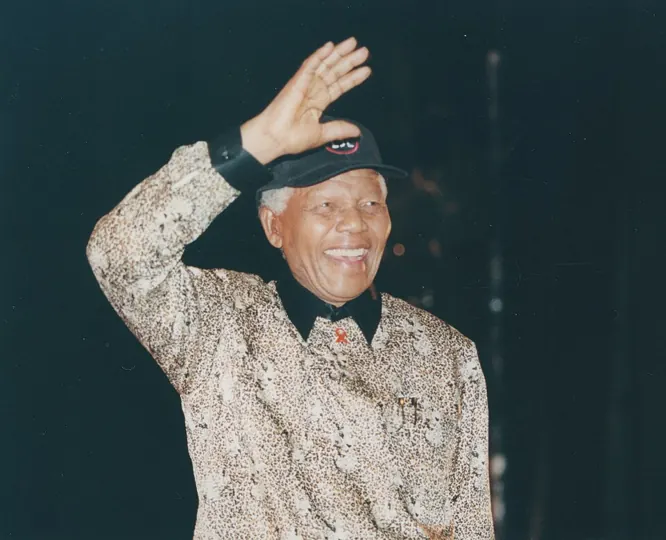
Picture a man locked away for 27 years for demanding equal rights, who walks out and invites his old jailer to his swearing-in. That spirit of forgiveness is why Mandela is remembered across the world.
| Point | Detail |
|---|---|
| ANC Youth League (1944) | Co-founder |
| Rivonia Trial | Life imprisonment (1964); 18 years on Robben Island; 27 years in prison |
| Release | 11 February 1990 under F. W. de Klerk |
| Nobel Peace Prize (1993) | Shared with de Klerk |
| President (1994–99) | Truth and Reconciliation Commission under Archbishop Tutu |
| Honours from India | Bharat Ratna (1990); Gandhi Peace Prize (2000) |
His life, step by step
- Early life: born in 1918 in the Eastern Cape, he trained as a lawyer and opened Johannesburg’s first Black law firm with Oliver Tambo.
- ANC Youth League: with Tambo and Walter Sisulu he set up this youth wing to make the ANC bolder, using mass protest instead of polite petitions.
- From non-violence to armed struggle: after the Sharpeville killings of 1960 and the ban on the ANC, he helped form Umkhonto we Sizwe (“Spear of the Nation”) in 1961 for sabotage, attacking property rather than people.
- Rivonia Trial: he and other leaders were tried for sabotage. In his famous speech from the dock he said he was prepared to die for a free and democratic society. He was jailed for life in 1964.
- Prison: Robben Island is a prison island off Cape Town, where he broke rocks in a lime quarry. In all he spent 27 years in prison and became the world’s best-known prisoner as the “Free Mandela” campaign grew.
- Release and talks: President F. W. de Klerk freed him on 11 February 1990. The two men negotiated an end to apartheid and shared the Nobel Peace Prize.
- President: in 1994 he became South Africa’s first Black president. He served one term only and stepped down in 1999, a rare example in Africa at the time.
The Truth and Reconciliation Commission
The TRC was a body set up to find out the truth about crimes during apartheid. Victims told their stories. People who fully confessed political crimes could ask for amnesty, which means a pardon. It was led by Archbishop Desmond Tutu. The idea was to heal the nation through truth, not revenge, so that old enemies could live side by side.
Mandela and Gandhi compared
| Point | Gandhi | Mandela |
|---|---|---|
| Method | Strict non-violence | Non-violence, then sabotage |
| Prison | Many short terms | 27 years |
| After victory | Held no office | President, one term |
Mandela and India
Mandela called Gandhi an inspiration. India gave him the Bharat Ratna in 1990, making him one of the very few foreigners to get it, and the Gandhi Peace Prize in 2000.
Common doubts
Was Mandela a follower of non-violence? At first, yes. He turned to sabotage only when peaceful protest was banned and met with bullets. He saw non-violence as a tactic, not an absolute rule.
What is his book called? His autobiography, Long Walk to Freedom, was published in 1994 and tells his story from childhood to freedom.
Why is 18 July special? It is Mandela’s birthday, marked by the UN as Nelson Mandela International Day.
What UPSC asks
Prelims: Rivonia Trial, Robben Island, release in 1990, Nobel 1993, Bharat Ratna 1990, TRC. Mains: Mandela’s methods compared with Gandhi’s, and the lessons of reconciliation.
Mains box: analysis and answer points
- Mandela vs Gandhi: methods and leadership.
- Reconciliation: lessons of the TRC.
Practice
Prelims PYQs on this topic (3)
Consider the following countries :
- 1. Italy
- 2. Japan
- 3. Nigeria
- 4. South Korea
- 5. South Africa
Which of the above countries are frequently mentioned in the media for their low birth rates, or ageing population or declining population ?
Answer (a) & explanation
Italy, Japan and South Korea face low births and ageing (a). Item 4 is right: South Korea has the world's lowest fertility rate, below 0.8 children per woman. Item 2 is right: Japan has one of the oldest populations, and it has been shrinking for over a decade. Item 1 is right: Italy has very low births and an ageing population. Item 3 is wrong: Nigeria has one of the fastest-growing, youngest populations. Item 5 is wrong: South Africa is also young and still growing.
Notice the term: a replacement fertility rate is about 2.1. China's population has also fallen since 2022. India's fertility rate has dropped to about 2.0, below replacement, while its demographic dividend continues for now.
Answer as per the official UPSC answer key.
In which one of the following groups are all the four countries members of G20 ?
Answer (a) & explanation
Argentina, Mexico, South Africa and Turkey are all G20 members (a). The G20 has 19 countries plus the European Union, and the African Union joined in 2023 at India's New Delhi summit. The 19 are Argentina, Australia, Brazil, Canada, China, France, Germany, India, Indonesia, Italy, Japan, Mexico, Russia, Saudi Arabia, South Africa, South Korea, Turkey, the UK and the USA. Option (b) fails because of Malaysia and New Zealand. Option (c) fails because of Iran and Vietnam. Option (d) fails because of Singapore.
Notice that the G20 began in 1999 as a meeting of finance ministers after the Asian financial crisis and became a leaders' summit in 2008. It has no permanent secretariat; the troika of past, present and next presidencies guides it.
each wrong option has three members and one outsider. Find the outsider: Malaysia, Iran, Singapore.
Answer as per the official UPSC answer key.
With reference to a grouping of countries known as BRICS, consider the following statements :
- 1. The First Summit of BRICS was held in Rio de Janeiro in 2009.
- 2. South Africa was the last to join the BRICS grouping.
Which of the statements given above is/are correct?
Answer (b) & explanation
Statement 1 is wrong: the first BRIC summit was held at Yekaterinburg, Russia, in 2009, not Rio. Brazil hosted the second, in Brasília in 2010. Statement 2 was correct in 2014: South Africa joined in 2010–11 and turned BRIC into BRICS.
The group has since grown: Egypt, Ethiopia, Iran and the UAE joined in 2024 and Indonesia in 2025. Its New Development Bank (Shanghai) and Contingent Reserve Arrangement were agreed at the Fortaleza summit in 2014. Notice how a question set in one year can age; always read membership questions in the year they were asked.
Answer as of 2014. The expansion from 2024 came after this question was set.
Answer as per the official UPSC answer key.
Write an answer
In 150 words, explain the significance of South Africa with one recent example.
Flashcards (4)
Mandela released?
11 February 1990.
Mandela's Bharat Ratna?
1990.
Nobel Peace Prize 1993?
Mandela and de Klerk.
TRC chair?
Archbishop Desmond Tutu.
 Next topic · 16.3 →South Africa: Transition to democracy
Syllabus: GS-I · History of the world will include events from 18th century such as industrial re…