
Chapter 5 · Topic 5.1 · Prelims + Mains1 of 3
Unification of Germany: Background and 1848
Key points
- Before 1871 there were 39 German states in a loose Confederation led by Austria.
- The Prussian-led Zollverein (1834), railways, and coal and iron tied Germany to Prussia.
- The liberal Frankfurt Parliament (1848–49) failed: no army, divided, and the Prussian king refused its crown.
Prelims box: facts and traps
- Zollverein: 1834, Prussian-led customs union without Austria.
- Carlsbad Decrees: 1819, Metternich's censorship.
- Frankfurt Parliament: May 1848, St Paul's Church; crown refused April 1849.
- Greater vs Lesser Germany: with or without Austria.
Background: 39 states and a customs union
Imagine 39 neighbouring housing societies that speak the same language but each has its own gate, guard and fee. Moving goods from one end to the other means paying at every gate. That was Germany in the early 1800s.
| Factor | What it did |
|---|---|
| Napoleon’s legacy | Holy Roman Empire dissolved (1806); 300-odd units cut to fewer, larger states |
| German Confederation (1815) | 39 states under Austrian presidency; Metternich suppressed liberals (Carlsbad Decrees, 1819) |
| Zollverein (1834) | Prussian-led customs union; excluded Austria and tied German economies to Prussia |
| Railways and industry | Coal and iron of the Ruhr and Silesia strengthened Prussia |
| Romantic nationalism | Fichte’s Addresses to the German Nation; the Grimm brothers’ folk tales |
Each factor in plain words
- Napoleon: by ending the old Holy Roman Empire and merging hundreds of tiny states, he made the map simpler and, without meaning to, made unity easier.
- German Confederation: a confederation is a loose club of states that keep their own powers. Austria chaired it and, under Metternich, banned liberal and nationalist groups. The Carlsbad Decrees of 1819 censored newspapers and watched universities.
- Zollverein: a customs union means member states remove taxes on goods crossing their borders. Prussia led it and kept Austria out, so German traders began to see Prussia, not Austria, as their natural leader.
- Coal, iron and railways: Prussia held the Ruhr and Silesia, rich in coal and iron. Railways joined markets, and industry made Prussia rich enough to build a strong army.
- Romantic nationalism: writers praised a shared German language, folk songs and history. The Grimm brothers collected folk tales to show a common culture.
1848: the liberal attempt
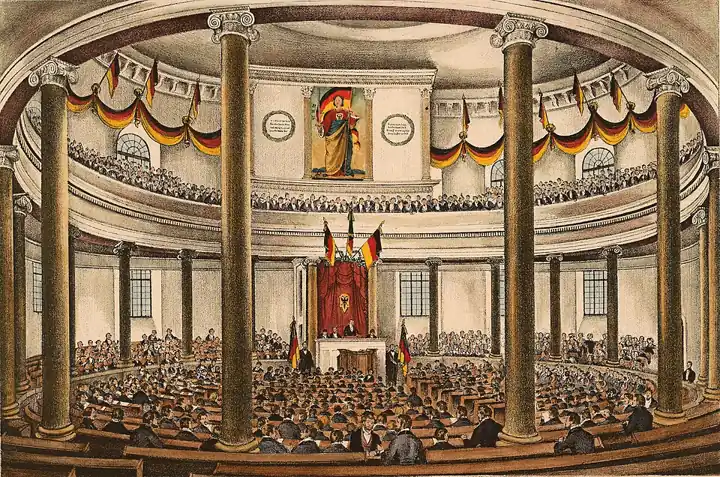
In 1848 revolutions spread across Europe. Liberals, people who wanted constitutions, elected parliaments and basic rights, tried to unite Germany peacefully.
| Event | What happened |
|---|---|
| March 1848 | Revolutions across German states |
| Frankfurt Parliament (May 1848) | Elected assembly in St Paul’s Church; drafted a constitution and fundamental rights |
| Greater vs Lesser Germany | With Austria (Grossdeutsch) or without it (Kleindeutsch) |
| April 1849 | Frederick William IV of Prussia refused the crown ‘from the gutter’ |
| Result | Parliament dissolved; Austria restored the Confederation (Olmütz, 1850) |
Why did 1848 fail?
- No army: the parliament could pass laws, but had no soldiers to enforce them.
- Divided members: they argued for months over whether Austria should be included.
- Mostly middle-class: NCERT notes that the Frankfurt Parliament was dominated by the middle classes. Workers and peasants felt left out, so it lost mass support.
- Kings were still strong: the Prussian king saw a crown offered by an elected parliament as an insult.
The lesson Bismarck drew: unity would come not by ‘speeches and majority decisions’ but by ‘blood and iron’, meaning war and industry.
Common doubts
Why was the Zollverein so important? It united Germany’s economy decades before its politics. When the time came, the states were already used to Prussian leadership.
What is the difference between Greater and Lesser Germany? Greater Germany meant including Austria’s German lands. Lesser Germany meant leaving Austria out, under Prussia. In the end, Lesser Germany won.
Was 1848 a total waste? No. It spread the idea of a single German nation with rights for citizens, and many of its ideas came back in later German constitutions.
What UPSC asks
Prelims: Zollverein 1834, the Frankfurt Parliament, Carlsbad Decrees. Mains: why the liberal path failed and the military path worked.
Mains box: analysis and answer points
- Why 1848 failed: no army, middle-class base, Austria question, strong kings.
- Lesson: 'blood and iron' replaced speeches and votes.
Practice
Write an answer
In 150 words, explain the significance of Unification of Germany with one recent example.
Flashcards (6)
Prussian customs union of 1834?
Zollverein.
How many states in the German
Confederation? 39.
Who presided over the Confederation?
Austria.
Where did the 1848 parliament meet?
St Paul's Church, Frankfurt.
Who refused the crown in 1849?
Frederick William IV of Prussia.
Germany without Austria was called?
Kleindeutsch (Lesser Germany).
 Next topic · 5.2 →Unification of Germany: Bismarck and the wars
Syllabus: GS-I · History of the world will include events from 18th century such as industrial re…