
CSAT 2012: every question, solved
80 questions from the official UPSC Prelims 2012 paper, in paper order. Tap an option; the answer and the reason appear instantly.
Read the passage
Education, without a doubt, has an important functional, instrumental and utilitarian dimension. This is revealed when one asks questions such as ‘what is the purpose of education ?’. The answers, too often, are ‘to acquire qualifications for employment/upward mobility’, ‘wider/higher (in terms of income) opportunities’, and ‘to meet the needs for trained human power in diverse fields for national development’. But in its deepest sense education is not instrumentalist. That is to say, it is not to be justified outside of itself because it leads to the acquisition of formal skills or of certain desired psychological – social attributes. It must be respected in itself. Education is thus not a commodity to be acquired or possessed and then used, but a process of inestimable importance to individuals and society, although it can and does have enormous use-value. Education then, is a process of expansion and conversion, not in the sense of converting or turning students into doctors or engineers, but the widening and turning out of the mind — the creation, sustenance and development of self-critical awareness and independence of thought. It is an inner process of moral – intellectual development.
What do you understand by the ‘instrumentalist’ view of education ?
Answer (a) & explanation
'Functional and utilitarian' is correct (a). Step 1: the passage says education has a 'functional, instrumental and utilitarian dimension' and lists the usual answers: jobs, upward mobility, higher income and trained manpower. That is the instrumentalist view: education valued as a tool for something outside itself. Step 2: (b) 'fulfil human needs' is too vague; it could fit any view. Step 3: (c) training the intellect and (d) moral development describe the author's deeper view, which he sets against the instrumentalist one. So (b), (c) and (d) fail.
Tip: 'instrumental' means 'used as an instrument or tool'. When a passage contrasts two views, check which side each option belongs to before choosing.
Answer as per the official UPSC answer key.
Read the passage
Education, without a doubt, has an important functional, instrumental and utilitarian dimension. This is revealed when one asks questions such as ‘what is the purpose of education ?’. The answers, too often, are ‘to acquire qualifications for employment/upward mobility’, ‘wider/higher (in terms of income) opportunities’, and ‘to meet the needs for trained human power in diverse fields for national development’. But in its deepest sense education is not instrumentalist. That is to say, it is not to be justified outside of itself because it leads to the acquisition of formal skills or of certain desired psychological – social attributes. It must be respected in itself. Education is thus not a commodity to be acquired or possessed and then used, but a process of inestimable importance to individuals and society, although it can and does have enormous use-value. Education then, is a process of expansion and conversion, not in the sense of converting or turning students into doctors or engineers, but the widening and turning out of the mind — the creation, sustenance and development of self-critical awareness and independence of thought. It is an inner process of moral – intellectual development.
According to the passage, education must be respected in itself because
Answer (c) & explanation
'An inner process of moral and intellectual development' is correct (c). Step 1: the passage says education 'must be respected in itself' and ends: 'It is an inner process of moral – intellectual development.' That is the reason it deserves respect for its own sake. Step 2: (a) jobs and (b) mobility and status are exactly the outside justifications the author says education does not need. Step 3: since (a) and (b) are wrong, (d) 'all of the above' also fails.
Tip: 'respected in itself' means valued for its own nature, not for what it brings. Any option about rewards like jobs, income or status is the opposite of that idea.
Answer as per the official UPSC answer key.
Read the passage
Education, without a doubt, has an important functional, instrumental and utilitarian dimension. This is revealed when one asks questions such as ‘what is the purpose of education ?’. The answers, too often, are ‘to acquire qualifications for employment/upward mobility’, ‘wider/higher (in terms of income) opportunities’, and ‘to meet the needs for trained human power in diverse fields for national development’. But in its deepest sense education is not instrumentalist. That is to say, it is not to be justified outside of itself because it leads to the acquisition of formal skills or of certain desired psychological – social attributes. It must be respected in itself. Education is thus not a commodity to be acquired or possessed and then used, but a process of inestimable importance to individuals and society, although it can and does have enormous use-value. Education then, is a process of expansion and conversion, not in the sense of converting or turning students into doctors or engineers, but the widening and turning out of the mind — the creation, sustenance and development of self-critical awareness and independence of thought. It is an inner process of moral – intellectual development.
Education is a process in which
Answer (c) & explanation
'Self-critical awareness and independence of thought' is correct (c). Step 1: the passage calls education 'a process of expansion and conversion' and explains it as 'the creation, sustenance and development of self-critical awareness and independence of thought'. Step 2: (a) is a trap: the author says conversion is 'not in the sense of converting or turning students into doctors or engineers'. Step 3: (b) higher income and (d) qualifications for mobility belong to the instrumentalist view the author treats as shallow. So (a), (b) and (d) fail.
Tip: watch for a word the passage uses in a special sense. Here 'conversion' means turning the mind outward, not producing professionals; the author even warns against the ordinary meaning.
Answer as per the official UPSC answer key.
Read the passage
Chemical pesticides lose their role in sustainable agriculture if the pests evolve resistance. The evolution of pesticide resistance is simply natural selection in action. It is almost certain to occur when vast numbers of a genetically variable population are killed. One or a few individuals may be unusually resistant (perhaps because they possess an enzyme that can detoxify the pesticide). If the pesticide is applied repeatedly, each successive generation of the pest will contain a larger proportion of resistant individuals. Pests typically have a high intrinsic rate of reproduction, and so a few individuals in one generation may give rise to hundreds or thousands in the next, and resistance spreads very rapidly in a population.
This problem was often ignored in the past, even though the first case of DDT (dichlorodiphenyltrichloroethane) resistance was reported as early as 1946. There is exponential increase in the numbers of invertebrates that have evolved resistance and in the number of pesticides against which resistance has evolved. Resistance has been recorded in every family of arthropod pests (including dipterans such as mosquitoes and house flies, as well as beetles, moths, wasps, fleas, lice and mites) as well as in weeds and plant pathogens. Take the Alabama leafworm, a moth pest of cotton, as an example. It has developed resistance in one or more regions of the world to aldrin, DDT, dieldrin, endrin, lindane and toxaphene.
If chemical pesticides brought nothing but problems, — if their use was intrinsically and acutely unsustainable — then they would already have fallen out of widespread use. This has not happened. Instead, their rate of production has increased rapidly. The ratio of cost to benefit for the individual agricultural producer has remained in favour of pesticide use. In the USA, insecticides have been estimated to benefit the agricultural products to the tune of around $5 for every $1 spent.
Moreover, in many poorer countries, the prospect of imminent mass starvation, or of an epidemic disease, are so frightening that the social and health costs of using pesticides have to be ignored. In general the use of pesticides is justified by objective measures such as ‘lives saved’, ‘economic efficiency of food production’ and ‘total food produced’. In these very fundamental senses, their use may be described as sustainable. In practice, sustainability depends on continually developing new pesticides that keep at least one step ahead of the pests — pesticides that are less persistent, biodegradable and more accurately targeted at the pests.
“The evolution of pesticide resistance is natural selection in action.” What does it actually imply ?
Answer (c) & explanation
'Some individuals show resistance' is correct (c). Step 1: the passage explains natural selection here: 'One or a few individuals may be unusually resistant'. When the pesticide kills the rest, these few survive and breed, so each generation has more resistant pests. Step 2: (a) says it is natural for many organisms to be resistant; the passage says only a few are at the start. Step 3: (b) 'universal' overstates even more. Since (c) is right, (d) fails.
Tip: natural selection always starts with a small variation in a few individuals that helps them survive. Options with 'many', 'all' or 'universal' usually overstate such passages.
Answer as per the official UPSC answer key.
Read the passage
Chemical pesticides lose their role in sustainable agriculture if the pests evolve resistance. The evolution of pesticide resistance is simply natural selection in action. It is almost certain to occur when vast numbers of a genetically variable population are killed. One or a few individuals may be unusually resistant (perhaps because they possess an enzyme that can detoxify the pesticide). If the pesticide is applied repeatedly, each successive generation of the pest will contain a larger proportion of resistant individuals. Pests typically have a high intrinsic rate of reproduction, and so a few individuals in one generation may give rise to hundreds or thousands in the next, and resistance spreads very rapidly in a population.
This problem was often ignored in the past, even though the first case of DDT (dichlorodiphenyltrichloroethane) resistance was reported as early as 1946. There is exponential increase in the numbers of invertebrates that have evolved resistance and in the number of pesticides against which resistance has evolved. Resistance has been recorded in every family of arthropod pests (including dipterans such as mosquitoes and house flies, as well as beetles, moths, wasps, fleas, lice and mites) as well as in weeds and plant pathogens. Take the Alabama leafworm, a moth pest of cotton, as an example. It has developed resistance in one or more regions of the world to aldrin, DDT, dieldrin, endrin, lindane and toxaphene.
If chemical pesticides brought nothing but problems, — if their use was intrinsically and acutely unsustainable — then they would already have fallen out of widespread use. This has not happened. Instead, their rate of production has increased rapidly. The ratio of cost to benefit for the individual agricultural producer has remained in favour of pesticide use. In the USA, insecticides have been estimated to benefit the agricultural products to the tune of around $5 for every $1 spent.
Moreover, in many poorer countries, the prospect of imminent mass starvation, or of an epidemic disease, are so frightening that the social and health costs of using pesticides have to be ignored. In general the use of pesticides is justified by objective measures such as ‘lives saved’, ‘economic efficiency of food production’ and ‘total food produced’. In these very fundamental senses, their use may be described as sustainable. In practice, sustainability depends on continually developing new pesticides that keep at least one step ahead of the pests — pesticides that are less persistent, biodegradable and more accurately targeted at the pests.
With reference to the passage, consider the following statements :
- 1. Use of chemical pesticides has become imperative in all the poor countries of the world.
- 2. Chemical pesticides should not have any role in sustainable agriculture.
- 3. One pest can develop resistance to many pesticides.
Which of the statements given above is/are correct ?
Answer (b) & explanation
Only statement 3 is correct (b). Step 1: the Alabama leafworm has become resistant to six pesticides (aldrin, DDT, dieldrin, endrin, lindane, toxaphene). So one pest can resist many pesticides: 3 is right. Step 2: statement 1 says pesticides are imperative in all poor countries. The passage only says 'many poorer countries' face fears of starvation or epidemics. So 1 overstates. Step 3: statement 2 says pesticides should have no role in sustainable agriculture. The passage calls their use sustainable 'in these very fundamental senses'. So 2 is wrong, and (a), (c) and (d) fail.
Tip: compare quantity words carefully: 'many' in the passage never supports 'all' in an option.
Answer as per the official UPSC answer key.
Read the passage
Chemical pesticides lose their role in sustainable agriculture if the pests evolve resistance. The evolution of pesticide resistance is simply natural selection in action. It is almost certain to occur when vast numbers of a genetically variable population are killed. One or a few individuals may be unusually resistant (perhaps because they possess an enzyme that can detoxify the pesticide). If the pesticide is applied repeatedly, each successive generation of the pest will contain a larger proportion of resistant individuals. Pests typically have a high intrinsic rate of reproduction, and so a few individuals in one generation may give rise to hundreds or thousands in the next, and resistance spreads very rapidly in a population.
This problem was often ignored in the past, even though the first case of DDT (dichlorodiphenyltrichloroethane) resistance was reported as early as 1946. There is exponential increase in the numbers of invertebrates that have evolved resistance and in the number of pesticides against which resistance has evolved. Resistance has been recorded in every family of arthropod pests (including dipterans such as mosquitoes and house flies, as well as beetles, moths, wasps, fleas, lice and mites) as well as in weeds and plant pathogens. Take the Alabama leafworm, a moth pest of cotton, as an example. It has developed resistance in one or more regions of the world to aldrin, DDT, dieldrin, endrin, lindane and toxaphene.
If chemical pesticides brought nothing but problems, — if their use was intrinsically and acutely unsustainable — then they would already have fallen out of widespread use. This has not happened. Instead, their rate of production has increased rapidly. The ratio of cost to benefit for the individual agricultural producer has remained in favour of pesticide use. In the USA, insecticides have been estimated to benefit the agricultural products to the tune of around $5 for every $1 spent.
Moreover, in many poorer countries, the prospect of imminent mass starvation, or of an epidemic disease, are so frightening that the social and health costs of using pesticides have to be ignored. In general the use of pesticides is justified by objective measures such as ‘lives saved’, ‘economic efficiency of food production’ and ‘total food produced’. In these very fundamental senses, their use may be described as sustainable. In practice, sustainability depends on continually developing new pesticides that keep at least one step ahead of the pests — pesticides that are less persistent, biodegradable and more accurately targeted at the pests.
Though the problems associated with the use of chemical pesticides is known for a long time, their widespread use has not waned. Why ?
Answer (d) & explanation
None of these is correct (d). Step 1: the passage gives the real reason pesticide use has not fallen: the cost-to-benefit ratio 'has remained in favour of pesticide use' (about $5 of benefit for $1 spent in the USA). None of the options says this. Step 2: (a) the passage never says alternatives do not exist at all. (b) is false: it speaks of 'continually developing new pesticides'. Step 3: (c) is wrong because the passage only hopes for future pesticides that are 'biodegradable'; it does not say present ones are. So (a), (b) and (c) fail.
Tip: when the true reason is missing from the options, 'none of the above' is a real choice. Check each option against the text before ruling it out.
Answer as per the official UPSC answer key.
Read the passage
Chemical pesticides lose their role in sustainable agriculture if the pests evolve resistance. The evolution of pesticide resistance is simply natural selection in action. It is almost certain to occur when vast numbers of a genetically variable population are killed. One or a few individuals may be unusually resistant (perhaps because they possess an enzyme that can detoxify the pesticide). If the pesticide is applied repeatedly, each successive generation of the pest will contain a larger proportion of resistant individuals. Pests typically have a high intrinsic rate of reproduction, and so a few individuals in one generation may give rise to hundreds or thousands in the next, and resistance spreads very rapidly in a population.
This problem was often ignored in the past, even though the first case of DDT (dichlorodiphenyltrichloroethane) resistance was reported as early as 1946. There is exponential increase in the numbers of invertebrates that have evolved resistance and in the number of pesticides against which resistance has evolved. Resistance has been recorded in every family of arthropod pests (including dipterans such as mosquitoes and house flies, as well as beetles, moths, wasps, fleas, lice and mites) as well as in weeds and plant pathogens. Take the Alabama leafworm, a moth pest of cotton, as an example. It has developed resistance in one or more regions of the world to aldrin, DDT, dieldrin, endrin, lindane and toxaphene.
If chemical pesticides brought nothing but problems, — if their use was intrinsically and acutely unsustainable — then they would already have fallen out of widespread use. This has not happened. Instead, their rate of production has increased rapidly. The ratio of cost to benefit for the individual agricultural producer has remained in favour of pesticide use. In the USA, insecticides have been estimated to benefit the agricultural products to the tune of around $5 for every $1 spent.
Moreover, in many poorer countries, the prospect of imminent mass starvation, or of an epidemic disease, are so frightening that the social and health costs of using pesticides have to be ignored. In general the use of pesticides is justified by objective measures such as ‘lives saved’, ‘economic efficiency of food production’ and ‘total food produced’. In these very fundamental senses, their use may be described as sustainable. In practice, sustainability depends on continually developing new pesticides that keep at least one step ahead of the pests — pesticides that are less persistent, biodegradable and more accurately targeted at the pests.
How do pesticides act as agents for the selection of resistant individuals in any pest population ?
- 1. It is possible that in a pest population the individuals will behave differently due to their genetic makeup.
- 2. Pests do possess the ability to detoxify the pesticides.
- 3. Evolution of pesticide resistance is equally distributed in pest population.
Which of the statements given above is/are correct ?
Answer (b) & explanation
Statements 1 and 2 are correct (b). Step 1: the passage speaks of a 'genetically variable population', so individuals respond differently because of their genes: 1 is right. Step 2: it says a few may be resistant 'perhaps because they possess an enzyme that can detoxify the pesticide': 2 is right. Step 3: statement 3 says resistance is equally distributed. The passage says it begins in 'one or a few individuals' and spreads over generations, so it is unequal at first. So 3 is wrong, and (a), (c) and (d) fail.
Tip: selection works only because individuals differ. Any statement saying everyone is the same ('equally distributed') goes against the whole idea of selection.
Answer as per the official UPSC answer key.
Read the passage
Chemical pesticides lose their role in sustainable agriculture if the pests evolve resistance. The evolution of pesticide resistance is simply natural selection in action. It is almost certain to occur when vast numbers of a genetically variable population are killed. One or a few individuals may be unusually resistant (perhaps because they possess an enzyme that can detoxify the pesticide). If the pesticide is applied repeatedly, each successive generation of the pest will contain a larger proportion of resistant individuals. Pests typically have a high intrinsic rate of reproduction, and so a few individuals in one generation may give rise to hundreds or thousands in the next, and resistance spreads very rapidly in a population.
This problem was often ignored in the past, even though the first case of DDT (dichlorodiphenyltrichloroethane) resistance was reported as early as 1946. There is exponential increase in the numbers of invertebrates that have evolved resistance and in the number of pesticides against which resistance has evolved. Resistance has been recorded in every family of arthropod pests (including dipterans such as mosquitoes and house flies, as well as beetles, moths, wasps, fleas, lice and mites) as well as in weeds and plant pathogens. Take the Alabama leafworm, a moth pest of cotton, as an example. It has developed resistance in one or more regions of the world to aldrin, DDT, dieldrin, endrin, lindane and toxaphene.
If chemical pesticides brought nothing but problems, — if their use was intrinsically and acutely unsustainable — then they would already have fallen out of widespread use. This has not happened. Instead, their rate of production has increased rapidly. The ratio of cost to benefit for the individual agricultural producer has remained in favour of pesticide use. In the USA, insecticides have been estimated to benefit the agricultural products to the tune of around $5 for every $1 spent.
Moreover, in many poorer countries, the prospect of imminent mass starvation, or of an epidemic disease, are so frightening that the social and health costs of using pesticides have to be ignored. In general the use of pesticides is justified by objective measures such as ‘lives saved’, ‘economic efficiency of food production’ and ‘total food produced’. In these very fundamental senses, their use may be described as sustainable. In practice, sustainability depends on continually developing new pesticides that keep at least one step ahead of the pests — pesticides that are less persistent, biodegradable and more accurately targeted at the pests.
Why is the use of chemical pesticides generally justified by giving the examples of poor and developing countries ?
- 1. Developed countries can afford to do away with use of pesticides by adapting to organic farming, but it is imperative for poor and developing countries to use chemical pesticides.
- 2. In poor and developing countries, the pesticide addresses the problem of epidemic diseases of crops and eases the food problem.
- 3. The social and health costs of pesticide use are generally ignored in poor and developing countries.
Which of the statements given above is/are correct ?
Answer (c) & explanation
Only statement 2 is correct (c). Step 1: the passage says in poorer countries 'the prospect of imminent mass starvation, or of an epidemic disease' is so frightening that pesticides are used. That is the justification: they ease food problems and disease: 2 is right. Step 2: statement 1 talks about organic farming in developed countries, which the passage never mentions. Step 3: statement 3 is a result of that fear (the costs 'have to be ignored'), not the reason for using pesticides. The question asks why use is justified, so 3 fails. Hence (a), (b) and (d) are wrong.
Tip: separate the reason from the consequence. A true fact from the passage can still be the wrong answer to a 'why' question.
Answer as per the official UPSC answer key.
Read the passage
Chemical pesticides lose their role in sustainable agriculture if the pests evolve resistance. The evolution of pesticide resistance is simply natural selection in action. It is almost certain to occur when vast numbers of a genetically variable population are killed. One or a few individuals may be unusually resistant (perhaps because they possess an enzyme that can detoxify the pesticide). If the pesticide is applied repeatedly, each successive generation of the pest will contain a larger proportion of resistant individuals. Pests typically have a high intrinsic rate of reproduction, and so a few individuals in one generation may give rise to hundreds or thousands in the next, and resistance spreads very rapidly in a population.
This problem was often ignored in the past, even though the first case of DDT (dichlorodiphenyltrichloroethane) resistance was reported as early as 1946. There is exponential increase in the numbers of invertebrates that have evolved resistance and in the number of pesticides against which resistance has evolved. Resistance has been recorded in every family of arthropod pests (including dipterans such as mosquitoes and house flies, as well as beetles, moths, wasps, fleas, lice and mites) as well as in weeds and plant pathogens. Take the Alabama leafworm, a moth pest of cotton, as an example. It has developed resistance in one or more regions of the world to aldrin, DDT, dieldrin, endrin, lindane and toxaphene.
If chemical pesticides brought nothing but problems, — if their use was intrinsically and acutely unsustainable — then they would already have fallen out of widespread use. This has not happened. Instead, their rate of production has increased rapidly. The ratio of cost to benefit for the individual agricultural producer has remained in favour of pesticide use. In the USA, insecticides have been estimated to benefit the agricultural products to the tune of around $5 for every $1 spent.
Moreover, in many poorer countries, the prospect of imminent mass starvation, or of an epidemic disease, are so frightening that the social and health costs of using pesticides have to be ignored. In general the use of pesticides is justified by objective measures such as ‘lives saved’, ‘economic efficiency of food production’ and ‘total food produced’. In these very fundamental senses, their use may be described as sustainable. In practice, sustainability depends on continually developing new pesticides that keep at least one step ahead of the pests — pesticides that are less persistent, biodegradable and more accurately targeted at the pests.
What does the passage imply ?
Answer (d) & explanation
Both (a) and (b) is the official key (d). Step 1: the passage shows heavy chemical use leads to resistance in every pest family and to social and health costs. That implies too much chemical use is not good for the ecosystem (b). Step 2: from the same problems, the key reads support for alternatives (a). Step 3: (c) is clearly wrong: the passage says sustainability depends on new, better pesticides that are less persistent and more targeted, so there is scope for improvement. Note: (a) is DOUBTFUL, because the passage never mentions alternatives; it pins its hope on improved pesticides. (b) alone is arguable, but UPSC's key is (d).
Tip: 'implies' questions allow reasonable inference, but stay close to the text.
Answer as per the official UPSC answer key.
Read the passage
Today’s developing economies use much less energy per capita than developed countries such as the United States did at similar incomes, showing the potential for lower-carbon growth. Adaptation and mitigation need to be integrated into a climate-smart development strategy that increases resilience, reduces the threat of further global warming, and improves development outcomes. Adaptation and mitigation measures can advance development, and prosperity can raise incomes and foster better institutions. A healthier population living in better-built houses and with access to bank loans and social security is better equipped to deal with a changing climate and its consequences. Advancing robust, resilient development policies that promote adaptation is needed today because changes in the climate, already begun, will increase even in the short term.
The spread of economic prosperity has always been intertwined with adaptation to changing ecological conditions. But as growth has altered the environment and as environmental change has accelerated, sustaining growth and adaptability demands greater capacity to understand our environment, generate new adaptive technologies and practices, and diffuse them widely. As economic historians have explained, much of humankind’s creative potential has been directed at adapting to the changing world. But adaptation cannot cope with all the impacts related to climate change, especially as larger changes unfold in the long term.
Countries cannot grow out of harm’s way fast enough to match the changing climate. And some growth strategies, whether driven by the government or the market, can also add to vulnerability — particularly if they overexploit natural resources. Under the Soviet development plan, irrigated cotton cultivation expanded in water-stressed Central Asia and led to the near disappearance of the Aral Sea, threatening the livelihoods of fishermen, herders and farmers. And clearing mangroves — the natural coastal buffers against storm surges — to make way for intensive farming or housing development, increases the physical vulnerability of coastal settlements, whether in Guinea or in Louisiana.
Which of the following conditions of growth can add to vulnerability ?
- 1. When the growth occurs due to excessive exploitation of mineral resources and forests.
- 2. When the growth brings about a change in humankind’s creative potential.
- 3. When the growth is envisaged only for providing houses and social security to the people.
- 4. When the growth occurs due to emphasis on farming only.
Select the correct answer using the codes given below :
Answer (a) & explanation
Only condition 1 is correct (a). Step 1: the passage says some growth strategies 'can also add to vulnerability — particularly if they overexploit natural resources'. Its examples are draining the Aral Sea and clearing mangroves. Overusing minerals and forests fits this: 1 is right. Step 2: condition 2 is wrong: creative potential helps us adapt; it does not add to vulnerability. Condition 3 is wrong: better houses and social security make people better equipped to cope. Step 3: condition 4 is wrong: the problem was intensive farming that overused water, not farming as such. So (b), (c) and (d) fail.
Tip: find the passage's exact cause ('overexploit natural resources') and pick the option that matches it, not one that matches only the example.
Answer as per the official UPSC answer key.
Read the passage
Today’s developing economies use much less energy per capita than developed countries such as the United States did at similar incomes, showing the potential for lower-carbon growth. Adaptation and mitigation need to be integrated into a climate-smart development strategy that increases resilience, reduces the threat of further global warming, and improves development outcomes. Adaptation and mitigation measures can advance development, and prosperity can raise incomes and foster better institutions. A healthier population living in better-built houses and with access to bank loans and social security is better equipped to deal with a changing climate and its consequences. Advancing robust, resilient development policies that promote adaptation is needed today because changes in the climate, already begun, will increase even in the short term.
The spread of economic prosperity has always been intertwined with adaptation to changing ecological conditions. But as growth has altered the environment and as environmental change has accelerated, sustaining growth and adaptability demands greater capacity to understand our environment, generate new adaptive technologies and practices, and diffuse them widely. As economic historians have explained, much of humankind’s creative potential has been directed at adapting to the changing world. But adaptation cannot cope with all the impacts related to climate change, especially as larger changes unfold in the long term.
Countries cannot grow out of harm’s way fast enough to match the changing climate. And some growth strategies, whether driven by the government or the market, can also add to vulnerability — particularly if they overexploit natural resources. Under the Soviet development plan, irrigated cotton cultivation expanded in water-stressed Central Asia and led to the near disappearance of the Aral Sea, threatening the livelihoods of fishermen, herders and farmers. And clearing mangroves — the natural coastal buffers against storm surges — to make way for intensive farming or housing development, increases the physical vulnerability of coastal settlements, whether in Guinea or in Louisiana.
What does low-carbon growth imply in the present context ?
- 1. More emphasis on the use of renewable sources of energy.
- 2. Less emphasis on manufacturing sector and more emphasis on agricultural sector.
- 3. Switching over from monoculture practices to mixed farming.
- 4. Less demand for goods and services.
Select the correct answer using the codes given below :
Answer (a) & explanation
Only point 1 is correct (a). Step 1: the passage says developing economies use 'much less energy per capita' than rich countries did at similar incomes, 'showing the potential for lower-carbon growth'. Growing with less carbon means relying more on cleaner, renewable energy: 1 fits. Step 2: point 2 (less manufacturing, more farming) and point 3 (mixed farming instead of monoculture) are never discussed. Step 3: point 4 (less demand for goods and services) is wrong: low-carbon growth still means growing, not shrinking demand. So (b), (c) and (d) fail.
Tip: 'low-carbon growth' has two parts: keep growing, but emit less carbon. Reject any option that gives up growth itself.
Answer as per the official UPSC answer key.
Read the passage
Today’s developing economies use much less energy per capita than developed countries such as the United States did at similar incomes, showing the potential for lower-carbon growth. Adaptation and mitigation need to be integrated into a climate-smart development strategy that increases resilience, reduces the threat of further global warming, and improves development outcomes. Adaptation and mitigation measures can advance development, and prosperity can raise incomes and foster better institutions. A healthier population living in better-built houses and with access to bank loans and social security is better equipped to deal with a changing climate and its consequences. Advancing robust, resilient development policies that promote adaptation is needed today because changes in the climate, already begun, will increase even in the short term.
The spread of economic prosperity has always been intertwined with adaptation to changing ecological conditions. But as growth has altered the environment and as environmental change has accelerated, sustaining growth and adaptability demands greater capacity to understand our environment, generate new adaptive technologies and practices, and diffuse them widely. As economic historians have explained, much of humankind’s creative potential has been directed at adapting to the changing world. But adaptation cannot cope with all the impacts related to climate change, especially as larger changes unfold in the long term.
Countries cannot grow out of harm’s way fast enough to match the changing climate. And some growth strategies, whether driven by the government or the market, can also add to vulnerability — particularly if they overexploit natural resources. Under the Soviet development plan, irrigated cotton cultivation expanded in water-stressed Central Asia and led to the near disappearance of the Aral Sea, threatening the livelihoods of fishermen, herders and farmers. And clearing mangroves — the natural coastal buffers against storm surges — to make way for intensive farming or housing development, increases the physical vulnerability of coastal settlements, whether in Guinea or in Louisiana.
Which of the following conditions is/are necessary for the sustainable economic growth ?
- 1. Spreading of economic prosperity more.
- 2. Popularising/spreading of adaptive technologies widely.
- 3. Investing on research in adaptation and mitigation technologies.
Select the correct answer using the codes given below :
Answer (b) & explanation
Points 2 and 3 are correct (b). Step 1: the passage says sustaining growth 'demands greater capacity to understand our environment, generate new adaptive technologies and practices, and diffuse them widely'. Spreading adaptive technologies (2) and research to create them (3) both follow. Step 2: point 1, spreading prosperity more, is how the paragraph begins its story ('the spread of economic prosperity has always been intertwined with adaptation'). It is described as a fact of history, not named as a condition for sustainable growth. Step 3: so (a), (c) and (d) fail.
Tip: in 'necessary condition' questions, look for words like 'demands', 'requires' or 'needs' in the passage and match the options to what follows them.
Answer as per the official UPSC answer key.
Read the passage
Today’s developing economies use much less energy per capita than developed countries such as the United States did at similar incomes, showing the potential for lower-carbon growth. Adaptation and mitigation need to be integrated into a climate-smart development strategy that increases resilience, reduces the threat of further global warming, and improves development outcomes. Adaptation and mitigation measures can advance development, and prosperity can raise incomes and foster better institutions. A healthier population living in better-built houses and with access to bank loans and social security is better equipped to deal with a changing climate and its consequences. Advancing robust, resilient development policies that promote adaptation is needed today because changes in the climate, already begun, will increase even in the short term.
The spread of economic prosperity has always been intertwined with adaptation to changing ecological conditions. But as growth has altered the environment and as environmental change has accelerated, sustaining growth and adaptability demands greater capacity to understand our environment, generate new adaptive technologies and practices, and diffuse them widely. As economic historians have explained, much of humankind’s creative potential has been directed at adapting to the changing world. But adaptation cannot cope with all the impacts related to climate change, especially as larger changes unfold in the long term.
Countries cannot grow out of harm’s way fast enough to match the changing climate. And some growth strategies, whether driven by the government or the market, can also add to vulnerability — particularly if they overexploit natural resources. Under the Soviet development plan, irrigated cotton cultivation expanded in water-stressed Central Asia and led to the near disappearance of the Aral Sea, threatening the livelihoods of fishermen, herders and farmers. And clearing mangroves — the natural coastal buffers against storm surges — to make way for intensive farming or housing development, increases the physical vulnerability of coastal settlements, whether in Guinea or in Louisiana.
Which of the following inferences can be made from the passage ?
- 1. Rainfed crops should not be cultivated in irrigated areas.
- 2. Farming under water-deficient areas should not be a part of development strategy.
Select the correct answer using the codes given below :
Answer (d) & explanation
Neither inference is correct (d). Step 1: statement 1 talks about rainfed crops in irrigated areas. The passage never mentions rainfed crops, so this cannot be inferred. Step 2: statement 2 says farming in water-short areas should not be part of development. The Aral Sea example blames overexploiting water for irrigated cotton, not farming in dry areas as such. Careful farming in such areas is not ruled out. Step 3: so (a), (b) and (c) fail.
Tip: an example in a passage warns against a specific mistake. Do not stretch it into a total ban; 'should not be part of development at all' is far stronger than what the passage says.
Answer as per the official UPSC answer key.
Read the passage
Today’s developing economies use much less energy per capita than developed countries such as the United States did at similar incomes, showing the potential for lower-carbon growth. Adaptation and mitigation need to be integrated into a climate-smart development strategy that increases resilience, reduces the threat of further global warming, and improves development outcomes. Adaptation and mitigation measures can advance development, and prosperity can raise incomes and foster better institutions. A healthier population living in better-built houses and with access to bank loans and social security is better equipped to deal with a changing climate and its consequences. Advancing robust, resilient development policies that promote adaptation is needed today because changes in the climate, already begun, will increase even in the short term.
The spread of economic prosperity has always been intertwined with adaptation to changing ecological conditions. But as growth has altered the environment and as environmental change has accelerated, sustaining growth and adaptability demands greater capacity to understand our environment, generate new adaptive technologies and practices, and diffuse them widely. As economic historians have explained, much of humankind’s creative potential has been directed at adapting to the changing world. But adaptation cannot cope with all the impacts related to climate change, especially as larger changes unfold in the long term.
Countries cannot grow out of harm’s way fast enough to match the changing climate. And some growth strategies, whether driven by the government or the market, can also add to vulnerability — particularly if they overexploit natural resources. Under the Soviet development plan, irrigated cotton cultivation expanded in water-stressed Central Asia and led to the near disappearance of the Aral Sea, threatening the livelihoods of fishermen, herders and farmers. And clearing mangroves — the natural coastal buffers against storm surges — to make way for intensive farming or housing development, increases the physical vulnerability of coastal settlements, whether in Guinea or in Louisiana.
Consider the following assumptions :
- 1. Sustainable economic growth demands the use of creative potential of man.
- 2. Intensive agriculture can lead to ecological backlash.
- 3. Spread of the economic prosperity can adversely affect the ecology and environment.
With reference to the passage, which of the above assumptions is/are valid ?
Answer (d) & explanation
All three assumptions are valid (d). Step 1: the passage says 'much of humankind's creative potential has been directed at adapting', and sustaining growth needs new adaptive technologies. So growth depends on human creativity: 1 is valid. Step 2: irrigated cotton led to the 'near disappearance of the Aral Sea', and mangroves were cleared for intensive farming. Intensive agriculture can backfire on ecology: 2 is valid. Step 3: it also says 'growth has altered the environment' and some growth strategies 'add to vulnerability'. So spreading prosperity can harm ecology: 3 is valid. Hence (a), (b) and (c) fail.
Tip: an assumption is valid if the passage takes it for granted or shows it through an example.
Answer as per the official UPSC answer key.
Read the passage
Today’s developing economies use much less energy per capita than developed countries such as the United States did at similar incomes, showing the potential for lower-carbon growth. Adaptation and mitigation need to be integrated into a climate-smart development strategy that increases resilience, reduces the threat of further global warming, and improves development outcomes. Adaptation and mitigation measures can advance development, and prosperity can raise incomes and foster better institutions. A healthier population living in better-built houses and with access to bank loans and social security is better equipped to deal with a changing climate and its consequences. Advancing robust, resilient development policies that promote adaptation is needed today because changes in the climate, already begun, will increase even in the short term.
The spread of economic prosperity has always been intertwined with adaptation to changing ecological conditions. But as growth has altered the environment and as environmental change has accelerated, sustaining growth and adaptability demands greater capacity to understand our environment, generate new adaptive technologies and practices, and diffuse them widely. As economic historians have explained, much of humankind’s creative potential has been directed at adapting to the changing world. But adaptation cannot cope with all the impacts related to climate change, especially as larger changes unfold in the long term.
Countries cannot grow out of harm’s way fast enough to match the changing climate. And some growth strategies, whether driven by the government or the market, can also add to vulnerability — particularly if they overexploit natural resources. Under the Soviet development plan, irrigated cotton cultivation expanded in water-stressed Central Asia and led to the near disappearance of the Aral Sea, threatening the livelihoods of fishermen, herders and farmers. And clearing mangroves — the natural coastal buffers against storm surges — to make way for intensive farming or housing development, increases the physical vulnerability of coastal settlements, whether in Guinea or in Louisiana.
Which one of the following statements constitutes central theme of this passage ?
Answer (b) & explanation
'Integrate adaptation and mitigation with development' is correct (b). Step 1: the passage's key sentence is: 'Adaptation and mitigation need to be integrated into a climate-smart development strategy.' Everything else supports this point. Step 2: (a) is true (healthier, better-housed people cope better), but it is a supporting detail, not the main theme. (d) is also only an example (Aral Sea, mangroves). Step 3: (c) is wrong: the passage never says growth should not be pursued; it wants better, climate-smart growth. So (a), (c) and (d) fail.
Tip: the central theme is usually a broad 'need to' or 'should' sentence. Examples and supporting facts are true but too narrow to be the theme.
Answer as per the official UPSC answer key.
Consider the following statements:
- 1. All artists are whimsical.
- 2. Some artists are drug addicts.
- 3. Frustrated people are prone to become drug addicts.
From the above three statements it may be concluded that
Answer (b) & explanation
'Some drug addicts are whimsical' is correct (b). Step 1: statement 1 says all artists are whimsical. Statement 2 says some artists are drug addicts. Step 2: those artists who are drug addicts are still artists, so they are whimsical. Therefore at least some drug addicts are whimsical. Step 3: (a) does not follow: the statements never say artists are frustrated. (c) fails: being 'prone to' addiction is not the same as all frustrated people being addicts. (d) fails: nothing links whimsical people to frustration. So (a), (c) and (d) fail.
Tip: draw circles: put the 'artists' circle fully inside 'whimsical', then let 'drug addicts' overlap artists. The overlap sits inside 'whimsical'.
Answer as per the official UPSC answer key.
Examine the following statements:
- 1. Either A and B are of the same age or A is older than B.
- 2. Either C and D are of the same age or D is older than C.
- 3. B is older than C.
Which one of the following conclusions can be drawn from the above statements?
Answer (d) & explanation
'A is older than C' is correct (d). Step 1: statement 1 means A is the same age as B or older: A ≥ B. Statement 2 means D ≥ C. Statement 3 says B > C. Step 2: join them: A ≥ B > C, so A is definitely older than C (d). Step 3: (a) fails because A and B may be the same age. (b) fails because nothing links B and D. (c) fails because C and D may be the same age. So only (d) is certain.
Tip: turn 'either the same age or older' into the sign ≥. Then chain the signs. A conclusion is certain only if every link holds; one 'may be equal' breaks a strict 'older than'.
Answer as per the official UPSC answer key.
Examine the following statements:
- 1. Only those who have a pair of binoculars can become the members of the birdwatcher's club.
- 2. Some members of the birdwatcher's club have cameras.
- 3. Those members who have cameras can take part in photo-contests.
Which of the following conclusions can be drawn from the above statements?
Answer (b) & explanation
'All members have binoculars' is correct (b). Step 1: 'Only those who have binoculars can become members' means every member must have binoculars. So (b) follows directly. Step 2: (a) reverses it: having binoculars does not make you a member; it only makes you eligible. Step 3: (c) fails: statement 3 says members with cameras can take part in photo-contests, but it never says only members take part; outsiders may join too. Since (b) follows, (d) also fails.
Tip: 'Only X can be Y' means 'every Y is X', not 'every X is Y'. Turning the sentence round is the most common trap in these questions.
Answer as per the official UPSC answer key.
During the last summer vacation, Ankit went to a summer camp where he took part in hiking, swimming and boating. This summer, he is looking forward to a music camp where he hopes to sing, dance and learn to play the guitar. Based on the above information, four conclusions, as given below, have been made. Which one of these logically follows from the information given above?
Answer (d) & explanation
'Ankit likes to sing and dance' is the key (d). Step 1: Ankit 'hopes to sing, dance and learn to play the guitar' at a camp he is 'looking forward to'. Looking forward to singing and dancing suggests he likes them. Step 2: (a) is wrong: his parents are never mentioned. (b) is wrong: we cannot compare his liking for music with outdoor activities; he enjoyed both camps. Step 3: (c) is wrong: two summers do not prove he goes every summer. So (a), (b) and (c) fail. Note: (d) is itself a mild inference, but it is the closest to the facts.
Tip: choose the conclusion that needs the fewest extra assumptions. 'Every', 'prefers' and new people are signs of overreach.
Answer as per the official UPSC answer key.
Three persons A, B and C wore shirts of black, blue and orange colours (not necessarily in that order) and pants of green, yellow and orange (not necessarily in that order). No person wore shirt and pants of the same colour. Further, it is given that
- 1. A did not wear shirt of black colour.
- 2. B did not wear shirt of blue colour.
- 3. C did not wear shirt of orange colour.
- 4. A did not wear pants of green colour.
- 5. B wore pants of orange colour.
What were the colours of the pants and shirt worn by C, respectively?
Answer (b) & explanation
Green pants and blue shirt is correct (b). Step 1: pants first. B wore orange pants. A did not wear green, so A wore yellow and C wore green. Step 2: shirts. B cannot wear blue (clue 2) and cannot wear orange (same as his pants), so B wore black. Step 3: C did not wear an orange shirt (clue 3), so C wore blue, and A wore orange. Check: A's orange shirt differs from his yellow pants. So C wore green pants and a blue shirt, and (a), (c) and (d) fail.
Tip: start with the most fixed clue (B's pants) and use 'no same colour' to cut options. A small grid of people vs colours makes this quick.
Answer as per the official UPSC answer key.
Ten new TV shows started in January — 5 sitcoms, 3 drama and 2 news magazines. By April, only seven of the new shows were still on, five of them being sitcoms. Based on the above information, four conclusions, as given below, have been made. Which one of these logically follows from the information given above?
Answer (c) & explanation
'At least one discontinued show was a drama' is correct (c). Step 1: 10 shows began; 7 were still on, and 5 of those were sitcoms. So all 5 sitcoms survived, and 3 shows were stopped, all from the 3 dramas and 2 news magazines. Step 2: there are only 2 news magazines, so at least one of the 3 stopped shows must be a drama. Step 3: (a) and (b) cannot be fixed; the survivors could be 2 dramas or 1 drama and 1 news show, or 2 news shows. (d) talks about viewers' choices, which the data does not show. So (a), (b) and (d) fail.
Tip: 'at least' answers often come from counting: if 3 items must come from a group where one type has only 2, the other type must appear.
Answer as per the official UPSC answer key.
Four men are waiting at Delhi airport for a Mumbai flight. Two are doctors and other two are businessmen. Two speak Gujarati and two speak Tamil. No two of the same profession speak the same language. Two are Muslims and two are Christians. No two of the same religion are of the same profession, nor do they speak same language. The Tamil speaking doctor is Christian.
- 1. The Christian-businessman speaks Gujarati.
- 2. The Gujarati-speaking doctor is a Muslim.
Which of the above statements is/are correct conclusion/conclusions?
Answer (c) & explanation
Both statements are correct (c). Step 1: no two of the same profession speak the same language, so each pair (doctors, businessmen) has one Gujarati and one Tamil speaker. Step 2: the Tamil-speaking doctor is Christian. The two doctors cannot share a religion, so the Gujarati doctor is Muslim: statement 2 is true. Step 3: the second Christian must be a businessman, and two Christians cannot speak the same language. Since one Christian speaks Tamil, the other speaks Gujarati: statement 1 is true. So (a), (b) and (d) fail.
Tip: write the four people in a 2×2 table (doctor/businessman × Gujarati/Tamil) and fill religions using the 'no two the same' rules.
Answer as per the official UPSC answer key.
Consider the following statements: "Though quite expensive, television is not a luxury item, as one can learn many things through television". Which one of the following is a valid inference from the above statements?
Answer (d) & explanation
'Television is not a luxury item' is correct (d). Step 1: the statement plainly says television 'is not a luxury item' although it is expensive. That is a direct, valid inference. Step 2: (a) is wrong: 'though quite expensive' actually shows that expensive things are not always luxuries. (b) is wrong: one example (TV) does not prove a rule about all learning items. Step 3: (c) is wrong: the statement says one 'can learn many things' through TV, which does not make TV essential for learning. So (a), (b) and (c) fail.
Tip: the safest inference restates what is said. Options that turn one example into a rule ('all') or 'can help' into 'essential' go too far.
Answer as per the official UPSC answer key.
Mr. Kumar drives to work at an average speed of 48 km/h. The time taken to cover the first 60% of the distance is 10 minutes more than the time taken to cover the remaining distance. How far is his office?
Answer (b) & explanation
40 km is correct (b). Step 1: the speed is the same all the way, so time depends only on distance. The first part is 60% of the distance and the rest is 40%. The 10-minute gap comes from the extra 20% of the distance. Step 2: in 10 minutes at 48 km/h he covers 48 × 10/60 = 8 km. So 20% of the distance = 8 km. Step 3: the full distance = 8 × 5 = 40 km. Check: 24 km takes 30 min, 16 km takes 20 min, a 10-minute gap. So (a), (c) and (d) fail.
Tip: at a constant speed, a time difference equals a distance difference. Turn minutes into km first and the rest is simple percentage.
Answer as per the official UPSC answer key.
Gita is prettier than Sita but not as pretty as Rita. Then,
Answer (a) & explanation
'Sita is not as pretty as Gita' is correct (a). Step 1: 'Gita is prettier than Sita' gives Gita > Sita. Step 2: 'but not as pretty as Rita' gives Rita > Gita. So the order is Rita > Gita > Sita. Step 3: (a) says Sita is not as pretty as Gita, which is true. (b) says Sita is prettier than Rita, but Sita is last. (c) says Rita is not as pretty as Gita, but Rita is first. (d) says Gita is prettier than Rita, the opposite of the second clue. So (b), (c) and (d) fail.
Tip: turn each comparison into a '>' sign and line everyone up from top to bottom. Then check each option against the line.
Answer as per the official UPSC answer key.
Given that,
- 1. A is the brother of B.
- 2. C is the father of A.
- 3. D is the brother of E.
- 4. E is the daughter of B.
Then the uncle of D is
Answer (a) & explanation
A is correct (a). Step 1: E is the daughter of B, and D is the brother of E. So D is also a child of B. Step 2: A is the brother of B. So A is the brother of D's parent. Step 3: a parent's brother is an uncle, so A is D's uncle. B is D's parent, C is D's grandfather (C is the father of A, and so also of B, since A and B are brothers), and E is D's sister. So (b), (c) and (d) fail.
Tip: draw a small family tree. Put B in the middle, A beside B as a sibling, C above them and D and E below B. The uncle is then easy to see.
Answer as per the official UPSC answer key.
Examine the following statements:
- 1. Rama scored more than Rani.
- 2. Rani scored less than Ratna.
- 3. Ratna scored more than Rama.
- 4. Padma scored more than Rama but less than Ratna.
Who scored the highest?
Answer (d) & explanation
Ratna is correct (d). Step 1: statement 1 gives Rama > Rani. Statement 3 gives Ratna > Rama. Statement 4 puts Padma between them: Ratna > Padma > Rama. Step 2: put them in one line: Ratna > Padma > Rama > Rani. Statement 2 (Rani < Ratna) agrees with this. Step 3: Ratna is at the top. Rama is third, Padma second and Rani last, so (a), (b) and (c) fail.
Tip: write each clue as a '>' sign and slot every new name into one single line. 'Scored less than' is just the same sign read the other way; turn all clues into 'more than' form so you do not mix up directions.
Answer as per the official UPSC answer key.
Read the passage
Invasions of exotic species into new geographic areas sometimes occur naturally and without human agency. However, human actions have increased this trickle to a flood. Human-caused introductions may occur either accidentally as a consequence of human transport, or intentionally but illegally to serve some private purpose or legitimately to procure some hoped-for public benefit by bringing a pest under control, producing new agricultural products or providing novel recreational opportunities. Many introduced species are assimilated into communities without much obvious effect. However, some have been responsible for dramatic changes to native species and natural communities. For example, the accidental introduction of the brown tree snake Boiga irregularis into Guam, an island in the Pacific, has through nest predation reduced 10 endemic forest bird species to the point of extinction.
One of the major reasons for the world’s great biodiversity is the occurrence of centers of endemism so that similar habitats in different parts of the world are occupied by different groups of species that happen to have evolved there. If every species naturally had access to everywhere on the globe, we might expect a relatively small number of successful species to become dominant in each biome. The extent to which this homogenization can happen naturally is restricted by the limited powers of dispersal of most species in the face of the physical barriers that exist to dispersal. By virtue of the transport opportunities offered by humans, these barriers have been breached by an ever-increasing number of exotic species. The effects of introductions have been to convert a hugely diverse range of local community compositions into something much more homogeneous.
It would be wrong, however, to conclude that introducing species to a region will inevitably cause a decline in species richness there. For example, there are numerous species of plants, invertebrates and vertebrates found in continental Europe but absent from the British Isles (many because they have so far failed to recolonize after the last glaciations). Their introduction would be likely to augment British biodiversity. The significant detrimental effect noted above arises where aggressive species provide a novel challenge to endemic biotas ill-equipped to deal with them.
With reference to the passage, which of the following statements is correct ?
Answer (d) & explanation
None of the statements is correct (d). Step 1: (a) says introductions always reduce biodiversity. The passage says this is 'wrong' and that bringing continental species to Britain would 'augment British biodiversity'. Step 2: (b) says introduced species have always greatly changed native systems. The passage says 'many introduced species are assimilated without much obvious effect'. Step 3: (c) says man is the only cause of homogenization. The passage says invasions also 'occur naturally', even if humans turned the trickle into a flood. So (a), (b) and (c) all fail.
Tip: words like 'always' and 'only' in options are warning signs. One counter-example in the passage is enough to reject them.
Answer as per the official UPSC answer key.
Read the passage
Invasions of exotic species into new geographic areas sometimes occur naturally and without human agency. However, human actions have increased this trickle to a flood. Human-caused introductions may occur either accidentally as a consequence of human transport, or intentionally but illegally to serve some private purpose or legitimately to procure some hoped-for public benefit by bringing a pest under control, producing new agricultural products or providing novel recreational opportunities. Many introduced species are assimilated into communities without much obvious effect. However, some have been responsible for dramatic changes to native species and natural communities. For example, the accidental introduction of the brown tree snake Boiga irregularis into Guam, an island in the Pacific, has through nest predation reduced 10 endemic forest bird species to the point of extinction.
One of the major reasons for the world’s great biodiversity is the occurrence of centers of endemism so that similar habitats in different parts of the world are occupied by different groups of species that happen to have evolved there. If every species naturally had access to everywhere on the globe, we might expect a relatively small number of successful species to become dominant in each biome. The extent to which this homogenization can happen naturally is restricted by the limited powers of dispersal of most species in the face of the physical barriers that exist to dispersal. By virtue of the transport opportunities offered by humans, these barriers have been breached by an ever-increasing number of exotic species. The effects of introductions have been to convert a hugely diverse range of local community compositions into something much more homogeneous.
It would be wrong, however, to conclude that introducing species to a region will inevitably cause a decline in species richness there. For example, there are numerous species of plants, invertebrates and vertebrates found in continental Europe but absent from the British Isles (many because they have so far failed to recolonize after the last glaciations). Their introduction would be likely to augment British biodiversity. The significant detrimental effect noted above arises where aggressive species provide a novel challenge to endemic biotas ill-equipped to deal with them.
Why does man introduce exotic species into new geographical areas ?
- 1. To breed exotic species with local varieties.
- 2. To increase agricultural productivity.
- 3. For beautification and landscaping.
Which of the above statements is/are correct ?
Answer (d) & explanation
All three is the official key (d). Step 1: the passage lists reasons for deliberate introductions: controlling pests, 'producing new agricultural products' and 'providing novel recreational opportunities'. Step 2: new agricultural products fit raising farm productivity (2). Recreational uses are read broadly to cover beautification and landscaping (3). Step 3: UPSC also reads 'new agricultural products' as covering breeding with local varieties (1). Note: statement 1 is DOUBTFUL — breeding is never mentioned, so (b) '2 and 3 only' is arguable. UPSC's key, however, is (d).
Tip: when the passage gives a general reason ('new products'), UPSC sometimes accepts specific examples of it. Choose the key, but note where the text is thin.
Answer as per the official UPSC answer key.
Read the passage
Invasions of exotic species into new geographic areas sometimes occur naturally and without human agency. However, human actions have increased this trickle to a flood. Human-caused introductions may occur either accidentally as a consequence of human transport, or intentionally but illegally to serve some private purpose or legitimately to procure some hoped-for public benefit by bringing a pest under control, producing new agricultural products or providing novel recreational opportunities. Many introduced species are assimilated into communities without much obvious effect. However, some have been responsible for dramatic changes to native species and natural communities. For example, the accidental introduction of the brown tree snake Boiga irregularis into Guam, an island in the Pacific, has through nest predation reduced 10 endemic forest bird species to the point of extinction.
One of the major reasons for the world’s great biodiversity is the occurrence of centers of endemism so that similar habitats in different parts of the world are occupied by different groups of species that happen to have evolved there. If every species naturally had access to everywhere on the globe, we might expect a relatively small number of successful species to become dominant in each biome. The extent to which this homogenization can happen naturally is restricted by the limited powers of dispersal of most species in the face of the physical barriers that exist to dispersal. By virtue of the transport opportunities offered by humans, these barriers have been breached by an ever-increasing number of exotic species. The effects of introductions have been to convert a hugely diverse range of local community compositions into something much more homogeneous.
It would be wrong, however, to conclude that introducing species to a region will inevitably cause a decline in species richness there. For example, there are numerous species of plants, invertebrates and vertebrates found in continental Europe but absent from the British Isles (many because they have so far failed to recolonize after the last glaciations). Their introduction would be likely to augment British biodiversity. The significant detrimental effect noted above arises where aggressive species provide a novel challenge to endemic biotas ill-equipped to deal with them.
How is homogenization prevented under natural conditions ?
Answer (d) & explanation
All three is correct (d). Step 1: the passage says biodiversity is high because of 'centers of endemism': similar habitats elsewhere hold different species 'that happen to have evolved there'. That supports (a) local evolution and (c) adaptation to local conditions. Step 2: it adds that natural homogenization is limited by species' poor dispersal 'in the face of the physical barriers'. Oceans and mountain ranges are such barriers (b). Step 3: all three work together, so (d) is right and any single option is incomplete.
Tip: when several options each match a different sentence of the passage and none contradicts it, 'all of the above' is likely. Check that each one has textual support first.
Answer as per the official UPSC answer key.
Read the passage
Invasions of exotic species into new geographic areas sometimes occur naturally and without human agency. However, human actions have increased this trickle to a flood. Human-caused introductions may occur either accidentally as a consequence of human transport, or intentionally but illegally to serve some private purpose or legitimately to procure some hoped-for public benefit by bringing a pest under control, producing new agricultural products or providing novel recreational opportunities. Many introduced species are assimilated into communities without much obvious effect. However, some have been responsible for dramatic changes to native species and natural communities. For example, the accidental introduction of the brown tree snake Boiga irregularis into Guam, an island in the Pacific, has through nest predation reduced 10 endemic forest bird species to the point of extinction.
One of the major reasons for the world’s great biodiversity is the occurrence of centers of endemism so that similar habitats in different parts of the world are occupied by different groups of species that happen to have evolved there. If every species naturally had access to everywhere on the globe, we might expect a relatively small number of successful species to become dominant in each biome. The extent to which this homogenization can happen naturally is restricted by the limited powers of dispersal of most species in the face of the physical barriers that exist to dispersal. By virtue of the transport opportunities offered by humans, these barriers have been breached by an ever-increasing number of exotic species. The effects of introductions have been to convert a hugely diverse range of local community compositions into something much more homogeneous.
It would be wrong, however, to conclude that introducing species to a region will inevitably cause a decline in species richness there. For example, there are numerous species of plants, invertebrates and vertebrates found in continental Europe but absent from the British Isles (many because they have so far failed to recolonize after the last glaciations). Their introduction would be likely to augment British biodiversity. The significant detrimental effect noted above arises where aggressive species provide a novel challenge to endemic biotas ill-equipped to deal with them.
How have the human beings influenced the biodiversity ?
- 1. By smuggling live organisms.
- 2. By building highways.
- 3. By making ecosystems sensitive so that new species are not allowed.
- 4. By ensuring that new species do not have major impact on local species.
Which of the statements given above are correct ?
Answer (a) & explanation
1 and 2 are correct (a). Step 1: the passage says introductions may be 'intentionally but illegally' made for private purposes, which matches smuggling live organisms (1). Step 2: it says 'transport opportunities offered by humans' have breached natural barriers. Highways are such transport routes (2). Step 3: statements 3 and 4 claim humans protect ecosystems from new species. The passage says the opposite: humans turned 'this trickle to a flood' and caused dramatic harm, as on Guam. So 3 and 4 are wrong, and (b), (c) and (d) fail.
Tip: check the direction of the passage. Here humans are blamed for spreading species, so options showing humans as protectors go against it.
Answer as per the official UPSC answer key.
Read the passage
Invasions of exotic species into new geographic areas sometimes occur naturally and without human agency. However, human actions have increased this trickle to a flood. Human-caused introductions may occur either accidentally as a consequence of human transport, or intentionally but illegally to serve some private purpose or legitimately to procure some hoped-for public benefit by bringing a pest under control, producing new agricultural products or providing novel recreational opportunities. Many introduced species are assimilated into communities without much obvious effect. However, some have been responsible for dramatic changes to native species and natural communities. For example, the accidental introduction of the brown tree snake Boiga irregularis into Guam, an island in the Pacific, has through nest predation reduced 10 endemic forest bird species to the point of extinction.
One of the major reasons for the world’s great biodiversity is the occurrence of centers of endemism so that similar habitats in different parts of the world are occupied by different groups of species that happen to have evolved there. If every species naturally had access to everywhere on the globe, we might expect a relatively small number of successful species to become dominant in each biome. The extent to which this homogenization can happen naturally is restricted by the limited powers of dispersal of most species in the face of the physical barriers that exist to dispersal. By virtue of the transport opportunities offered by humans, these barriers have been breached by an ever-increasing number of exotic species. The effects of introductions have been to convert a hugely diverse range of local community compositions into something much more homogeneous.
It would be wrong, however, to conclude that introducing species to a region will inevitably cause a decline in species richness there. For example, there are numerous species of plants, invertebrates and vertebrates found in continental Europe but absent from the British Isles (many because they have so far failed to recolonize after the last glaciations). Their introduction would be likely to augment British biodiversity. The significant detrimental effect noted above arises where aggressive species provide a novel challenge to endemic biotas ill-equipped to deal with them.
What can be the impact of invasion of exotic species on an ecosystem ?
- 1. Erosion of endemic species.
- 2. Change in the species composition of the community of the ecosystem.
Select the correct answer using the codes given below :
Answer (c) & explanation
Both 1 and 2 are correct (c). Step 1: the brown tree snake brought to Guam reduced 10 endemic bird species to near extinction. That is erosion of endemic species (1). Step 2: the passage says introductions have turned diverse local communities into 'something much more homogeneous'. That is a change in species composition (2). Step 3: since both are directly supported, (a), (b) and (d) fail.
Tip: 'can be the impact' asks what is possible, not what always happens. The passage also says some species fit in without much effect, but one clear example of harm is enough to show what invasions can do. Match each statement to a fact or example in the passage.
Answer as per the official UPSC answer key.
Read the passage
Most champions of democracy have been rather reticent in suggesting that democracy would itself promote development and enhancement of social welfare — they have tended to see them as good but distinctly separate and largely independent goals. The detractors of democracy, on the other hand, seemed to have been quite willing to express their diagnosis of what they see as serious tensions between democracy and development. The theorists of the practical split — “Make up your mind : do you want democracy, or instead, do you want development ?” — often came, at least to start with, from East Asian countries, and their voice grew in influence as several of these countries were immensely successful — through the 1970s and 1980s and even later — in promoting economic growth without pursuing democracy.
To deal with these issues we have to pay particular attention to both the content of what can be called development and to the interpretation of democracy (in particular to the respective roles of voting and of public reasoning). The assessment of development cannot be divorced from the lives that people can lead and the real freedom that they enjoy. Development can scarcely be seen merely in terms of enhancement of inanimate objects of convenience, such as a rise in the GNP (or in personal incomes), or industrialization — important as they may be as means to the real ends. Their value must depend on what they do to the lives and freedom of the people involved, which must be central to the idea of development.
If development is understood in a broader way, with a focus on human lives, then it becomes immediately clear that the relation between development and democracy has to be seen partly in terms of their constitutive connection, rather than only through their external links. Even though the question has often been asked whether political freedom is “conducive to development”, we must not miss the crucial recognition that political liberties and democratic rights are among the “constituent components” of development. Their relevance for development does not have to be established indirectly through their contribution to the growth of GNP.
According to the passage, why is a serious tension perceived between democracy and development by the detractors of democracy ?
Answer (b) & explanation
(b) is correct. Step 1: the detractors' view came from East Asian countries that were 'immensely successful… in promoting economic growth without pursuing democracy'. That success is why they saw tension between the two. Step 2: (a) is wrong: seeing democracy and development as separate goals is the view of the champions of democracy, not the detractors. Step 3: (c) is wrong: the passage never says non-democracies grow faster or more successfully than democracies; it makes no comparison. Since (a) and (c) fail, (d) fails too.
Tip: when a passage presents two groups, tag each idea with its group. Many wrong options quote one side's view as the other side's.
Answer as per the official UPSC answer key.
Read the passage
Most champions of democracy have been rather reticent in suggesting that democracy would itself promote development and enhancement of social welfare — they have tended to see them as good but distinctly separate and largely independent goals. The detractors of democracy, on the other hand, seemed to have been quite willing to express their diagnosis of what they see as serious tensions between democracy and development. The theorists of the practical split — “Make up your mind : do you want democracy, or instead, do you want development ?” — often came, at least to start with, from East Asian countries, and their voice grew in influence as several of these countries were immensely successful — through the 1970s and 1980s and even later — in promoting economic growth without pursuing democracy.
To deal with these issues we have to pay particular attention to both the content of what can be called development and to the interpretation of democracy (in particular to the respective roles of voting and of public reasoning). The assessment of development cannot be divorced from the lives that people can lead and the real freedom that they enjoy. Development can scarcely be seen merely in terms of enhancement of inanimate objects of convenience, such as a rise in the GNP (or in personal incomes), or industrialization — important as they may be as means to the real ends. Their value must depend on what they do to the lives and freedom of the people involved, which must be central to the idea of development.
If development is understood in a broader way, with a focus on human lives, then it becomes immediately clear that the relation between development and democracy has to be seen partly in terms of their constitutive connection, rather than only through their external links. Even though the question has often been asked whether political freedom is “conducive to development”, we must not miss the crucial recognition that political liberties and democratic rights are among the “constituent components” of development. Their relevance for development does not have to be established indirectly through their contribution to the growth of GNP.
According to the passage, what should be the ultimate assessment/aim/view of development ?
Answer (d) & explanation
'Extent of real freedom' is correct (d). Step 1: the passage says development 'cannot be divorced from the lives that people can lead and the real freedom that they enjoy', which 'must be central to the idea of development'. Step 2: (a) incomes and industrial growth and (b) GNP are called only 'means to the real ends', not the aim itself. The HDI is not mentioned. Step 3: (c) savings and consumption are not mentioned at all. So (a), (b) and (c) fail.
Tip: the author is drawing on the idea of 'development as freedom'. When a passage separates means from ends, the 'ultimate aim' question always wants the end, not the means like GNP or income.
Answer as per the official UPSC answer key.
Read the passage
Most champions of democracy have been rather reticent in suggesting that democracy would itself promote development and enhancement of social welfare — they have tended to see them as good but distinctly separate and largely independent goals. The detractors of democracy, on the other hand, seemed to have been quite willing to express their diagnosis of what they see as serious tensions between democracy and development. The theorists of the practical split — “Make up your mind : do you want democracy, or instead, do you want development ?” — often came, at least to start with, from East Asian countries, and their voice grew in influence as several of these countries were immensely successful — through the 1970s and 1980s and even later — in promoting economic growth without pursuing democracy.
To deal with these issues we have to pay particular attention to both the content of what can be called development and to the interpretation of democracy (in particular to the respective roles of voting and of public reasoning). The assessment of development cannot be divorced from the lives that people can lead and the real freedom that they enjoy. Development can scarcely be seen merely in terms of enhancement of inanimate objects of convenience, such as a rise in the GNP (or in personal incomes), or industrialization — important as they may be as means to the real ends. Their value must depend on what they do to the lives and freedom of the people involved, which must be central to the idea of development.
If development is understood in a broader way, with a focus on human lives, then it becomes immediately clear that the relation between development and democracy has to be seen partly in terms of their constitutive connection, rather than only through their external links. Even though the question has often been asked whether political freedom is “conducive to development”, we must not miss the crucial recognition that political liberties and democratic rights are among the “constituent components” of development. Their relevance for development does not have to be established indirectly through their contribution to the growth of GNP.
What does a “constitutive” connection between democracy and development imply ?
Answer (c) & explanation
(c) is correct. Step 1: the passage says political liberties and democratic rights are 'among the constituent components of development'. 'Constitutive' means they are part of what development is, not just a cause of it. Step 2: (a) is wrong: the author says the link should be seen 'partly in terms of their constitutive connection, rather than only through their external links'. Step 3: (b) is wrong because of 'only': the passage does not say rights alone lead to economic growth; it says their value need not be shown through GNP at all. Since (c) is right, (d) fails.
Tip: 'constitutive' = 'part of the make-up'. Think of bricks in a wall, not a tool used to build it.
Answer as per the official UPSC answer key.
Read the passage
The need for Competition Law becomes more evident when foreign direct investment (FDI) is liberalised. The impact of FDI is not always pro-competitive. Very often FDI takes the form of a foreign corporation acquiring a domestic enterprise or establishing a joint venture with one. By making such an acquisition the foreign investor may substantially lessen competition and gain a dominant position in the relevant market, thus charging higher prices. Another scenario is where the affiliates of two separate multinational companies (MNCs) have been established in competition with one another in a particular developing economy, following the liberalisation of FDI. Subsequently, the parent companies overseas merge. With the affiliates no longer remaining independent, competition in the host country may be virtually eliminated and the prices of the products may be artificially inflated. Most of these adverse consequences of mergers and acquisitions by MNCs can be avoided if an effective competition law is in place. Also, an economy that has implemented an effective competition law is in a better position to attract FDI than one that has not. This is not just because most MNCs are expected to be accustomed to the operation of such a law in their home countries and know how to deal with such concerns but also that MNCs expect competition authorities to ensure a level playing field between domestic and foreign firms.
With reference to the passage, consider the following statements :
- 1. It is desirable that the impact of Foreign Direct Investment should be pro-competitive.
- 2. The entry of foreign investors invariably leads to the inflated prices in domestic markets.
Which of the statements given above is/are correct ?
Answer (a) & explanation
Only statement 1 is correct (a). Step 1: the passage begins by saying the impact of FDI 'is not always pro-competitive' and shows how it can harm competition. This implies it is desirable for FDI to be pro-competitive: 1 is right. Step 2: statement 2 says foreign entry invariably inflates prices. The passage says a dominant investor 'may' charge higher prices and prices 'may be artificially inflated' in certain cases like mergers. 'May' is not 'always', so 2 is wrong. Step 3: hence (b), (c) and (d) fail.
Tip: 'invariably', 'always' and 'never' need equally strong words in the passage. If the passage says 'may' or 'can', the strong option fails.
Answer as per the official UPSC answer key.
Read the passage
The need for Competition Law becomes more evident when foreign direct investment (FDI) is liberalised. The impact of FDI is not always pro-competitive. Very often FDI takes the form of a foreign corporation acquiring a domestic enterprise or establishing a joint venture with one. By making such an acquisition the foreign investor may substantially lessen competition and gain a dominant position in the relevant market, thus charging higher prices. Another scenario is where the affiliates of two separate multinational companies (MNCs) have been established in competition with one another in a particular developing economy, following the liberalisation of FDI. Subsequently, the parent companies overseas merge. With the affiliates no longer remaining independent, competition in the host country may be virtually eliminated and the prices of the products may be artificially inflated. Most of these adverse consequences of mergers and acquisitions by MNCs can be avoided if an effective competition law is in place. Also, an economy that has implemented an effective competition law is in a better position to attract FDI than one that has not. This is not just because most MNCs are expected to be accustomed to the operation of such a law in their home countries and know how to deal with such concerns but also that MNCs expect competition authorities to ensure a level playing field between domestic and foreign firms.
According to the passage, how does a foreign investor dominate the relevant domestic market ?
- 1. Multinational companies get accustomed to domestic laws.
- 2. Foreign companies establish joint ventures with domestic companies.
- 3. Affiliates in a particular market/sector lose their independence as their parent companies overseas merge.
- 4. Foreign companies lower the cost of their products as compared to that of products of domestic companies.
Which of the statements given above are correct ?
Answer (b) & explanation
2 and 3 are correct (b). Step 1: the passage says a foreign investor may gain a dominant position by acquiring a domestic firm or setting up a joint venture with one (2). Step 2: it also says when parent MNCs overseas merge, their local affiliates stop competing and competition 'may be virtually eliminated' (3). Step 3: statement 1 is wrong: MNCs are used to competition law in their home countries, and that is a reason they invest, not how they dominate. Statement 4 is wrong: dominance leads to higher prices, not lower costs. So (a), (c) and (d) fail.
Tip: answer the exact question ('how does it dominate') and ignore true facts that answer a different one.
Answer as per the official UPSC answer key.
Read the passage
The need for Competition Law becomes more evident when foreign direct investment (FDI) is liberalised. The impact of FDI is not always pro-competitive. Very often FDI takes the form of a foreign corporation acquiring a domestic enterprise or establishing a joint venture with one. By making such an acquisition the foreign investor may substantially lessen competition and gain a dominant position in the relevant market, thus charging higher prices. Another scenario is where the affiliates of two separate multinational companies (MNCs) have been established in competition with one another in a particular developing economy, following the liberalisation of FDI. Subsequently, the parent companies overseas merge. With the affiliates no longer remaining independent, competition in the host country may be virtually eliminated and the prices of the products may be artificially inflated. Most of these adverse consequences of mergers and acquisitions by MNCs can be avoided if an effective competition law is in place. Also, an economy that has implemented an effective competition law is in a better position to attract FDI than one that has not. This is not just because most MNCs are expected to be accustomed to the operation of such a law in their home countries and know how to deal with such concerns but also that MNCs expect competition authorities to ensure a level playing field between domestic and foreign firms.
What is the inference from this passage ?
Answer (c) & explanation
(c) is correct. Step 1: the passage says most harms of MNC mergers 'can be avoided if an effective competition law is in place', and that MNCs expect competition authorities to 'ensure a level playing field between domestic and foreign firms'. Step 2: (a) is wrong because of 'always': the passage only describes situations where foreign firms may dominate. Step 3: (b) is wrong: the passage does not oppose mergers as such; it wants them checked by competition law. (d) is wrong: whether FDI is essential for growth is never discussed. So (a), (b) and (d) fail.
Tip: the best inference usually echoes the passage's conclusion (here, the value of competition law). Options with 'always' or new topics are traps.
Answer as per the official UPSC answer key.
Examine the following statements:
- 1. I watch TV only if I am bored.
- 2. I am never bored when I have my brother's company.
- 3. Whenever I go to the theatre, I take my brother along.
Which one of the following conclusions is valid in the context of the above statements?
Answer (d) & explanation
(d) is correct. Step 1: 'I watch TV only if I am bored' means: if I watch TV, I am bored. Its valid flip (contrapositive) is: if I am not bored, I do not watch TV. That is (d). Step 2: (a) reverses the rule; being bored does not force me to watch TV. Step 3: (b) is wrong: the statements say I am never bored with my brother, not that boredom makes me seek him. (c) is wrong: being without my brother does not prove I am bored, and even boredom does not force TV. So (a), (b) and (c) fail.
Tip: 'A only if B' means 'if A then B'. The safe conclusion is 'if not B then not A'; never reverse it to 'if B then A'.
'only if' puts the condition after the arrow: P only if Q means P → Q.
Answer as per the official UPSC answer key.
Only six roads A, B, C, P, Q and R connect a military camp to the rest of the country. Only one out of A, P and R is open at any one time. If B is closed so is Q. Only one of A and B is open during storms. P is closed during floods. In the context, which one of the following statements is correct?
Answer (b) & explanation
'During storms at least one road is open' is correct (b). Step 1: the rule says 'only one of A and B is open during storms'. So in a storm exactly one of these two roads is open, which means at least one road is open. Step 2: (a) and (c) state exact numbers of open roads (three). The rules never fix these numbers; for example, during floods P is closed, but the others depend on unknown choices. Step 3: (d) says all roads close during calamities, but the storm rule already keeps one road open. So (a), (c) and (d) fail.
Tip: in rule puzzles, prefer options that come straight from a rule. Exact counts usually need information the question does not give.
Answer as per the official UPSC answer key.
Examine the following statements:
- 1. None but students are the members of the club.
- 2. Some members of the club are married.
- 3. All married persons are invited for dance.
Which one of the conclusions can be drawn from the above statements?
Answer (b) & explanation
'All married students are invited' is correct (b). Step 1: statement 3 says all married persons are invited for dance. So any married student, being a married person, is invited: (b) follows. Statement 1 tells us club members are all students, and statement 2 confirms that some of them are married. Step 2: (a) is wrong: unmarried students are not covered by the dance rule. Step 3: (c) is wrong: only some members are married, not all. Since (b) follows, (d) fails.
Tip: apply the 'all' statement to any subgroup that fits it. 'All married persons' covers married students, but says nothing about students who are not married.
Answer as per the official UPSC answer key.
Four political parties W, X, Y and Z decided to set up a joint candidate for the coming parliamentary election. The formula agreed by them was the acceptance of a candidate of the most of the parties. Four aspiring candidates A, B, C and D approached the parties for their tickets. A was acceptable to W but not to Z. B was acceptable to Y but not to X. C was acceptable to W and Y. D was acceptable to W and X. When candidate B was preferred by W and Z, candidate C was preferred by X and Z and candidate A was acceptable to X but not to Y; who got the ticket?
Answer (c) & explanation
C got the ticket (c). Step 1: list who accepts each candidate. A: W, and later X, so 2 parties (Z and Y reject A). B: Y, and later W and Z, so 3 parties (X rejects B). C: W and Y, and later X and Z, so all 4 parties. D: W and X, so 2 parties. Step 2: the formula was the candidate acceptable to most parties. Step 3: C has the most support (4), so C gets the ticket. A and D have 2 each and B has 3, so (a), (b) and (d) fail.
Tip: make a small table of candidates against parties and tick each acceptance as you read. Counting ticks avoids mixing up the later preferences.
Answer as per the official UPSC answer key.
Consider the following statements:
- 1. All X-brand cars parked here are white.
- 2. Some of them have radial tyres.
- 3. All X-brand cars manufactured after 1986 have radial tyres.
- 4. All cars are not X-brand.
Which one of the following conclusions can be drawn from the above statements?
Answer (b) & explanation
(b) is correct. Step 1: statement 1 says all X-brand cars parked here are white. Statement 2 says some of them (these parked X-brand cars) have radial tyres. Step 2: so some white X-brand cars with radial tyres are parked here: (b) follows. Step 3: (a) is wrong: the statements cover only X-brand cars; other white or non-white cars may be parked too. (c) is wrong: nothing says non-X-brand cars cannot have radial tyres. (d) is wrong: no data on how many cars were made before 1986. So (a), (c) and (d) fail.
Tip: watch what 'them' refers to. Linking statement 2 to statement 1 gives the answer directly.
Answer as per the official UPSC answer key.
Consider the following statements: The Third World War, if it ever starts will end very quickly with possible end of civilization. It is only the misuse of nuclear power which will trigger it. Based on the above statement, which one of the following inferences is correct?
Answer (a) & explanation
'Nuclear power will be used in the Third World War' is correct (a). Step 1: the statement says it is 'only the misuse of nuclear power' that will trigger the war. So if the war happens, nuclear power must have been misused, that is, used. Step 2: (b) is wrong: the statement says 'possible end of civilization', not certain end. (c) is wrong: it blames misuse, not the growth of nuclear power. Step 3: (d) is wrong: the statement says 'if it ever starts', leaving the war possible. So (b), (c) and (d) fail.
Tip: 'only X will trigger Y' means 'if Y, then X happened'. Also watch soft words like 'possible'; options that make them certain go too far.
Answer as per the official UPSC answer key.
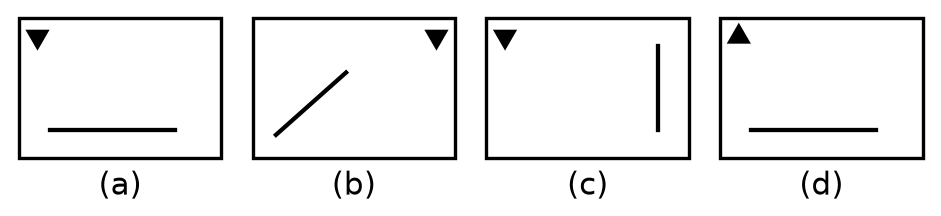
The elements of the problem figures given below are changing with a certain rule as we observe them from left to right:
According to this rule, which of the following would be the next figure if the changes were continued with the same rule?
Answer (d) & explanation
Figure (d) is correct. Step 1: watch the black triangle. It moves round the corners anticlockwise: top-left, bottom-left, bottom-right, top-right. Next it returns to the top-left. Step 2: the triangle points up, down, up, down in turn, so next it points up. Step 3: the line turns a little each time: upright, slightly tilted, slanting, nearly flat. Next it becomes flat (horizontal). A flat line with an upward triangle in the top-left corner is (d). So (a), (b) and (c) fail.
Tip: in figure series, follow one element at a time (position, direction, angle). Write a short rule for each, then combine the rules to build the next figure.
(a) has the right line and corner but the triangle points down.
Answer as per the official UPSC answer key.
Consider the following information regarding the performance of a class of 1000 students in four different tests:
| Tests | I | II | III | IV |
|---|---|---|---|---|
| Average marks | 60 | 60 | 70 | 80 |
| Range of marks | 30 to 90 | 45 to 75 | 20 to 100 | 0 to 100 |
If a student scores 74 marks in each of the four tests, in which one of the following tests is her performance the best comparatively?
Answer (b) & explanation
1. 74 is good or bad only compared with how others scored. Ask: how close is 74 to the top mark of that test?
2. Test I: top is 90, so 74 is 16 marks short. Test III: 26 short of 100. Test IV: 26 short of 100, and below the average of 80.
3. Test II: top is only 75, so 74 is just 1 mark below the best student, and 14 above the average.
4. Her best showing is in Test II.
Answer as per the official UPSC answer key.
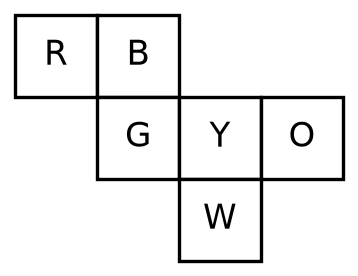
Six squares are coloured, front and back, red (R), blue (B), yellow (Y), green (G), white (W) and orange (O) and are hinged together as shown in the figure given below. If they were folded to form a cube, what would be the face opposite the white face?
Answer (c) & explanation
B is correct (c). Step 1: keep Y as the front face. In the net, G folds to the left, O to the right and W folds under to become the bottom. Step 2: B is attached to the top of G. When G folds to the left side, B lands on the top of the cube. Step 3: top and bottom are opposite, so B is opposite W. R then folds round to the back, opposite Y. So R, G and O are not opposite white, and (a), (b) and (d) fail.
Tip: in a cube net, fix one face as the front and fold the others one by one. Two faces that are separated by one square in a straight line of the net are usually opposite.
Answer as per the official UPSC answer key.
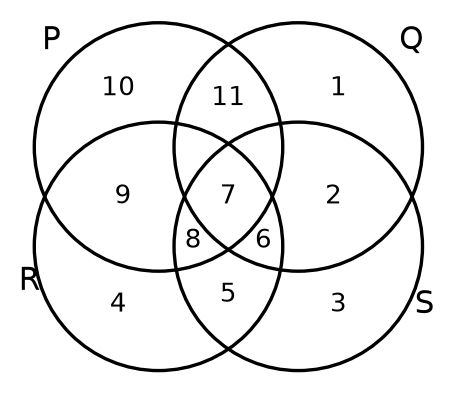
In the above figure, circle P represents hardworking people, circle Q represents intelligent people, circle R represents truthful people, and circle S represents honest people. Which region represents the people who are intelligent, honest and truthful but not hardworking?
Answer (a) & explanation
Region 6 is correct (a). Step 1: we need people who are intelligent (Q), truthful (R) and honest (S) but not hardworking (outside P). So the region must lie inside Q, R and S, and outside P. Step 2: region 7 is inside all four circles, so it includes hardworking people: wrong. Region 8 is inside P: wrong. Region 11 is only in P and Q: wrong. Step 3: region 6 is inside Q, R and S and outside P. So (b), (c) and (d) fail.
Tip: turn the description into 'inside' and 'outside' lists first. Then test each region number against both lists; one wrong circle rules it out.
Answer as per the official UPSC answer key.
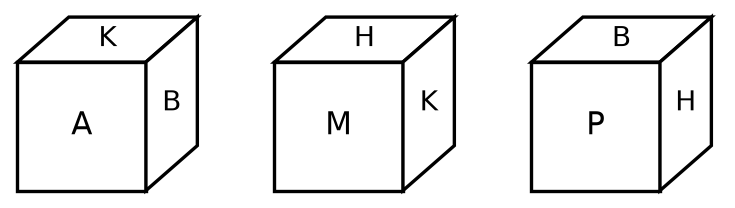
Three views of a cube following a particular motion are given below:
What is the letter opposite to A?
Answer (a) & explanation
H is correct (a). Step 1: letters seen together in one view are neighbours, so they cannot be opposite each other. Step 2: view 2 shows H with M and K. View 3 shows H with B and P. So H touches K, M, B and P. Step 3: a face touches four faces and is opposite just one. The only letter H never touches is A, so H is opposite A. B, P and M all touch H's group of neighbours, so (b), (c) and (d) fail.
Tip: list each letter's neighbours from all the views. A cube face has exactly four neighbours; the one letter left over is the opposite face.
Answer as per the official UPSC answer key.

Which one of the figures shown below occupies the blank space (?) in the matrix given above?
Answer (d) & explanation
Figure (d) is correct. Step 1: in each row the first and last circles are the same. Step 2: the middle circle has its black quarter in the opposite corner. Row 1: the ends have top-right black, the middle has bottom-left black. Row 3: the ends have bottom-right black, the middle has top-left black. Step 3: row 2's ends have the top-left quarter black, so the middle must have the bottom-right quarter black. That is (d). So (a), (b) and (c) fail.
Tip: in matrix figures, check rows first, then columns. Look for 'same at both ends' and 'opposite in the middle' patterns; they are very common in UPSC CSAT.
Answer as per the official UPSC answer key.
Read the passage
The poor especially in market economies, need the strength that collectivities offer for creating more economic, social and political space for themselves, for enhancing their socio-economic well-being and voice, and as a protection against free market individualism. It has been argued that a group approach to farming, especially in the form of bottom up agricultural production collectivities, offers substantial scope for poverty alleviation and empowering the poor as well as enhancing agricultural productivity. To realise this potential, however, the groups would need to be voluntary in nature, small in size, participative in decision making and equitable in work sharing and benefit distribution. There are many notable examples of such collectivities to be found in varied contexts, such as in the transition economies. All of them bear witness to the possibility of successful cooperation under given conditions. And although the gender impact of the family cooperatives in the transition economies are uncertain, the Indian examples of women-only groups farming offer considerable potential for benefiting women.
Agricultural collectivities such as group based farming can provide the rural poor
- 1. empowerment.
- 2. increased agricultural productivity.
- 3. safeguard against exploitative markets.
- 4. surplus production of agricultural commodities.
Select the correct answer using the codes given below :
Answer (b) & explanation
1, 2 and 3 are correct (b). Step 1: the passage says group farming offers scope for 'empowering the poor' (1) and 'enhancing agricultural productivity' (2). Step 2: it says collectivities give the poor 'a protection against free market individualism'. That is a safeguard against harsh, exploitative markets (3). Step 3: point 4, surplus production, is never claimed. Higher productivity does not mean a surplus beyond needs. So (a), (c) and (d), which include 4 or leave out 1, fail.
Tip: separate what the passage says from what might follow from it. 'More productive' is stated; 'surplus' is your own extra step, and UPSC usually rejects such steps.
Answer as per the official UPSC answer key.
Read the passage
The poor especially in market economies, need the strength that collectivities offer for creating more economic, social and political space for themselves, for enhancing their socio-economic well-being and voice, and as a protection against free market individualism. It has been argued that a group approach to farming, especially in the form of bottom up agricultural production collectivities, offers substantial scope for poverty alleviation and empowering the poor as well as enhancing agricultural productivity. To realise this potential, however, the groups would need to be voluntary in nature, small in size, participative in decision making and equitable in work sharing and benefit distribution. There are many notable examples of such collectivities to be found in varied contexts, such as in the transition economies. All of them bear witness to the possibility of successful cooperation under given conditions. And although the gender impact of the family cooperatives in the transition economies are uncertain, the Indian examples of women-only groups farming offer considerable potential for benefiting women.
What does the author imply by “gender impact” ?
Answer (c) & explanation
(c) is correct. Step 1: 'gender impact' means the effect on women (and men). The passage says the gender impact of family cooperatives in transition economies is uncertain, but the Indian women-only groups 'offer considerable potential for benefiting women'. So the author is talking about women benefiting from group farming. Step 2: (a) and (b) are wrong: the passage never says women are doubtful participants or that family cooperatives leave women out. Step 3: (d) is wrong: nothing says women's role in transition economies is highly restrictive; the impact there is only 'uncertain'. So (a), (b) and (d) fail.
Tip: 'impact' asks about effects. Pick the option that names an effect the passage mentions.
Answer as per the official UPSC answer key.
Read the passage
The poor especially in market economies, need the strength that collectivities offer for creating more economic, social and political space for themselves, for enhancing their socio-economic well-being and voice, and as a protection against free market individualism. It has been argued that a group approach to farming, especially in the form of bottom up agricultural production collectivities, offers substantial scope for poverty alleviation and empowering the poor as well as enhancing agricultural productivity. To realise this potential, however, the groups would need to be voluntary in nature, small in size, participative in decision making and equitable in work sharing and benefit distribution. There are many notable examples of such collectivities to be found in varied contexts, such as in the transition economies. All of them bear witness to the possibility of successful cooperation under given conditions. And although the gender impact of the family cooperatives in the transition economies are uncertain, the Indian examples of women-only groups farming offer considerable potential for benefiting women.
Consider the following assumptions :
- 1. It is imperative for transition economies to have agricultural collectivities.
- 2. Agricultural productivity can be increased by group approach to farming.
With reference to the above passage, which of these assumptions is/are valid ?
Answer (b) & explanation
Only assumption 2 is valid (b). Step 1: the passage says group farming 'offers substantial scope for… enhancing agricultural productivity'. So assumption 2 is valid. Step 2: assumption 1 says collectivities are imperative (a must) for transition economies. The passage only mentions transition economies as places where examples of such groups are found. It never says they must have them. Step 3: so 1 is not valid, and (a), (c) and (d) fail.
Tip: 'imperative', 'must' and 'essential' are strong words. If the passage only gives examples or says something 'can' happen, such strong statements are not valid assumptions. Match the strength of the option to the strength of the text.
Answer as per the official UPSC answer key.
Read the passage
In a typical Western liberal context, deepening of democracy invariably leads to consolidation of ‘liberal values’. In the Indian context, democratization is translated into greater involvement of people not as ‘individuals’ which is a staple to liberal discourse, but as communities or groups. Individuals are getting involved in the public sphere not as ‘atomized’ individuals but as members of primordial communities drawn on religious or caste identity. Community-identity seems to be the governing force. It is not therefore surprising that the so-called peripheral groups continue to maintain their identities with reference to the social groups (caste, religion or sect) to which they belong while getting involved in the political processes despite the fact that their political goals remain more or less identical. By helping to articulate the political voice of the marginalized, democracy in India has led to ‘a loosening of social strictures’ and empowered the peripherals to be confident of their ability to improve the socio-economic conditions in which they are placed. This is a significant political process that had led to a silent revolution through a meaningful transfer of power from the upper caste elites to various subaltern groups within the democratic framework of public governance.
According to the passage, what does “deepening of democracy” mean in the Western context ?
Answer (c) & explanation
(c) is correct. Step 1: the passage contrasts the West with India. In India people take part 'not as individuals, which is a staple to liberal discourse, but as communities'. In the West, therefore, deepening democracy means more involvement of people as 'atomized' individuals. Step 2: (a) is wrong: group and caste identities describe the Indian pattern, not the Western one. Step 3: (b) is wrong because it is too general: 'greater involvement of people' fits both India and the West and misses the key word 'individuals'. Since (c) is right, (d) fails.
Tip: in contrast passages, the answer for one side is usually the opposite of what is said about the other side.
Answer as per the official UPSC answer key.
Read the passage
In a typical Western liberal context, deepening of democracy invariably leads to consolidation of ‘liberal values’. In the Indian context, democratization is translated into greater involvement of people not as ‘individuals’ which is a staple to liberal discourse, but as communities or groups. Individuals are getting involved in the public sphere not as ‘atomized’ individuals but as members of primordial communities drawn on religious or caste identity. Community-identity seems to be the governing force. It is not therefore surprising that the so-called peripheral groups continue to maintain their identities with reference to the social groups (caste, religion or sect) to which they belong while getting involved in the political processes despite the fact that their political goals remain more or less identical. By helping to articulate the political voice of the marginalized, democracy in India has led to ‘a loosening of social strictures’ and empowered the peripherals to be confident of their ability to improve the socio-economic conditions in which they are placed. This is a significant political process that had led to a silent revolution through a meaningful transfer of power from the upper caste elites to various subaltern groups within the democratic framework of public governance.
Greater democratization in India has not necessarily led to
Answer (b) & explanation
(b) is correct. Step 1: the passage says 'community-identity seems to be the governing force' and groups keep their caste or religious identity even as they join politics. So democratization has not made community identity irrelevant. Step 2: (a) is close, since caste identities have also not been diluted, but (b) uses the passage's own words ('governing force') and is the key. Step 3: (c) is wrong: the passage says power has moved from upper-caste elites to subaltern groups, so elites have in fact been weakened. (d) is wrong: the passage does not compare hereditary and class identities. So (a), (c) and (d) fail.
Tip: when two options look similar, choose the one closest to the passage's wording.
Answer as per the official UPSC answer key.
Read the passage
In a typical Western liberal context, deepening of democracy invariably leads to consolidation of ‘liberal values’. In the Indian context, democratization is translated into greater involvement of people not as ‘individuals’ which is a staple to liberal discourse, but as communities or groups. Individuals are getting involved in the public sphere not as ‘atomized’ individuals but as members of primordial communities drawn on religious or caste identity. Community-identity seems to be the governing force. It is not therefore surprising that the so-called peripheral groups continue to maintain their identities with reference to the social groups (caste, religion or sect) to which they belong while getting involved in the political processes despite the fact that their political goals remain more or less identical. By helping to articulate the political voice of the marginalized, democracy in India has led to ‘a loosening of social strictures’ and empowered the peripherals to be confident of their ability to improve the socio-economic conditions in which they are placed. This is a significant political process that had led to a silent revolution through a meaningful transfer of power from the upper caste elites to various subaltern groups within the democratic framework of public governance.
What is the “silent revolution” that has occurred in the Indian democratic process ?
Answer (c) & explanation
(c) is correct. Step 1: the passage says democracy led to 'a silent revolution through a meaningful transfer of power from the upper caste elites to various subaltern groups'. That is exactly (c). Step 2: (a) is wrong: caste is still very relevant; community identity is called 'the governing force'. Step 3: (b) is wrong: 'loosening of social strictures' is mentioned, but not in voting behaviour and patterns; it refers to the marginalized gaining confidence. Since (a) and (b) fail, (d) fails too.
Tip: when the passage defines a quoted phrase in the same sentence ('a silent revolution through…'), the answer is usually that definition. Read the words right after the phrase.
Answer as per the official UPSC answer key.
Directions for the following 5 (five) items: Examine the information given in the following paragraph and answer the items that follow:
Guest lectures on five subjects viz., Economics, History, Statistics, English and Mathematics have to be arranged in a week from Monday to Friday. Only one lecture can be arranged on each day. Economics cannot be scheduled on Tuesday. Guest faculty for History is available only on Tuesday. Mathematics lecture has to be scheduled immediately after the day of Economics lecture. English lecture has to be scheduled immediately before the day of Economics lecture.
Which lecture is scheduled on Monday?
Answer (d) & explanation
Statistics is correct (d). Step 1: History is fixed on Tuesday. Step 2: English must come immediately before Economics, and Mathematics immediately after it. So English, Economics, Mathematics take three days in a row. With Tuesday taken, the only three free days in a row are Wednesday, Thursday, Friday. Economics on Thursday also obeys 'not on Tuesday'. Step 3: so Wednesday English, Thursday Economics, Friday Mathematics, and the only day left, Monday, gets Statistics. Full week: Mon Statistics, Tue History, Wed English, Thu Economics, Fri Mathematics. So (a), (b) and (c) fail.
Tip: place the fixed item first, then fit the block of linked items into the gaps that remain.
Answer as per the official UPSC answer key.
(Same information as the question above.)
Which lecture is scheduled between Statistics and English?
Answer (b) & explanation
History is correct (b). Step 1: from the schedule worked out from the clues: Mon Statistics, Tue History, Wed English, Thu Economics, Fri Mathematics. (History is fixed on Tuesday; English–Economics–Mathematics must run on three days in a row, which can only be Wed–Fri; Statistics takes Monday.) Step 2: Statistics is on Monday and English on Wednesday. Step 3: the lecture between them, on Tuesday, is History. Economics and Mathematics come after English, and there is a lecture between them, so (a), (c) and (d) fail.
Tip: in a set of linked questions, build the full timetable once and write it down. Each later question then takes a few seconds and you avoid repeating errors.
Answer as per the official UPSC answer key.
(Same information as the question above.)
Which lecture is the last one in the week?
Answer (c) & explanation
Mathematics is correct (c). Step 1: History is fixed on Tuesday. English, Economics and Mathematics must run on three days in a row in that order, and the only such free days are Wednesday, Thursday and Friday. Step 2: so Mathematics, the last of the three, falls on Friday. Statistics fills Monday. Step 3: the week is Mon Statistics, Tue History, Wed English, Thu Economics, Fri Mathematics. Friday is the last day, so the last lecture is Mathematics. History, English and Economics are earlier in the week, so (a), (b) and (d) fail.
Tip: when three items must come in a row and one day is already taken, list the possible runs of free days. Often only one run fits.
Answer as per the official UPSC answer key.
(Same information as the question above.)
Which lecture is scheduled on Wednesday?
Answer (c) & explanation
English is correct (c). Step 1: History is on Tuesday (only day the faculty is free). Step 2: the block English → Economics → Mathematics needs three days in a row; only Wed–Thu–Fri are free in a row, and this also keeps Economics off Tuesday. Step 3: so English is on Wednesday, Economics Thursday, Mathematics Friday, and Statistics Monday. Statistics is Monday, Economics Thursday and History Tuesday, so (a), (b) and (d) fail.
Tip: check your schedule against every clue once before answering. Here: Economics not on Tuesday (✓ Thursday), History Tuesday (✓), English just before Economics (✓), Mathematics just after Economics (✓). One check protects all five linked answers.
Answer as per the official UPSC answer key.
(Same information as the question above.)
Which lecture is scheduled before the Mathematics lecture?
Answer (a) & explanation
Economics is correct (a). Step 1: the clue itself says Mathematics is scheduled 'immediately after the day of Economics'. Step 2: in the full week (Mon Statistics, Tue History, Wed English, Thu Economics, Fri Mathematics), Economics on Thursday comes just before Mathematics on Friday. Step 3: History (Tuesday), Statistics (Monday) and English (Wednesday) also come before Mathematics in the week, but not just before it. The question means the lecture immediately before, so (b), (c) and (d) fail.
Tip: some answers can be read straight from a clue. Before working the whole puzzle, check whether one clue already answers the question.
Answer as per the official UPSC answer key.
Two glasses of equal volume are respectively half and three-fourths filled with milk. They are then filled to the brim by adding water. Their contents are then poured into another vessel. What will be the ratio of milk to water in this vessel?
Answer (d) & explanation
5 : 3 is correct (d). Step 1: take each glass as 4 units so the fractions are easy. Glass 1 is half milk: 2 milk + 2 water. Glass 2 is three-fourths milk: 3 milk + 1 water. Step 2: pour both into the vessel. Milk = 2 + 3 = 5 units. Water = 2 + 1 = 3 units. Step 3: so milk : water = 5 : 3. (a) 1 : 3 and (b) 2 : 3 put water above milk, and (c) 3 : 2 is the wrong split. So (a), (b) and (c) fail.
Tip: choose a glass size that clears all fractions (the LCM of the denominators, here 4). Then everything becomes whole numbers and simple adding.
Answer as per the official UPSC answer key.
Consider the following statements:
- 1. All machines consume energy.
- 2. Electricity provides energy.
- 3. Electrically operated machines are cheap to maintain.
- 4. Electrically operated machines do not cause pollution.
Which one of the following inferences can be drawn from the above statements?
Answer (d) & explanation
(d) is correct. Step 1: statements 3 and 4 give two advantages of electric machines: they are cheap to maintain and do not cause pollution. So electric machines are preferable to use. Step 2: (a) is wrong: statement 1 says all machines use energy, not that all use electricity. (b) is wrong: 'electricity provides energy' does not mean it is the only form of energy. Step 3: (c) is wrong: nothing tells us how many machines run on electricity, so 'most' cannot be inferred. So (a), (b) and (c) fail.
Tip: 'X provides energy' does not mean 'only X provides energy'. Inferences that add 'all', 'only' or 'most' need direct support.
Answer as per the official UPSC answer key.
Examine the following statements:
- 1. None but the rich can afford air travel.
- 2. Some of those who travel by air become sick.
- 3. Some of those who become sick require treatment.
Which one of the following conclusions can be drawn from the above statements?
Answer (d) & explanation
(d) is correct. Step 1: 'None but the rich can afford air travel' means only the rich travel by air. So every air traveller is rich: (d). Step 2: (b) is wrong: only some air travellers become sick, not all. Step 3: (a) and (c) are wrong: nothing says all rich people travel or fall sick; the statements are about air travellers, a part of the rich. So (a), (b) and (c) fail.
Tip: 'None but X' = 'only X' = 'everyone who does this is X'. It never means every X does it. Draw the 'air travellers' circle inside the 'rich' circle and the answer is clear; the 'some… sick' circle only overlaps.
Answer as per the official UPSC answer key.
In five flats, one above the other, live five professionals. The professor has to go up to meet his IAS officer friend. The doctor is equally friendly to all, and has to go up as frequently as go down. The engineer has to go up to meet his MLA friend above whose flat lives the professor's friend. From the ground floor to the top floor, in what order do the five professionals live?
Answer (d) & explanation
(d) is correct. Step 1: the doctor goes up as often as down, so he lives in the middle (3rd) flat. Step 2: the engineer goes up to meet the MLA, above whom lives the professor's friend, the IAS officer. So Engineer < MLA < IAS officer. The professor also goes up to the IAS officer, so the IAS officer is near the top. Step 3: with the doctor 3rd, MLA must be 4th and IAS 5th, leaving professor and engineer in flats 1 and 2. Only (d) fits: Professor, Engineer, Doctor, MLA, IAS officer. (a) and (c) put the IAS officer below the MLA, and (b) puts the MLA on top, so they fail.
Tip: anyone who goes up and down equally sits in the middle.
Answer as per the official UPSC answer key.
Read the passage
For fourteen and a half months I lived in my little cell or room in the Dehradun jail, and I began to feel as if I was almost a part of it. I was familiar with every bit of it, I knew every mark and dent on the whitewashed walls and on the uneven floor and the ceiling with its moth-eaten rafters. In the little yard outside I greeted little tufts of grass and odd bits of stone as old friends. I was not alone in my cell, for several colonies of wasp and hornets lived there, and many lizards found a home behind the rafters, emerging in the evenings in search of prey.
Which of the following explains best the sentence in the passage “I was almost a part of it” ?
Answer (b) & explanation
(b) is correct. Step 1: the very next sentence explains the phrase: 'I was familiar with every bit of it, I knew every mark and dent on the… walls'. Feeling part of the cell means knowing it in every detail. Step 2: (a) 'not alone' refers to the wasps and lizards, a different point. (c) greeting grass as friends is about the yard outside, not the cell. Step 3: (d) 'felt quite at home' is a close distractor, but the passage never says he felt comfortable; it stresses familiarity. So (a), (c) and (d) fail.
Tip: when asked to explain a phrase, look at the sentence right after it. Authors often explain their own words there.
Answer as per the official UPSC answer key.
Read the passage
For fourteen and a half months I lived in my little cell or room in the Dehradun jail, and I began to feel as if I was almost a part of it. I was familiar with every bit of it, I knew every mark and dent on the whitewashed walls and on the uneven floor and the ceiling with its moth-eaten rafters. In the little yard outside I greeted little tufts of grass and odd bits of stone as old friends. I was not alone in my cell, for several colonies of wasp and hornets lived there, and many lizards found a home behind the rafters, emerging in the evenings in search of prey.
The passage attempts to describe
Answer (c) & explanation
(c) is correct. Step 1: the prisoner knows every dent in the walls, greets 'little tufts of grass and odd bits of stone as old friends', and notices the wasps, hornets and lizards that share his cell. These details show a man making a conscious effort to cope with loneliness. Step 2: (a) is wrong: he describes one cell, not the country's jails in general. Step 3: (b) is true on the surface, but noticing details is the means, not the purpose. (d) overstates: he does not say he lived happily with the creatures. So (a), (b) and (d) fail.
Tip: ask why the author gives these details. The purpose behind them is usually the main idea.
Answer as per the official UPSC answer key.
Read the passage
For fourteen and a half months I lived in my little cell or room in the Dehradun jail, and I began to feel as if I was almost a part of it. I was familiar with every bit of it, I knew every mark and dent on the whitewashed walls and on the uneven floor and the ceiling with its moth-eaten rafters. In the little yard outside I greeted little tufts of grass and odd bits of stone as old friends. I was not alone in my cell, for several colonies of wasp and hornets lived there, and many lizards found a home behind the rafters, emerging in the evenings in search of prey.
The author of the passage seems to suggest that
Answer (a) & explanation
(a) is correct. Step 1: over fourteen and a half months, the prisoner came to feel 'almost a part of' a bare cell with dents, moth-eaten rafters and insects. This shows a person can adjust to unpleasant surroundings. Step 2: (b) and (d) are wrong: he does not judge whether Indian prisons are good or need improvement. Step 3: (c) is wrong: he never says prison life is easy; the effort to find company in grass and stones shows it was hard. So (b), (c) and (d) fail.
Tip: 'the author seems to suggest' asks for the general lesson from the story. Choose the broad idea and reject options about topics (prison policy) the author never discusses.
Answer as per the official UPSC answer key.
Read the passage
We started pitching the highest camp that has ever been made. Everything took five times as long as it would have taken in a place where there was enough air to breathe; but at last we got the tent up, and when we crawled in, it was not too bad. There was only a light wind, and inside it was not too cold for us to take off our gloves. At night most climbers take off their boots; but I prefer to keep them on. Hillary, on the other hand, took his off and laid them next to his sleeping bag.
What does the expression “pitching the highest camp” imply ?
Answer (c) & explanation
(c) is correct. Step 1: the author says they were pitching 'the highest camp that has ever been made'. So nobody had ever camped that high before. Step 2: (a) is wrong: they were still pitching a camp, so they had not yet reached the summit. Step 3: (b) is wrong: the passage does not say earlier climbers reached that height without camping; it implies no one had camped there. (d) is wrong: 'highest' refers to height, not to a big camp for many climbers. So (a), (b) and (d) fail.
Tip: read the key word carefully: 'highest' is about altitude. Do not mix up 'high' with 'large'. 'Ever' makes it a record.
Answer as per the official UPSC answer key.
Read the passage
We started pitching the highest camp that has ever been made. Everything took five times as long as it would have taken in a place where there was enough air to breathe; but at last we got the tent up, and when we crawled in, it was not too bad. There was only a light wind, and inside it was not too cold for us to take off our gloves. At night most climbers take off their boots; but I prefer to keep them on. Hillary, on the other hand, took his off and laid them next to his sleeping bag.
They took a long time to finish the work because
Answer (b) & explanation
(b) is correct. Step 1: the passage says everything 'took five times as long as it would have taken in a place where there was enough air to breathe'. So the thin air at that height slowed them down. Step 2: (a) is wrong: tiredness is not given as the reason. Step 3: (c) is wrong: the passage says inside 'it was not too cold'. (d) is wrong: darkness is never mentioned. So (a), (c) and (d) fail.
Tip: in 'because' questions, find the sentence that gives the cause directly. Here the comparison with 'a place where there was enough air' tells you the cause was lack of air. Remember: at great heights air is thin and every action takes longer.
Answer as per the official UPSC answer key.
Read the passage
We started pitching the highest camp that has ever been made. Everything took five times as long as it would have taken in a place where there was enough air to breathe; but at last we got the tent up, and when we crawled in, it was not too bad. There was only a light wind, and inside it was not too cold for us to take off our gloves. At night most climbers take off their boots; but I prefer to keep them on. Hillary, on the other hand, took his off and laid them next to his sleeping bag.
When they crawled into the tent
Answer (a) & explanation
(a) is correct. Step 1: the passage says 'inside it was not too cold for us to take off our gloves'. So they took their gloves off because it was not very cold. Step 2: (b) and (c) are wrong: both say it was very cold, the opposite of the text. Step 3: (d) is wrong: it says they did not take off their gloves, which reverses the action. So (b), (c) and (d) fail.
Tip: the phrase 'not too cold to do X' means it was warm enough to do X. Options here change one or two small parts (the temperature or the action). Check both parts against the sentence before choosing.
Answer as per the official UPSC answer key.
Read the passage
A local man, staying on the top floor of an old wooden house, was awakened at midnight by a fire. Losing his way in a smoke-filled passage, he missed the stairway and went into another room. He picked up a bundle to protect his face from the fire and immediately fell through the floor below where he managed to escape through a clear doorway. The “bundle” proved to be the baby of the Mayor’s wife. The “hero” was congratulated by all.
The man went into another room because
Answer (b) & explanation
(b) is correct. Step 1: the passage says 'Losing his way in a smoke-filled passage, he missed the stairway'. The smoke made him lose his way, so he went into the wrong room. Step 2: (a) is wrong: he lived in the house, so he knew where the stairway was; he just could not see it in the smoke. Step 3: (c) is wrong: nervousness is not mentioned. (d) is wrong: he picked up the bundle after going into the room, so it was not the cause. So (a), (c) and (d) fail.
Tip: check the order of events. An action that happens later can never be the cause of an earlier one.
Answer as per the official UPSC answer key.
Read the passage
A local man, staying on the top floor of an old wooden house, was awakened at midnight by a fire. Losing his way in a smoke-filled passage, he missed the stairway and went into another room. He picked up a bundle to protect his face from the fire and immediately fell through the floor below where he managed to escape through a clear doorway. The “bundle” proved to be the baby of the Mayor’s wife. The “hero” was congratulated by all.
The man was called a hero because he
Answer (d) & explanation
(d) is correct. Step 1: the 'bundle' he grabbed to protect his face turned out to be the Mayor's baby, and both escaped. So he saved a life, and people called him a hero. Step 2: (a) is wrong: he did not choose to risk his life for others; he grabbed the bundle for his own protection. (b) is wrong: escaping alone would not make him a hero. Step 3: (c) is wrong: he did not fight the fire at all. So (a), (b) and (c) fail.
Tip: the quotation marks round 'hero' and 'bundle' show irony: he saved the baby by accident. Still, the question asks why he was called a hero, and the answer is that a life was saved.
Answer as per the official UPSC answer key.
Directions: each item describes a situation and is followed by four possible responses. Indicate the response you find most appropriate. There is no penalty for wrong answers for these items. You have differences of opinion regarding the final report prepared by your subordinate that is to be submitted urgently. The subordinate is justifying the information given in the report. You would...
Answer (a) & explanation
(a) and (c) are both correct (UPSC accepted both; no negative marking). Step 1: the report is urgent and you disagree with it. You need a quick, correct result. Step 2: (a) convincing the subordinate with reasons settles the issue and helps him learn. (c) revising the report yourself ensures it goes out correct and on time. Step 3: (b) sending it back to 'reconsider' wastes time when he is already defending it. (d) simply telling him not to justify the mistake is bossy and solves nothing.
Tip: for these interpersonal items, pick the response that is lawful, honest and fixes the real problem through proper channels. Avoid options that give in, run away from duty or act without hearing the facts.
Answer as per the official UPSC answer key.
You are competing with your batch-mate for a prestigious award to be decided based on an oral presentation. Ten minutes are allowed for each presentation. You have been asked by the committee to finish on time. Your friend, however, is allowed more than the stipulated time period. You would...
Answer (a) & explanation
(a) and (d) are both correct (UPSC accepted both; no negative marking). Step 1: you are being treated unequally: your time is limited, your rival's is not. Step 2: (a) a complaint to the chairperson is the proper, formal way to raise discrimination. The key also accepts (d), a protest, as a firm stand against unfairness. Step 3: (b) refusing to hear the committee shuts out dialogue. (c) withdrawing gives up your chance and leaves the unfairness in place.
Tip: for these interpersonal items, pick the response that is lawful, honest and fixes the real problem through proper channels. Avoid options that give in, run away from duty or act without hearing the facts.
Answer as per the official UPSC answer key.
You are handling a time-bound project. During the project review meeting, you find that the project is likely to get delayed due to lack of cooperation of the team members. You would...
Answer (a) & explanation
(a) and (b) are both correct (UPSC accepted both; no negative marking). Step 1: the project is time-bound and is slipping because the team is not cooperating. Step 2: (b) finding out why they are not cooperating lets you fix the root cause. (a) a clear warning makes it plain that non-cooperation must stop. Step 3: (c) asking for new team members wastes time and avoids leadership. (d) asking for an extension accepts the delay instead of solving it.
Tip: for these interpersonal items, pick the response that is lawful, honest and fixes the real problem through proper channels. Avoid options that give in, run away from duty or act without hearing the facts.
Answer as per the official UPSC answer key.
You are the chairperson of a state sports committee. You have received a complaint and later it was found that an athlete in the junior age category who has won a medal has crossed the age criteria by 5 days. You would...
Answer (a) & explanation
(a) and (d) are both correct (UPSC accepted both; no negative marking). Step 1: an athlete was found 5 days over the age limit after winning a medal. You must act fairly and follow due process. Step 2: (a) asking the screening committee to explain how the error happened, and (d) taking the views of the sports committee, both gather facts before a decision. Step 3: (b) taking the medal back at once skips due process. (c) a court affidavit cannot change the athlete's real age.
Tip: for these interpersonal items, pick the response that is lawful, honest and fixes the real problem through proper channels. Avoid options that give in, run away from duty or act without hearing the facts.
Answer as per the official UPSC answer key.
You are handling a priority project and have been meeting all the deadlines and are therefore planning your leave during the project. Your immediate boss does not grant your leave citing the urgency of the project. You would...
Answer (c) & explanation
(c) and (d) are both correct (UPSC accepted both; no negative marking). Step 1: your leave was refused because the project is urgent, though you have met all deadlines. Step 2: (d) telling the boss honestly that the refusal is not justified, and (c) asking a higher authority to reconsider, are both honest and within the rules. Step 3: (a) going on leave without sanction breaks service rules. (b) pretending to be sick is dishonest and can lead to disciplinary action.
Tip: for these interpersonal items, pick the response that is lawful, honest and fixes the real problem through proper channels. Avoid options that give in, run away from duty or act without hearing the facts.
Answer as per the official UPSC answer key.
You are involved in setting up a water supply project in a remote area. Full recovery of cost is impossible in any case. The income levels in the area are low and 25% of the population is below poverty line (BPL). When a decision has to be taken on pricing you would...
Answer (c) & explanation
(c) and (d) are both correct (UPSC accepted both; no negative marking). Step 1: full cost recovery is impossible, incomes are low and 25% of people are BPL. A fair price must protect the poor but still recover some cost. Step 2: (c) free water for BPL and a fixed charge for others, and (d) charges by use with lower rates for BPL, both do this; (d) also discourages waste. Step 3: (a) free water for all recovers nothing and invites waste. (b) a one-time fee with free use does the same.
Tip: for these interpersonal items, pick the response that is lawful, honest and fixes the real problem through proper channels. Avoid options that give in, run away from duty or act without hearing the facts.
Answer as per the official UPSC answer key.
As a citizen you have some work with a government department. The official calls you again and again; and without directly asking you, sends out feelers for a bribe. You want to get your work done. You would...
Answer (b) & explanation
(b) and (c) are both correct (UPSC accepted both; no negative marking). Step 1: the official is hinting at a bribe but has not asked directly. You want your work done honestly. Step 2: (b) ignoring the hints and pressing your application, or (c) asking a senior officer for help, both refuse the bribe and keep your case moving. Step 3: (a) paying a bribe is a crime under the Prevention of Corruption Act. (d) a formal complaint based only on hints is hard to prove and may delay your work.
Tip: for these interpersonal items, pick the response that is lawful, honest and fixes the real problem through proper channels. Avoid options that give in, run away from duty or act without hearing the facts.
Answer as per the official UPSC answer key.
All years by topic
Every question from 2011 to 2026, grouped by syllabus topic, with year-wise trends.