
CSAT 2013: every question, solved
80 questions from the official UPSC Prelims 2013 paper, in paper order. Tap an option; the answer and the reason appear instantly.
Read the passage
The subject of democracy has become severely muddled because of the way the rhetoric surrounding it has been used in recent years. There is, increasingly, an oddly confused dichotomy between those who want to ‘impose’ democracy on countries in the non-Western world (in these countries’ ‘own interest’, of course) and those who are opposed to such ‘imposition’ (because of the respect for the countries’ ‘own ways’). But the entire language of ‘imposition’, used by both sides, is extraordinarily inappropriate since it makes the implicit assumption that democracy belongs exclusively to the West, taking it to be a quintessentially ‘Western’ idea which has originated and flourished only in the West.
But the thesis and the pessimism it generates about the possibility of democratic practice in the world would be extremely hard to justify. There were several experiments in local democracy in ancient India. Indeed, in understanding the roots of democracy in the world, we have to take an interest in the history of people participation and public reasoning in different parts of the world. We have to look beyond thinking of democracy only in terms of European and American evolution. We would fail to understand the pervasive demands for participatory living, on which Aristotle spoke with far-reaching insight, if we take democracy to be a kind of a specialized cultural product of the West.
It cannot, of course, be doubted that the institutional structure of the contemporary practice of democracy is largely the product of European and American experience over the last few centuries. This is extremely important to recognize since these developments in institutional formats were immensely innovative and ultimately effective. There can be little doubt that there is a major ‘Western’ achievement here.
Which of the following is closest to the view of democracy as mentioned in the above passage ?
Answer (c) & explanation
(c) is correct. Step 1: the author makes two points. Democracy is not a purely Western idea; there were experiments in local democracy in ancient India, and participation and public reasoning existed in many places. But the institutional structure of today's democracy is 'largely the product of European and American experience', a 'major Western achievement'. (c) states both points. Step 2: (a) is wrong: the muddle comes from the confused rhetoric of 'imposition', and no one is said to call democracy 'alien'. Step 3: (b) is wrong: its second half adopts the 'own ways' position that the author criticises. So (a), (b) and (d) fail.
Tip: when a passage says 'X, but also Y', the best option keeps both halves.
Answer as per the official UPSC answer key.
Read the passage
The subject of democracy has become severely muddled because of the way the rhetoric surrounding it has been used in recent years. There is, increasingly, an oddly confused dichotomy between those who want to ‘impose’ democracy on countries in the non-Western world (in these countries’ ‘own interest’, of course) and those who are opposed to such ‘imposition’ (because of the respect for the countries’ ‘own ways’). But the entire language of ‘imposition’, used by both sides, is extraordinarily inappropriate since it makes the implicit assumption that democracy belongs exclusively to the West, taking it to be a quintessentially ‘Western’ idea which has originated and flourished only in the West.
But the thesis and the pessimism it generates about the possibility of democratic practice in the world would be extremely hard to justify. There were several experiments in local democracy in ancient India. Indeed, in understanding the roots of democracy in the world, we have to take an interest in the history of people participation and public reasoning in different parts of the world. We have to look beyond thinking of democracy only in terms of European and American evolution. We would fail to understand the pervasive demands for participatory living, on which Aristotle spoke with far-reaching insight, if we take democracy to be a kind of a specialized cultural product of the West.
It cannot, of course, be doubted that the institutional structure of the contemporary practice of democracy is largely the product of European and American experience over the last few centuries. This is extremely important to recognize since these developments in institutional formats were immensely innovative and ultimately effective. There can be little doubt that there is a major ‘Western’ achievement here.
With reference to the passage, the following assumptions have been made :
- 1. Many of the non-Western countries are unable to have democracy because they take democracy to be a specialized cultural product of the West.
- 2. Western countries are always trying to impose democracy on non-Western countries.
Which of the above is/are valid assumption/assumptions ?
Answer (d) & explanation
Neither assumption is valid (d). Step 1: assumption 1 says non-Western countries are unable to have democracy because they see it as a Western product. The passage says the 'Western idea' thesis is held by those debating imposition, and it calls the resulting pessimism 'hard to justify'. It never says these countries cannot have democracy. Step 2: assumption 2 says Western countries always try to impose democracy. The passage speaks only of 'those who want to impose' it, without naming the West as a whole or saying 'always'. Step 3: so (a), (b) and (c) fail.
Tip: an assumption must be something the author takes for granted. Strong words like 'unable' and 'always' rarely pass that test.
Answer as per the official UPSC answer key.
Read the passage
Corporate governance is based on principles such as conducting the business with all integrity and fairness, being transparent with regard to all transactions, making all the necessary disclosures and decisions, complying with all the laws of the land, accountability and responsibility towards the stakeholders and commitment to conducting business in an ethical manner. Another point which is highlighted on corporate governance is the need for those in control to be able to distinguish between what are personal and corporate funds while managing a company.
Fundamentally, there is a level of confidence that is associated with a company that is known to have good corporate governance. The presence of an active group of independent directors on the board contributes a great deal towards ensuring confidence in the market. Corporate governance is known to be one of the criteria that foreign institutional investors are increasingly depending on when deciding on which companies to invest in. It is also known to have a positive influence on the share price of the company. Having a clean image on the corporate governance front could also make it easier for companies to source capital at more reasonable costs. Unfortunately, corporate governance often becomes the centre of discussion only after the exposure of a large scam.
According to the passage, which of the following should be the practice/practices in good corporate governance ?
- 1. Companies should always comply with labour and tax laws of the land.
- 2. Every company in the country should have a government representative as one of the independent directors on the board to ensure transparency.
- 3. The manager of a company should never invest his personal funds in the company.
Select the correct answer using the codes given below :
Answer (a) & explanation
Only practice 1 is correct (a). Step 1: the passage lists 'complying with all the laws of the land' as a principle of corporate governance. Labour and tax laws are laws of the land, so 1 fits. Step 2: practice 2 is wrong: the passage praises an active group of independent directors, but never says one must be a government representative. Step 3: practice 3 is wrong: the passage only asks those in control to distinguish between personal and corporate funds. It does not ban managers from investing their own money. So (b), (c) and (d) fail.
Tip: 'keep separate' is not 'never mix at all'. Watch for options that turn a mild rule into a strict ban.
Answer as per the official UPSC answer key.
Read the passage
Corporate governance is based on principles such as conducting the business with all integrity and fairness, being transparent with regard to all transactions, making all the necessary disclosures and decisions, complying with all the laws of the land, accountability and responsibility towards the stakeholders and commitment to conducting business in an ethical manner. Another point which is highlighted on corporate governance is the need for those in control to be able to distinguish between what are personal and corporate funds while managing a company.
Fundamentally, there is a level of confidence that is associated with a company that is known to have good corporate governance. The presence of an active group of independent directors on the board contributes a great deal towards ensuring confidence in the market. Corporate governance is known to be one of the criteria that foreign institutional investors are increasingly depending on when deciding on which companies to invest in. It is also known to have a positive influence on the share price of the company. Having a clean image on the corporate governance front could also make it easier for companies to source capital at more reasonable costs. Unfortunately, corporate governance often becomes the centre of discussion only after the exposure of a large scam.
According to the passage, which of the following is/are the major benefit/benefits of good corporate governance ?
- 1. Good corporate governance leads to increase in share price of the company.
- 2. A company with good corporate governance always increases its business turnover rapidly.
- 3. Good corporate governance is the main criterion for foreign institutional investors when they decide to buy a company.
Select the correct answer using the codes given below :
Answer (a) & explanation
Only benefit 1 is correct (a). Step 1: the passage says good corporate governance has 'a positive influence on the share price'. So 1 is right. Step 2: benefit 2 is wrong: business turnover is never mentioned, and 'always increases rapidly' is far too strong. Step 3: benefit 3 is wrong: the passage calls governance 'one of the criteria' foreign investors use, not the main criterion. So (b), (c) and (d) fail.
Tip: compare small words: 'one of the' never equals 'the main'. Also note the other benefits named in the passage, such as market confidence and cheaper capital; UPSC often tests whether you notice which one the options actually match.
Answer as per the official UPSC answer key.
Read the passage
Malnutrition most commonly occurs between the ages of six months and two years. This happens despite the child’s food requirements being less than that of an older child. Malnutrition is often attributed to poverty, but it has been found that even in households where adults eat adequate quantities of food, more than 50 per cent of children-under-five do not consume enough food. The child’s dependence on someone else to feed him/her is primarily responsible for the malnutrition. Very often the mother is working and the responsibility of feeding the young child is left to an older sibling. It is therefore crucial to increase awareness regarding the child’s food needs and how to satisfy them.
According to the passage, malnutrition in children can be reduced
Answer (c) & explanation
(c) is correct. Step 1: the passage ends: 'It is therefore crucial to increase awareness regarding the child's food needs and how to satisfy them.' So malnutrition falls when the food needs of young children are known. Step 2: (a) regular intake sounds good, but the passage blames the lack of awareness of how much a child needs; it does not offer 'regular food' as the remedy. Step 3: (b) is wrong: the problem peaks at six months to two years; waiting until age five is no remedy. (d) is wrong: the passage does not say feeding by adults solves it; even in households where adults eat well, children go hungry. So (a), (b) and (d) fail.
Tip: look for 'therefore' or 'it is crucial'; the solution usually follows.
Answer as per the official UPSC answer key.
Read the passage
Malnutrition most commonly occurs between the ages of six months and two years. This happens despite the child’s food requirements being less than that of an older child. Malnutrition is often attributed to poverty, but it has been found that even in households where adults eat adequate quantities of food, more than 50 per cent of children-under-five do not consume enough food. The child’s dependence on someone else to feed him/her is primarily responsible for the malnutrition. Very often the mother is working and the responsibility of feeding the young child is left to an older sibling. It is therefore crucial to increase awareness regarding the child’s food needs and how to satisfy them.
According to the author, poverty is not the main cause of malnutrition, but the fact that
- 1. taking care of younger ones is not a priority for working mothers.
- 2. awareness of nutritional needs is not propagated by the Public Health authorities.
Select the correct answer using the code given below :
Answer (b) & explanation
Only statement 2 is the key (b). Step 1: the passage says even well-fed families have hungry children, so the real cause is that people do not know a child's food needs. It calls for 'increasing awareness', which suggests awareness is not being spread: the key reads this as statement 2. Step 2: note that the passage never names Public Health authorities, so statement 2 is a loose fit; it is DOUBTFUL, and (d) is arguable. Step 3: statement 1 is wrong: working mothers lack time, so older siblings feed the child; nothing says the child is not a priority for them. So (a) and (c) fail.
Tip: when an option adds a new actor (here, health authorities), check carefully. UPSC sometimes accepts it if the core idea matches.
Answer as per the official UPSC answer key.
Read the passage
A number of empirical studies find that farmers are risk-averse, though only moderately in many cases. There is also evidence to show that farmers’ risk aversion results in cropping patterns and input use designed to reduce risk rather than to maximize income. Farmers adopt a number of strategies to manage and cope with agricultural risks. These include practices like crop and field diversification, non-farm employment, storage of stocks and strategic migration of family members. There are also institutions ranging from share tenancy to kinship, extended family and informal credit agencies. One major obstacle to risk sharing by farmers is that the same type of risks can affect a large number of farmers in the region. Empirical studies show that the traditional methods are not adequate. Hence there is a need for policy interventions, especially measures that cut across geographical regions.
Policies may aim at tackling agricultural risks directly or indirectly. Examples of risk-specific policies are crop insurance, price stabilization and the development of varieties resistant to pests and diseases. Policies which affect risk indirectly are irrigation, subsidized credit and access to information. No single risk-specific policy is sufficient to reduce risk and is without side-effects, whereas policies not specific to risk influence the general situation and affect risks only indirectly. Crop insurance, as a policy measure to tackle agricultural risk directly, deserves careful consideration in the Indian context and in many other developing countries — because the majority of farmers depend on rain-fed agriculture and in many areas yield variability is the predominant cause of their income instability.
The need for policy intervention to mitigate risks in agriculture is because
Answer (c) & explanation
(c) is correct. Step 1: the passage lists farmers' own strategies (diversifying crops, non-farm jobs, storing stocks, migration) and institutions like share tenancy and kinship. Then it says: 'the traditional methods are not adequate. Hence there is a need for policy interventions.' So (c) gives the stated reason. Step 2: (a) is wrong: farmers are only 'moderately' risk-averse, not 'extremely'. (b) is wrong: farmers do know many ways to handle risk. Step 3: (d) is true, but it is the reason crop insurance in particular deserves attention, not the reason for policy intervention in general. So (a), (b) and (d) fail.
Tip: words like 'hence' and 'therefore' link a cause to its result; the sentence before them is the answer.
Answer as per the official UPSC answer key.
Read the passage
A number of empirical studies find that farmers are risk-averse, though only moderately in many cases. There is also evidence to show that farmers’ risk aversion results in cropping patterns and input use designed to reduce risk rather than to maximize income. Farmers adopt a number of strategies to manage and cope with agricultural risks. These include practices like crop and field diversification, non-farm employment, storage of stocks and strategic migration of family members. There are also institutions ranging from share tenancy to kinship, extended family and informal credit agencies. One major obstacle to risk sharing by farmers is that the same type of risks can affect a large number of farmers in the region. Empirical studies show that the traditional methods are not adequate. Hence there is a need for policy interventions, especially measures that cut across geographical regions.
Policies may aim at tackling agricultural risks directly or indirectly. Examples of risk-specific policies are crop insurance, price stabilization and the development of varieties resistant to pests and diseases. Policies which affect risk indirectly are irrigation, subsidized credit and access to information. No single risk-specific policy is sufficient to reduce risk and is without side-effects, whereas policies not specific to risk influence the general situation and affect risks only indirectly. Crop insurance, as a policy measure to tackle agricultural risk directly, deserves careful consideration in the Indian context and in many other developing countries — because the majority of farmers depend on rain-fed agriculture and in many areas yield variability is the predominant cause of their income instability.
Which of the following observations emerges from the above passage ?
Answer (b) & explanation
(b) is correct. Step 1: the passage says plainly: 'No single risk-specific policy is sufficient to reduce risk and is without side-effects.' That is (b). Step 2: (a) says one can find a single policy that reduces risk with no side-effect, which is the opposite of the passage. Step 3: (c) is wrong: indirect policies only 'affect risks indirectly'; they do not eliminate risk. (d) is wrong: the passage never says government action can remove risk completely. So (a), (c) and (d) fail.
Tip: options with 'eliminate' and 'completely' are almost always wrong in passages that talk about reducing or managing a problem. Choose the option that repeats the passage's careful wording.
Answer as per the official UPSC answer key.
Consider the following statements:
- 1. A primary group is relatively smaller in size.
- 2. Intimacy is an essential characteristic of a primary group.
- 3. A family may be an example of a primary group.
In the light of the above statements, which one of the following is true?
Answer (d) & explanation
(d) is correct. Step 1: statement 2 says intimacy is essential to a primary group. So members of every primary group know each other intimately: (d) follows. Step 2: (a) is wrong: statement 3 says a family 'may be' an example of a primary group, not that all families are. (b) reverses this: nothing says every primary group is a family. Step 3: (c) is wrong: statement 1 says primary groups are relatively small, but a small group need not be primary; without intimacy, it is not. So (a), (b) and (c) fail.
Tip: 'essential characteristic' means every member of the category has it; that gives a safe 'all' conclusion. 'May be' and 'relatively' never do.
Answer as per the official UPSC answer key.
Four friends, A, B, C and D distribute some money among themselves in such a manner that A gets one less than B, C gets 5 more than D, D gets 3 more than B. Who gets the smallest amount?
Answer (a) & explanation
A is correct (a). Step 1: let B get x. A gets one less than B, so A = x − 1. D gets 3 more than B, so D = x + 3. C gets 5 more than D, so C = x + 8. Step 2: put them in order: C (x + 8) > D (x + 3) > B (x) > A (x − 1). Step 3: A gets the smallest amount. B is just above A, D is in the middle and C gets the most, so (b), (c) and (d) fail.
Tip: when everything is described relative to others, give one person the value x and write everyone else in terms of x. The order then becomes clear without knowing the actual money.
Answer as per the official UPSC answer key.
Directions for the following 4 (four) items: Read the following statements and answer the four items that follow:
Five cities P, Q, R, S and T are connected by different modes of transport as follows:
P and Q are connected by boat as well as rail.
S and R are connected by bus and boat.
Q and T are connected by air only.
P and R are connected by boat only.
T and R are connected by rail and bus.
Which mode of transport would help one to reach R starting from Q, but without changing the mode of transport?
Answer (a) & explanation
Boat is correct (a). Step 1: list the links. P–Q: boat, rail. S–R: bus, boat. Q–T: air. P–R: boat. T–R: rail, bus. Step 2: from Q, one route is Q → P → R. Q to P can be done by boat, and P to R is by boat only, so the whole trip works by boat. Step 3: the other route, Q → T → R, needs air to T and then rail or bus to R, so you must change. Rail (Q–P by rail) fails because P–R is boat only. Bus and air do not connect Q to R either. So (b), (c) and (d) fail.
Tip: write each link with its modes in a small list. Then follow one mode at a time from start to finish.
Answer as per the official UPSC answer key.
(Same information as the question above.)
If a person visits each of the places starting from P and gets back to P, which of the following places must he visit twice?
Answer (b) & explanation
R is correct (b). Step 1: from the links (P–Q, S–R, Q–T, P–R, T–R), S is linked only to R. So to visit S you must go R → S and then come back to R. Step 2: this means R is passed through twice in any round trip from P back to P. Example trip: P → Q → T → R → S → R → P. Step 3: Q, T and S can each be visited once on this route, so (a), (c) and (d) fail.
Tip: look for a 'dead end': a place with only one link. To leave it you must return the way you came, so its only neighbour gets visited twice. Draw the five cities as dots with lines to see this at once.
Answer as per the official UPSC answer key.
(Same information as the question above.)
Which one of the following pairs of cities is connected by any of the routes directly without going to any other city?
Answer (d) & explanation
None of these is correct (d). Step 1: the direct links given are P–Q, S–R, Q–T, P–R and T–R. No other pairs are joined directly. Step 2: (a) P and T: no direct link (you must go through Q or R). (b) T and S: no direct link (you must go through R). Step 3: (c) Q and R: no direct link (you must go through P or T). Since none of the three pairs is directly connected, (a), (b) and (c) fail and the answer is 'none of these'.
Tip: copy the list of direct links before answering. Then check each pair against it; anything not in the list needs a stop in another city, which the question rules out.
Answer as per the official UPSC answer key.
(Same information as the question above.)
Between which two cities among the pairs of cities given below are there maximum travel options available?
Answer (a) & explanation
1. Count the ways by multiplying the number of modes on each leg.
2. Q to S: Q → P (2 ways) → R (1) → S (2) = 4; Q → T (1) → R (2) → S (2) = 4. Total 8.
3. P to R: direct boat 1; P → Q → T → R = 2 × 1 × 2 = 4. Total 5.
4. P to T: P → Q → T = 2; P → R → T = 2. Total 4. Q to R: via P = 2, via T = 2. Total 4.
5. The most options are between Q and S.
Answer as per the official UPSC answer key.
Directions for the following 3 (three) items: Read the following passage and answer the three items that follow:
A tennis coach is trying to put together a team of four players for the forthcoming tournament. For this 7 players are available: males A, B and C; and females W, X, Y and Z. All players have equal capability and at least 2 males will be there in the team. For a team of four, all players must be able to play with each other. But, B cannot play with W, C cannot play with Z and W cannot play with Y.
If Y is selected and B is rejected, the team will consist of which one of the following groups?
Answer (b) & explanation
A, C, X and Y is correct (b). Step 1: B is rejected, and the team needs at least 2 males, so both A and C must play. Y is selected, so the team so far is A, C, Y. One more woman is needed. Step 2: W cannot play with Y, so W is out. Z cannot play with C, so Z is out. Only X is left. Step 3: the team is A, C, X and Y. (a) puts W with Y, (c) puts Z with C, and (d) has only one male and puts W with Y. So (a), (c) and (d) fail.
Tip: first fix the people forced in or out, then use each 'cannot play with' rule to remove candidates one by one.
Answer as per the official UPSC answer key.
(Same information as the question above.)
If B is selected and Y is rejected, the team will consist of which one of the following groups?
Answer (c) & explanation
A, B, C and X is correct (c). Step 1: Y is rejected, so (d), which includes Y and has only one male (A), is out. Step 2: (a) puts B with W, which is not allowed. (b) puts C with Z, which is not allowed. Step 3: (c) A, B, C and X breaks no rule: X has no restrictions, and B, C are not paired with W or Z. It also has three males, meeting the 'at least 2 males' rule. So (a), (b) and (d) fail.
Tip: in team questions with ready options, test each option against every rule. One broken rule rules it out. This is often faster than building the team from scratch.
Answer as per the official UPSC answer key.
(Same information as the question above.)
If all the three males are selected, then how many combinations of four member teams are possible?
Answer (b) & explanation
2 teams is correct (b). Step 1: A, B and C are all selected, so we need exactly one woman to make four. Step 2: W cannot play with B, so W is out. Z cannot play with C, so Z is out. Step 3: X and Y have no problem with A, B or C (the W–Y rule does not apply, since only one woman is chosen). So the possible teams are A, B, C, X and A, B, C, Y: 2 combinations. So (a), (c) and (d) fail.
Tip: count only the free choices. Once three places are fixed, ask how many candidates can fill the last place without breaking any rule.
Answer as per the official UPSC answer key.
The music director of a film wants to select four persons to work on different aspects of the composition of a piece of music. Seven persons are available for this work; they are Rohit, Tanya, Shobha, Kaushal, Kunal, Mukesh and Jaswant.
Rohit and Tanya will not work together. Kunal and Shobha will not work together. Mukesh and Kunal want to work together.
Which of the following is the most acceptable group of people that can be selected by the music director?
Answer (c) & explanation
(c) is correct. Step 1: the rules are: Rohit and Tanya not together; Kunal and Shobha not together; Mukesh and Kunal together. Step 2: (a) has Kunal with Shobha: not allowed, and Kunal is without Mukesh. (b) has Rohit with Tanya: not allowed. (d) has Rohit with Tanya too, and Mukesh without Kunal. Step 3: (c) Tanya, Mukesh, Kunal and Jaswant breaks no rule and keeps Mukesh and Kunal together. So (a), (b) and (d) fail.
Tip: treat 'want to work together' as a pair that must come as a unit. Any option with only one of the pair fails, just like an option that joins two people who refuse to work together.
Answer as per the official UPSC answer key.
Five people A, B, C, D and E are seated about a round table. Every chair is spaced equidistant from adjacent chairs.
- (i) C is seated next to A.
- (ii) A is seated two seats from D.
- (iii) B is not seated next to A.
Which of the following must be true?
- 1. D is seated next to B.
- 2. E is seated next to A.
Select the correct answer from the codes given below:
Answer (c) & explanation
Both statements are correct (c). Step 1: B is not next to A (clue iii), and D is two seats from A (clue ii), so D is not next to A either. A's two neighbours must therefore be C and E. So E sits next to A: statement 2 is true. Step 2: at a table of five, the two seats not next to A are next to each other. B and D fill those two seats. Step 3: so D is seated next to B: statement 1 is true. Hence (a), (b) and (d) fail.
Tip: at a round table of five, each person has two neighbours and two 'far' seats, and the two far seats always touch each other.
Answer as per the official UPSC answer key.
Directions for the following 3 (three) items: Examine carefully the following statements and answer the three items that follow:
Out of four friends A, B, C and D,
A and B play football and cricket,
B and C play cricket and hockey,
A and D play basketball and football,
C and D play hockey and basketball.
Who does not play hockey?
Answer (d) & explanation
A is correct (d). Step 1: each pair plays two games, so build a list for each friend. A: football, cricket (with B), basketball, football (with D) = football, cricket, basketball. Step 2: B: football, cricket, hockey. C: cricket, hockey, basketball. D: basketball, football, hockey. Step 3: B, C and D all play hockey; only A does not. So (a), (b) and (c) fail.
Tip: turn pair statements into one list per person before answering. A small table of friends against games, with ticks, makes all three linked questions quick and avoids missing a game.
Answer as per the official UPSC answer key.
(Same information as the question above.)
Who plays football, basketball and hockey?
Answer (a) & explanation
D is correct (a). Step 1: from the pair statements, D plays basketball and football (with A) and hockey and basketball (with C). So D plays football, basketball and hockey. Step 2: C plays cricket, hockey and basketball, but not football. Step 3: B plays football, cricket and hockey, but not basketball. A plays football, cricket and basketball, but not hockey. So only D plays all three named games, and (b), (c) and (d) fail.
Tip: the friends' lists: A — football, cricket, basketball; B — football, cricket, hockey; C — cricket, hockey, basketball; D — football, basketball, hockey. Each friend misses exactly one game, which is a quick check that your table is right.
Answer as per the official UPSC answer key.
(Same information as the question above.)
Which game do B, C and D play?
Answer (b) & explanation
Hockey is correct (b). Step 1: from the lists, B plays football, cricket, hockey; C plays cricket, hockey, basketball; D plays football, basketball, hockey. Step 2: the only game all three share is hockey. Step 3: basketball is not played by B, cricket is not played by D, and football is not played by C. So (a), (c) and (d) fail.
Tip: to find a common game, write the three lists side by side and look for the item present in all of them. Here, A is the only one without hockey, so the other three must share it. Using the earlier answer ('A does not play hockey') gives this in seconds.
Answer as per the official UPSC answer key.
Geeta is older than her cousin Meena. Meena's brother Bipin is older than Geeta. When Meena and Bipin visit Geeta, they like to play chess. Meena wins the game more often than Geeta. Based on the above information, four conclusions, as given below, have been made. Which one of these logically follows from the information given above?
Answer (d) & explanation
'Meena is the youngest' is correct (d). Step 1: Geeta is older than Meena: Geeta > Meena. Bipin is older than Geeta: Bipin > Geeta. So the order is Bipin > Geeta > Meena, and Meena is youngest. Step 2: (b) is wrong: Bipin, not Geeta, is the oldest. Step 3: (a) is wrong: we only know Meena wins more than Geeta; nothing is said about Bipin's results. (c) is wrong: Geeta's feelings about losing are never mentioned. So (a), (b) and (c) fail.
Tip: separate facts (ages) from extra details (chess). Conclusions about feelings or unstated results are guesses, not logical conclusions.
Answer as per the official UPSC answer key.
Read the passage
Financial markets in India have acquired greater depth and liquidity over the years. Steady reforms since 1991 have led to growing linkages and integration of the Indian economy and its financial system with the global economy. Weak global economic prospects and continuing uncertainties in the international financial markets therefore, have had their impact on the emerging market economies. Sovereign risk concerns, particularly in the Euro area, affected financial markets for the greater part of the year, with the contagion of Greece’s sovereign debt problem spreading to India and other economies by way of higher-than-normal levels of volatility.
The funding constraints in international financial markets could impact both the availability and cost of foreign funding for banks and corporates. Since the Indian financial system is bank dominated, banks’ ability to withstand stress is critical to overall financial stability. Indian banks, however, remain robust, notwithstanding a decline in capital to risk-weighted assets ratio and a rise in non-performing asset levels in the recent past. Capital adequacy levels remain above the regulatory requirements. The financial market infrastructure continues to function without any major disruption. With further globalization, consolidation, deregulation, and diversification of the financial system, the banking business may become more complex and riskier. Issues like risk and liquidity management and enhancing skill therefore assume greater significance.
According to the passage, the financial markets in the emerging market economies including India had the adverse impact in recent years due to
- 1. weak global economic prospects.
- 2. uncertainties in the international financial markets.
- 3. sovereign risk concerns in the Euro area.
- 4. bad monsoons and the resultant crop loss.
Select the correct answer using the code given below :
Answer (b) & explanation
1, 2 and 3 are correct (b). Step 1: the passage names 'weak global economic prospects' (1) and 'continuing uncertainties in the international financial markets' (2) as affecting emerging markets. Step 2: it adds that 'sovereign risk concerns, particularly in the Euro area' hit markets, with Greece's debt problem spreading to India (3). Step 3: point 4, bad monsoons and crop loss, is never mentioned. So (a), (c) and (d) fail; (a) and (c) leave out true points, and (d) includes 4.
Tip: in 'select the correct points' questions, tick each point only if you can find it in the passage. A point that sounds reasonable for India (monsoon) but is absent from the text is a trap.
Answer as per the official UPSC answer key.
Read the passage
Financial markets in India have acquired greater depth and liquidity over the years. Steady reforms since 1991 have led to growing linkages and integration of the Indian economy and its financial system with the global economy. Weak global economic prospects and continuing uncertainties in the international financial markets therefore, have had their impact on the emerging market economies. Sovereign risk concerns, particularly in the Euro area, affected financial markets for the greater part of the year, with the contagion of Greece’s sovereign debt problem spreading to India and other economies by way of higher-than-normal levels of volatility.
The funding constraints in international financial markets could impact both the availability and cost of foreign funding for banks and corporates. Since the Indian financial system is bank dominated, banks’ ability to withstand stress is critical to overall financial stability. Indian banks, however, remain robust, notwithstanding a decline in capital to risk-weighted assets ratio and a rise in non-performing asset levels in the recent past. Capital adequacy levels remain above the regulatory requirements. The financial market infrastructure continues to function without any major disruption. With further globalization, consolidation, deregulation, and diversification of the financial system, the banking business may become more complex and riskier. Issues like risk and liquidity management and enhancing skill therefore assume greater significance.
The Indian financial markets are affected by global changes mainly due to the
Answer (c) & explanation
(c) is correct. Step 1: the passage says reforms since 1991 'have led to growing linkages and integration' of India's economy with the global economy, and global troubles 'therefore' affected emerging markets. So integration is the main reason. Step 2: (a) remittances and (b) foreign exchange reserves are never mentioned. Step 3: (d) Greece's debt problem is one example of a shock that spread to India; it travelled through the linkages, so it is not the main reason. So (a), (b) and (d) fail.
Tip: distinguish the channel (the reason things spread) from a single event that used it. 'Mainly due to' asks for the general cause, not one instance.
Answer as per the official UPSC answer key.
Read the passage
Financial markets in India have acquired greater depth and liquidity over the years. Steady reforms since 1991 have led to growing linkages and integration of the Indian economy and its financial system with the global economy. Weak global economic prospects and continuing uncertainties in the international financial markets therefore, have had their impact on the emerging market economies. Sovereign risk concerns, particularly in the Euro area, affected financial markets for the greater part of the year, with the contagion of Greece’s sovereign debt problem spreading to India and other economies by way of higher-than-normal levels of volatility.
The funding constraints in international financial markets could impact both the availability and cost of foreign funding for banks and corporates. Since the Indian financial system is bank dominated, banks’ ability to withstand stress is critical to overall financial stability. Indian banks, however, remain robust, notwithstanding a decline in capital to risk-weighted assets ratio and a rise in non-performing asset levels in the recent past. Capital adequacy levels remain above the regulatory requirements. The financial market infrastructure continues to function without any major disruption. With further globalization, consolidation, deregulation, and diversification of the financial system, the banking business may become more complex and riskier. Issues like risk and liquidity management and enhancing skill therefore assume greater significance.
According to the passage, in the Indian financial system, banks’ ability to withstand stress is critical to ensure overall financial stability because Indian financial system is
Answer (d) & explanation
(d) is correct. Step 1: the passage says: 'Since the Indian financial system is bank dominated, banks' ability to withstand stress is critical to overall financial stability.' So the reason is that banks dominate the system. Step 2: (a) and (c) are wrong: control by the Government or the RBI is not mentioned as the reason. Step 3: (b) is wrong: 'less integrated with banks' contradicts the passage, which says the system is dominated by banks. So (a), (b) and (c) fail.
Tip: words like 'since' and 'because' introduce the reason. When the question repeats a sentence from the passage, find it and read the clause beginning with 'since'; that is your answer.
Answer as per the official UPSC answer key.
Read the passage
Financial markets in India have acquired greater depth and liquidity over the years. Steady reforms since 1991 have led to growing linkages and integration of the Indian economy and its financial system with the global economy. Weak global economic prospects and continuing uncertainties in the international financial markets therefore, have had their impact on the emerging market economies. Sovereign risk concerns, particularly in the Euro area, affected financial markets for the greater part of the year, with the contagion of Greece’s sovereign debt problem spreading to India and other economies by way of higher-than-normal levels of volatility.
The funding constraints in international financial markets could impact both the availability and cost of foreign funding for banks and corporates. Since the Indian financial system is bank dominated, banks’ ability to withstand stress is critical to overall financial stability. Indian banks, however, remain robust, notwithstanding a decline in capital to risk-weighted assets ratio and a rise in non-performing asset levels in the recent past. Capital adequacy levels remain above the regulatory requirements. The financial market infrastructure continues to function without any major disruption. With further globalization, consolidation, deregulation, and diversification of the financial system, the banking business may become more complex and riskier. Issues like risk and liquidity management and enhancing skill therefore assume greater significance.
Risk and liquidity management assumes more importance in the Indian banking system in future due to
- 1. further globalization.
- 2. more consolidation and deregulation of the financial system.
- 3. further diversification of the financial system.
- 4. more financial inclusion in the economy.
Select the correct answer using the code given below :
Answer (a) & explanation
1, 2 and 3 are correct (a). Step 1: the passage says: 'With further globalization, consolidation, deregulation, and diversification of the financial system, the banking business may become more complex and riskier.' So risk and liquidity management matters more because of 1, 2 and 3. Step 2: point 4, financial inclusion, is not mentioned anywhere. Step 3: (b) and (d) include 4, and (c) leaves out 3. So (b), (c) and (d) fail.
Tip: match each point to a word in the sentence. When the passage gives a list, the correct option usually repeats that list exactly; any extra item from general knowledge is a trap.
Answer as per the official UPSC answer key.
There are five hobby clubs in a college viz, photography, yachting, chess, electronics and gardening. The gardening group meets every second day, the electronics group meets every third day, the chess group meets every fourth day, the yachting group meets every fifth day and the photography group meets every sixth day. How many times do all the five groups meet on the same day within 180 days?
Answer (a) & explanation
3 times is correct (a). Step 1: all five groups meet on the same day only when the day number is a multiple of 2, 3, 4, 5 and 6 together. Step 2: the LCM of 2, 3, 4, 5 and 6 is 60. (4 = 2², 6 = 2 × 3, so LCM = 2² × 3 × 5 = 60.) Step 3: within 180 days, the common days are 60, 120 and 180, which is 3 times. So (b), (c) and (d) fail.
Tip: 'meet together every…' questions are LCM questions. Then divide the period by the LCM (180 ÷ 60 = 3). Check the wording: if day 0 were counted as a meeting day, the answer would change, but here the count starts after day 0.
Answer as per the official UPSC answer key.
A, B, C, D and E belong to five different cities P, Q, R, S and T (not necessarily in that order). Each one of them comes from a different city. Further it is given that
- 1. B and C do not belong to Q.
- 2. B and E do not belong to P and R.
- 3. A and C do not belong to R, S and T.
- 4. D and E do not belong to Q and T.
Which one of the following statements is not correct?
Answer (d) & explanation
'B belongs to S' is not correct (d). Step 1: from clue 3, A and C are not in R, S or T, so they are in P or Q. Clue 1 says C is not in Q, so C = P and A = Q. Step 2: clue 4 says E is not in Q or T, and clue 2 says E is not in P or R, so E = S. Clue 4 says D is not in T, so D = R, and B = T. Step 3: so C belongs to P (true), D to R (true), A to Q (true), but B belongs to T, not S. So (a), (b) and (c) are correct statements and (d) is the incorrect one.
Tip: in 'not correct' questions, solve fully first, then pick the false statement. Start with people who have only two possible cities.
Answer as per the official UPSC answer key.
Seven men, A, B, C, D, E, F and G are standing in a queue in that order. Each one is wearing a cap of a different colour like violet, indigo, blue, green, yellow, orange and red. D is able to see in front of him green and blue, but not violet. E can see violet and yellow, but not red. G can see caps of all colours other than orange. If E is wearing an indigo coloured cap, then the colour of the cap worn by F is
Answer (c) & explanation
Red is correct (c). Step 1: G, last in the queue, sees everyone but cannot see orange, so G wears orange. Step 2: D sees green and blue in front (A, B, C) but not violet. E sees violet and yellow but not red. So violet is on D, and A, B, C wear green, blue and yellow. Step 3: E wears indigo (given). The only colour left is red, so F wears red. Check: E cannot see red because F is behind him. So (a), (b) and (d) fail.
Tip: in queue questions, a person sees only those in front. A colour someone cannot see is either his own or behind him.
Answer as per the official UPSC answer key.
There are some balls of red, green and yellow colour lying on a table. There are as many red balls as there are yellow balls. There are twice as many yellow balls as there are green ones. The number of red balls
Answer (b) & explanation
'Double the number of green balls' is correct (b). Step 1: let the green balls be g. Yellow balls are twice the green, so yellow = 2g. Red balls equal yellow, so red = 2g. Step 2: so red is double the green balls: (b). Step 3: (a) says red = yellow + green = 3g, but red is 2g. (c) says red = yellow − green = g, but red is 2g. (d) is wrong because the relationship can be fixed even without the actual numbers. So (a), (c) and (d) fail.
Tip: when only relations are given, call the smallest group x and express the others in terms of it. 'Cannot be ascertained' is wrong whenever the ratios are fully fixed.
(d) is tempting because no number is given, but a ratio is enough here.
Answer as per the official UPSC answer key.
Read the passage
Crude mineral oil comes out of the earth as a thick brown or black liquid with a strong smell. It is a complex mixture of many different substances, each with its own individual qualities. Most of them are combinations of hydrogen and carbon in varying proportions. Such hydrocarbons are also found in other forms such as bitumen, asphalt and natural gas. Mineral oil originates from the carcasses of tiny animals and from plants that live in the sea. Over millions of years, these dead creatures form large deposits under the sea-bed; and ocean currents cover them with a blanket of sand and silt. As this mineral hardens, it becomes sedimentary rock and effectively shuts out the oxygen, so preventing the complete decomposition of the marine deposits underneath. The layers of sedimentary rock become thicker and heavier. Their pressure produces heat, which transforms the tiny carcasses into crude oil in a process that is still going on today.
Mineral oil deposits under the sea do not get completely decomposed because they
Answer (b) & explanation
(b) is correct. Step 1: the passage says the sediment 'becomes sedimentary rock and effectively shuts out the oxygen, so preventing the complete decomposition' of the deposits. So they do not fully decompose because rock forms and keeps oxygen out. Step 2: (a) is wrong: ocean currents only cover the deposits with sand and silt; they do not keep washing them. Step 3: (c) is wrong: being made of hydrogen and carbon describes oil, not why decay stops. (d) is wrong: saline conditions are not given as the reason. So (a), (c) and (d) fail.
Tip: decomposition needs oxygen. When a passage says something 'shuts out the oxygen', it is explaining why decay stops.
Answer as per the official UPSC answer key.
Read the passage
Crude mineral oil comes out of the earth as a thick brown or black liquid with a strong smell. It is a complex mixture of many different substances, each with its own individual qualities. Most of them are combinations of hydrogen and carbon in varying proportions. Such hydrocarbons are also found in other forms such as bitumen, asphalt and natural gas. Mineral oil originates from the carcasses of tiny animals and from plants that live in the sea. Over millions of years, these dead creatures form large deposits under the sea-bed; and ocean currents cover them with a blanket of sand and silt. As this mineral hardens, it becomes sedimentary rock and effectively shuts out the oxygen, so preventing the complete decomposition of the marine deposits underneath. The layers of sedimentary rock become thicker and heavier. Their pressure produces heat, which transforms the tiny carcasses into crude oil in a process that is still going on today.
Sedimentary rock leads to the formation of oil deposits because
Answer (c) & explanation
(c) is correct. Step 1: the passage says the rock layers 'become thicker and heavier. Their pressure produces heat, which transforms the tiny carcasses into crude oil'. So the weight of the layers above makes heat, which forms oil. Step 2: (a) is wrong: saline conditions are never mentioned. (b) is wrong: the rock shuts out oxygen, the opposite of letting it in. Step 3: (d) is wrong: the passage mentions no catalysts in the rock. So (a), (b) and (d) fail.
Tip: follow the chain of cause and effect in a process passage: rock layers grow → pressure rises → heat is produced → oil forms. The question usually asks about one link in this chain.
Answer as per the official UPSC answer key.
In a class of 45 students, a boy is ranked 20th. When two boys joined, his rank was dropped by one. What is his new rank from the end?
Answer (c) & explanation
27th is correct (c). Step 1: two boys joined, so the class now has 45 + 2 = 47 students. His rank dropped by one, so he is now 21st from the top. Step 2: rank from the end = total − rank from top + 1 = 47 − 21 + 1 = 27. Step 3: check: 20 students above him plus himself is 21, and 26 students are below him, so he is 27th from the bottom. So (a), (b) and (d) fail.
Tip: remember the rule: rank from top + rank from bottom = total + 1. Always update both the total and the rank when people join or leave before using it.
Answer as per the official UPSC answer key.
A thief running at 8 km/hr is chased by a policeman whose speed is 10 km/hr. If the thief is 100 m ahead of the policeman, then the time required for the policeman to catch the thief will be
Answer (b) & explanation
3 minutes is correct (b). Step 1: both are running the same way, so the policeman gains on the thief at the relative speed: 10 − 8 = 2 km/hr. Step 2: the gap is 100 m = 0.1 km. Step 3: time = 0.1 ÷ 2 = 1/20 hour = 60/20 = 3 minutes. So (a), (c) and (d) fail.
Tip: when two things move in the same direction, subtract their speeds; when they move towards each other, add them. Then convert units carefully: metres to km and hours to minutes. A quick check: at 2 km/hr, the policeman gains about 33 m per minute, so 100 m takes 3 minutes.
Answer as per the official UPSC answer key.
A train travels at a certain average speed for a distance of 63 km and then travels a distance of 72 km at an average speed of 6 km/hr more than its original speed. If it takes 3 hours to complete the total journey, what is the original speed of the train in km/hr?
Answer (c) & explanation
42 km/hr is correct (c). Step 1: let the speed be v. Time for 63 km = 63/v; time for 72 km = 72/(v + 6). Total = 3 hours. Step 2: solving the quadratic is slow, so test the options. v = 42: 63/42 = 1.5 hours and 72/48 = 1.5 hours. Total = 3 hours. It fits. Step 3: v = 24 gives 2.6 + 2.4 = 5 hours; v = 33 gives about 1.9 + 1.85 = 3.75 hours; v = 66 gives about 0.95 + 1 = 1.95 hours. So (a), (b) and (d) fail.
Tip: in CSAT, plugging options back in is often quicker than algebra. Start with a number that divides evenly (63 and 42 share 21).
Answer as per the official UPSC answer key.
Read the passage
The law in many parts of the world increasingly restricts the discharge of agricultural slurry into watercourses. The simplest and often the most economically sound practice returns the material to the land as semisolid manure or as sprayed slurry. This dilutes its concentration in the environment to what might have occurred in a more primitive and sustainable type of agriculture and converts pollutant into fertilizer. Soil microorganisms decompose the organic components of sewage and slurry and most of the mineral nutrients become available to be absorbed again by the vegetation.
The excess input of nutrients, both nitrogen and phosphorus — based, from agricultural runoff (and human sewage) has caused many ‘healthy’ oligotrophic lakes (low nutrient concentrations, low plant productivity with abundant water weeds, and clear water) to change to eutrophic condition where high nutrient inputs lead to high phytoplankton productivity (sometimes dominated by bloom-forming toxic species). This makes the water turbid, eliminates large plants and, in the worst situations, leads to anoxia and fish kills; so called cultural eutrophication. Thus, important ecosystem services are lost, including the provisioning service of wild-caught fish and the cultural services associated with recreation.
The process of cultural eutrophication of lakes has been understood for some time. But only recently did scientists notice huge ‘dead zones’ in the oceans near river outlets, particularly those draining large catchment areas such as the Mississippi in North America and the Yangtze in China. The nutrient-enriched water flows through streams, rivers and lakes, and eventually to the estuary and ocean where the ecological impact may be huge, killing virtually all invertebrates and fish in areas up to 70,000 km² in extent. More than 150 sea areas worldwide are now regularly starved of oxygen as a result of decomposition of algal blooms, fuelled particularly by nitrogen from agricultural runoff of fertilizers and sewage from large cities. Oceanic dead zones are typically associated with industrialized nations and usually lie off countries that subsidize their agriculture, encouraging farmers to increase productivity and use more fertilizer.
According to the passage, why should the discharge of agricultural slurry into watercourses be restricted ?
- 1. Losing nutrients in this way is not a good practice economically.
- 2. Watercourses do not contain the microorganisms that can decompose organic components of agricultural slurry.
- 3. The discharge may lead to the eutrophication of water bodies.
Select the correct answer using the codes given below :
Answer (c) & explanation
1 and 3 are correct (c). Step 1: the passage calls returning slurry to the land 'often the most economically sound practice', which turns 'pollutant into fertilizer'. Dumping it in water wastes these nutrients, so 1 is right. Step 2: the passage shows that nutrients from runoff cause eutrophication of lakes and 'dead zones' in the sea, so 3 is right. Step 3: statement 2 is wrong: the passage talks of soil microorganisms, but never says watercourses lack them. So (a), (b) and (d) fail.
Tip: 'never discussed' is enough to reject a statement. Do not accept a point because it sounds scientific; it must come from the passage.
Answer as per the official UPSC answer key.
Read the passage
The law in many parts of the world increasingly restricts the discharge of agricultural slurry into watercourses. The simplest and often the most economically sound practice returns the material to the land as semisolid manure or as sprayed slurry. This dilutes its concentration in the environment to what might have occurred in a more primitive and sustainable type of agriculture and converts pollutant into fertilizer. Soil microorganisms decompose the organic components of sewage and slurry and most of the mineral nutrients become available to be absorbed again by the vegetation.
The excess input of nutrients, both nitrogen and phosphorus — based, from agricultural runoff (and human sewage) has caused many ‘healthy’ oligotrophic lakes (low nutrient concentrations, low plant productivity with abundant water weeds, and clear water) to change to eutrophic condition where high nutrient inputs lead to high phytoplankton productivity (sometimes dominated by bloom-forming toxic species). This makes the water turbid, eliminates large plants and, in the worst situations, leads to anoxia and fish kills; so called cultural eutrophication. Thus, important ecosystem services are lost, including the provisioning service of wild-caught fish and the cultural services associated with recreation.
The process of cultural eutrophication of lakes has been understood for some time. But only recently did scientists notice huge ‘dead zones’ in the oceans near river outlets, particularly those draining large catchment areas such as the Mississippi in North America and the Yangtze in China. The nutrient-enriched water flows through streams, rivers and lakes, and eventually to the estuary and ocean where the ecological impact may be huge, killing virtually all invertebrates and fish in areas up to 70,000 km² in extent. More than 150 sea areas worldwide are now regularly starved of oxygen as a result of decomposition of algal blooms, fuelled particularly by nitrogen from agricultural runoff of fertilizers and sewage from large cities. Oceanic dead zones are typically associated with industrialized nations and usually lie off countries that subsidize their agriculture, encouraging farmers to increase productivity and use more fertilizer.
The passage refers to the conversion of “pollutant to fertilizer”. What is pollutant and what is fertilizer in this context ?
Answer (b) & explanation
(b) is correct. Step 1: slurry dumped into watercourses is a pollutant. When returned to land, soil microorganisms decompose it, and 'most of the mineral nutrients become available to be absorbed again by the vegetation'. So decomposed slurry in the soil acts as fertilizer. Step 2: (a) is wrong: microorganisms are the agents that break down the slurry, not the fertilizer itself. Step 3: (c) is wrong: a watercourse cannot be a fertilizer, and spraying slurry on land is the remedy, not the pollution. Since (b) is right, (d) fails.
Tip: in 'what is X and what is Y' questions, check both halves of each option. One wrong half rejects the whole option.
Answer as per the official UPSC answer key.
Read the passage
The law in many parts of the world increasingly restricts the discharge of agricultural slurry into watercourses. The simplest and often the most economically sound practice returns the material to the land as semisolid manure or as sprayed slurry. This dilutes its concentration in the environment to what might have occurred in a more primitive and sustainable type of agriculture and converts pollutant into fertilizer. Soil microorganisms decompose the organic components of sewage and slurry and most of the mineral nutrients become available to be absorbed again by the vegetation.
The excess input of nutrients, both nitrogen and phosphorus — based, from agricultural runoff (and human sewage) has caused many ‘healthy’ oligotrophic lakes (low nutrient concentrations, low plant productivity with abundant water weeds, and clear water) to change to eutrophic condition where high nutrient inputs lead to high phytoplankton productivity (sometimes dominated by bloom-forming toxic species). This makes the water turbid, eliminates large plants and, in the worst situations, leads to anoxia and fish kills; so called cultural eutrophication. Thus, important ecosystem services are lost, including the provisioning service of wild-caught fish and the cultural services associated with recreation.
The process of cultural eutrophication of lakes has been understood for some time. But only recently did scientists notice huge ‘dead zones’ in the oceans near river outlets, particularly those draining large catchment areas such as the Mississippi in North America and the Yangtze in China. The nutrient-enriched water flows through streams, rivers and lakes, and eventually to the estuary and ocean where the ecological impact may be huge, killing virtually all invertebrates and fish in areas up to 70,000 km² in extent. More than 150 sea areas worldwide are now regularly starved of oxygen as a result of decomposition of algal blooms, fuelled particularly by nitrogen from agricultural runoff of fertilizers and sewage from large cities. Oceanic dead zones are typically associated with industrialized nations and usually lie off countries that subsidize their agriculture, encouraging farmers to increase productivity and use more fertilizer.
According to the passage, what are the effects of indiscriminate use of fertilizers ?
- 1. Addition of pollutants to the soil and water.
- 2. Destruction of decomposer microorganisms in soil.
- 3. Nutrient enrichment of water bodies.
- 4. Creation of algal blooms.
Select the correct answer from the codes given below :
Answer (b) & explanation
1, 3 and 4 are correct (b). Step 1: fertilizer runoff adds excess nitrogen and phosphorus to soil and water, which pollutes them (1). Step 2: this nutrient enrichment turns clear lakes eutrophic (3), and the passage says dead zones are caused by 'algal blooms, fuelled particularly by nitrogen from agricultural runoff of fertilizers' (4). Step 3: point 2, destruction of soil decomposers, is never mentioned; the passage actually shows soil microbes working. So (a), (c) and (d) fail.
Tip: list the chain the passage describes: fertilizer → runoff → nutrient-rich water → algal blooms → no oxygen → dead fish. Any effect outside this chain is likely a trap.
Answer as per the official UPSC answer key.
Read the passage
The law in many parts of the world increasingly restricts the discharge of agricultural slurry into watercourses. The simplest and often the most economically sound practice returns the material to the land as semisolid manure or as sprayed slurry. This dilutes its concentration in the environment to what might have occurred in a more primitive and sustainable type of agriculture and converts pollutant into fertilizer. Soil microorganisms decompose the organic components of sewage and slurry and most of the mineral nutrients become available to be absorbed again by the vegetation.
The excess input of nutrients, both nitrogen and phosphorus — based, from agricultural runoff (and human sewage) has caused many ‘healthy’ oligotrophic lakes (low nutrient concentrations, low plant productivity with abundant water weeds, and clear water) to change to eutrophic condition where high nutrient inputs lead to high phytoplankton productivity (sometimes dominated by bloom-forming toxic species). This makes the water turbid, eliminates large plants and, in the worst situations, leads to anoxia and fish kills; so called cultural eutrophication. Thus, important ecosystem services are lost, including the provisioning service of wild-caught fish and the cultural services associated with recreation.
The process of cultural eutrophication of lakes has been understood for some time. But only recently did scientists notice huge ‘dead zones’ in the oceans near river outlets, particularly those draining large catchment areas such as the Mississippi in North America and the Yangtze in China. The nutrient-enriched water flows through streams, rivers and lakes, and eventually to the estuary and ocean where the ecological impact may be huge, killing virtually all invertebrates and fish in areas up to 70,000 km² in extent. More than 150 sea areas worldwide are now regularly starved of oxygen as a result of decomposition of algal blooms, fuelled particularly by nitrogen from agricultural runoff of fertilizers and sewage from large cities. Oceanic dead zones are typically associated with industrialized nations and usually lie off countries that subsidize their agriculture, encouraging farmers to increase productivity and use more fertilizer.
What is/are the characteristics of a water body with cultural eutrophication ?
- 1. Loss of ecosystem services
- 2. Loss of flora and fauna
- 3. Loss of mineral nutrients
Select the correct answer using the code given below :
Answer (b) & explanation
1 and 2 are correct (b). Step 1: the passage says 'important ecosystem services are lost', such as wild-caught fish and recreation (1). Step 2: it says eutrophication 'eliminates large plants' and leads to anoxia and 'fish kills', so flora and fauna are lost (2). Step 3: point 3 is wrong: eutrophication comes from an excess of nutrients, not a loss of them. So (a), (c) and (d) fail.
Tip: 'eutrophic' means 'well-fed' or nutrient-rich. Any option saying nutrients are lost contradicts the very meaning of the word. Remember: too many nutrients → algae bloom → oxygen falls → plants and fish die.
Answer as per the official UPSC answer key.
Read the passage
The law in many parts of the world increasingly restricts the discharge of agricultural slurry into watercourses. The simplest and often the most economically sound practice returns the material to the land as semisolid manure or as sprayed slurry. This dilutes its concentration in the environment to what might have occurred in a more primitive and sustainable type of agriculture and converts pollutant into fertilizer. Soil microorganisms decompose the organic components of sewage and slurry and most of the mineral nutrients become available to be absorbed again by the vegetation.
The excess input of nutrients, both nitrogen and phosphorus — based, from agricultural runoff (and human sewage) has caused many ‘healthy’ oligotrophic lakes (low nutrient concentrations, low plant productivity with abundant water weeds, and clear water) to change to eutrophic condition where high nutrient inputs lead to high phytoplankton productivity (sometimes dominated by bloom-forming toxic species). This makes the water turbid, eliminates large plants and, in the worst situations, leads to anoxia and fish kills; so called cultural eutrophication. Thus, important ecosystem services are lost, including the provisioning service of wild-caught fish and the cultural services associated with recreation.
The process of cultural eutrophication of lakes has been understood for some time. But only recently did scientists notice huge ‘dead zones’ in the oceans near river outlets, particularly those draining large catchment areas such as the Mississippi in North America and the Yangtze in China. The nutrient-enriched water flows through streams, rivers and lakes, and eventually to the estuary and ocean where the ecological impact may be huge, killing virtually all invertebrates and fish in areas up to 70,000 km² in extent. More than 150 sea areas worldwide are now regularly starved of oxygen as a result of decomposition of algal blooms, fuelled particularly by nitrogen from agricultural runoff of fertilizers and sewage from large cities. Oceanic dead zones are typically associated with industrialized nations and usually lie off countries that subsidize their agriculture, encouraging farmers to increase productivity and use more fertilizer.
What is the central theme of this passage ?
Answer (c) & explanation
(c) is correct. Step 1: the passage begins with laws on agricultural slurry, then explains how nutrient runoff causes eutrophication of lakes and huge 'dead zones' in the oceans. The common thread is that improper disposal of farm waste damages aquatic ecosystems: (c). Step 2: (a) is wrong: legislation is only mentioned in the first sentence; it is not the theme. Step 3: (b) and (d) are too sweeping: the passage does not blame all of modern agriculture, nor say chemical fertilizers are undesirable in themselves; it even recommends turning slurry into fertilizer. So (a), (b) and (d) fail.
Tip: the central theme should cover the whole passage, not only one sentence, and should not go further than the passage does.
Answer as per the official UPSC answer key.
Read the passage
The miseries of the world cannot be cured by physical help only. Until man’s nature changes, his physical needs will always arise, and miseries will always be felt, and no amount of physical help will remove them completely. The only solution of the problem is to make mankind pure. Ignorance is the mother of evil and of all the misery we see. Let men have light, let them be pure and spiritually strong and educated; then alone will misery cease in the world. We may convert every house in the country into a charitable asylum, we may fill the land with hospitals, but human misery will continue until man’s character changes.
According to the passage, which of the following statements is most likely to be true as the reason for man’s miseries ?
Answer (b) & explanation
(b) is correct. Step 1: the passage says 'human misery will continue until man's character changes' and 'Until man's nature changes… miseries will always be felt'. So the root of misery is man's failure to change his character: (b). Step 2: (a) is wrong: poor economic and social conditions are not called the cause; the author says even hospitals and charity everywhere will not end misery. Step 3: (c) is wrong: physical help cannot cure misery, so its absence is not the cause. (d) is wrong: changing social structure is never mentioned. So (a), (c) and (d) fail.
Tip: find the sentence the author repeats in different words; the repeated idea is usually the main reason he gives.
Answer as per the official UPSC answer key.
Read the passage
The miseries of the world cannot be cured by physical help only. Until man’s nature changes, his physical needs will always arise, and miseries will always be felt, and no amount of physical help will remove them completely. The only solution of the problem is to make mankind pure. Ignorance is the mother of evil and of all the misery we see. Let men have light, let them be pure and spiritually strong and educated; then alone will misery cease in the world. We may convert every house in the country into a charitable asylum, we may fill the land with hospitals, but human misery will continue until man’s character changes.
With reference to the passage, the following assumptions have been made :
- 1. The author gives primary importance to physical and material help in eradicating human misery.
- 2. Charitable homes, hospitals, etc. can remove human misery to a great extent.
Which of the assumptions is/are valid ?
Answer (d) & explanation
Neither assumption is valid (d). Step 1: assumption 1 says the author gives primary importance to physical help. The passage says misery 'cannot be cured by physical help only' and that the 'only solution' is to make mankind pure. So 1 is wrong. Step 2: assumption 2 says charitable homes and hospitals can remove misery to a great extent. The author says even if we fill the land with them, 'human misery will continue'. So 2 is wrong. Step 3: so (a), (b) and (c) fail.
Tip: when an author uses 'only' and 'then alone', he is ranking one solution above all others. Assumptions that put any other solution first go against him.
Answer as per the official UPSC answer key.
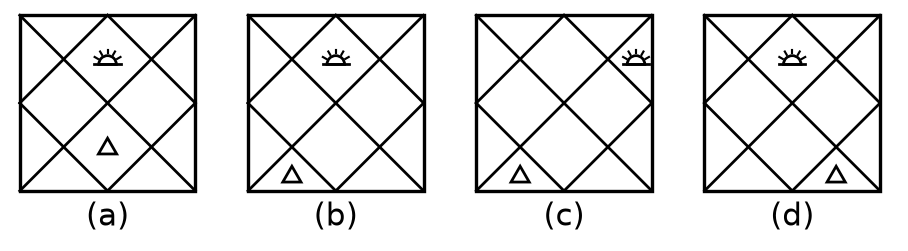
Consider the following figures 1, 2, 3 and 4:
In the figures from 1 to 4 above, two symbols are shown to change their position in a regular direction. Following the same sequence, which one of the following will appear at the fifth stage?
Answer (b) & explanation
Figure (b) is correct. Step 1: follow the sun. It moves round the four middle boxes anticlockwise: top, left, bottom, right. Next it returns to the top box. Step 2: follow the triangle. It moves down the left side one space at a time: top-left corner (upper half), top-left corner (side half), left middle box, bottom-left corner (side half). Next is the lower half of the bottom-left corner. Step 3: the figure with the sun at the top and the triangle in the lower half of the bottom-left corner is (b). So (a), (c) and (d) fail.
Tip: track each moving symbol separately. Write its path in words, find the next step, then pick the answer figure that matches both.
(d) has the sun right but puts the triangle in the wrong (bottom-right) corner.
Answer as per the official UPSC answer key.
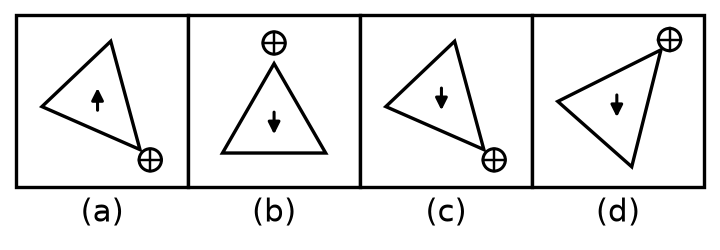
Directions for the following 2 (two) items: In each item, there are two sets of figures; first four figures named Problem figures and next four figures named Answer figures indicated as (a), (b), (c) and (d). The problem figures follow a particular sequence. In accordance with the same, which one of the four answer figures should appear as the fifth figure?
Problem figures:
Answer figures:
Answer (c) & explanation
Figure (c) is correct. Step 1: watch the arrow inside. It flips each time: down, up, down, up. So in the fifth figure it points down. Step 2: watch the triangle's position. It goes 1, 2, 3, then back to 1 in figure 4. So figure 5 repeats figure 2's position (circle at the bottom-right). Step 3: figure 2's position with a downward arrow is (c). So (a), (b) and (d) fail.
Tip: when a pattern returns to its start, it is cycling. Find the cycle length (here 3 positions) and count forward. Combine that with the simpler flipping rule to fix the next figure.
(a) has the right position but the arrow points up.
Answer as per the official UPSC answer key.
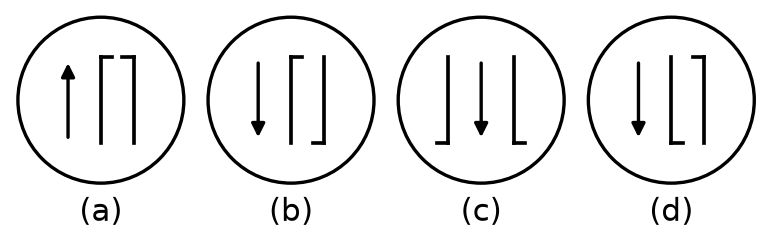
(Same directions as the question above.)
Problem figures:
Answer figures:
Answer (b) & explanation
1. Read the elements as one long chain: hook-left foot, up-arrow, right foot, hook-left top, down-arrow, hook-right top, …
2. Each figure shows three elements in a row, and the next figure slides one step along the chain (the left one drops off, a new one joins on the right).
3. Figure 4 ends with down-arrow and right-top hook. So figure 5 starts with these two, and the chain then restarts with the first element (the left-foot piece).
4. Down-arrow, right-top hook, left-foot piece: (b).
Answer as per the official UPSC answer key.
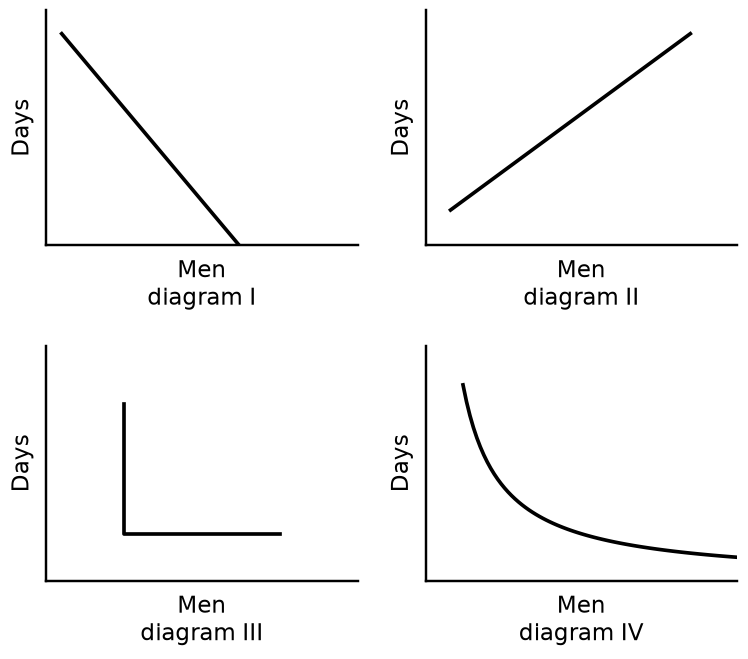
Consider the following diagrams:
x men, working at constant speed, do a certain job in y days. Which one of these diagrams shows the relation between x and y?
Answer (d) & explanation
Diagram IV is correct (d). Step 1: the job is fixed, so men × days = constant. More men finish the job in fewer days: double the men, half the days. This is inverse proportion. Step 2: on a graph, inverse proportion is a smooth curve that falls steeply at first and then more slowly, but never reaches zero. Step 3: diagram I hits zero days, which is impossible. Diagram II rises, which is the wrong direction. Diagram III has a sharp corner, which does not fit a steady rule. Diagram IV shows the smooth falling curve. So (a), (b) and (c) fail.
Tip: xy = constant always gives a smooth curve (a hyperbola) that approaches but never touches the axes.
Answer as per the official UPSC answer key.
Consider the following matrix:
| 3 | 370 | 7 |
|---|---|---|
| 2 | 224 | 6 |
| 1 | 730 | X |
What is the number at 'X' in the above matrix?
Answer (c) & explanation
1. Row 1: 3 × 3 × 3 = 27 and 7 × 7 × 7 = 343. 27 + 343 = 370, the middle number.
2. Row 2: 2 × 2 × 2 = 8 and 6 × 6 × 6 = 216. 8 + 216 = 224. The rule holds.
3. Row 3: 1 + (X × X × X) = 730, so X × X × X = 729 = 9 × 9 × 9.
4. X = 9.
Answer as per the official UPSC answer key.
Four cars are hired at the rate of ₹ 6 per km plus the cost of diesel at ₹ 40 a litre. In this context, consider the details given in the following table:
| Car | Mileage (km/l) | Hours | Total Payment (₹) |
|---|---|---|---|
| A | 8 | 20 | 2120 |
| B | 10 | 25 | 1950 |
| C | 9 | 24 | 2064 |
| D | 11 | 22 | 1812 |
Which car maintained the maximum average speed?
Answer (a) & explanation
1. Find the cost of 1 km for each car: ₹ 6 hire + diesel (₹ 40 ÷ mileage).
2. A: 6 + 40 ÷ 8 = ₹ 11 per km. Distance = 2120 ÷ 11 ≈ 193 km. Speed ≈ 193 ÷ 20 ≈ 9·6 km/h.
3. B: 6 + 4 = ₹ 10 per km. Distance = 195 km. Speed = 195 ÷ 25 = 7·8 km/h.
4. C: 6 + 4·44 = ₹ 10·44 per km. Distance ≈ 198 km. Speed ≈ 198 ÷ 24 ≈ 8·2 km/h.
5. D: 6 + 3·64 = ₹ 9·64 per km. Distance ≈ 188 km. Speed ≈ 188 ÷ 22 ≈ 8·5 km/h.
6. The highest speed is for Car A.
Answer as per the official UPSC answer key.
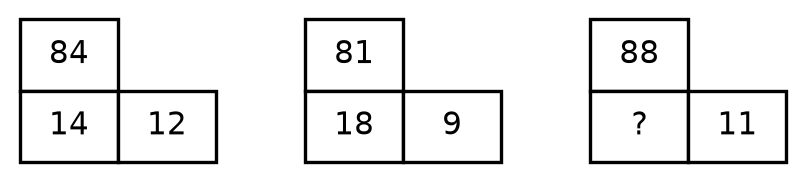
Examine the following three figures in which the numbers follow a specific pattern:
The missing number (?) in the third figure above is
Answer (b) & explanation
16 is correct (b). Step 1: in the first figure, 14 × 12 = 168, and half of 168 is 84, the top number. Step 2: in the second figure, 18 × 9 = 162, and half is 81. The rule holds: top number = (product of the two bottom numbers) ÷ 2. Step 3: in the third figure, ? × 11 must equal 2 × 88 = 176. So ? = 176 ÷ 11 = 16. So (a), (c) and (d) fail.
Tip: in number figures, try simple operations (add, multiply, half, double) on the given numbers and check the rule on every complete figure before using it on the missing one.
Answer as per the official UPSC answer key.
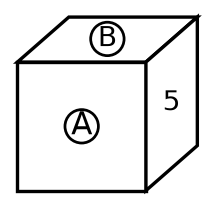
A cube has six numbers marked 1, 2, 3, 4, 5 and 6 on its faces. Three views of the cube are shown below:
What possible number can exist on the two faces marked (A) and (B), respectively on the cube?
Answer (a) & explanation
1. Find what is opposite 6. In the views, 6 sits next to 1, 4 (view 1) and 5, 3 (view 3). The only number never beside 6 is 2, so 2 is opposite 6.
2. Take view 3 (front 5, top 3, right 6) and give the cube a quarter turn so that 5 moves to the right side.
3. The top stays 3. The face that comes to the front is the one that was on the left, which is opposite 6, that is, 2.
4. So A = 2 and B = 3: (a).
Answer as per the official UPSC answer key.
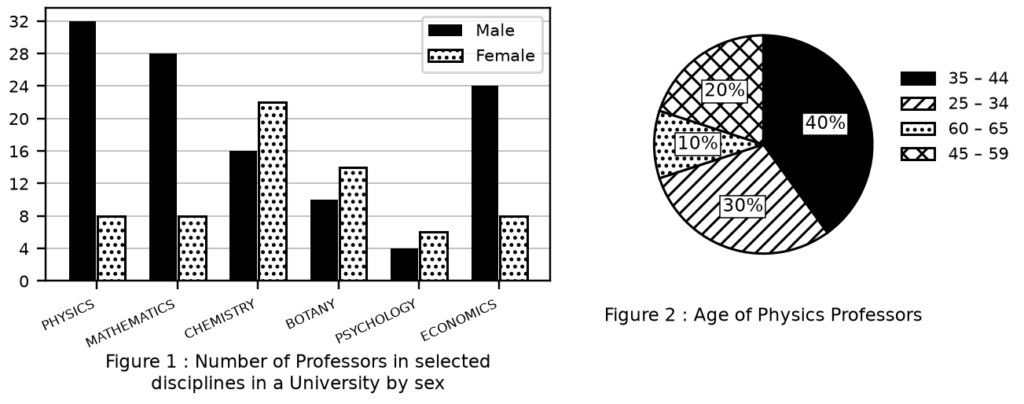
Direction for the following 5 (five) items: Study the two figures given below and answer the five items that follow:
How many Physics professors belong to the age group 35 – 44?
Answer (b) & explanation
16 is correct (b). Step 1: from Figure 1, Physics has 32 men + 8 women = 40 professors. Step 2: Figure 2 shows that 40% of Physics professors are in the age group 35–44. Step 3: 40% of 40 = 0.4 × 40 = 16. So (a), (c) and (d) fail.
Tip: in data questions, first get the total for the group (here all Physics professors), then apply the percentage. Write down the totals for each subject once at the start; the next four questions use the same figures. A quick check: 40% of 40 is the same as 40% × 40 = 16, as 10% is 4.
Answer as per the official UPSC answer key.
(Same figures as the question above.)
Which one of the following disciplines has the highest ratio of males to females?
Answer (a) & explanation
Physics is correct (a). Step 1: work out men ÷ women for each subject. Physics: 32 ÷ 8 = 4. Mathematics: 28 ÷ 8 = 3.5. Step 2: Chemistry: 16 ÷ 22, which is less than 1 (more women than men). Economics: 24 ÷ 8 = 3. Step 3: the highest ratio is Physics (4). So (b), (c) and (d) fail.
Tip: a 'ratio of males to females' is men divided by women. When the number of women is the same in several subjects (8 here), simply compare the number of men. Physics has the most men among those, so it wins quickly.
Answer as per the official UPSC answer key.
(Same figures as the question above.)
What percentage of all Psychology professors are females?
Answer (c) & explanation
60% is correct (c). Step 1: from Figure 1, Psychology has 4 men and 6 women, so 10 professors in all. Step 2: women's share = 6 ÷ 10 = 0.6. Step 3: as a percentage, 0.6 × 100 = 60%. (a) 40% is the share of men, a common trap. (b) and (d) do not match the figures. So (a), (b) and (d) fail.
Tip: percentage = part ÷ whole × 100. Make sure the 'whole' is the total of the group (men + women), not the number of men. When the total is 10, the percentage is simply the part × 10.
Answer as per the official UPSC answer key.
(Same figures as the question above.)
If the number of female Physics professors in the age group 25 – 34 equals 25% of all the Physics professors in that age group, then what is the number of male Physics professors in the age group 25 – 34?
Answer (a) & explanation
9 is correct (a). Step 1: Physics has 40 professors in all, and Figure 2 shows 30% of them are aged 25–34. So 30% of 40 = 12 professors in that age group. Step 2: women are 25% (one quarter) of these 12, so women = 3. Step 3: men = 12 − 3 = 9. (c) 3 is the number of women, a common trap. So (b), (c) and (d) fail.
Tip: in multi-step percentage questions, find the size of the sub-group first, then apply the second percentage to that sub-group, not to the whole. Read the last line of the question again to check whether it asks for men or women.
Answer as per the official UPSC answer key.
(Same figures as the question above.)
If the Psychology professors in the University constitute 2% of all the professors in the University, then what is the number of professors in the University?
Answer (b) & explanation
500 is correct (b). Step 1: from Figure 1, Psychology has 4 men + 6 women = 10 professors. Step 2: these 10 are 2% of all professors. So 1% = 10 ÷ 2 = 5. Step 3: 100% = 5 × 100 = 500. Check: 2% of 500 = 10. So (a), (c) and (d) fail; for example, 2% of 400 is only 8, and 2% of 600 is 12.
Tip: when a part and its percentage are given, find 1% first and then multiply by 100. Or simply divide the part by the percentage as a decimal: 10 ÷ 0.02 = 500. Always check by working backwards from your answer.
Answer as per the official UPSC answer key.
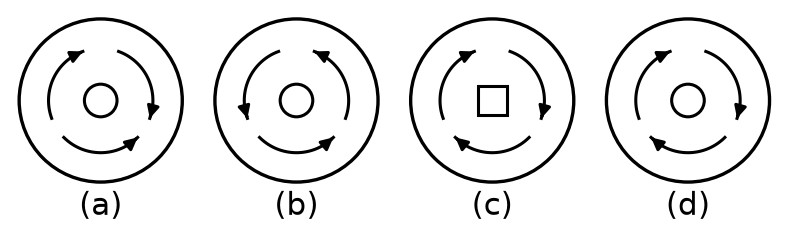
Consider the following figures:
Which one of the following figures would logically come in the 7th position indicated above by a question mark?
Answer (d) & explanation
Figure (d) is correct. Step 1: the centre shape alternates: circle, square, circle, square… Figure 7 is odd-numbered, so it has a circle. Step 2: the three arrows repeat every three figures: figure 4 matches figure 1, figure 5 matches figure 2, figure 6 matches figure 3. So figure 7 matches figure 1, with all three arrows going clockwise. Step 3: a circle with all three arrows clockwise is (d). So (a), (b) and (c) fail.
Tip: when a series has two or more changing parts, find the cycle of each separately (here 2 for the shape and 3 for the arrows). Then use the position number to find where each part is at the required step.
(a) has the circle but its bottom arrow points the other way.
Fell for this one? Most aspirants do. The PYQ Book puts every UPSC trap side by side, so the pattern finally clicks. Try the free sample
Answer as per the official UPSC answer key.
Read the passage
Ecological research over the last quarter of the century has established the deleterious effects of habitat fragmentation due to mining, highways and such other intrusions on forests. When a large block of forests gets fragmented into smaller bits, the edges of all these bits come into contact with human activities resulting in the degradation of the entire forests. Continuity of forested landscapes and corridors gets disrupted affecting several extinction-prone species of wildlife. Habitat fragmentation is therefore considered as the most serious threat to biodiversity conservation. Ad hoc grants of forest lands to mining companies coupled with rampant illegal mining is aggravating this threat.
What is the central focus of this passage ?
Answer (d) & explanation
'Disruption of habitat' is correct (d). Step 1: the passage is about habitat fragmentation: mining and highways break forests into bits, edges are degraded, corridors are cut, and this is 'the most serious threat to biodiversity conservation'. Every sentence returns to the disruption of habitat. Step 2: (a) illegal mining is only one cause, mentioned in the last sentence. (b) extinction of wildlife is one effect. Step 3: (c) conservation of nature is too broad: the passage is about one specific threat, not conservation in general. So (a), (b) and (c) fail.
Tip: the central focus is usually the idea linking the cause and the effect. Options naming only a cause or only an effect are too narrow.
Answer as per the official UPSC answer key.
Read the passage
Ecological research over the last quarter of the century has established the deleterious effects of habitat fragmentation due to mining, highways and such other intrusions on forests. When a large block of forests gets fragmented into smaller bits, the edges of all these bits come into contact with human activities resulting in the degradation of the entire forests. Continuity of forested landscapes and corridors gets disrupted affecting several extinction-prone species of wildlife. Habitat fragmentation is therefore considered as the most serious threat to biodiversity conservation. Ad hoc grants of forest lands to mining companies coupled with rampant illegal mining is aggravating this threat.
What is the purpose of maintaining the continuity of forested landscapes and corridors ?
- 1. Preservation of biodiversity.
- 2. Management of mineral resources.
- 3. Grant of forest lands for human activities.
Select the correct answer using the codes given below :
Answer (a) & explanation
Only 1 is correct (a). Step 1: the passage says when continuity of forests and corridors is broken, it affects 'several extinction-prone species of wildlife'. So keeping forests connected helps preserve biodiversity (1). Step 2: point 2, managing mineral resources, is wrong: mining is described as a threat to forests, not a purpose of corridors. Step 3: point 3, granting forest land for human activities, is wrong: such grants cause fragmentation; they are the problem. So (b), (c) and (d) fail.
Tip: ask whether an option is the goal or the threat. Here mining and land grants are the threats, and saving wildlife is the goal. Wildlife corridors let animals move between forest patches and keep populations healthy.
Answer as per the official UPSC answer key.
In a rare coin collection, there is one gold for every three non-gold coins. 10 more gold coins are added to the collection and the ratio of gold coins to non-gold coins would be 1 : 2. Based on the information, the total number of coins in the collection now becomes
Answer (a) & explanation
90 is correct (a). Step 1: gold to non-gold is 1 : 3, so let gold = k and non-gold = 3k. Non-gold coins do not change. Step 2: after adding 10 gold coins, (k + 10) : 3k = 1 : 2. So 2(k + 10) = 3k, which gives 2k + 20 = 3k, and k = 20. Step 3: now gold = 20 + 10 = 30 and non-gold = 60. Total = 90. Check: 30 : 60 = 1 : 2. So (b), (c) and (d) fail.
Tip: in ratio-change questions, fix the quantity that stays the same (non-gold coins here) and build the equation around it. Always check the new ratio with your final numbers.
the question asks for the total now, after adding 10. 80 is the old total.
Fell for this one? Most aspirants do. The PYQ Book puts every UPSC trap side by side, so the pattern finally clicks. Try the free sample
Answer as per the official UPSC answer key.
A gardener has 1000 plants. He wants to plant them in such a way that the number of rows and the number of columns remains the same. What is the minimum number of plants that he needs more for this purpose?
Answer (b) & explanation
24 is correct (b). Step 1: equal rows and columns means the plants form a square, so the total must be a perfect square. Step 2: 31² = 961, which is less than 1,000, so too small. The next square is 32² = 1,024. Step 3: he needs 1,024 − 1,000 = 24 more plants. (a) 14 gives 1,014, (c) 32 gives 1,032 and (d) 34 gives 1,034, none of which is a perfect square. So (a), (c) and (d) fail.
Tip: learn squares up to 35 or so; they save time in CSAT. 'Minimum number to add' means go up to the next perfect square; 'minimum to remove' means go down to the one before it (here 961, removing 39).
Answer as per the official UPSC answer key.
A sum of Rs. 700 has to be used to give seven cash prizes to the students of a school for their overall academic performance. If each prize is Rs. 20 less than its preceding prize, then what is the least value of the prize?
Answer (b) & explanation
Rs. 40 is correct (b). Step 1: the seven prizes fall in equal steps of Rs. 20, so they form an arithmetic series. In such a series, the middle (4th) prize equals the average: 700 ÷ 7 = Rs. 100. Step 2: the smallest prize is three steps below the middle: 100 − 3 × 20 = Rs. 40. Step 3: check: 160 + 140 + 120 + 100 + 80 + 60 + 40 = 700. So (a), (c) and (d) fail.
Tip: for an odd number of equally spaced values, the middle value is the average. This avoids writing equations. With an even count, the average lies halfway between the two middle values.
Answer as per the official UPSC answer key.
Out of 120 applications for a post, 70 are male and 80 have a driver's license. What is the ratio between the minimum to maximum number of males having driver's license?
Answer (c) & explanation
3 to 7 is correct (c). Step 1: the maximum number of licensed males is when all 70 males have a licence: 70 (there are 80 licences, enough). Step 2: the minimum is when overlap is as small as possible: 70 males + 80 licence-holders = 150, but there are only 120 people, so at least 150 − 120 = 30 must be both. Step 3: minimum : maximum = 30 : 70 = 3 : 7. So (a), (b) and (d) fail.
Tip: for two groups in a fixed total, maximum overlap = the smaller group; minimum overlap = sum of groups − total (or zero if that is negative). Draw two circles inside a box to see it.
Answer as per the official UPSC answer key.
In a garrison, there was food for 1000 soldiers for one month. After 10 days, 1000 more soldiers joined the garrison. How long would the soldiers be able to carry on with the remaining food?
Answer (d) & explanation
10 days is correct (d). Step 1: taking a month as 30 days, food is for 1,000 soldiers × 30 days. After 10 days, food is left for 1,000 soldiers for 20 days. Step 2: now 2,000 soldiers share it. Double the soldiers, half the time: 20 ÷ 2 = 10 days. Step 3: (b) 20 days ignores the new soldiers; (a) and (c) do not fit the numbers. So (a), (b) and (c) fail. Note: the answer assumes a 30-day month, the usual convention in such questions.
Tip: think in 'soldier-days': total food = soldiers × days. What is left (1,000 × 20 = 20,000 soldier-days) divided by the new number of soldiers (2,000) gives the days.
Answer as per the official UPSC answer key.
The tank-full petrol in Arun's motorcycle lasts for 10 days. If he starts using 25% more everyday, how many days will the tank-full petrol last?
Answer (d) & explanation
8 days is correct (d). Step 1: let the tank hold 10 units, so he uses 1 unit a day for 10 days. Step 2: using 25% more means 1.25 units a day. Step 3: days = 10 ÷ 1.25 = 8. So (a), (b) and (c) fail.
Tip: when use per day goes up by 25%, the days do not fall by 25% (which would give 7.5). They fall to 1 ÷ 1.25 = 4/5 of the old figure, a 20% drop. Remember: a 25% rise is undone by a 20% fall. This pair (25% up, 20% down) appears often in CSAT, so it is worth memorising, along with 50% up and 33⅓% down.
Answer as per the official UPSC answer key.
A person can walk a certain distance and drive back in six hours. He can also walk both ways in 10 hours. How much time will he take to drive both ways?
Answer (a) & explanation
2 hours is correct (a). Step 1: walking both ways takes 10 hours, so one walk takes 5 hours. Step 2: walking one way and driving back takes 6 hours, so one drive takes 6 − 5 = 1 hour. Step 3: driving both ways takes 1 + 1 = 2 hours. So (b), (c) and (d) fail.
Tip: break 'both ways' into one-way trips and use the information that has the same activity twice (walking both ways) to find one unit first. Then the mixed trip gives the other unit. A shortcut: drive both ways = 2 × (walk + drive) − (walk both ways) = 12 − 10 = 2 hours.
Answer as per the official UPSC answer key.
Read the passage
Seven-year-old Jim came home from the park without his new bicycle. “An old man and a little boy borrowed it,” he explained. “They are going to bring it back at four o’clock.” His parents were upset that he had given his expensive new bicycle, but were secretly proud of his kindness and faith. Came four o’clock, no bicycle. The parents were anxious. But at 4:30, the door bell rang, and there stood a happy man and a boy, with the bicycle and a box of chocolates. Jim suddenly disappeared into his bedroom, and then came running out. “All right,” he said, after examining the bicycle. “You can have your watch back !”
When Jim came home without his bicycle, his parents
Answer (b) & explanation
'Were worried' is correct (b). Step 1: the passage says his parents 'were upset that he had given his expensive new bicycle', and at four o'clock with no bicycle 'the parents were anxious'. Being upset and anxious means worried. Step 2: (a) is wrong: they were 'secretly proud of his kindness and faith', so not angry with him. Step 3: (c) is wrong: they clearly were concerned. (d) is wrong: nothing says they were eager to meet the man and the boy. So (a), (c) and (d) fail.
Tip: collect all the emotion words in the passage (upset, proud, anxious). The answer should fit them together; 'angry' clashes with 'proud'.
Answer as per the official UPSC answer key.
Read the passage
Seven-year-old Jim came home from the park without his new bicycle. “An old man and a little boy borrowed it,” he explained. “They are going to bring it back at four o’clock.” His parents were upset that he had given his expensive new bicycle, but were secretly proud of his kindness and faith. Came four o’clock, no bicycle. The parents were anxious. But at 4:30, the door bell rang, and there stood a happy man and a boy, with the bicycle and a box of chocolates. Jim suddenly disappeared into his bedroom, and then came running out. “All right,” he said, after examining the bicycle. “You can have your watch back !”
Jim returned the watch to the old man and the little boy because
Answer (c) & explanation
(c) is correct. Step 1: Jim said 'All right… You can have your watch back!' only 'after examining the bicycle'. So the watch was security for the bicycle's safe return, and he gave it back once he was satisfied with the bicycle's condition. Step 2: (a) is wrong: the chocolates were a thank-you gift; Jim's reply depends on checking the bicycle. Step 3: (b) is wrong: his father's pride is not linked to the watch. (d) is wrong: being late by 30 minutes is not a reason to return the watch. So (a), (b) and (d) fail.
Tip: the twist at the end of such stories shows the real reason. Read the last lines carefully: here Jim was not just trusting; he was also careful.
Answer as per the official UPSC answer key.
Read the passage
It was already late when we set out for the next town, which according to the map was about fifteen kilometres away on the other side of the hills. There we felt that we would find a bed for the night. Darkness fell soon after we left the village, but luckily we met no one as we drove swiftly along the narrow winding road that led to the hills. As we climbed higher, it became colder and rain began to fall, making it difficult at times to see the road. I asked John, my companion, to drive more slowly. After we had travelled for about twenty kilometres, there was still no sign of the town which was marked on the map. We were beginning to get worried. Then without warning, the car stopped and we found we had run out of petrol.
The author asked John to drive more slowly because
Answer (c) & explanation
(c) is correct. Step 1: the passage says 'rain began to fall, making it difficult at times to see the road. I asked John… to drive more slowly.' So the reason was poor visibility. Step 2: (a) is wrong: the road leading to the hills was true all along; the request came only when it became hard to see. Step 3: (b) is wrong: John's driving experience is never mentioned. (d) is wrong: the passage does not say they were in wilderness. So (a), (b) and (d) fail.
Tip: when the cause and the action are in back-to-back sentences, the first usually explains the second. Look for what changed just before the action.
Answer as per the official UPSC answer key.
Read the passage
It was already late when we set out for the next town, which according to the map was about fifteen kilometres away on the other side of the hills. There we felt that we would find a bed for the night. Darkness fell soon after we left the village, but luckily we met no one as we drove swiftly along the narrow winding road that led to the hills. As we climbed higher, it became colder and rain began to fall, making it difficult at times to see the road. I asked John, my companion, to drive more slowly. After we had travelled for about twenty kilometres, there was still no sign of the town which was marked on the map. We were beginning to get worried. Then without warning, the car stopped and we found we had run out of petrol.
The travellers set out for the town although it was getting dark because
Answer (d) & explanation
(d) is correct. Step 1: the passage says the town was 'about fifteen kilometres away' and 'there we felt that we would find a bed for the night'. So they set out because the town was near and offered a place to rest: (d). Step 2: (b) is wrong: its first half is right, but nothing calls the town a hill-resort. Step 3: (a) is wrong: being in a hurry is not mentioned. (c) is wrong: they had just left a village, not a wilderness. So (a), (b) and (c) fail.
Tip: when two options share the same first half, the difference lies in the second half. Check that half against the passage.
Answer as per the official UPSC answer key.
Read the passage
It was already late when we set out for the next town, which according to the map was about fifteen kilometres away on the other side of the hills. There we felt that we would find a bed for the night. Darkness fell soon after we left the village, but luckily we met no one as we drove swiftly along the narrow winding road that led to the hills. As we climbed higher, it became colder and rain began to fall, making it difficult at times to see the road. I asked John, my companion, to drive more slowly. After we had travelled for about twenty kilometres, there was still no sign of the town which was marked on the map. We were beginning to get worried. Then without warning, the car stopped and we found we had run out of petrol.
The travellers were worried after twenty kilometres because
Answer (b) & explanation
(b) is correct. Step 1: the map showed the town about fifteen kilometres away, but after about twenty kilometres there was 'still no sign of the town'. So they feared they had lost their way: (b). Step 2: (c) and (d) are wrong: the rain and the cold had started earlier, while they climbed; the worry came after they found no town. Step 3: (a) is wrong: a lonely countryside is not given as the reason. So (a), (c) and (d) fail.
Tip: match the worry to the new fact that appears just before it. Here the new fact is 'no sign of the town' after travelling further than the map said.
Answer as per the official UPSC answer key.
Read the passage
A stout old lady was walking with her basket down the middle of a street in Petrograd to the great confusion of the traffic and no small peril to herself. It was pointed out to her that the pavement was the place for foot-passengers, but she replied, “I’m going to walk where I like. We’ve got liberty now.” It did not occur to the dear lady that if liberty entitled the foot-passenger to walk down the middle of the road it also entitled the taxi-driver to drive on the pavement, and that the end of such liberty would be universal chaos. Everything would be getting in everybody else’s way and nobody would get anywhere. Individual liberty would have become social anarchy.
It was pointed out to the lady that she should walk on the pavement because she was
Answer (a) & explanation
'A pedestrian' is correct (a). Step 1: she was told that 'the pavement was the place for foot-passengers'. A foot-passenger is a pedestrian. So she was asked to use the pavement because she was walking. Step 2: (b) carrying a basket, (c) being stout and (d) being old are descriptions of her, but they are not the reason given. Step 3: the rule applies to every walker, whatever their age, size or luggage. So (b), (c) and (d) fail.
Tip: separate description from reason. Writers add colourful details (stout, old, basket), but the 'because' answer should come from the actual explanation, here the rule about foot-passengers.
Answer as per the official UPSC answer key.
Read the passage
A stout old lady was walking with her basket down the middle of a street in Petrograd to the great confusion of the traffic and no small peril to herself. It was pointed out to her that the pavement was the place for foot-passengers, but she replied, “I’m going to walk where I like. We’ve got liberty now.” It did not occur to the dear lady that if liberty entitled the foot-passenger to walk down the middle of the road it also entitled the taxi-driver to drive on the pavement, and that the end of such liberty would be universal chaos. Everything would be getting in everybody else’s way and nobody would get anywhere. Individual liberty would have become social anarchy.
The lady refused to move from the middle of the street because
Answer (b) & explanation
(b) is correct. Step 1: she replied, 'I'm going to walk where I like. We've got liberty now.' She believed her new freedom entitled her to do whatever she liked: (b). Step 2: (a) is wrong: she was in danger, but the passage does not say she refused because she was not afraid. Step 3: (c) is wrong: she never says she dislikes the pavement. (d) is wrong: it was the traffic that was confused, not her. So (a), (c) and (d) fail.
Tip: when a character's own words explain the action, use them. Note that 'confusion' in the passage belongs to the traffic, a classic word-swap trap.
Answer as per the official UPSC answer key.
Read the passage
A stout old lady was walking with her basket down the middle of a street in Petrograd to the great confusion of the traffic and no small peril to herself. It was pointed out to her that the pavement was the place for foot-passengers, but she replied, “I’m going to walk where I like. We’ve got liberty now.” It did not occur to the dear lady that if liberty entitled the foot-passenger to walk down the middle of the road it also entitled the taxi-driver to drive on the pavement, and that the end of such liberty would be universal chaos. Everything would be getting in everybody else’s way and nobody would get anywhere. Individual liberty would have become social anarchy.
The old lady failed to realise that
Answer (b) & explanation
(b) is correct. Step 1: the author says she did not realise that if liberty let a walker use the middle of the road, it also let a taxi drive on the pavement, ending in 'universal chaos'. So she failed to see that liberty is not unlimited: (b). Step 2: (a) is wrong: she was free; the point is that freedom has limits, not that she lacked it. Step 3: (c) is wrong: her age is irrelevant. (d) is wrong: the author never says roads are for vehicles only. So (a), (c) and (d) fail.
Tip: this is a passage about the limits of rights: one person's freedom ends where it harms others. The answer often has words like 'not unlimited'.
Answer as per the official UPSC answer key.
Directions: each item describes a situation and is followed by four possible responses. Indicate the response you find most appropriate. There is no penalty for wrong answers for these items. You are the head of your office. There are certain houses reserved for the allotment to the office staff and you have been given the discretion to do so. A set of rules for the allotment of the houses has been laid down by you and has been made public. Your personal secretary, who is very close to you, comes to you and pleads that as his father is seriously ill, he should be given priority in allotment of a house. The office secretariat that examined the request as per the rules turns down the request and recommends the procedure to be followed according to the rules. You do not want to annoy your personal secretary. In such circumstances, what would you do ?
Answer (a) & explanation
(a) and (c) are both correct (UPSC accepted both; no negative marking). Step 1: you made the allotment rules public, and your office has applied them and refused the request. Step 2: (c) agreeing with the office note shows you follow your own rules without favouritism. (a) explaining the decision to him personally is also fair and keeps a good working relationship. Step 3: (b) allotting the house to win his loyalty is favouritism. (d) sitting on the file avoids a decision and is poor administration.
Tip: for these interpersonal items, pick the response that is lawful, honest and fixes the real problem through proper channels. Avoid options that give in to pressure, show favouritism or dodge a decision.
Answer as per the official UPSC answer key.
While travelling in a Delhi-registered commercial taxi from Delhi to an adjacent city (another State), your taxi driver informs you that as he has no permit for running the taxi in that city, he will stop at its Transport Office and pay the prescribed fee of ₹ forty for a day. While paying the fee at the counter you find that the transport clerk is taking an extra fifty rupees for which no receipt is being given. You are in a hurry for your meeting. In such circumstances, what would you do ?
Answer (a) & explanation
(a) and (c) are both correct (UPSC accepted both; no negative marking). Step 1: the clerk is taking an extra Rs. 50 with no receipt, which is plain corruption. Step 2: (a) asking him on the spot to return the money, or (c) noting the details and reporting it later when you have time, both act against it. Step 3: (b) saying it is only the driver's business, and (d) treating it as normal, both let corruption continue. A good citizen does not ignore it because he is in a hurry.
Tip: for these interpersonal items, pick the response that is lawful, honest and fixes the real problem through proper channels. Avoid options that give in to pressure, show favouritism or dodge a decision.
Answer as per the official UPSC answer key.
A person lives in a far off village which is almost two hours by bus. The villager’s neighbour is a very powerful landlord who is trying to occupy the poor villager’s land by force. You are the District Magistrate and busy in a meeting called by a local Minister. The villager has come all the way, by bus and on foot, to see you and give an application seeking protection from the powerful landlord. The villager keeps on waiting outside the meeting hall for an hour. You come out of the meeting and are rushing to another meeting. The villager follows you to submit his application. What would you do ?
Answer (c) & explanation
(c) and (d) are both correct (UPSC accepted both; no negative marking). Step 1: a poor villager has travelled far and waited an hour for protection from a powerful landlord. His complaint is urgent. Step 2: (d) quickly taking his application and asking key questions, or (c) handing it to a senior officer to resolve, both ensure action today. Step 3: (a) asking him to wait two more hours is unkind and delays protection. (b) sending him to a junior officer passes the buck and may leave him unheard.
Tip: for these interpersonal items, pick the response that is lawful, honest and fixes the real problem through proper channels. Avoid options that give in to pressure, show favouritism or dodge a decision.
Answer as per the official UPSC answer key.
There is a shortage of sugar in your District where you are the District Magistrate. The Government has ordered that only a maximum amount of 30 kg sugar is to be released for wedding celebrations. A son of your close friend is getting married and your friend requests you to release at least 50 kg sugar for his son’s wedding. He expresses annoyance when you tell him about the Government’s restrictions on this matter. He feels that since you are the District Magistrate you can release any amount. You do not want to spoil your friendship with him. In such circumstances, how would you deal with the situation ?
Answer (b) & explanation
(b) and (c) are both correct (UPSC accepted both; no negative marking). Step 1: there is a sugar shortage and a government limit of 30 kg per wedding. Your friend wants 50 kg. Step 2: (b) refusing and strictly following the rule, and (c) showing him the government order and persuading him to accept 30 kg, both obey the rule; (c) also tries to save the friendship. Step 3: (a) releasing extra sugar misuses your office. (d) sending him to another authority dodges your own responsibility.
Tip: for these interpersonal items, pick the response that is lawful, honest and fixes the real problem through proper channels. Avoid options that give in to pressure, show favouritism or dodge a decision.
Answer as per the official UPSC answer key.
You are in-charge of implementing the Family Planning programme in an area where there is a strong opposition to the present policy. You want to convince the residents of the need for keeping small families. What would be the best way of communicating this message ?
Answer (a) & explanation
(a) and (c) are both correct (UPSC accepted both; no negative marking). Step 1: people strongly oppose the policy, so you must win them over. Step 2: (a) explaining calmly how small families improve health and living standards, and (c) offering incentives to adopt family planning, both give people good reasons to agree. Step 3: (b) late marriage and spacing are related ideas but do not directly address keeping families small. (d) using people who were sterilised may meet the same hostility and does not explain the benefits.
Tip: for these interpersonal items, pick the response that is lawful, honest and fixes the real problem through proper channels. Avoid options that give in to pressure, show favouritism or dodge a decision.
Answer as per the official UPSC answer key.
You are a teacher in a University and are setting a question paper on a particular subject. One of your colleagues, whose son is preparing for the examination on that subject, comes to you and informs you that it is his son’s last chance to pass that examination and whether you could help him by indicating what questions are going to be in the examination. In the past, your colleague had helped you in another matter. Your colleague informs you that his son will suffer from depression if he fails in this examination. In such circumstances, what would you do?
Answer (b) & explanation
(b) and (c) are both correct (UPSC accepted both; no negative marking). Step 1: a colleague asks you to leak exam questions for his son. This would break the trust placed in you as a paper-setter. Step 2: (b) politely refusing, and (c) refusing while explaining that it would violate the university's trust, both protect the exam's fairness. Step 3: (a) helping him because he once helped you is a serious breach of duty. (d) reporting him at once is harsher than a first, emotional request needs; a clear refusal is enough.
Tip: for these interpersonal items, pick the response that is lawful, honest and fixes the real problem through proper channels. Avoid options that give in to pressure, show favouritism or dodge a decision.
Answer as per the official UPSC answer key.
All years by topic
Every question from 2011 to 2026, grouped by syllabus topic, with year-wise trends.