
CSAT 2015: every question, solved
80 questions from the official UPSC Prelims 2015 paper, in paper order. Tap an option; the answer and the reason appear instantly.
Read the passage
Human history abounds in claims and theories confining the right of governing to a few select citizens. Exclusion of the many is justified on the ground that human beings may be rightfully segregated for the good of society and viability of the political process.
Which one of the following statements is least essential as a part of the argument in the above passage ?
Answer (a) & explanation
Statement (a) is least essential to the argument (a). Step 1: find the argument. The passage says some theories give the right to govern to "a few select citizens", excluding the many "for the good of society and viability of the political process". Step 2: check what this argument needs. It needs humans to be unequal, some "super" and some "sub" (b). It needs exclusion to help the system work (c). It needs the idea that people have different capacities to govern (d). Step 3: option (a), man seeking control over external things, plays no part in the argument. So it is least essential.
Tip: for "least essential" questions, ask of each option: "If I remove this, does the argument collapse?" The one whose removal changes nothing is the answer.
Answer as per the official UPSC answer key.
Read the passage
By 2050, the Earth’s population will likely have swelled from seven to nine billion people. To fill all those stomachs — while accounting for shifting consumption patterns, climate change, and a finite amount of arable land and potable water — some experts say food production will have to double. How can we make the numbers add up ? Experts say higher yielding crop varieties and more efficient farming methods will be crucial. So will waste reduction. Experts urge cities to reclaim nutrients and water from waste streams and preserve farmland. Poor countries, they say, can improve crop storage and packaging and rich nations could cut back on resource-intensive foods like meat.
Which one of the following statements best sums up the above passage ?
Answer (d) & explanation
Food security is increasingly a collective challenge (d). Step 1: see who has a role in the passage. Experts propose better crops and methods; cities should reclaim nutrients and water; poor countries should improve storage; rich nations should eat less meat. Everyone must act together, so it is a collective challenge. Step 2: test the others. Option (a) is only the starting fact, not the summary. Option (b) is wrong: the word "only" fails, as rich nations are also involved. Option (c) is wrong: it is defeatist, while the passage offers solutions to "make the numbers add up".
Tip: a good summary covers the whole passage. When a passage lists many actors with many roles, the summary is usually about shared responsibility.
Answer as per the official UPSC answer key.
Read the passage
Many people in India feel that if we cut our defence expenditure on weapon-building, we can create a climate of peace with our neighbours, subsequently reducing the conflict or creating a no-war situation. People who proclaim such ideas are either the victims of war or the propagators of false argument.
With reference to the above passage, which of the following is the most valid assumption ?
Answer (b) & explanation
The author assumes that more weapon spending lessens the chance of conflict (b). Step 1: find the author's view. Many people feel that cutting defence spending will create peace. The author says such people are "victims of war or the propagators of false argument". So he rejects the idea. Step 2: if cutting spending does not bring peace, he must believe that spending deters war. That is option (b). Step 3: test the others. Option (a) is wrong: it says our weapons cause war, the opposite of his view. Option (c) is close but goes beyond the passage, which talks about conflict with neighbours, not state-of-the-art systems. Option (d) is wrong: it restates the view he rejects, not his assumption.
Tip: an assumption is the unstated belief behind the author's conclusion.
Answer as per the official UPSC answer key.
Read the passage
India accounts for nearly a fifth of the world’s child deaths. In terms of numbers, it is the highest in the world — nearly 16 lakhs every year. Of these, more than half die in the first month of life. Officials believe that the reason for this is the absence of steps to propagate basic health practices relating to breast feeding and immunisation. Also the large reproductive population of 2·6 crore remains bereft of care during the critical phases of pregnancy and post-delivery. Added to this is the prevalence of child marriages, anaemia among young women and lack of focus on adolescent sanitation, all of which impact child death rates.
Which is the critical inference that can be made from the above passage ?
Answer (c) & explanation
Joint maternal and child health services can address the problem (c). Step 1: list the causes of child deaths in the passage. Some concern infants: poor practices on breast feeding and immunisation. Others concern mothers: no care during pregnancy and after delivery, child marriages, anaemia among young women. Step 2: since causes lie with both mother and child, universal and integrated maternal and child services fit best. Step 3: test the others. Option (a) is wrong: illiteracy is not mentioned. Option (b) is wrong: the passage does not say the government cannot manage. Option (d) is wrong: it contradicts the passage, which links anaemia among young women to child deaths.
Tip: a "critical inference" often joins several causes into one solution.
Answer as per the official UPSC answer key.
Read the passage
Foods travel more than the people who eat them. Grocery stores and supermarkets are loaded with preserved and processed foods. This, however, often leads to environmental threats, such as pollution generated by long distance food transportation and wastage of food during processing and transportation, destruction of rain forests, reduced nutritional content, increased demand for preservation and packaging. Food insecurity also increases as the produce comes from regions that are not feeding their own population properly.
With reference to the above passage, which of the following statements is/are true ?
- 1. Consuming regionally grown food and not depending on long travelled food is a part of eco-friendly behaviour.
- 2. Food processing industry puts a burden on our natural resources.
Select the correct answer using the code given below :
Answer (c) & explanation
Both statements are true (c). Step 1: test statement 1. The passage says food that travels long distances causes pollution, wastage and destruction of rain forests. So eating locally grown food, which does not travel far, is eco-friendly. Statement 1 holds. Step 2: test statement 2. Processed foods lead to "wastage of food during processing" and "increased demand for preservation and packaging". These use up natural resources. Statement 2 holds. So options (a), (b) and (d) fail.
Tip: a statement can be true even if the passage does not use the same words, as long as it follows directly. Here "regionally grown food" is the opposite of "long distance food", which the passage criticises.
Answer as per the official UPSC answer key.
Read the passage
I must say that, beyond occasionally exposing me to laughter, my constitutional shyness has been of no disadvantage whatever. In fact I can see that, on the contrary, it has been all to my advantage. My hesitancy in speech, which was once an annoyance, is now a pleasure. Its greatest benefit has been that it has taught me the economy of words. I have naturally formed the habit of restraining my thoughts. And I can now give myself the certificate that a thoughtless word hardly ever escapes my tongue or pen. I do not recollect ever having had to regret anything in my speech or writing. I have thus been spared many a mishap and waste of time. Experience has taught me that silence is part of the spiritual discipline of a votary of truth. Proneness to exaggerate, to suppress or modify the truth, wittingly or unwittingly, is a natural weakness of man, and silence is necessary in order to surmount it. A man of few words will rarely be thoughtless in his speech; he will measure every word. We find so many people impatient to talk. There is no chairman of a meeting who is not pestered with notes for permission to speak. And whenever the permission is given the speaker generally exceeds the time-limit, asks for more time, and keeps on talking without permission. All this talking can hardly be said to be of any benefit to the world. It is so much waste of time. My shyness has been in reality my shield and buckler. It has allowed me to grow. It has helped me in my discernment of truth.
The author says that a thoughtless word hardly ever escapes his tongue or pen. Which one of the following is not a valid reason for this ?
Answer (a) & explanation
Wanting to save time is not a valid reason (a). Step 1: find the reasons the author gives. His hesitancy in speech (d) "taught me the economy of words" (b). "I have naturally formed the habit of restraining my thoughts" (c). These lead to: "a thoughtless word hardly ever escapes my tongue or pen." Step 2: test option (a). The author says he has been spared "waste of time", but that is a result of speaking carefully, not the cause. He never says he speaks carefully because he wants to save time. So (a) is not a valid reason.
Tip: separate causes from results. Linking words like "taught me" show a cause; "thus been spared" shows a result. UPSC often offers a result dressed up as a reason.
Answer as per the official UPSC answer key.
Read the passage
I must say that, beyond occasionally exposing me to laughter, my constitutional shyness has been of no disadvantage whatever. In fact I can see that, on the contrary, it has been all to my advantage. My hesitancy in speech, which was once an annoyance, is now a pleasure. Its greatest benefit has been that it has taught me the economy of words. I have naturally formed the habit of restraining my thoughts. And I can now give myself the certificate that a thoughtless word hardly ever escapes my tongue or pen. I do not recollect ever having had to regret anything in my speech or writing. I have thus been spared many a mishap and waste of time. Experience has taught me that silence is part of the spiritual discipline of a votary of truth. Proneness to exaggerate, to suppress or modify the truth, wittingly or unwittingly, is a natural weakness of man, and silence is necessary in order to surmount it. A man of few words will rarely be thoughtless in his speech; he will measure every word. We find so many people impatient to talk. There is no chairman of a meeting who is not pestered with notes for permission to speak. And whenever the permission is given the speaker generally exceeds the time-limit, asks for more time, and keeps on talking without permission. All this talking can hardly be said to be of any benefit to the world. It is so much waste of time. My shyness has been in reality my shield and buckler. It has allowed me to grow. It has helped me in my discernment of truth.
The most appropriate reason for the author to be spared many a mishap is that
Answer (a) & explanation
He was spared mishaps because he rarely uttered a thoughtless word (a). Step 1: find the sentence. "A thoughtless word hardly ever escapes my tongue or pen. I do not recollect ever having had to regret anything... I have thus been spared many a mishap." The word "thus" links the mishaps directly to his careful speech. Step 2: test the others. Option (b) is wrong: patience is not mentioned; in fact he criticises impatient talkers. Option (c) is wrong: silence is part of spiritual discipline, but that is not why he was spared mishaps. Option (d) is wrong: being a votary of truth comes later and explains silence, not the mishaps.
Tip: words like "thus", "hence" and "therefore" point back to the cause in the previous sentence.
Answer as per the official UPSC answer key.
Read the passage
I must say that, beyond occasionally exposing me to laughter, my constitutional shyness has been of no disadvantage whatever. In fact I can see that, on the contrary, it has been all to my advantage. My hesitancy in speech, which was once an annoyance, is now a pleasure. Its greatest benefit has been that it has taught me the economy of words. I have naturally formed the habit of restraining my thoughts. And I can now give myself the certificate that a thoughtless word hardly ever escapes my tongue or pen. I do not recollect ever having had to regret anything in my speech or writing. I have thus been spared many a mishap and waste of time. Experience has taught me that silence is part of the spiritual discipline of a votary of truth. Proneness to exaggerate, to suppress or modify the truth, wittingly or unwittingly, is a natural weakness of man, and silence is necessary in order to surmount it. A man of few words will rarely be thoughtless in his speech; he will measure every word. We find so many people impatient to talk. There is no chairman of a meeting who is not pestered with notes for permission to speak. And whenever the permission is given the speaker generally exceeds the time-limit, asks for more time, and keeps on talking without permission. All this talking can hardly be said to be of any benefit to the world. It is so much waste of time. My shyness has been in reality my shield and buckler. It has allowed me to grow. It has helped me in my discernment of truth.
For the author, silence is necessary in order to surmount
Answer (d) & explanation
Silence is needed to overcome the tendency to overstate (d). Step 1: find the sentence. "Proneness to exaggerate, to suppress or modify the truth... is a natural weakness of man, and silence is necessary in order to surmount it." To exaggerate means to overstate. Step 2: test the others. Options (a) and (b) are wrong: the author values his shyness and hesitancy; he calls them his "shield and buckler", not weaknesses to overcome. Option (c) is wrong: suppression of truth is part of the weakness, but option (c) says suppression of thoughts, which he sees as a good habit ("restraining my thoughts").
Tip: "surmount" means overcome. Look for the weakness the passage says must be overcome, and match the word, here "exaggerate" = "overstate".
Answer as per the official UPSC answer key.
Twelve people form a club. By picking lots, one of them will host a dinner for all once in a month. The number of dinners a particular member has to host in one year is
Answer (d) & explanation
It cannot be predicted (d). Step 1: understand the rule. Every month, a lot is drawn from all twelve members to choose the host. Step 2: lots are drawn fresh each month, so the same person can be picked again, and someone may never be picked. Step 3: in one year (12 draws), a member might host zero, one, two or more dinners. No single number is certain. Option (a) is the trap: "one" would be true only if each member took a turn, which the question does not say. Options (b) and (c) are also only possibilities.
Tip: "picking lots" means chance. With chance, an exact count cannot be fixed; only an average could be estimated (here one a year on average).
12 dinners for 12 people does not mean one each. Lots are drawn at random every time.
Answer as per the official UPSC answer key.
An automobile owner reduced his monthly petrol consumption when the prices went up. The price-consumption relationship is as follows :
| Price (in ₹ per litre) | 40 | 50 | 60 | 75 |
|---|---|---|---|---|
| Monthly consumption (in litres) | 60 | 48 | 40 | 32 |
If the price goes up to ₹ 80 per litre, his expected consumption (in litres) will be
Answer (a) & explanation
He will use 30 litres at ₹80 (a). Step 1: look at the table. Multiply price by consumption in each column: in every case the answer is 2,400. So he always spends ₹2,400 a month on petrol, whatever the price. Step 2: at ₹80 a litre: 2,400 ÷ 80 = 30 litres. Options (b), (c) and (d) would mean a different monthly spend.
Tip: in price-quantity tables, check whether price × quantity stays the same. If it does, the person has a fixed budget, and the new quantity is simply budget ÷ new price. This is quicker than looking for a pattern in the differences.
the drops (12, 8, 8) do not follow a steady pattern. Look for the constant product.
Answer as per the official UPSC answer key.
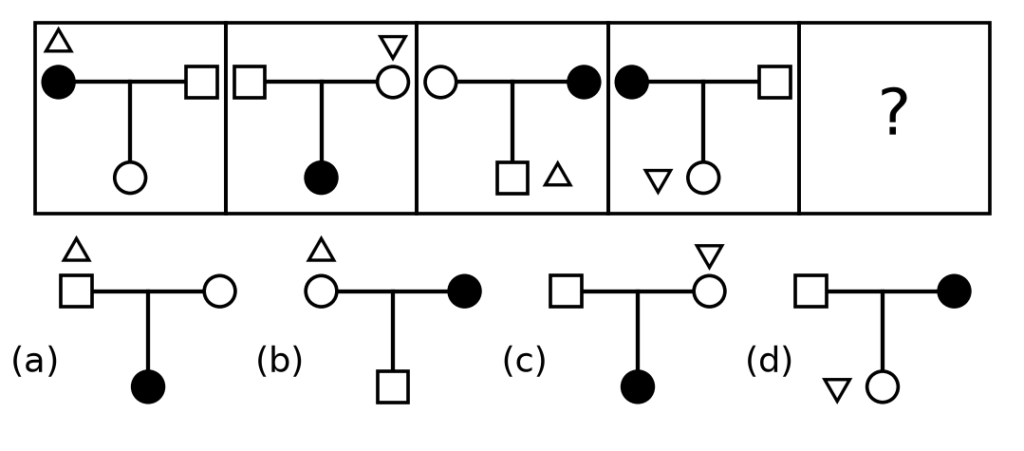
Consider the figures given below :
To fit the question mark, the correct answer is
Answer (a) & explanation
1. Look at the three end symbols (left, right, bottom). Figure 4 has the same ones as Figure 1, so they repeat every 3 figures. Figure 5 must match Figure 2: square left, open circle right, black circle at the bottom.
2. The small triangle moves round the corners: top-left, top-right, bottom-right, bottom-left, so next it is back at top-left. It points up, down, up, down, so next it points up.
3. Only (a) has both: the Figure 2 symbols and an upward triangle at the top-left.
(c) copies Figure 2 completely, but forgets that the triangle has moved on.
Answer as per the official UPSC answer key.
Consider the following matrix :
| 3 | 8 | 10 | 2 | ? | 1 |
|---|---|---|---|---|---|
| 6 | 56 | 90 | 2 | 20 | 0 |
What is the missing number at '?' in the matrix ?
Answer (a) & explanation
The missing number is 5 (a). Step 1: look for a rule linking the top and bottom numbers. 3 → 6: 3 × 2 = 6. 8 → 56: 8 × 7 = 56. 10 → 90: 10 × 9 = 90. 1 → 0: 1 × 0 = 0. So bottom = top × (top − 1). Step 2: for the missing top number, the bottom is 20. Which number times one less than itself gives 20? 5 × 4 = 20. So the answer is 5. Options (b), (c) and (d) do not fit: 0 × (−1) = 0, 7 × 6 = 42, 3 × 2 = 6.
Tip: when numbers look like 6, 56, 90, think of products of neighbours: 2 × 3, 7 × 8, 9 × 10. Spotting such pairs is a common CSAT shortcut.
Answer as per the official UPSC answer key.
What is the missing number 'X' of the series 7, X, 21, 31, 43 ?
Answer (c) & explanation
X is 13 (c). Step 1: look at the gaps between the known numbers: 21 to 31 is 10, and 31 to 43 is 12. The gaps grow by 2 each time. Step 2: work backwards. The gap before 10 is 8, and the one before that is 6. Step 3: X = 7 + 6 = 13. Check: 13 + 8 = 21. Correct. Options (a), (b) and (d) break the pattern.
Tip: in number series, first write the differences between neighbours. If the differences themselves form a simple pattern (here +2 each time), the series is easy to complete in both directions.
Answer as per the official UPSC answer key.
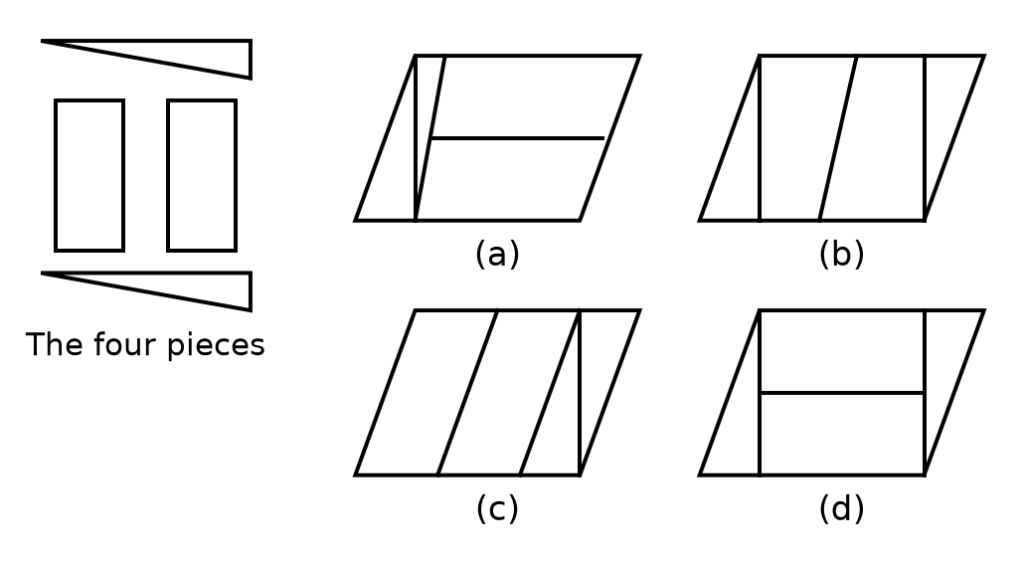
Four cardboard pieces of specific shapes are shown in the following figure :
Which one of the following figures given can be formed by joining these pieces together ?
Answer (d) & explanation
The pieces form figure (d) (d). Step 1: look at the four pieces. There are two equal rectangles and two equal right-angled triangles. Step 2: place the two rectangles flat, one on top of the other, to make a bigger rectangle (a box). Step 3: stand one triangle at each end of this box. The result is a slanted four-sided figure, like a parallelogram. Step 4: that matches figure (d), with two rectangles in the middle and one triangle on each side. Options (a), (b) and (c) need pieces of other shapes or sizes.
Tip: in shape-joining questions, first name and count the pieces, then try the simplest arrangement. Check that the total area of the answer matches the pieces.
Pieces may be turned around; only their shape and size must stay the same.
Answer as per the official UPSC answer key.
In a test, a candidate attempted only 8 questions and secured 50% marks in each of the questions. If he obtained a total of 40% in the test and all questions in the test carried equal marks, how many questions were there in the test?
Answer (b) & explanation
There were 10 questions (b). Step 1: he got half marks on each of 8 questions. That equals the full marks of 4 questions. Step 2: those marks are 40% of the total. So 4 questions = 40% of all questions. Step 3: all questions = 4 ÷ 0.4 = 10. Check: 50% of 8 questions = 4 questions' marks; 4 out of 10 = 40%. Options (a), (c) and (d) fail the check.
Tip: turn percentages into "question-equivalents". Half marks on 8 questions is the same as full marks on 4. This avoids having to know the marks per question.
Answer as per the official UPSC answer key.
A father is nine times as old as his son and the mother is eight times as old as the son. The sum of the father's and the mother's age is 51 years. What is the age of the son?
Answer (d) & explanation
The son is 3 years old (d). Step 1: call the son's age s. The father is 9s and the mother is 8s. Step 2: father + mother = 9s + 8s = 17s = 51. Step 3: s = 51 ÷ 17 = 3. Check: father 27, mother 24, total 51. Options (a), (b) and (c) give totals of 119, 85 and 68.
Tip: when everyone's age is a multiple of one person's age, add the multiples first (9 + 8 = 17) and divide the total by that. You can also test options: 3 × 17 = 51 works straight away.
Answer as per the official UPSC answer key.
Four persons A, B, C and D consisting of two married couples are in a group. Both the women are shorter than their respective husbands. A is the tallest among the four. C is taller than B. D is B's brother. In this context, which one of the following statements is not correct ?
Answer (c) & explanation
Statement (c) is not correct (c). Step 1: A is the tallest. Each wife is shorter than her husband, so the tallest person must be a husband: A is a man. D is B's brother, so D is also a man. Step 2: that leaves B and C as the two wives. Step 3: D cannot marry his own sister B, so the couples are A–B and D–C. Step 4: C is D's wife, so C is shorter than D. Option (c), "C is taller than D", is wrong. Check the others: (a) all are linked by family; (b) B is shorter than C, and C is shorter than her husband D and than A, so B is the shortest; (d) A is B's husband. These are correct.
Tip: in such puzzles, first fix who is a man and who is a woman, then pair the couples.
Answer as per the official UPSC answer key.
Consider the following statements :
- 1. A man had a wife, two sons and two daughters in his family.
- 2. The daughters were invited to a feast and the male members of the family went out to take part in a picnic.
- 3. The man's father did not return from his work.
Which of the following statements is true ?
Answer (b) & explanation
It is likely that the wife was at home (b). Step 1: account for each person. The two daughters went to a feast. The male members (the man and his two sons) went on a picnic. The man's father did not return from work. Step 2: the only person not accounted for is the man's wife. Step 3: but we are not told where she was. She might have stayed home or gone out. So it is only likely, not certain, that she was home. Option (a) is too certain. Option (c) is not supported. Option (d) is wrong: no one else could be home.
Tip: CSAT logic rewards careful wording. If the facts do not settle a point, prefer "likely" or "possibly" over a definite claim.
Answer as per the official UPSC answer key.
Geeta : Naresh has become a better boxer since he started meditation.
Radha : Impossible. A boxer's most important asset is his aggressiveness.
Radha's statement reflects her belief that
Answer (a) & explanation
Radha believes meditation makes a person less aggressive (a). Step 1: read Radha's words. She says it is "impossible" that meditation made Naresh a better boxer, because a boxer's most important asset is aggressiveness. Step 2: for her reasoning to work, she must believe meditation reduces aggression. That is her hidden belief, option (a). Step 3: test the others. Option (b) is wrong: if meditation had no effect, it could not make him worse, and she would not call improvement "impossible" for that reason. Option (c) is wrong: she says nothing about his past. Option (d) is wrong: she does not deny he meditates.
Tip: to find someone's belief, ask: "What must they think for their argument to make sense?"
Answer as per the official UPSC answer key.
All good athletes want to win and all athletes who want to win eat a well-balanced diet; therefore all athletes who do not eat a well-balanced diet are bad athletes.
The best conclusion from this statement is that
Answer (b) & explanation
No athlete who skips a balanced diet is a good athlete (b). Step 1: write the chain. Good athlete → wants to win → eats a balanced diet. Step 2: if something always leads to a result, then no result means no cause. So an athlete who does not eat a balanced diet cannot be a good athlete. That is option (b). Step 3: test the others. Option (a) is not supported: bad athletes might also want to win. Option (c) reverses the chain: eating well does not prove someone is good. Option (d) also reverses it: wanting to win does not prove someone is good.
Tip: "If A then B" also means "if not B then not A". It does not mean "if B then A". Reversing the arrow is the most common logic trap.
Answer as per the official UPSC answer key.
Read the passage
The richer States have a responsibility to cut down carbon emissions and promote clean energy investments. These are the States that got electricity, grew faster and now have high per capita income, making them capable of sharing India’s burden of becoming eco-friendly. Delhi, for example, can help by generating its own clean electricity using solar rooftop panels or even help poor States finance their clean energy projects. It is no secret that State Electricity Boards, which control 95% of the distribution network, are neck-deep in losses. These losses further discourage State utilities from adopting renewable energy as it is more expensive than fossil fuels.
Which among the following is the most logical and rational assumption that can be made from the above passage ?
Answer (a) & explanation
The richer States must lead in renewable energy (a). Step 1: find the main point. The richer States "have a responsibility" to cut emissions and promote clean energy; they grew faster and have high incomes, making them capable of sharing the burden. Delhi can make its own solar power or help finance poor States. So rich States should lead. Step 2: test the others. Option (b) is wrong: "always" is too strong. Option (c) is wrong: renewables are "more expensive", so they would worsen, not improve, Board finances. Option (d) is wrong: disparity is not said to cause emissions.
Tip: an assumption must fit the passage's direction. Option (c) uses passage words but flips the logic.
Answer as per the official UPSC answer key.
Read the passage
Set against a rural backdrop, ‘Stench of kerosene’ is the story of a couple, Guleri and Manak, who have been happily married for several years but do not have a child. Manak’s mother is desperate to have a grandchild to carry on the family name. Hence, she gets Manak remarried in Guleri’s absence. Manak, who acts as a reluctant but passive spectator, is meanwhile, informed by a friend that Guleri, on hearing about her husband’s second marriage, poured kerosene on her clothes and set fire to them. Manak is heartbroken and begins to live as if he were a dead man. When his second wife delivers a son, Manak stares at the child for a long time and blurts out, “Take him away! He stinks of kerosene.”
This is a sensitive issue-based story which tries to sensitise the readers about
Answer (d) & explanation
The story sensitises readers to the influence of a patriarchal mindset (d). Step 1: find what drives the tragedy. Manak's mother is desperate for a grandchild "to carry on the family name", so she gets him remarried. Wanting a male heir to continue the family name is a patriarchal idea. Guleri's death follows. Step 2: test the others. Option (a) is wrong: Manak is a "reluctant but passive spectator", not a man seeking another woman, so infidelity misreads him. Option (b) is too general. Option (c) is wrong: legal safeguards are not discussed.
Tip: for theme questions, find the root cause of events in the story, not just the events themselves. Here the root cause is the pressure for an heir.
Answer as per the official UPSC answer key.
Read the passage
The ultimate aim of government is not to rule or control by fear, nor to demand obedience, but conversely, to free every man from fear, that he may live in all possible security. In other words, to strengthen his natural right to exist and work without injury to himself or others. The object of government is not to change men from rational beings into beasts or puppets. It should enable them to develop their minds and bodies in security, and to employ their reason unshackled.
Which among the following is the most logical and rational inference that can be made from the above passage ?
Answer (a) & explanation
Government's true aim is to secure citizens' social and political freedom (a). Step 1: find the aim. Government should "free every man from fear", let him live "in all possible security", and let him "employ his reason unshackled". This is about freedom with security. Step 2: test the others. Options (b), (c) and (d) all use "absolute". The passage limits freedom: man should act "without injury to himself or others". So absolute security or absolute liberty goes beyond it. Option (c) also misses the role of security.
Tip: watch for extreme words like "absolute", "all" and "only". If the passage puts limits on an idea, an option that removes those limits is wrong.
Answer as per the official UPSC answer key.
Read the passage
Our municipal corporations are understaffed. The issue of skills and competencies of the staff poses an even greater challenge. Urban services delivery and infrastructure are complex to plan and execute. They require a high degree of specialization and professionalism. The current framework within which municipal employees, including senior Management, are recruited does not adequately factor in the technical and managerial competencies required. Cadre and recruitment rules only specify the bare minimum in academic qualifications. There is no mention of managerial or technical competencies, or of relevant work experience. This is the case with most municipal corporations. They also suffer from weak organisation design and structure.
Which among the following is the most logical and rational assumption that can be made from the above passage ?
Answer (b) & explanation
Cities can do better if local bodies have adequate skilled staff (b). Step 1: find the problems. Municipal bodies are "understaffed", and the bigger challenge is staff skills and competencies. Recruitment rules ignore technical and managerial abilities. So the hidden assumption is that more and better-skilled staff would improve city life. Step 2: test the others. Option (a) is wrong: expanding organisations ignores the skills problem. Option (c) is wrong: the cause given is recruitment rules, not missing training institutions. Option (d) is wrong: the demographic dividend is not mentioned.
Tip: an assumption links the problem described to the result the author wants. Here: fix staff and skills, and services improve.
Answer as per the official UPSC answer key.
Read the passage
Flamingos in large flocks in the wild are social and extremely loyal. They perform group mating dances. Parents are very fond of their chicks, gathering them into crèches for protection while both males and females fly off to search for food.
Which among the following is the most logical corollary to the above passage ?
Answer (c) & explanation
Social behaviour in some birds improves survival (c). Step 1: find the example. Flamingos are social and loyal, and parents gather chicks "into crèches for protection" while both go for food. This shows that social behaviour helps chicks survive. Step 2: the passage is about one species, so the safe corollary is about "some species". Step 3: test the others. Option (a) is wrong: "all species" and "complete survival" are too strong. Option (b) is wrong: "only birds" is not supported. Option (d) is wrong: "all species" set up crèches, and crèches are for protection, not to teach loyalty.
Tip: one example can support "some", never "all" or "only".
Answer as per the official UPSC answer key.
Read the passage
Vast numbers of Indian citizens without bank accounts live in rural areas, are financially and functionally illiterate, and have little experience with technology. A research study was conducted in a particular area in which electronic wage payments in Mahatma Gandhi National Rural Employment Guarantee Scheme (MGNREGS) are meant to go directly to the poor. It was observed that recipients often assume that the village leader needs to mediate the process, as was the case under the previous paper-based system. Among households under this research study area who claimed to have at least one bank account, over a third reported still receiving MGNREGS wages in cash directly from a village leader.
What is the most logical, rational and crucial message that is implied in the above passage ?
Answer (d) & explanation
The crucial message is the need for financial literacy (d). Step 1: find the problem. Rural citizens are "financially and functionally illiterate". Even with electronic payments meant to go directly to them, they assume a village leader must mediate, and over a third of account holders still took wages in cash from a leader. The root problem is lack of awareness, so financial literacy is the answer. Step 2: test the others. Option (a) is wrong: limiting MGNREGS to account holders is never suggested. Option (b) is wrong: the passage does not praise the paper-based system. Option (c) reverses the goal: direct payment was meant to remove middlemen.
Tip: the "crucial message" is the fix for the root cause the passage describes.
Answer as per the official UPSC answer key.
Read the passage
Individuals, groups and leaders who promote human development operate under strong institutional, structural and political constraints that affect policy options. But experience suggests broad principles for shaping an appropriate agenda for human development. One important finding from several decades of human development experience is that focusing exclusively on economic growth is problematic. While we have good knowledge about how to advance health and education, the causes of growth are much less certain and growth is often elusive. Further, an unbalanced emphasis on growth is often associated with negative environmental consequences and adverse distributional effects. The experience of China, with its impressive growth record, reflects these broader concerns and underlines the importance of balanced approaches that emphasize investments in the non-income aspects of human development.
With reference to the above passage, consider the following statements :
- 1. In developing countries, a strong institutional framework is the only requirement for human development and policy options.
- 2. Human development and economic growth are not always positively inter-related.
- 3. Focusing only on human development should be the goal of economic growth.
Which of the above statements is/are correct ?
Answer (c) & explanation
Only statement 2 is correct (c). Step 1: test statement 2. The passage says focusing only on growth brings "adverse distributional effects" and environmental harm. So growth does not always improve human development; the two are not always positively linked. 2 holds. Step 2: test statement 1. It says a strong institutional framework is the "only" requirement. The passage never says this; it mentions constraints but not a single requirement. 1 fails. Step 3: test statement 3. It says growth should focus "only" on human development. The passage calls for "balanced approaches", not an exclusive focus. 3 fails. Options (a), (b) and (d) fail.
Tip: "only" in a statement usually clashes with a passage that asks for balance.
Answer as per the official UPSC answer key.
Read the passage
Individuals, groups and leaders who promote human development operate under strong institutional, structural and political constraints that affect policy options. But experience suggests broad principles for shaping an appropriate agenda for human development. One important finding from several decades of human development experience is that focusing exclusively on economic growth is problematic. While we have good knowledge about how to advance health and education, the causes of growth are much less certain and growth is often elusive. Further, an unbalanced emphasis on growth is often associated with negative environmental consequences and adverse distributional effects. The experience of China, with its impressive growth record, reflects these broader concerns and underlines the importance of balanced approaches that emphasize investments in the non-income aspects of human development.
With reference to the above passage, the following assumptions have been made :
- 1. Higher economic growth is essential to ensure reduction in economic disparity.
- 2. Environmental degradation is sometimes a consequence of economic growth.
Which of the above is/are valid assumption/assumptions ?
Answer (b) & explanation
Only assumption 2 is valid (b). Step 1: test assumption 2. The passage says "an unbalanced emphasis on growth is often associated with negative environmental consequences". So environmental harm is sometimes a result of growth. 2 holds. Step 2: test assumption 1. It says higher growth is essential to reduce disparity. The passage says growth often brings "adverse distributional effects", meaning it can widen disparity. So 1 contradicts the passage. Options (a), (c) and (d) fail.
Tip: the word "sometimes" in assumption 2 matches "often" in the passage. Mild words that match the passage's tone are usually safe. A strong claim like "essential" needs strong support.
Answer as per the official UPSC answer key.
If A runs less fast than B, and B runs as fast but not faster than C; then, as compared to A, C runs
Answer (b) & explanation
C runs faster than A (b). Step 1: "A runs less fast than B" means A < B. Step 2: "B runs as fast but not faster than C" means B = C. Step 3: so A < B = C, which means A < C. C is faster than A. Option (a) is the reverse. Option (c) is wrong: A is slower than B, so it cannot equal C. Option (d) is wrong: the data are enough.
Tip: turn wordy comparisons into simple symbols (<, =, >). "As fast but not faster" is a roundabout way of saying "equal". Once written as A < B = C, the answer is immediate.
Answer as per the official UPSC answer key.
Each of A, B, C and D has ₹ 100. A pays ₹ 20 to B, who pays ₹ 10 to C, who gets ₹ 30 from D. In this context, which one of the following statements is not correct?
Answer (c) & explanation
Statement (c) is not correct (c). Step 1: everyone starts with ₹100. Step 2: A pays ₹20 to B: A = 80, B = 120. B pays ₹10 to C: B = 110, C = 110. C gets ₹30 from D: C = 140, D = 70. Step 3: final amounts: A 80, B 110, C 140, D 70. Step 4: test each option. (a) C is the richest, with 140: correct. (b) D is the poorest, with 70: correct. (c) A + D = 80 + 70 = 150, which is more than C's 140. So (c) is not correct. (d) B (110) is richer than D (70): correct.
Tip: in money-transfer questions, track each person in a small table step by step. Then check every option against the final numbers.
the question asks for the statement that is not correct.
Answer as per the official UPSC answer key.
In a town, 45% population read magazine A, 55% read magazine B, 40% read magazine C, 30% read magazines A and B, 15% read magazines B and C, 25% read magazines A and C; and 10% read all the three magazines. What percentage do not read any magazine ?
Answer (c) & explanation
20% read no magazine (c). Step 1: use the three-set rule. Readers of at least one magazine = (A + B + C) − (each pair) + (all three). Step 2: A + B + C = 45 + 55 + 40 = 140. Pairs: 30 + 15 + 25 = 70. All three: 10. Step 3: at least one = 140 − 70 + 10 = 80%. Step 4: none = 100 − 80 = 20%. Options (a), (b) and (d) miss a step.
Tip: why add the "all three" back? When we subtract the pairs, people who read all three are taken away three times, after being added three times, so they vanish. Adding them once restores them. Draw a three-circle Venn diagram if unsure.
Answer as per the official UPSC answer key.
Examine the following statements :
- 1. Lady's finger is tastier than cabbage.
- 2. Cauliflower is tastier than lady's finger.
- 3. Cabbage is not tastier than peas.
The conclusion that can be drawn from these statements is that
Answer (d) & explanation
Cauliflower is tastier than cabbage (d). Step 1: put the clear comparisons in a line. Cauliflower > lady's finger (statement 2). Lady's finger > cabbage (statement 1). So cauliflower > lady's finger > cabbage. That gives option (d) directly. Step 2: what about peas? Statement 3 says cabbage is not tastier than peas, so peas are at least as tasty as cabbage. We do not know where peas stand against lady's finger or cauliflower. Step 3: so (a) and (b) are not certain, and (c) is not certain either, because peas might be equal to cabbage.
Tip: "not tastier than" means "less than or equal to". It does not fix an exact position.
Answer as per the official UPSC answer key.
Shahid and Rohit start from the same point in opposite directions. After each 1 km, Shahid always turns left and Rohit always turns right. Which of the following statements is correct ?
Answer (b) & explanation
They meet after each has travelled 3 km (b). Step 1: Shahid walks north and Rohit south, in opposite directions. After 1 km, Shahid turns left (west) and Rohit turns right (also west, since he faces south). Step 2: after 2 km each, both have gone 1 km west. They are still 2 km apart (one north, one south of the start). So (a), saying 4 km, is wrong. Step 3: now Shahid turns left again, to south, and Rohit turns right again, to north. They walk toward each other and meet after 1 km more. Each has travelled 3 km. Options (c) and (d) are wrong.
Tip: draw the paths on paper. "Left" and "right" depend on which way a person is facing.
Answer as per the official UPSC answer key.
In a 500 metres race, B starts 45 metres ahead of A, but A wins the race while B is still 35 metres behind. What is the ratio of the speeds of A to B assuming that both start at the same time?
Answer (a) & explanation
The speed ratio of A to B is 25 : 21 (a). Step 1: A runs the full 500 m. Step 2: B starts 45 m ahead, so B has only 455 m to run. When A finishes, B is still 35 m short. So B has run 455 − 35 = 420 m. Step 3: in the same time, A ran 500 m and B ran 420 m. Speed ratio = 500 : 420. Divide both by 20: 25 : 21. Options (b), (c) and (d) do not match.
Tip: when two runners run for the same time, their speeds are in the same ratio as their distances. Work out exactly how far each actually ran.
500 : 400 (= 25 : 20) forgets one of the two gaps.
Answer as per the official UPSC answer key.
Two equal glasses of same type are respectively 1/3 and 1/4 full of milk. They are then filled up with water and the contents are mixed in a pot. What is the ratio of milk and water in the pot?
Answer (a) & explanation
The milk to water ratio is 7 : 17 (a). Step 1: pick a glass size that both fractions divide into easily. 12 units works for 1/3 and 1/4. Step 2: glass 1 is 1/3 milk: 4 units of milk, 8 of water. Glass 2 is 1/4 milk: 3 units of milk, 9 of water. Step 3: in the pot: milk = 4 + 3 = 7, water = 8 + 9 = 17. Total 24. Ratio 7 : 17. Options (b), (c) and (d) do not match.
Tip: choose a size equal to the LCM of the denominators (here 3 and 4 give 12). This turns fractions into whole numbers and makes mixing easy.
Answer as per the official UPSC answer key.
Out of 130 students appearing in an examination, 62 failed in English, 52 failed in Mathematics, whereas 24 failed in both English and Mathematics. The number of students who passed finally is
Answer (a) & explanation
40 students passed (a). Step 1: students who failed in at least one subject = English fails + Maths fails − both. That is 62 + 52 − 24 = 90. We subtract 24 because those students were counted in both 62 and 52. Step 2: students who passed both = 130 − 90 = 40. Options (b), (c) and (d) miss the overlap.
Tip: "passed finally" means passed both subjects. In two-set questions, always remove the double count: total in either = A + B − both. A two-circle diagram makes this clear.
Answer as per the official UPSC answer key.
In a group of persons travelling in a bus, 6 persons can speak Tamil, 15 can speak Hindi and 6 can speak Gujarati. In that group none can speak any other language. If 2 persons in the group can speak two languages only and one person can speak all the three languages, then how many persons are there in the group ?
Answer (c) & explanation
There are 23 persons (c). Step 1: add the language counts: 6 + 15 + 6 = 27. But this counts some people more than once. Step 2: each person who speaks two languages is counted twice, so is counted 1 extra time. There are 2 such persons: 2 extra counts. Step 3: the person who speaks all three is counted three times, so 2 extra counts. Step 4: people = 27 − 2 − 2 = 23. Options (a), (b) and (d) remove too much or too little.
Tip: think "extra counts". Someone in two groups adds one extra; someone in three groups adds two extra. Subtract all extras from the raw total.
Answer as per the official UPSC answer key.
In a parking area, the total number of wheels of all the cars (four-wheelers) and scooters/motorbikes (two-wheelers) is 100 more than twice the number of parked vehicles. The number of cars parked is
Answer (c) & explanation
There are 50 cars (c). Step 1: let c be cars and s be two-wheelers. Total wheels = 4c + 2s. Twice the number of vehicles = 2c + 2s. Step 2: the wheels are 100 more: 4c + 2s = 2c + 2s + 100. Step 3: the 2s appears on both sides, so it cancels. That leaves 2c = 100, so c = 50. The number of two-wheelers does not matter. Options (a), (b) and (d) do not fit.
Tip: a simple way to see it: give every vehicle 2 wheels first. That uses "twice the vehicles". The extra 100 wheels are the 2 more wheels each car has. 100 ÷ 2 = 50 cars.
Answer as per the official UPSC answer key.
Read the passage
The mangroves can shed tons of leaves per acre every year; fungi and bacteria break down this leaf litter and consume it, they then are consumed by tiny worms and crustaceans, which in turn feed small fish, which feed larger fish and birds and crocodiles.
Which among the following is the most logical inference of the above statement ?
Answer (c) & explanation
Mangroves play a crucial role in some coastal food chains (c). Step 1: see what the passage shows. Mangrove leaf litter feeds fungi and bacteria, which feed worms and crustaceans, then small fish, larger fish, birds and crocodiles. So mangroves start an important food chain. Step 2: one example supports "some" food chains. Step 3: test the others. Option (a) is wrong: "cannot" have food chains without mangroves is too strong. Option (b) is wrong: "all marine ecosystems" goes far beyond. Option (d) is wrong: "largely determined" is not shown.
Tip: one example supports a modest conclusion. Strong words like "cannot", "all" and "largely" need much more evidence.
Answer as per the official UPSC answer key.
Read the passage
“By liberty I mean the eager maintenance of that atmosphere in which men have the opportunity to be their best selves.”
Which one of the following expresses the view implied in the above statement ?
Answer (d) & explanation
Liberty means keeping conditions for people to grow (d). Step 1: read the definition. Liberty is "the eager maintenance of that atmosphere in which men have the opportunity to be their best selves." An "atmosphere" is a set of conditions, and being one's best self is the growth of personality. That is option (d). Step 2: test the others. Options (a) and (c) give the negative idea of liberty, simply no restraint or doing what one likes. Option (b) is wrong: liberty as only what law permits is not mentioned.
Tip: this is the positive idea of liberty (associated with Harold Laski): freedom to develop, not just freedom from control. Spot key words like "atmosphere" and "opportunity".
Answer as per the official UPSC answer key.
Read the passage
Climate change is already making many people hungry all over the world, by disrupting crop yields and pushing up prices. And it is not just food but nutrients that are becoming scarcer as the climate changes. It is the poorest communities that will suffer the worst effects of climate change, including increased hunger and malnutrition as crop production and livelihoods are threatened. On the other hand, poverty is a driver of climate change, as desperate communities resort to unsustainable use of resources to meet current needs.
Which among the following is the most logical corollary to the above passage ?
Answer (b) & explanation
Poverty and climate impacts reinforce each other, so food systems must change (b). Step 1: find both directions. Climate change makes the poor hungrier by hitting crops and prices. And "poverty is a driver of climate change", as desperate people overuse resources. Each worsens the other: a two-way loop. Step 2: breaking the loop needs a new approach to food systems. Step 3: test the others. Option (a) is wrong: more subsidies address only one side. Option (c) is wrong: it ignores climate. Option (d) is wrong: "immediately" is too strong, and food prices are only part of the story.
Tip: a "corollary" follows naturally from the whole passage. When a passage shows two things causing each other, the answer usually mentions both.
Answer as per the official UPSC answer key.
Read the passage
The Global Financial Stability Report finds that the share of portfolio investments from advanced economies in the total debt and equity investments in emerging economies has doubled in the past decade to 12 percent. The phenomenon has implications for Indian policy makers as foreign portfolio investments in the debt and equity markets have been on the rise. The phenomenon is also flagged as a threat that could compromise global financial stability in a chain reaction, in the event of United States Federal Reserve’s imminent reversal of its “Quantitative Easing” policy.
Which among the following is the most rational and critical inference that can be made from the above passage ?
Answer (d) & explanation
Emerging economies face a risk of shock from advanced economies (d). Step 1: find the warning. Portfolio money from advanced economies into emerging markets has doubled to 12%. This is "flagged as a threat" that could start "a chain reaction" if the US Federal Reserve reverses Quantitative Easing. So emerging economies are at risk of shock. Step 2: test the others. Option (a) is wrong: the passage flags a risk, not that such investment is bad. Option (b) is wrong: it does not say advanced economies undermine stability on purpose. Option (c) is wrong: it never suggests India should stop accepting such investment.
Tip: a passage that flags a risk does not recommend a ban. Choose the option that matches the strength of the passage.
Answer as per the official UPSC answer key.
Read the passage
Open defecation is disastrous when practised in very densely populated areas, where it is impossible to keep away human faeces from crops, wells, food and children’s hands. Groundwater is also contaminated by open defecation. Many ingested germs and worms spread diseases. They prevent the body from absorbing calories and nutrients. Nearly one-half of India’s children remain malnourished. Lakhs of them die from preventable conditions. Diarrhoea leaves Indians’ bodies smaller on average than those of people in some poorer countries where people eat fewer calories. Underweight mothers produce stunted babies prone to sickness who may fail to develop their full cognitive potential. The germs released into environment harm rich and poor alike, even those who use latrines.
Which among the following is the most critical inference that can be made from the above passage ?
Answer (c) & explanation
Open defecation reduces the human capital of India's workforce (c). Step 1: follow the chain. Open defecation spreads germs, which stop the body absorbing nutrients. Children stay malnourished, bodies stay smaller, and underweight mothers have stunted babies who may not reach their full cognitive potential. Weaker, less healthy people mean lower human capital. Step 2: test the others. Option (a) is wrong: the cost of latrines is not discussed. Option (b) is wrong: "most important" problem is too strong. Option (d) is wrong: "all developing countries" is not stated.
Tip: "human capital" means the health, skills and abilities of people. When a passage links a problem to poor health and lower brain development, it is about human capital.
Answer as per the official UPSC answer key.
Read the passage
We generally talk about democracy but when it comes to any particular thing, we prefer a belonging to our caste or community or religion. So long as we have this kind of temptation, our democracy will remain a phoney kind of democracy. We must be in a position to respect a man as a man and to extend opportunities for development to those who deserve them and not to those who happen to belong to our community or race. This fact of favouritism has been responsible for much discontent and ill-will in our country.
Which one of the following statements best sums up the above passage ?
Answer (b) & explanation
True democracy needs equal opportunities for all (b). Step 1: find the main point. The author says we prefer people of our own caste, community or religion. This makes our democracy "phoney". We must "respect a man as a man" and give opportunities to those who deserve them. That is equal opportunity. Step 2: test the others. Option (a) is wrong: diversity is the background, not the message. Option (c) is wrong: "none of us" is too strong. Option (d) is wrong: "never" is too pessimistic; the author suggests a fix.
Tip: when a passage criticises a problem and then says "we must...", the "must" line is usually the summary.
Answer as per the official UPSC answer key.
Read the passage
The existence/establishment of formal financial institutions that offer safe, reliable, and alternative financial instruments is fundamental in mobilising savings. To save, individuals need access to safe and reliable financial institutions, such as banks, and to appropriate financial instruments and reasonable financial incentives. Such access is not always available to all people in developing countries like India and more so, in rural areas. Savings help poor households manage volatility in cash flow, smoothen consumption, and build working capital. Poor households without access to a formal savings mechanism encourage immediate spending temptations.
With reference to the above passage, consider the following statements :
- 1. Indian financial institutions do not offer any financial instruments to rural households to mobilise their savings.
- 2. Poor households tend to spend their earnings/savings due to lack of access to appropriate financial instruments.
Which of the statements given above is/are correct ?
Answer (b) & explanation
Only statement 2 is correct (b). Step 1: test statement 2. The passage says poor households without access to a formal savings mechanism face "immediate spending temptations". So they spend their earnings because they lack suitable instruments. 2 holds. Step 2: test statement 1. The passage says access is "not always available to all people", especially in rural areas. That is different from saying institutions offer no instruments at all. So 1 goes too far. Options (a), (c) and (d) fail.
Tip: "not always available" means some people lack access, not everyone. UPSC often turns a partial problem into a total one to make a wrong statement.
Answer as per the official UPSC answer key.
Read the passage
The existence/establishment of formal financial institutions that offer safe, reliable, and alternative financial instruments is fundamental in mobilising savings. To save, individuals need access to safe and reliable financial institutions, such as banks, and to appropriate financial instruments and reasonable financial incentives. Such access is not always available to all people in developing countries like India and more so, in rural areas. Savings help poor households manage volatility in cash flow, smoothen consumption, and build working capital. Poor households without access to a formal savings mechanism encourage immediate spending temptations.
What is the crucial message conveyed in the passage ?
Answer (d) & explanation
The crucial message is to promote financial inclusion (d). Step 1: find the theme. Savings need access to "safe and reliable financial institutions" and "appropriate financial instruments". Such access is not always available, especially in rural areas, and lack of it pushes the poor to spend. Bringing everyone into formal finance is financial inclusion. Step 2: test the others. Option (a) is wrong: more banks is only one narrow means. Option (b) is wrong: GDP is not discussed. Option (c) is wrong: interest rates are not discussed; incentives are mentioned only in passing.
Tip: the "crucial message" names the big idea that covers the whole passage, not a single tool.
Answer as per the official UPSC answer key.
Read the passage
Governments may have to take steps which would otherwise be an infringement on the Fundamental Rights of individuals, such as acquiring a person’s land against his will, or refusing permission for putting up a building, but the larger public interest for which these are done must be authorized by the people (Parliament). Discretionary powers to the administration can be done away with. It is becoming more and more difficult to keep this power within limits as the government has many number of tasks to perform. Where discretion has to be used, there must be rules and safeguards to prevent misuse of that power. Systems have to be devised which minimise, if not prevent, the abuse of discretionary power. Government work must be conducted within a framework of recognised rules and principles, and decisions should be similar and predictable.
Which among the following is the most logical assumption that can be made from the above passage ?
Answer (b) & explanation
Rules and safeguards should prevail over unchecked discretion (b). Step 1: find the main idea. Where discretion is used, "there must be rules and safeguards to prevent misuse". Government work "must be conducted within a framework of recognised rules and principles", and decisions should be predictable. So rules should rule, not personal discretion. Step 2: test the others. Option (a) is wrong: "always... wide discretionary power" reverses the passage. Option (c) is wrong: it also reverses it, linking democracy to more discretion. Option (d) is wrong because (b) fits.
Tip: this is the idea of the Rule of Law, associated with A.V. Dicey: government by fixed rules, not by the whims of officials.
Answer as per the official UPSC answer key.
A selection is to be made for one post of Principal and two posts of Vice-Principal. Amongst the six candidates called for the interview, only two are eligible for the post of Principal while they all are eligible for the post of Vice-Principal. The number of possible combinations of selectees is
Answer (d) & explanation
The answer is 20, which is none of the given numbers (d). Step 1: choose the Principal. Only 2 candidates are eligible, so 2 ways. Step 2: choose two Vice-Principals from the remaining 5 people (everyone is eligible). Pairs from 5 = 5 × 4 ÷ 2 = 10 ways. We divide by 2 because the two posts are equal and order does not matter. Step 3: total = 2 × 10 = 20. 20 is not among (a), (b) or (c), so the answer is (d).
Tip: once a person is picked for one post, remove them before choosing the next. For choosing 2 from n without order, use n × (n − 1) ÷ 2.
Answer as per the official UPSC answer key.
A student has to opt for 2 subjects out of 5 subjects for a course, namely, Commerce, Economics, Statistics, Mathematics I and Mathematics II. Mathematics II can be offered only if Mathematics I is also opted. The number of different combinations of two subjects which can be opted is
Answer (c) & explanation
There are 7 combinations (c). Step 1: count all possible pairs of 2 subjects from 5. That is 5 × 4 ÷ 2 = 10 pairs. Step 2: remove pairs that break the rule. Maths II can be taken only with Maths I. So pairs with Maths II but not Maths I are not allowed: Maths II with Commerce, with Economics, and with Statistics. That is 3 pairs. Step 3: allowed pairs = 10 − 3 = 7. Options (a), (b) and (d) do not match.
Tip: when there is a restriction, count everything first, then subtract the forbidden cases. This is often faster than counting the allowed cases one by one.
Answer as per the official UPSC answer key.
A person ordered 5 pairs of black socks and some pairs of brown socks. The price of a black pair was thrice that of a brown pair. While preparing the bill, the bill clerk interchanged the number of black and brown pairs by mistake which increased the bill by 100%. What was the number of pairs of brown socks in the original order ?
Answer (d) & explanation
The original order had 25 brown pairs (d). Step 1: let a brown pair cost ₹1, so a black pair costs ₹3. Step 2: test the options. Try 25 brown pairs. Correct bill: 5 black × 3 + 25 brown × 1 = 15 + 25 = ₹40. Step 3: wrong bill, with the numbers swapped: 25 black × 3 + 5 brown × 1 = 75 + 5 = ₹80. Step 4: ₹80 is double ₹40, a 100% increase. This matches. Options (a), (b) and (c) do not double the bill: for example, 10 brown gives ₹25 and ₹35.
Tip: when an algebra setup seems long, test the options. Give prices simple values like 1 and 3 to keep the arithmetic easy.
Answer as per the official UPSC answer key.
The number of persons who read magazine X only is thrice the number of persons who read magazine Y. The number of persons who read magazine Y only is thrice the number of persons who read magazine X. Then, which of the following conclusions can be drawn ?
- 1. The number of persons who read both the magazines is twice the number of persons who read only magazine X.
- 2. The total number of persons who read either one magazine or both the magazines is twice the number of persons who read both the magazines.
Select the correct answer using the code given below :
No official answer (question dropped) & notes
1. Call the readers of only X 'x', only Y 'y', and both 'b'. All Y readers = y + b; all X readers = x + b.
2. The facts say x = 3 × (y + b) and y = 3 × (x + b). So x is bigger than 3y, and y is bigger than 3x.
3. Both cannot be true at the same time for any real counts. The question has no valid answer as worded, which is why UPSC dropped it.
UPSC dropped this question from evaluation, so it has no official answer. It is printed here for practice only.
UPSC dropped this question from evaluation; there is no official answer.
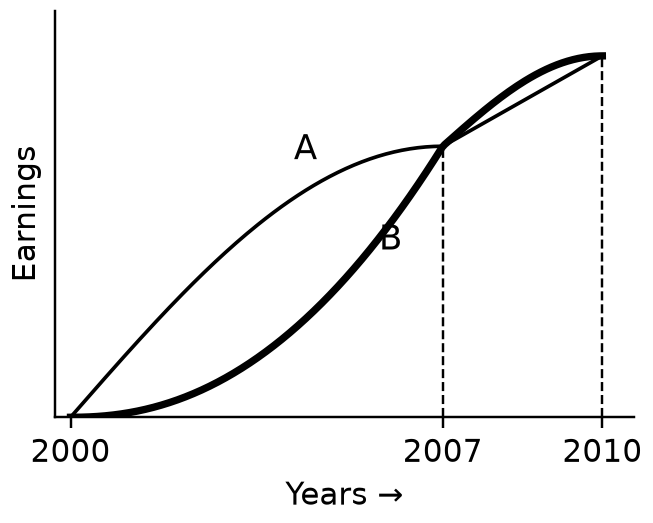
The graph below depicts the earnings of A and B over the period 2000 to 2010 :
From the graph, which one of the following can be concluded ?
Answer (a) & explanation
On average, A earned more than B (a). Step 1: read the graph from 2000 to 2007. A's curve stays well above B's, for seven years. Step 2: the two curves meet at 2007. From 2007 to 2010, B is only a little above A, for three years. Step 3: A's big lead over a long period outweighs B's small lead over a short period. So on average A earned more. Option (b) is wrong for the same reason. Option (c) is wrong: they were equal only at one point. Option (d) is wrong: A earned less only in the last few years.
Tip: "on average" over a period depends on both how big the gap is and how long it lasts. Compare the area between the curves on each side of the crossing point.
Do not judge by the end point alone; look at the whole period.
Answer as per the official UPSC answer key.
Two pipes A and B can independently fill a tank completely in 20 and 30 minutes respectively. If both the pipes are opened simultaneously, how much time will they take to fill the tank completely?
Answer (b) & explanation
Together they fill the tank in 12 minutes (b). Step 1: pick a tank size that both times divide into: the LCM of 20 and 30 is 60 units. Step 2: pipe A fills 60 ÷ 20 = 3 units a minute. Pipe B fills 60 ÷ 30 = 2 units a minute. Step 3: together they fill 3 + 2 = 5 units a minute. Time = 60 ÷ 5 = 12 minutes. Options (a) and (c) do not fit the rates. Option (d), 25 minutes, is the trap: the plain average of 20 and 30.
Tip: when two pipes work together, the time is always less than the faster pipe alone (here less than 20). That alone rules out (d).
25 minutes is the average of 20 and 30. Two pipes must be faster than either alone.
Answer as per the official UPSC answer key.
Each of the six different faces of a cube has been coated with a different colour i.e., V, I, B, G, Y and O. Following information is given :
- 1. Colours Y, O and B are on adjacent faces.
- 2. Colours I, G and Y are on adjacent faces.
- 3. Colours B, G and Y are on adjacent faces.
- 4. Colours O, V and B are on adjacent faces.
Which is the colour of the face opposite to the face coloured with O ?
Answer (c) & explanation
G is opposite O (c). Step 1: a face cannot be adjacent to its opposite face. Find each colour's neighbours. Y appears with O, B, I and G. That is four neighbours, so Y is opposite the only one left, V. Step 2: B appears with Y, O, G and V. So B is opposite the remaining one, I. Step 3: the only pair left is O and G. So G is opposite O. Options (a), (b) and (d) are adjacent to O or already paired.
Tip: on a cube, each face touches four others and is opposite one. List each colour's neighbours; once a colour has four, its opposite is the missing one.
Answer as per the official UPSC answer key.
Consider the following statements followed by two conclusions :
Statements : Some men are great. Some men are wise.
Conclusion I : Men are either great or wise.
Conclusion II : Some men are neither great nor wise.
Which one of the following is correct ?
Answer (d) & explanation
Neither conclusion is valid (d). Step 1: "Some men are great" and "Some men are wise" tell us only about some men. They say nothing about the rest. Step 2: test conclusion I: "Men are either great or wise." This would mean every man is at least one of the two. The statements do not say that. So I fails. Step 3: test conclusion II: "Some men are neither great nor wise." This might be true, but it is not certain: perhaps every man is great or wise. So II fails too. Options (a), (b) and (c) fail.
Tip: "some" gives no information about the others. A valid conclusion must be certain, not just possible.
Answer as per the official UPSC answer key.
Consider the following statements :
- 1. Some claim to have seen UFOs (Unidentified Flying Objects).
- 2. Life on other heavenly bodies is considered to be a possibility.
- 3. Voyage to space is now an established fact.
From the above statements, it may be concluded that
Answer (d) & explanation
Nothing definite can be said about UFOs (d). Step 1: weigh each statement. Statement 1 is only a claim that some people have seen UFOs. Statement 2 says life elsewhere is only a possibility. Statement 3 is about human space travel, not UFOs. Step 2: none of these tells us what UFOs are or where they come from. Step 3: test the others. Option (a), saying UFOs are heavenly bodies, is not supported. Option (b), saying they come from other worlds, is a guess. Option (c), about more intelligent species, is not mentioned at all.
Tip: claims and possibilities cannot be joined into a definite conclusion. When statements are weak, the safe answer is often "nothing definite".
Answer as per the official UPSC answer key.
If ABC × DEED = ABCABC; where A, B, C, D and E are different digits, what are the values of D and E?
Answer (c) & explanation
D = 1 and E = 0 (c). Step 1: look at ABCABC. It is the number ABC written twice. Writing a three-digit number twice is the same as multiplying it by 1001. For example, 123 × 1001 = 123123. Step 2: so ABC × DEED = ABC × 1001, and DEED = 1001. Step 3: reading 1001 as D E E D gives D = 1 and E = 0. Options (a), (b) and (d) give 2002, 0110 and 1221, which do not work.
Tip: remember the 1001 trick: abc × 1001 = abcabc. Similarly, ab × 101 = abab. These patterns come up in CSAT digit puzzles.
Answer as per the official UPSC answer key.
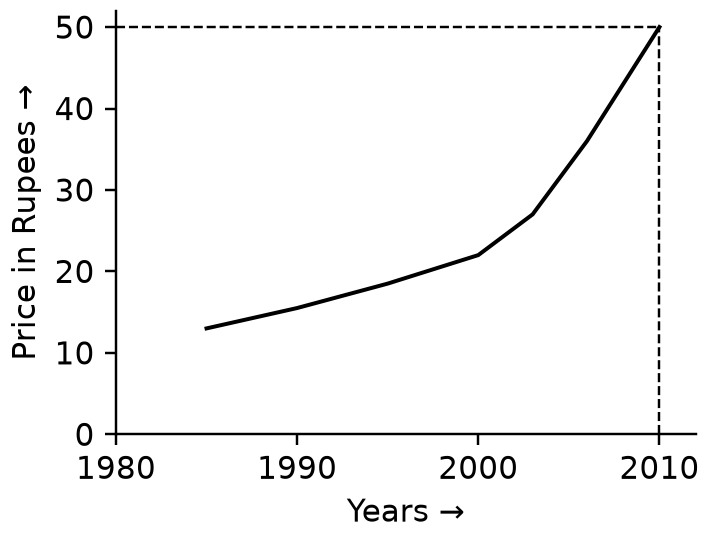
Year-wise variation of the price of a certain commodity is shown in the following graph :
The price of the commodity in the year 1990
Answer (c) & explanation
The 1990 price was somewhere between ₹10 and ₹20 (c). Step 1: look at 1990 on the graph. The line sits a little above the ₹10 mark and below the ₹20 mark. Step 2: the graph's scale is too rough to read an exact value, so options (a) and (b), which say "must have been" a precise number, are not safe. Step 3: the line rises all the time, so the 1990 price is lower than the 1991 price. Option (d) is wrong. Only a range can be stated with certainty.
Tip: when a graph does not give exact grid lines at a point, choose the answer that gives a safe range. "Must have been" an exact number needs exact data.
Answer as per the official UPSC answer key.
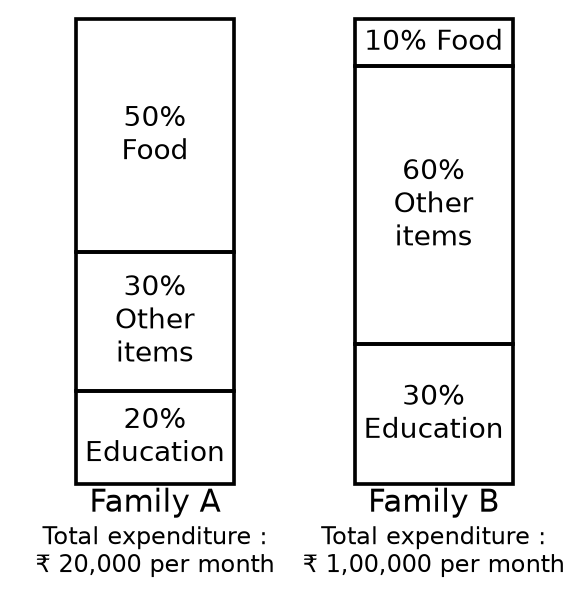
The proportion of expenditure on various items by two families A and B are represented in the following Bar Charts :
From these charts, we can conclude that
Answer (c) & explanation
Both families spent the same on food (c). Step 1: Family A's income is ₹20,000, and food is 50% of spending. 50% of 20,000 = ₹10,000. Step 2: Family B's income is ₹1,00,000, and food is 10%. 10% of 1,00,000 = ₹10,000. Step 3: both spent ₹10,000. Options (a) and (b) are wrong. Option (d) is wrong: the amounts can be compared because the totals are given.
Tip: percentages from different totals cannot be compared directly. Always convert each percentage into an actual amount first. Here a big share of a small income equals a small share of a big income.
A bigger percentage does not mean more money; multiply by the total first.
Answer as per the official UPSC answer key.
Usha runs faster than Kamala, Priti runs slower than Swati, Swati runs slower than Kamala. Who is the slowest runner ?
Answer (b) & explanation
Priti is the slowest (b). Step 1: write each clue as a comparison. Usha > Kamala. Swati > Priti. Kamala > Swati. Step 2: link them into one line, fastest to slowest: Usha > Kamala > Swati > Priti. Step 3: the slowest is Priti. Options (a), (c) and (d) are faster than Priti.
Tip: change "runs slower than" into ">" pointing the right way. "Priti runs slower than Swati" means Swati > Priti. Turning every clue into the same symbol avoids mistakes. Then join the chains at the shared name.
Answer as per the official UPSC answer key.
Read the passage
India has suffered from persistent high inflation. Increase in administered prices, demand and supply imbalances, imported inflation aggravated by rupee depreciation, and speculation — have combined to keep high inflation going. If there is an element common to all of them, it is that many of them are the outcomes of economic reforms. India’s vulnerability to the effects of changes in international prices has increased with trade liberalisation. The effort to reduce subsidies has resulted in a continuous increase in the prices of commodities that are administered.
What is the most logical, rational and crucial message that is implied in the above passage ?
Answer (d) & explanation
Economic reforms can often create high inflation (d). Step 1: find the link. The passage lists causes of inflation: higher administered prices, demand-supply gaps, imported inflation and speculation. It then says, "many of them are the outcomes of economic reforms". Trade liberalisation increased exposure to world prices, and subsidy cuts raised administered prices. So reforms can create inflation. Step 2: test the others. Option (a) is wrong: "completely avoid all" is too extreme. Option (b) is wrong: the passage does not say India is not ready. Option (c) is wrong: poverty is not discussed.
Tip: the "crucial message" is often in the sentence that names a common element, here "If there is an element common to all of them".
Answer as per the official UPSC answer key.
Read the passage
No Right is absolute, exclusive or inviolable. The Right of personal property, similarly, has to be perceived in the larger context of its assumed legitimacy. The Right of personal property should unite the principle of liberty with that of equality, and both with the principle of cooperation.
In the light of the argument in the above passage, which one of the following statements is the most convincing explanation ?
Answer (d) & explanation
Each person's right to property must be balanced with others' (d). Step 1: read the passage. "No Right is absolute." The right to property must unite liberty with equality and with cooperation. So one person's right has to be reconciled with the rights of others. That is option (d). Step 2: test the others. Option (a) is wrong: calling it a natural right backed by scriptures goes beyond the passage, which says no right is absolute. Options (b) and (c) are wrong: they reject the right outright, while the passage accepts it with limits.
Tip: when a passage says "no right is absolute" but does not abolish the right, the answer is about balance, not rejection.
Answer as per the official UPSC answer key.
Read the passage
The conflict between man and State is as old as State history. Although attempts have been made for centuries to bring about a proper adjustment between the competing claims of State and the individual, the solution seems to be still far off. This is primarily because of the dynamic nature of human society where old values and ideas constantly yield place to new ones. It is obvious that if individuals are allowed to have absolute freedom of speech and action, the result would be chaos, ruin and anarchy.
The author’s viewpoint can be best summed up in which of the following statements ?
Answer (a) & explanation
The State-individual conflict remains unresolved (a). Step 1: find the author's view. Attempts have been made "for centuries" to balance State and individual, but "the solution seems to be still far off". That is option (a). Step 2: test the others. Option (b) is wrong: anarchy follows absolute freedom, not democratic traditions. Option (c) is wrong: the passage says old values "constantly yield place to new ones", the opposite of persisting. Option (d) is wrong: the author warns against absolute freedom of speech, not against a constitutional guarantee.
Tip: the author's viewpoint is often stated plainly in a short line, here "still far off". Options that twist a detail, like "absolute freedom" into "democracy", are traps.
Answer as per the official UPSC answer key.
Read the passage
Climate change is a complex policy issue with major implications in terms of finance. All actions to address climate change ultimately involve costs. Funding is vital for countries like India to design and implement adaptation and mitigation plans and projects. Lack of funding is a large impediment to implementing adaptation plans. The scale and magnitude of the financial support required by developing countries to enhance their domestic mitigation and adaptation actions are a matter of intense debate in the multilateral negotiations under the United Nations Framework Convention on Climate Change (UNFCCC). The Convention squarely puts the responsibility for provision of financial support on the developed countries, taking into account their contribution to the stock of greenhouse gases (GHGs) in the atmosphere. Given the magnitude of the task and the funds required, domestic finances are likely to fall short of the current and projected needs of the developing countries. Global funding through the multilateral mechanism of the Convention will enhance their domestic capacity to finance the mitigation efforts.
According to the passage, which of the following is/are a matter of intense debate in the multilateral negotiations under UNFCCC regarding the role of developing countries in climate change ?
- 1. The scale and size of required financial support.
- 2. The crop loss due to climate change in the developing countries.
- 3. To enhance the mitigation and adaptation actions in the developing countries.
Select the correct answer using the code given below :
Answer (c) & explanation
Financial support and mitigation-adaptation actions are debated (c). Step 1: find the line. "The scale and magnitude of the financial support required by developing countries to enhance their domestic mitigation and adaptation actions are a matter of intense debate" under the UNFCCC. That gives items 1 and 3. Step 2: test item 2. Crop loss due to climate change is never mentioned. So options (b) and (d) fail. Option (a) misses item 3.
Tip: break the sentence into parts. The debate is about the size of finance (1), and the purpose, enhancing mitigation and adaptation (3). Then tick each item that is actually in that sentence.
Answer as per the official UPSC answer key.
Read the passage
Climate change is a complex policy issue with major implications in terms of finance. All actions to address climate change ultimately involve costs. Funding is vital for countries like India to design and implement adaptation and mitigation plans and projects. Lack of funding is a large impediment to implementing adaptation plans. The scale and magnitude of the financial support required by developing countries to enhance their domestic mitigation and adaptation actions are a matter of intense debate in the multilateral negotiations under the United Nations Framework Convention on Climate Change (UNFCCC). The Convention squarely puts the responsibility for provision of financial support on the developed countries, taking into account their contribution to the stock of greenhouse gases (GHGs) in the atmosphere. Given the magnitude of the task and the funds required, domestic finances are likely to fall short of the current and projected needs of the developing countries. Global funding through the multilateral mechanism of the Convention will enhance their domestic capacity to finance the mitigation efforts.
In this passage, the Convention puts the responsibility for the provision of financial support on the developed countries because of
- 1. their higher level of per capita incomes.
- 2. their large quantum of GDP.
- 3. their large contribution to the stock of GHGs in the atmosphere.
Select the correct answer using the code given below :
Answer (c) & explanation
Their contribution to greenhouse gases is the reason (c). Step 1: find the line. The Convention puts the responsibility on developed countries, "taking into account their contribution to the stock of greenhouse gases (GHGs) in the atmosphere". That is item 3. Step 2: test items 1 and 2. Higher per capita income and large GDP are not given as reasons, even though they are true facts about rich countries. So options (a), (b) and (d) fail.
Tip: this is the idea of historical responsibility: those who polluted most in the past should pay most now. It underlies the UNFCCC principle of Common But Differentiated Responsibilities (CBDR). In "according to the passage" questions, accept only the reason the text actually gives.
Answer as per the official UPSC answer key.
Read the passage
Climate change is a complex policy issue with major implications in terms of finance. All actions to address climate change ultimately involve costs. Funding is vital for countries like India to design and implement adaptation and mitigation plans and projects. Lack of funding is a large impediment to implementing adaptation plans. The scale and magnitude of the financial support required by developing countries to enhance their domestic mitigation and adaptation actions are a matter of intense debate in the multilateral negotiations under the United Nations Framework Convention on Climate Change (UNFCCC). The Convention squarely puts the responsibility for provision of financial support on the developed countries, taking into account their contribution to the stock of greenhouse gases (GHGs) in the atmosphere. Given the magnitude of the task and the funds required, domestic finances are likely to fall short of the current and projected needs of the developing countries. Global funding through the multilateral mechanism of the Convention will enhance their domestic capacity to finance the mitigation efforts.
With regards to developing countries, it can be inferred from the passage that climate change is likely to have implications on their
- 1. domestic finances.
- 2. capacity for multilateral trade.
Select the correct answer using the code given below :
Answer (a) & explanation
Only domestic finances are affected (a). Step 1: test item 1. The passage says "domestic finances are likely to fall short of the current and projected needs of the developing countries". So climate change affects their domestic finances. 1 holds. Step 2: test item 2. The word "multilateral" appears, but only in "multilateral negotiations" and the "multilateral mechanism" for funding. Trade is never mentioned. So 2 fails. Options (b), (c) and (d) fail.
Tip: UPSC often reuses a passage word ("multilateral") in a new context ("trade") to trap careless readers. Check that the whole phrase, not just one word, is in the passage.
Answer as per the official UPSC answer key.
Read the passage
Climate change is a complex policy issue with major implications in terms of finance. All actions to address climate change ultimately involve costs. Funding is vital for countries like India to design and implement adaptation and mitigation plans and projects. Lack of funding is a large impediment to implementing adaptation plans. The scale and magnitude of the financial support required by developing countries to enhance their domestic mitigation and adaptation actions are a matter of intense debate in the multilateral negotiations under the United Nations Framework Convention on Climate Change (UNFCCC). The Convention squarely puts the responsibility for provision of financial support on the developed countries, taking into account their contribution to the stock of greenhouse gases (GHGs) in the atmosphere. Given the magnitude of the task and the funds required, domestic finances are likely to fall short of the current and projected needs of the developing countries. Global funding through the multilateral mechanism of the Convention will enhance their domestic capacity to finance the mitigation efforts.
Which one of the following is essentially discussed in the passage ?
Answer (a) & explanation
The passage discusses the conflict over support for mitigation (a). Step 1: find the centre of the passage. It explains that climate action costs money, that funding is "a matter of intense debate" between countries, and that the Convention puts the duty on developed countries. So the core topic is the disagreement between developed and developing countries over financial support. Step 2: test the others. Option (b) is wrong: the causes of climate change are not discussed. Option (c) is wrong: political will is not mentioned. Option (d) is wrong: governance problems are not discussed.
Tip: "essentially discussed" means the main topic. Check which option runs through most sentences of the passage.
Answer as per the official UPSC answer key.
Between 6 PM and 7 PM the minute hand of a clock will be ahead of the hour hand by 3 minutes at
Answer (c) & explanation
1. Between 6 and 7, the hour hand starts at the 30-minute mark and moves 1 minute-mark every 12 minutes.
2. Check (c) 6:36. The hour hand has moved 36 ÷ 12 = 3 marks, so it is at 33. The minute hand is at 36. It is 3 ahead. Works.
3. Quick check of the others: at 6:48 the hour hand is at 34 and the minute hand at 48 (14 ahead), so (d) fails; at 6:15 and 6:18 the minute hand is still behind.
4. Answer: 6:36 PM.
Answer as per the official UPSC answer key.
There are 5 tasks and 5 persons. Task-1 cannot be assigned to either person-1 or person-2. Task-2 must be assigned to either person-3 or person-4. Every person is to be assigned one task. In how many ways can the assignment be done ?
Answer (c) & explanation
There are 24 ways (c). Step 1: Task-2 must go to person-3 or person-4: 2 ways. Step 2: Task-1 cannot go to person-1 or person-2, so it must go to one of persons 3, 4 or 5. One of 3 or 4 is already used by Task-2, so 2 choices are left. Step 3: the remaining 3 tasks go to the remaining 3 persons in 3 × 2 × 1 = 6 ways. Step 4: total = 2 × 2 × 6 = 24. Options (a), (b) and (d) miss or double a step.
Tip: in assignment problems, place the most restricted items first (here Task-2, then Task-1). Then the rest can be arranged freely: n items in n! ways.
Answer as per the official UPSC answer key.
The monthly incomes of Peter and Paul are in the ratio of 4 : 3. Their expenses are in the ratio of 3 : 2. If each saves ₹ 6,000 at the end of the month, their monthly incomes respectively are (in ₹)
Answer (a) & explanation
Their incomes are ₹24,000 and ₹18,000 (a). Step 1: every option keeps incomes in the ratio 4 : 3, so test each one using savings of ₹6,000. Step 2: option (a): expenses = 24,000 − 6,000 = 18,000 and 18,000 − 6,000 = 12,000. 18,000 : 12,000 = 3 : 2. This matches. Step 3: check option (b): expenses 22,000 and 15,000, which is not 3 : 2. Options (c) and (d) also fail.
Tip: when all options satisfy one condition, use the other condition to test them. Testing options is often faster than setting up two equations.
Answer as per the official UPSC answer key.
Two cities A and B are 360 km apart. A car goes from A to B with a speed of 40 km/hr and returns to A with a speed of 60 km/hr. What is the average speed of the car ?
Answer (b) & explanation
The average speed is 48 km/hr (b). Step 1: going from A to B at 40 km/hr takes 360 ÷ 40 = 9 hours. Step 2: coming back at 60 km/hr takes 360 ÷ 60 = 6 hours. Step 3: total distance = 360 + 360 = 720 km. Total time = 9 + 6 = 15 hours. Average speed = 720 ÷ 15 = 48 km/hr. Option (c), 50 km/hr, is the trap: the simple average of 40 and 60. Options (a) and (d) are wrong.
Tip: average speed = total distance ÷ total time, never the simple average of speeds. For equal distances, a shortcut is 2 × a × b ÷ (a + b) = 2 × 40 × 60 ÷ 100 = 48.
50 km/hr is the plain average of 40 and 60. The car spends more time at the slower speed, so the true average is lower.
Answer as per the official UPSC answer key.
A, B, C, D, E and F are cousins. No two cousins are of the same age, but all have birthdays on the same day of the same month. The youngest is 17 years old and the oldest E is 22 years old. F is somewhere between B and D in age. A is older than B. C is older than D. A is one year older than C.
Which one of the following is possible ?
Answer (b) & explanation
F can be 18 years old (b). Step 1: all six have the same birthday and different ages from 17 to 22. So their ages are exactly 17, 18, 19, 20, 21, 22. E is the oldest, 22. Step 2: A is one year older than C. A is older than B, and C is older than D. A and C must be high to have people below them, so A = 21 and C = 20. Step 3: B, D and F share 17, 18, 19, with F between B and D. So F = 18. Options (a), (c) and (d) fail: D is 17 or 19, and F cannot be 19 or 20.
Tip: when ages are whole numbers in a fixed range with no repeats, list them all first.
Answer as per the official UPSC answer key.
(Same information as the question above.)
What is the number of logically possible orders of all six cousins in terms of increasing age ?
Answer (b) & explanation
There are 2 possible orders (b). Step 1: from the question above, E = 22, A = 21, C = 20 and F = 18. Step 2: B and D take the ages 17 and 19, with F in between. Either B is 17 and D is 19, or D is 17 and B is 19. Both fit all the clues: A is older than B, and C is older than D, in both cases. Step 3: so there are 2 orders. Options (a), (c) and (d) do not match.
Tip: in follow-up questions, reuse the fixed results and look only at the people who are still free to move. Count their possible arrangements.
Answer as per the official UPSC answer key.
In a society it is customary for friends of the same sex to hug and for friends of opposite sex to shake hands when they meet. A group of friends met in a party and there were 24 handshakes.
Which one among the following numbers indicates the possible number of hugs ?
Answer (c) & explanation
1. Handshakes happen only between a man and a woman, so men × women = 24.
2. Hugs happen between each pair of the same sex. Among 4 people there are 3 + 2 + 1 = 6 pairs; among 6 people there are 5 + 4 + 3 + 2 + 1 = 15 pairs.
3. 4 men and 6 women (4 × 6 = 24 handshakes) give 6 + 15 = 21 hugs.
4. The other splits (3 and 8, 2 and 12, 1 and 24) give 31, 67 and 276 hugs, which are not options.
Answer as per the official UPSC answer key.
Two men, Anil and David, and two women, Shabnam and Rekha are in a sales group. Only two speak Tamil. The other two speak Marathi. Only one man and one woman can drive a car. Shabnam speaks Marathi. Anil speaks Tamil. Both Rekha and David can drive.
Which of the following statements is true ?
Answer (d) & explanation
One of the drivers speaks Tamil (d). Step 1: list what we know. Anil speaks Tamil. Shabnam speaks Marathi. Rekha and David are the drivers (one man, one woman). Step 2: exactly two speak Tamil and two speak Marathi. Anil has one Tamil and Shabnam one Marathi, so Rekha and David share the other Tamil and the other Marathi between them. Step 3: so one driver speaks Tamil and one speaks Marathi. That is option (d). Options (a), (b) and (c) need both drivers to speak the same language, which is impossible here.
Tip: in grouping puzzles, place the known people first. Then the remaining slots must be split among the unknown people.
Answer as per the official UPSC answer key.
In a plane, line X is perpendicular to line Y and parallel to line Z; line U is perpendicular to both lines V and W; line X is perpendicular to line V. Which one of the following statements is correct?
Answer (d) & explanation
Y, V and W are parallel (d). Step 1: use one rule: in a flat plane, two lines perpendicular to the same line are parallel. Step 2: Y and V are both perpendicular to X, so Y ∥ V. Step 3: U is perpendicular to V, and X is also perpendicular to V, so U ∥ X. Step 4: W is perpendicular to U. U is parallel to X, so W is perpendicular to X too. Like Y and V, W is perpendicular to X, so W ∥ V ∥ Y. Options (a), (b) and (c) mix up parallel and perpendicular lines.
Tip: sort the lines into two families: lines like X (here X, Z, U) and lines at right angles to them (Y, V, W). Lines within a family are parallel.
Answer as per the official UPSC answer key.
A cow costs more than 4 goats but less than 5 goats. If a goat costs between ₹ 600 and ₹ 800, which of the following is a most valid conclusion?
Answer (d) & explanation
A cow costs between ₹2,400 and ₹4,000 (d). Step 1: the cow costs more than 4 goats and less than 5 goats. A goat costs between ₹600 and ₹800. Step 2: the lowest a cow could cost is just over 4 × 600 = ₹2,400. Step 3: the highest is just under 5 × 800 = ₹4,000. Step 4: only option (d) covers every possible price. Option (a) is too narrow at the bottom (a cow might cost ₹2,450). Option (b) misses prices up to ₹4,000. Option (c) misses both ends.
Tip: for a "most valid" range, use the smallest values together for the minimum and the largest values together for the maximum.
(a), (b) and (c) can fail. A cow could cost ₹ 2,450 or ₹ 3,900. The most valid conclusion is the one that always holds.
Answer as per the official UPSC answer key.
A society consists of only two types of people — fighters and cowards. Two cowards are always friends. A fighter and a coward are always enemies. Fighters are indifferent to one another. If A and B are enemies, C and D are friends, E and F are indifferent to each other, A and E are not enemies, while B and F are enemies.
Which of the following statements is correct ?
Answer (b) & explanation
A, E and F are fighters (b). Step 1: use the rules. Two cowards are always friends. A fighter and a coward are always enemies. Fighters are indifferent to each other. Step 2: E and F are indifferent, so both are fighters. Step 3: B and F are enemies, and F is a fighter, so B is a coward. Step 4: A and B are enemies, and B is a coward, so A is a fighter. Check: A and E are both fighters, so they are not enemies. That fits. Options (a), (c) and (d) contradict these steps.
Tip: start with the relationship that fixes both people at once. Here "indifferent" can only mean two fighters.
Answer as per the official UPSC answer key.
In a box of marbles, there are three less white marbles than the red ones and five more white marbles than the green ones. If there are a total of 10 white marbles, how many marbles are there in the box?
Answer (b) & explanation
There are 28 marbles (b). Step 1: there are 10 white marbles. Step 2: white is 3 less than red, so red = 10 + 3 = 13. Step 3: white is 5 more than green, so green = 10 − 5 = 5. Step 4: total = 10 + 13 + 5 = 28. Options (a), (c) and (d) come from adding or subtracting the wrong way.
Tip: read "three less white marbles than the red ones" carefully: white = red − 3, so red = white + 3. Write each sentence as a simple equation before working it out to avoid flipping the direction.
Answer as per the official UPSC answer key.
Candidates in a competitive examination consisted of 60% men and 40% women. 70% men and 75% women cleared the qualifying test and entered the final test where 80% men and 70% women were successful. Which of the following statements is correct?
Answer (c) & explanation
More men cleared the exam than women (c). Step 1: take 100 candidates: 60 men and 40 women. Step 2: men who passed both tests: 60 × 0.7 × 0.8 = 33.6. Women: 40 × 0.75 × 0.7 = 21. So more men cleared (c). Step 3: test (a). Men's success rate = 33.6 ÷ 60 = 56%. Women's = 21 ÷ 40 = 52.5%. Women's rate is lower, so (a) is wrong. Step 4: test (b). Overall = 33.6 + 21 = 54.6%, above 50%, so (b) is wrong. Option (d) is wrong too.
Tip: for multi-stage pass rates, multiply the stages. Taking 100 as the total turns every answer into a percentage directly.
Answer as per the official UPSC answer key.
All years by topic
Every question from 2011 to 2026, grouped by syllabus topic, with year-wise trends.