
CSAT 2018: every question, solved
80 questions from the official UPSC Prelims 2018 paper, in paper order. Tap an option; the answer and the reason appear instantly.
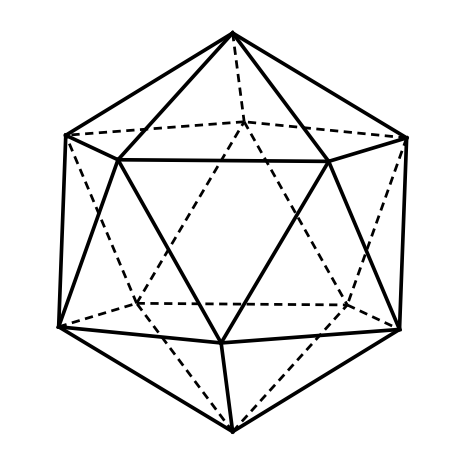
Consider the following three-dimensional figure :
How many triangles does the above figure have?
Answer (b) & explanation
The figure has 20 triangles (b). Step 1: the solid is made only of triangle faces, and 5 triangles meet at every corner. That shape is an icosahedron, a 20-faced solid. Step 2: count in layers. There are 5 triangles around the top point and 5 around the bottom point. Step 3: the middle band has 10 triangles, 5 pointing up and 5 pointing down. Total = 5 + 5 + 10 = 20. Options (a) 18, (c) 22 and (d) 24 come from missing or double-counting a layer.
Tip: count solid figures in layers, top, middle and bottom, so you neither miss nor repeat a face. Euler's rule, faces + corners − edges = 2, gives a quick check: 20 + 12 − 30 = 2.
Count the faces of the solid; the dotted lines are the hidden back edges, not extra lines.
Answer as per the official UPSC answer key.
Consider the following sum :
• + 1• + 2• + •3 + •1 = 21•
In the above sum, • stands for
Answer (d) & explanation
1. Test the options by putting the digit in place of •.
2. Try 8: 8 + 18 + 28 + 83 + 81 = 218. The answer has the form 21• with • = 8. Works.
3. Try 4: 4 + 14 + 24 + 43 + 41 = 126, not 214. Try 5: 5 + 15 + 25 + 53 + 51 = 149. Try 6: 6 + 16 + 26 + 63 + 61 = 172. All fail.
4. • = 8.
Answer as per the official UPSC answer key.
Consider the following pattern of numbers :
| 8 | 10 | 15 | 13 |
|---|---|---|---|
| 6 | 5 | 7 | 4 |
| 4 | 6 | 8 | 8 |
| 6 | 11 | 16 | ? |
What is the number at ? in the above pattern?
Answer (a) & explanation
The missing number is 17 (a). Step 1: look for a rule that works down each column. Here: top − middle + third = bottom. Step 2: check it on the known columns: 8 − 6 + 4 = 6, 10 − 5 + 6 = 11, and 15 − 7 + 8 = 16. The rule works every time. Step 3: apply it to the last column: 13 − 4 + 8 = 17. Options (b) 19, (c) 21 and (d) 23 come from adding all three numbers or using a wrong sign.
Tip: in number grids, try simple operations (add, subtract, multiply) on each column or row. Only accept a rule after it works on every complete column, not just one.
Answer as per the official UPSC answer key.
How many diagonals can be drawn by joining the vertices of an octagon?
Answer (a) & explanation
An octagon has 20 diagonals (a). Step 1: an octagon has 8 corners. From each corner, you can draw a diagonal to every other corner except itself and its 2 neighbours. That is 8 − 3 = 5 diagonals. Step 2: 8 corners × 5 = 40. But each diagonal joins two corners, so it is counted twice. Step 3: 40 ÷ 2 = 20. Option (d), 64, is 8 × 8. Option (c), 28, counts all lines between corners, including the 8 sides. Option (b), 24, does not fit.
Tip: the formula for diagonals of an n-sided shape is n(n − 3) ÷ 2. For a hexagon it is 6 × 3 ÷ 2 = 9.
Answer as per the official UPSC answer key.
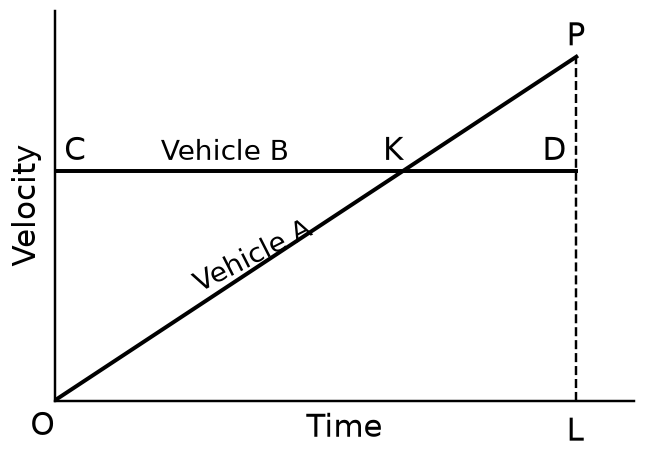
The figure drawn below gives the velocity graphs of two vehicles A and B. The straight line OKP represents the velocity of vehicle A at any instant, whereas the horizontal straight line CKD represents the velocity of vehicle B at any instant. In the figure, D is the point where perpendicular from P meets the horizontal line CKD such that PD = ½ LD :
What is the ratio between the distances covered by vehicles A and B in the time interval OL?
Answer (c) & explanation
The ratio of distances is 3 : 4 (c). Step 1: on a speed–time graph, distance = the area under the line. Let LD = 2 units, so PD = 1 and PL = 3. Let the time OL = 1 unit. Step 2: B moves at a steady speed of 2. Its area is a rectangle: 1 × 2 = 2. Step 3: A starts at 0 and speeds up evenly to 3. Its area is a triangle: ½ × 1 × 3 = 1.5. So A : B = 1.5 : 2 = 3 : 4. Option (d), 1 : 1, wrongly assumes equal distances because the lines cross at K. Options (a) and (b) do not fit.
Tip: on speed graphs, compare areas, not the heights of the lines.
Answer as per the official UPSC answer key.
A train 200 metres long is moving at the rate of 40 kmph. In how many seconds will it cross a man standing near the railway line?
Answer (d) & explanation
The train takes 18 seconds (d). Step 1: change the speed to metres per second. 40 km/hr × 5/18 = 100/9 m/s, about 11.1 m/s. Step 2: to pass a man standing still, the train only needs to cover its own length, 200 m. Step 3: time = 200 ÷ (100/9) = 200 × 9/100 = 18 seconds. Option (a), 12, option (b), 15, and option (c), 16, come from errors in changing the units.
Tip: to change km/hr to m/s, multiply by 5/18. A person or a pole counts as having no length. For a platform or bridge, add its length to the train's length.
Answer as per the official UPSC answer key.
Read the passage
Global population was around 1·6 billion in 1990—today it is around 7·2 billion and growing. Recent estimates on population growth predict a global population of 9·6 billion in 2050 and 10·9 billion in 2100. Unlike Europe and North America, where only three to four per cent of population is engaged in agriculture, around 47 per cent of India’s population is dependent upon agriculture. Even if India continues to do well in the service sector and the manufacturing sector picks up, it is expected that around 2030 when India overtakes China as the world’s most populous country, nearly 42 per cent of India’s population will still be predominantly dependent on agriculture.
Which of the following is the most logical and rational inference that can be made from the above passage?
Answer (a) & explanation
The inference is that the prosperity of agriculture is critically important for India (a). Step 1: the passage says that even in the future, about 42–47% of people will still depend on farming. So the farm sector's health matters a great deal. That is option (a). Step 2: option (b) says the economy greatly depends on agriculture. But the passage is about people who depend on farming, not GDP share. So (b) shifts the subject. Step 3: options (c), population control, and (d), farmers leaving farming, are not suggested.
Tip: farming's share of India's GDP is under a fifth, but it employs a much bigger share of workers. Do not confuse the two.
Answer as per the official UPSC answer key.
Read the passage
Many pathogens that cause foodborne illnesses are unknown. Food contamination can occur at any stage from farm to plate. Since most cases of food poisoning go unreported, the true extent of global foodborne illnesses is unknown. Improvements in international monitoring have led to greater public awareness, yet the rapid globalization of food production increases consumers’ vulnerability by making food harder to regulate and trace. “We have the world on our plates”, says an official of WHO.
Which of the following is the most logical corollary to the above passage?
Answer (a) & explanation
The corollary is that more food options bring more risks (a). Step 1: the passage says "the world on our plates" gives wider choice. But globalisation makes food "harder to regulate and trace", so the risk of illness grows. That is option (a). Step 2: option (b) says processing is the source of all foodborne illness. "All" goes too far. Step 3: options (c), eat only local food, and (d), cut back globalisation, are prescriptions the passage avoids. It describes a risk; it does not ask us to stop.
Tip: a corollary follows directly from what the passage says. Reject options that tell us what to do unless the author does.
Answer as per the official UPSC answer key.
Read the passage
I am a scientist, privileged to be somebody who tries to understand nature using the tools of science. But it is also clear that there are some really important questions that science cannot really answer, such as : Why is there something instead of nothing? Why are we here? In those domains, I have found that faith provides a better path to answers. I find it oddly anachronistic that in today’s culture there seems to be a widespread presumption that scientific and spiritual views are incompatible.
Which of the following is the most logical and rational inference that can be made from the above passage?
Answer (b) & explanation
The inference is that science and faith can complement each other if their domains are understood (b). Step 1: the passage gives science the study of nature and faith the question "Why are we here?". It calls the idea that they cannot fit together "anachronistic", meaning out of date. So they can work side by side. That is option (b). Step 2: option (a) says faith can solve all problems, which goes too far. Step 3: option (c), that some questions cannot be answered by either, contradicts the passage's line that faith gives a better path. Option (d) is not discussed.
Tip: "complementary" means each fills the other's gap. A passage giving each a separate area usually points to this.
Answer as per the official UPSC answer key.
Read the passage
Though I have discarded much of past tradition and custom, and am anxious that India should rid herself of all shackles that bind and contain her and divide her people, and suppress vast numbers of them, and prevent the free development of the body and the spirit; though I seek all this, yet I do not wish to cut myself off from that past completely. I am proud of that great inheritance that has been and is, ours and I am conscious that I too, like all of us, am a link in that unbroken chain which goes back to the dawn of history in the immemorial past of India.
The author wants India to rid herself of certain past bonds because
Answer (d) & explanation
He wants India free of past bonds because they block her physical and spiritual growth (d). Step 1: the passage says these shackles "prevent the free development of the body and the spirit". That is option (d). Step 2: the author also says he is "proud of that great inheritance". So he does value India's past. Step 3: this rules out option (a), that he sees no relevance in the past, option (b), that there is little to be proud of, and option (c), that he has no interest in history.
Tip: this passage is from Jawaharlal Nehru. He admired India's heritage but rejected parts of it that held the country back. Watch for options that contradict the author's stated pride.
Answer as per the official UPSC answer key.

Directions for the following 3 (three) items : The following three items are based on the graph given below which shows imports of three different types of steel over a period of six months of a year. Study the graph and answer the three items that follow.
The figures in the brackets indicate the average cost per ton over six months period.
By how much (measured in thousands of tons) did the import of sheet steel exceed the import of coil steel in the first three months of the year?
Answer (c) & explanation
Sheet steel imports exceeded coil steel by 19 thousand tons (c). Step 1: read the graph for January to March. Sheet steel: 40 + 37 + 36 = 113 thousand tons. Step 2: coil steel for the same months: 30 + 31 + 33 = 94 thousand tons. Step 3: difference = 113 − 94 = 19 thousand tons. Options (a) 11, (b) 15 and (d) 23 come from misreading one month's bar or adding the wrong months.
Tip: in graph questions, write down each value you read before adding. Check the question's period carefully; "first three months" means January, February and March only. Read each point against the gridline to avoid small errors.
Answer as per the official UPSC answer key.
(Same graph as the question above.)
What was the approximate total value (in $) of sheet steel imported over the six months period?
Answer (c) & explanation
The total value is about 55,550 (c). Step 1: add sheet steel imports over all six months: 40 + 37 + 36 + 36 + 34 + 34 = 217 thousand tons. Step 2: the bracket gives the average cost as 256 per ton. Step 3: value = 217 × 256 = 55,552, which is about 55,550 (in thousands of dollars). Option (a), 45,555, option (b), 50,555, and option (d), 65,750, come from wrong totals or a wrong cost figure.
Tip: when an average cost is given for the whole period, multiply it by the total quantity. You do not need month-by-month costs. Round only at the end to keep the answer close.
Use the sheet price ($ 256), not the coil or scrap price.
Answer as per the official UPSC answer key.
(Same graph as the question above.)
What was the approximate ratio of sheet steel and scrap steel imports in the first three months of the year?
Answer (b) & explanation
The ratio is about 1.2 : 1 (b). Step 1: sheet steel for January to March = 113 thousand tons, as found before. Step 2: scrap steel for the same months: 32 + 34 + 32 = 98 thousand tons. Step 3: ratio = 113 ÷ 98 ≈ 1.15, which rounds to 1.2 : 1. Option (a), 1 : 1, ignores the gap. Options (c) 1.4 : 1 and (d) 1.6 : 1 are much too large.
Tip: for "approximate ratio", divide and round to the nearest option. 113 is about 15% more than 98, so the ratio is a little above 1. That alone rules out (c) and (d).
Answer as per the official UPSC answer key.
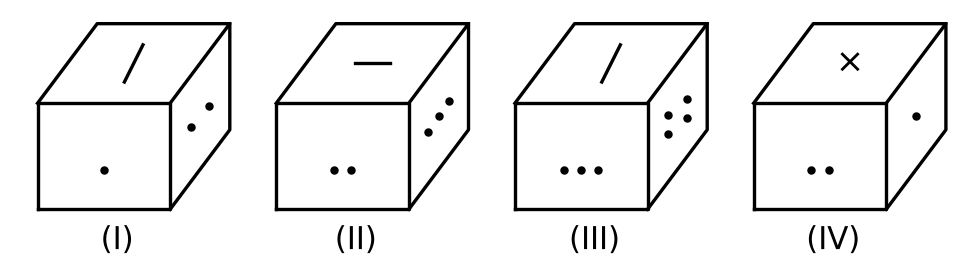
Directions for the following 3 (three) items : Rotated positions of a single solid are shown below. The various faces of the solid are marked with different symbols like dots, cross and line. Answer the three items that follow the given figures.
What is the symbol on the face opposite to that containing a single dot?
Answer (b) & explanation
1. The six faces are: line, cross, one dot, two dots, three dots, four dots.
2. The line is seen next to one, two, three and four dots, so the only face left for its opposite is the cross.
3. The four dot faces go round the middle: 1 is next to 2, 2 is next to 3, 3 is next to 4. So the order round the ring is 1, 2, 3, 4.
4. In a ring of four, the face two steps away is opposite. So one dot is opposite three dots.
Answer as per the official UPSC answer key.
(Same figures as the question above.)
What is the symbol on the face opposite to that containing two dots?
Answer (c) & explanation
Four dots are opposite two dots (c). Step 1: from the given views of the cube, the faces around the middle ring run in the order 1, 2, 3, 4 dots. Step 2: on a ring of four faces, a face is opposite the one two steps away. Step 3: two steps from two dots is four dots. Option (a), single dot, and option (b), three dots, are next to two dots, so they cannot be opposite. Option (d), line, touches all four dot faces, so it is not opposite any of them.
Tip: on a cube, each face touches four others and is opposite one. Faces that appear next to each other in any view can never be opposite.
Answer as per the official UPSC answer key.
(Same figures as the question above.)
What is the symbol on the face opposite to that containing the cross?
Answer (c) & explanation
The line is opposite the cross (c). Step 1: from the views, the line appears next to all four dot faces (one, two, three and four dots). Step 2: a face touching four others must be opposite the sixth face. Step 3: the only face left is the cross. So the cross is opposite the line. Options (a) single dot, (b) two dots and (d) four dots are all neighbours of the line in the ring, and they pair with each other as opposites.
Tip: when one face touches four others, its opposite is the one face it never touches. This shortcut solves many dice and cube questions in one step.
Answer as per the official UPSC answer key.
Read the passage
It is no longer enough for us to talk about providing for universal access to education. Making available schooling facilities is an essential prerequisite, but is insufficient to ensure that all children attend school and participate in the learning process. The school may be there, but children may not attend or they may drop out after a few months. Through school and social mapping, we must address the entire gamut of social, economic, cultural and indeed linguistic and pedagogic issues, factors that prevent children from weaker sections and disadvantaged groups, as also girls, from regularly attending and complementing elementary education. The focus must be on the poorest and most vulnerable since these groups are the most disempowered and at the greatest risk of violation or denial of their right to education.
The right to education goes beyond free and compulsory education to include quality education for all. Quality is an integral part of the right to education. If the education process lacks quality, children are being denied their right. The Right of Children to Free and Compulsory Education Act lays down that the curriculum should provide for learning through activities, exploration and discovery. This places an obligation on us to change our perception of children as passive receivers of knowledge, and to move beyond the convention of using textbooks as the basis of examinations. The teaching-learning process must become stress-free; and a massive programme for curricular reform should be initiated to provide for a child-friendly learning system, that is more relevant and empowering. Teacher accountability systems and processes must ensure that children are learning, and that their right to learn in a child-friendly environment is not violated. Testing and assessment systems must be reexamined and redesigned to ensure that these do not force children to struggle between school and tuition centres, and bypass childhood.
According to the passage, which of the following is/are of paramount importance under the Right to Education?
- 1. Sending of children to school by all parents
- 2. Provision of adequate physical infrastructure in schools
- 3. Curricular reforms for developing child-friendly learning system
Select the correct answer using the code given below.
Answer (c) & explanation
Only statement 3 is of paramount importance (c). Step 1: the passage demands "a massive programme for curricular reform" to build a child-friendly learning system. That is statement 3. Step 2: it calls physical facilities "essential" but "insufficient". So statement 2 matters, but it is not of paramount importance. Step 3: parents sending children to school (1) is not discussed. So options (a), (b) and (d) fail.
Tip: "paramount" means the most important of all. When a passage says something is "essential but insufficient", it is pointing to something else as the key. The Right to Education Act came into force in 2010.
Answer as per the official UPSC answer key.
Read the passage
It is no longer enough for us to talk about providing for universal access to education. Making available schooling facilities is an essential prerequisite, but is insufficient to ensure that all children attend school and participate in the learning process. The school may be there, but children may not attend or they may drop out after a few months. Through school and social mapping, we must address the entire gamut of social, economic, cultural and indeed linguistic and pedagogic issues, factors that prevent children from weaker sections and disadvantaged groups, as also girls, from regularly attending and complementing elementary education. The focus must be on the poorest and most vulnerable since these groups are the most disempowered and at the greatest risk of violation or denial of their right to education.
The right to education goes beyond free and compulsory education to include quality education for all. Quality is an integral part of the right to education. If the education process lacks quality, children are being denied their right. The Right of Children to Free and Compulsory Education Act lays down that the curriculum should provide for learning through activities, exploration and discovery. This places an obligation on us to change our perception of children as passive receivers of knowledge, and to move beyond the convention of using textbooks as the basis of examinations. The teaching-learning process must become stress-free; and a massive programme for curricular reform should be initiated to provide for a child-friendly learning system, that is more relevant and empowering. Teacher accountability systems and processes must ensure that children are learning, and that their right to learn in a child-friendly environment is not violated. Testing and assessment systems must be reexamined and redesigned to ensure that these do not force children to struggle between school and tuition centres, and bypass childhood.
With reference to the above passage, the following assumptions have been made :
- 1. The Right to Education guarantees teachers’ accountability for the learning process of children.
- 2. The Right to Education guarantees 100% enrolment of children in the schools.
- 3. The Right to Education intends to take full advantage of demographic dividend.
Which of the above assumptions is/are valid?
Answer (a) & explanation
Only assumption 1 is valid (a). Step 1: the passage says "teacher accountability systems and processes must ensure that children are learning". So the right to education includes teacher accountability for learning. Assumption 1 holds. Step 2: assumption 2 says RTE guarantees 100% enrolment. But the passage notes children may still "drop out". So 2 fails. Step 3: assumption 3, about the demographic dividend, is never mentioned. So options (b), (c) and (d) fail.
Tip: words like "guarantees" and "100%" are strong. Check whether the passage really promises a full result. Here it admits drop-outs, so "100%" cannot be assumed.
Answer as per the official UPSC answer key.
Read the passage
It is no longer enough for us to talk about providing for universal access to education. Making available schooling facilities is an essential prerequisite, but is insufficient to ensure that all children attend school and participate in the learning process. The school may be there, but children may not attend or they may drop out after a few months. Through school and social mapping, we must address the entire gamut of social, economic, cultural and indeed linguistic and pedagogic issues, factors that prevent children from weaker sections and disadvantaged groups, as also girls, from regularly attending and complementing elementary education. The focus must be on the poorest and most vulnerable since these groups are the most disempowered and at the greatest risk of violation or denial of their right to education.
The right to education goes beyond free and compulsory education to include quality education for all. Quality is an integral part of the right to education. If the education process lacks quality, children are being denied their right. The Right of Children to Free and Compulsory Education Act lays down that the curriculum should provide for learning through activities, exploration and discovery. This places an obligation on us to change our perception of children as passive receivers of knowledge, and to move beyond the convention of using textbooks as the basis of examinations. The teaching-learning process must become stress-free; and a massive programme for curricular reform should be initiated to provide for a child-friendly learning system, that is more relevant and empowering. Teacher accountability systems and processes must ensure that children are learning, and that their right to learn in a child-friendly environment is not violated. Testing and assessment systems must be reexamined and redesigned to ensure that these do not force children to struggle between school and tuition centres, and bypass childhood.
According to the passage, which one of the following is critical in bringing quality in education?
Answer (d) & explanation
Learning through activities and discovery is critical for quality (d). Step 1: in the paragraph on quality, the passage says the curriculum should provide "learning through activities, exploration and discovery". That is option (d). Step 2: option (c), understanding children's social background, appears in the paragraph on access, not quality. Step 3: option (a), regular attendance, and option (b), money for teachers, are not called critical for quality.
Tip: in long passages, notice which paragraph covers which topic. Options often take a correct phrase from the wrong paragraph. Matching the question's key word, here "quality", to the right paragraph avoids that trap.
Answer as per the official UPSC answer key.
Read the passage
It is no longer enough for us to talk about providing for universal access to education. Making available schooling facilities is an essential prerequisite, but is insufficient to ensure that all children attend school and participate in the learning process. The school may be there, but children may not attend or they may drop out after a few months. Through school and social mapping, we must address the entire gamut of social, economic, cultural and indeed linguistic and pedagogic issues, factors that prevent children from weaker sections and disadvantaged groups, as also girls, from regularly attending and complementing elementary education. The focus must be on the poorest and most vulnerable since these groups are the most disempowered and at the greatest risk of violation or denial of their right to education.
The right to education goes beyond free and compulsory education to include quality education for all. Quality is an integral part of the right to education. If the education process lacks quality, children are being denied their right. The Right of Children to Free and Compulsory Education Act lays down that the curriculum should provide for learning through activities, exploration and discovery. This places an obligation on us to change our perception of children as passive receivers of knowledge, and to move beyond the convention of using textbooks as the basis of examinations. The teaching-learning process must become stress-free; and a massive programme for curricular reform should be initiated to provide for a child-friendly learning system, that is more relevant and empowering. Teacher accountability systems and processes must ensure that children are learning, and that their right to learn in a child-friendly environment is not violated. Testing and assessment systems must be reexamined and redesigned to ensure that these do not force children to struggle between school and tuition centres, and bypass childhood.
What is the essential message in this passage?
Answer (c) & explanation
The message is that the Right to Free and Compulsory Education should include quality education for all (c). Step 1: the passage says "the right to education goes beyond free and compulsory education to include quality education for all". That is option (c). Step 2: option (a), that education is now a Fundamental Right, is true (Article 21A), but it is outside knowledge, not the passage's message. Step 3: options (b) and (d) cover only access, getting children into school, and miss quality.
Tip: an answer can be true in real life and still be wrong for a passage question. The essential message must come from the passage itself.
Answer as per the official UPSC answer key.
If LSJXVC is the code for MUMBAI, the code for DELHI is
Answer (a) & explanation
DELHI is written as CCIDD (a). Step 1: compare MUMBAI with LSJXVC letter by letter. M → L is −1, U → S is −2, M → J is −3, B → X is −4 (going back round the alphabet), A → V is −5, and I → C is −6. So each letter moves back one more step than the last. Step 2: apply it to DELHI. D − 1 = C, E − 2 = C, L − 3 = I, H − 4 = D, I − 5 = D. Step 3: the code is CCIDD. Options (b), (c) and (d) break the pattern at one or more letters.
Tip: write the alphabet with numbers (A = 1 … Z = 26) to count shifts quickly. Going back from A wraps round to Z.
Answer as per the official UPSC answer key.
If RAMON is written as 12345 and DINESH as 675849, then HAMAM will be written as
Answer (b) & explanation
HAMAM is written as 92323 (b). Step 1: from RAMON = 12345: R = 1, A = 2, M = 3, O = 4, N = 5. Step 2: from DINESH = 675849: D = 6, I = 7, N = 5, E = 8, S = 4, H = 9. Step 3: HAMAM = H A M A M = 9 2 3 2 3 = 92323. Option (a), 92233, mixes up the order. Options (c) and (d) begin with 93, which would make A = 3.
Tip: in letter-to-digit codes, make a small key of each letter and its digit. Then write the new word one letter at a time. Keep the letter order exactly; that is where most slips happen.
Answer as per the official UPSC answer key.
If X is between –3 and –1, and Y is between –1 and 1, then X2 – Y2 is in between which of the following?
Answer (d) & explanation
X² − Y² lies between 0 and 9 (d). Step 1: squaring removes the minus sign. X is between −3 and −1, so X² is between 1 and 9. Y is between −1 and 1, so Y² is between 0 and 1. Step 2: the largest value of X² − Y² is just under 9 − 0 = 9. Step 3: the smallest is just over 1 − 1 = 0. So the answer is between 0 and 9. Option (a), −9 and 1, and option (b), −9 and −1, forget that squares are never negative. Option (c), 0 and 8, gets the upper end wrong.
Tip: for the range of a difference, make the first part as big as possible and the second as small, then the reverse.
multiplying the end points without squaring first gives the negative options.
Answer as per the official UPSC answer key.
X and Y are natural numbers other than 1, and Y is greater than X. Which of the following represents the largest number?
Answer (a) & explanation
XY is the largest (a). Step 1: try simple numbers that fit: X = 2 and Y = 3. Then XY = 6, X/Y = 0.67, Y/X = 1.5 and (X + Y)/XY = 5/6. Step 2: XY is the biggest here. Step 3: check that it always holds. XY ÷ (Y/X) = X², and since X is more than 1, X² > 1. So XY is always bigger than Y/X. X/Y is less than 1, and (X + Y)/XY is at most 1. So options (b), (c) and (d) are smaller.
Tip: testing small numbers that obey the conditions is a quick way to pick the answer. Then a one-line check confirms it works in general.
Answer as per the official UPSC answer key.
The plan of an office block for six officers A, B, C, D, E and F is as follows : Both B and C occupy offices to the right of the corridor (as one enters the office block) and A occupies on the left of the corridor. E and F occupy offices on opposite sides of the corridor but their offices do not face each other. The offices of C and D face each other. E does not have a corner office. F's office is further down the corridor than A's, but on the same side.
If E sits in his office and faces the corridor, whose office is to his left?
Answer (c) & explanation
1. C faces D, so D is on the left side. F is on A's side, so the left side has A, D, F and the right side B, C, E.
2. E is not in a corner: E is in the middle on the right. F is not opposite E and is beyond A, so F is at the far end and A in the middle. C faces D, so both are at the entrance end and B is at the far end.
3. E faces the corridor from the right side, so his left is towards the entrance: C.
Answer as per the official UPSC answer key.
The plan of an office block for six officers A, B, C, D, E and F is as follows : Both B and C occupy offices to the right of the corridor (as one enters the office block) and A occupies on the left of the corridor. E and F occupy offices on opposite sides of the corridor but their offices do not face each other. The offices of C and D face each other. E does not have a corner office. F's office is further down the corridor than A's, but on the same side.
Who is/are F's immediate neighbour/neighbours?
Answer (a) & explanation
A is F's only neighbour (a). Step 1: B and C are on the right of the corridor, and A is on the left. C and D face each other, so D is on the left. E and F are on opposite sides but do not face each other, and E has no corner office. Step 2: F is further down than A on the same side, so F is on the left. The layout is: left side, from the entrance, D, A, F; right side C, E, B. Step 3: F is at the far end of the left side. Its only neighbour on that side is A. Option (b) adds D, who is not next to F. Options (c) and (d) are across the corridor, not neighbours.
Tip: draw the corridor with two columns of offices before placing anyone.
Answer as per the official UPSC answer key.
Read the passage
‘Desertification’ is a term used to explain a process of decline in the biological productivity of an ecosystem, leading to total loss of productivity. While this phenomenon is often linked to the arid, semi-arid and sub-humid ecosystems, even in the humid tropics, the impact could be most dramatic. Impoverishment of human-impacted terrestrial ecosystems may exhibit itself in a variety of ways : accelerated erosion as in the mountain regions of the country, salinization of land as in the semi-arid and arid ‘green revolution’ areas of the country, e.g., Haryana and western Uttar Pradesh, and site quality decline—a common phenomenon due to general decline in tree cover and monotonous monoculture of rice/wheat across the Indian plains. A major consequence of deforestation is that it relates to adverse alterations in the hydrology and related soil and nutrient losses. The consequences of deforestation invariably arise out of site degradation through erosive losses. Tropical Asia, Africa and South America have the highest levels of erosion. The already high rates for the tropics are increasing at an alarming rate (e.g., through the major river systems—Ganga and Brahmaputra, in the Indian context), due to deforestation and ill-suited land management practices subsequent to forest clearing. In the mountain context, the declining moisture retention of the mountain soils, drying up of the underground springs and smaller rivers in the Himalayan region could be attributed to drastic changes in the forest cover. An indirect consequence is drastic alteration in the upland-lowland interaction, mediated through water. The current concern the tea planter of Assam has is about the damage to tea plantations due to frequent inundation along the flood-plains of Brahmaputra, and the damage to tea plantation and the consequent loss in tea productivity is due to rising level of the river bottom because of siltation and the changing course of the river system. The ultimate consequences of site desertification are soil degradation, alteration in available water and its quality, and the consequent decline in food, fodder and fuel-wood yields essential for the economic well-being of rural communities.
According to the passage, which of the following are the consequences of decline in forest cover?
- 1. Loss of topsoil
- 2. Loss of smaller rivers
- 3. Adverse effect on agricultural production
- 4. Declining of groundwater
Select the correct answer using the code given below.
Answer (d) & explanation
All four are consequences of falling forest cover (d). Step 1: the passage lists erosive soil losses, which means loss of topsoil. So statement 1 holds. Step 2: it mentions "drying up of the underground springs and smaller rivers". That covers the loss of smaller rivers (2) and falling groundwater (4). Step 3: it also mentions falling food and fodder yields, an effect on farm output (3). So all four are right. Options (a), (b) and (c) each leave out at least one stated effect.
Tip: one sentence in a passage can support two statements, as "springs and smaller rivers" does here. Tick every statement the passage backs, even if they come from the same line.
Answer as per the official UPSC answer key.
Read the passage
‘Desertification’ is a term used to explain a process of decline in the biological productivity of an ecosystem, leading to total loss of productivity. While this phenomenon is often linked to the arid, semi-arid and sub-humid ecosystems, even in the humid tropics, the impact could be most dramatic. Impoverishment of human-impacted terrestrial ecosystems may exhibit itself in a variety of ways : accelerated erosion as in the mountain regions of the country, salinization of land as in the semi-arid and arid ‘green revolution’ areas of the country, e.g., Haryana and western Uttar Pradesh, and site quality decline—a common phenomenon due to general decline in tree cover and monotonous monoculture of rice/wheat across the Indian plains. A major consequence of deforestation is that it relates to adverse alterations in the hydrology and related soil and nutrient losses. The consequences of deforestation invariably arise out of site degradation through erosive losses. Tropical Asia, Africa and South America have the highest levels of erosion. The already high rates for the tropics are increasing at an alarming rate (e.g., through the major river systems—Ganga and Brahmaputra, in the Indian context), due to deforestation and ill-suited land management practices subsequent to forest clearing. In the mountain context, the declining moisture retention of the mountain soils, drying up of the underground springs and smaller rivers in the Himalayan region could be attributed to drastic changes in the forest cover. An indirect consequence is drastic alteration in the upland-lowland interaction, mediated through water. The current concern the tea planter of Assam has is about the damage to tea plantations due to frequent inundation along the flood-plains of Brahmaputra, and the damage to tea plantation and the consequent loss in tea productivity is due to rising level of the river bottom because of siltation and the changing course of the river system. The ultimate consequences of site desertification are soil degradation, alteration in available water and its quality, and the consequent decline in food, fodder and fuel-wood yields essential for the economic well-being of rural communities.
Which of the following is/are the correct inference/inferences that can be made from the passage?
- 1. Deforestation can cause changes in the course of rivers.
- 2. Salinization of land takes place due to human activities only.
- 3. Intense monoculture practice in plains is a major reason for desertification in Tropical Asia, Africa and South America.
Select the correct answer using the code given below.
Answer (a) & explanation
Only inference 1 is correct (a). Step 1: the passage says deforestation causes siltation and "the changing course of the river system". So deforestation can change a river's course. Inference 1 holds. Step 2: inference 2 says salinisation happens due to human activity only. The passage does not say "only", and natural causes also exist. So 2 fails. Step 3: inference 3 links heavy monoculture in plains to desertification in Asia, Africa and South America. But the passage ties monoculture to Indian plains, not other continents. So 3 fails, and options (b), (c) and (d) fail.
Tip: check that a statement keeps the passage's place and scope. Moving a point to a new region makes it unsupported.
Answer as per the official UPSC answer key.
Read the passage
‘Desertification’ is a term used to explain a process of decline in the biological productivity of an ecosystem, leading to total loss of productivity. While this phenomenon is often linked to the arid, semi-arid and sub-humid ecosystems, even in the humid tropics, the impact could be most dramatic. Impoverishment of human-impacted terrestrial ecosystems may exhibit itself in a variety of ways : accelerated erosion as in the mountain regions of the country, salinization of land as in the semi-arid and arid ‘green revolution’ areas of the country, e.g., Haryana and western Uttar Pradesh, and site quality decline—a common phenomenon due to general decline in tree cover and monotonous monoculture of rice/wheat across the Indian plains. A major consequence of deforestation is that it relates to adverse alterations in the hydrology and related soil and nutrient losses. The consequences of deforestation invariably arise out of site degradation through erosive losses. Tropical Asia, Africa and South America have the highest levels of erosion. The already high rates for the tropics are increasing at an alarming rate (e.g., through the major river systems—Ganga and Brahmaputra, in the Indian context), due to deforestation and ill-suited land management practices subsequent to forest clearing. In the mountain context, the declining moisture retention of the mountain soils, drying up of the underground springs and smaller rivers in the Himalayan region could be attributed to drastic changes in the forest cover. An indirect consequence is drastic alteration in the upland-lowland interaction, mediated through water. The current concern the tea planter of Assam has is about the damage to tea plantations due to frequent inundation along the flood-plains of Brahmaputra, and the damage to tea plantation and the consequent loss in tea productivity is due to rising level of the river bottom because of siltation and the changing course of the river system. The ultimate consequences of site desertification are soil degradation, alteration in available water and its quality, and the consequent decline in food, fodder and fuel-wood yields essential for the economic well-being of rural communities.
With reference to ‘desertification’, as described in the passage, the following assumptions have been made :
- 1. Desertification is a phenomenon in tropical areas only.
- 2. Deforestation invariably leads to floods and desertification.
Which of the above assumptions is/are valid?
Answer (d) & explanation
Neither assumption is valid (d). Step 1: the passage says desertification is "often linked to the arid, semi-arid and sub-humid ecosystems". These exist outside the tropics too. So assumption 1, tropics only, fails. Step 2: assumption 2 says deforestation invariably leads to floods and desertification. "Invariably" means always, and the passage never says that. Step 3: so 2 fails too, and options (a), (b) and (c) fail.
Tip: "only" and "invariably" are absolute words. A passage that says "often linked" supports a tendency, not a rule. India itself has large drylands, in Rajasthan and Gujarat, that face desertification.
Answer as per the official UPSC answer key.
Read the passage
A diversity of natural assets will be needed to cope with climate change and ensure productive agriculture, forestry, and fisheries. For example, crop varieties are needed that perform well under drought, heat, and enhanced CO₂. But the private-sector and farmer-led process of choosing crops favours homogeneity adapted to past or current conditions, not varieties capable of producing consistently high yields in warmer, wetter, or drier conditions. Accelerated breeding programmes are needed to conserve a wider pool of genetic resources of existing crops, breeds, and their wild relatives. Relatively intact ecosystems, such as forested catchments, mangroves, wetlands, can buffer the impacts of climate change. Under a changing climate, these ecosystems are themselves at risk, and management approaches will need to be more proactive and adaptive. Connections between natural areas, such as migration corridors, may be needed to facilitate species movements to keep up with the change in climate.
With reference to the above passage, which of the following would assist us in coping with the climate change?
- 1. Conservation of natural water sources
- 2. Conservation of wider gene pool
- 3. Existing crop management practices
- 4. Migration corridors
Select the correct answer using the code given below.
Answer (b) & explanation
Statements 1, 2 and 4 help us cope with climate change (b). Step 1: the passage says catchments and wetlands buffer climate impacts, so conserving natural water sources helps (1). Step 2: it names a wider genetic pool (2) and migration corridors (4) as ways to cope. Corridors let animals and plants move as the climate shifts. Step 3: statement 3, existing crop practices, fails. The passage says current practice "favours homogeneity" and must change. So options (a), (c) and (d) fail.
Tip: watch for the word "existing". If a passage criticises present practice, any statement praising it is wrong.
Answer as per the official UPSC answer key.
Read the passage
A diversity of natural assets will be needed to cope with climate change and ensure productive agriculture, forestry, and fisheries. For example, crop varieties are needed that perform well under drought, heat, and enhanced CO₂. But the private-sector and farmer-led process of choosing crops favours homogeneity adapted to past or current conditions, not varieties capable of producing consistently high yields in warmer, wetter, or drier conditions. Accelerated breeding programmes are needed to conserve a wider pool of genetic resources of existing crops, breeds, and their wild relatives. Relatively intact ecosystems, such as forested catchments, mangroves, wetlands, can buffer the impacts of climate change. Under a changing climate, these ecosystems are themselves at risk, and management approaches will need to be more proactive and adaptive. Connections between natural areas, such as migration corridors, may be needed to facilitate species movements to keep up with the change in climate.
With reference to the above passage, the following assumptions have been made :
- 1. Diversification of livelihoods acts as a coping strategy for climate change.
- 2. Adoption of monocropping practice leads to the extinction of plant varieties and their wild relatives.
Which of the above assumptions is/are valid?
Answer (c) & explanation
Both assumptions are valid (c). Step 1: the passage links the diversity of natural assets to farming, forestry and fisheries. UPSC's key reads this as diversity of livelihoods, which helps people cope with climate shocks. So assumption 1 holds. Step 2: the passage treats homogeneity, growing one uniform crop, as a threat to genetic resources that need protection. So monocropping leads to the loss of plant varieties and their wild relatives. Assumption 2 holds. Step 3: so options (a), (b) and (d) fail.
Tip: diversity reduces risk, in farming as in money. When one crop or job fails, others carry the load. That idea runs through most climate passages.
Answer as per the official UPSC answer key.
Read the passage
Today, the top environmental challenge is a combination of people and their aspirations. If the aspirations are more like the frugal ones we had after the Second World War, a lot more is possible than if we view the planet as a giant shopping mall. We need to get beyond the fascination with glitter and understand that the planet works as a biological system.
Which of the following is the most crucial and logical inference that can be made from the above passage?
Answer (c) & explanation
The inference is that reducing our consumerism is in our own interest (c). Step 1: the passage says modest, frugal aspirations make "a lot more" possible than treating the planet as "a giant shopping mall". So cutting consumption benefits us. That is option (c). Step 2: option (b) says limiting population is the only way. But the passage blames aspirations, not numbers alone. Step 3: option (a), that Earth can meet only basic needs, and option (d), that biology alone can save the planet, are not supported.
Tip: the author's key image, here the "shopping mall", usually points to the main message. This links to India's Mission LiFE, which promotes mindful consumption.
Answer as per the official UPSC answer key.
Read the passage
Some people believe that leadership is a quality which you have at birth or not at all. This theory is false, for the art of leadership can be acquired and can indeed be taught. This discovery is made in time of war and the results achieved can surprise even the instructors. Faced with the alternatives of going left or right, every soldier soon grasps that a prompt decision either way is better than an endless discussion. A firm choice of direction has an even chance of being right while to do nothing will be almost certainly wrong.
The author of the passage holds the view that
Answer (b) & explanation
The author holds that leadership can be acquired and taught (b). Step 1: the passage says "the art of leadership can be acquired and can indeed be taught". That is option (b). Step 2: option (a) says leadership can be taught through war experience only. War is where this was discovered, not the only way. Step 3: option (d) says very few leaders come out of training. That contradicts the passage's surprising results: more leaders emerged than expected. Option (c) twists those results into a claim the passage does not make.
Tip: when the passage states the author's view in one sentence, match the option to it. Reject options that add "only" or reverse the findings.
Answer as per the official UPSC answer key.
A number consists of three digits of which the middle one is zero and their sum is 4. If the number formed by interchanging the first and last digits is greater than the number itself by 198, then the difference between the first and last digits is
Answer (b) & explanation
The difference between the first and last digits is 2 (b). Step 1: the number has the form a0c, with a zero in the middle. Swapping the end digits changes the number by 99 × (c − a). Step 2: the new number is 198 more, so 99(c − a) = 198, which gives c − a = 2. Step 3: check: the digits add to 4, so a + c = 4. With c − a = 2, we get a = 1 and c = 3. The number is 103, and 301 − 103 = 198. Options (a), (c) and (d) fail.
Tip: for any 3-digit number, swapping the first and last digits changes it by 99 times their difference. This saves solving long equations.
Answer as per the official UPSC answer key.
A solid cube of 3 cm side, painted on all its faces, is cut up into small cubes of 1 cm side. How many of the small cubes will have exactly two painted faces?
Answer (a) & explanation
12 small cubes have exactly two painted faces (a). Step 1: a cube with exactly two painted faces sits on an edge of the big cube, but not at a corner. Step 2: the 3 cm cube is cut into 3 × 3 × 3 = 27 small cubes. Each edge has 3 small cubes. The 2 at the ends are corners (three painted faces), so 1 in the middle has two. Step 3: a cube has 12 edges, so 12 × 1 = 12. Option (b), 8, is the corner count. Option (c), 6, is the number with one painted face. Option (d), 4, does not fit.
Tip: for an n-cube, two-face cubes = 12 × (n − 2). For n = 3 that is 12.
Answer as per the official UPSC answer key.
While writing all the numbers from 700 to 1000, how many numbers occur in which the digit at hundred's place is greater than the digit at ten's place, and the digit at ten's place is greater than the digit at unit's place?
Answer (c) & explanation
1. Pick the hundreds digit h, then any two different smaller digits. They can sit only one way (bigger one in the tens place).
2. h = 7: two digits from 0 to 6 (7 digits): 6 + 5 + 4 + 3 + 2 + 1 = 21 pairs.
3. h = 8: from 0 to 7: 7 + 6 + … + 1 = 28. h = 9: from 0 to 8: 8 + 7 + … + 1 = 36.
4. Total 21 + 28 + 36 = 85. (1000 does not qualify.)
Answer as per the official UPSC answer key.
If Pen < Pencil, Pencil < Book and Book > Cap, then which one of the following is always true?
Answer (b) & explanation
Pen < Book is always true (b). Step 1: chain the facts: Pen < Pencil and Pencil < Book. So Pen < Pencil < Book, and Pen < Book always. Step 2: Cap is only linked to Book: Book > Cap. That tells us Cap is below Book, but not where it stands against Pen or Pencil. Step 3: so option (a), Pen > Cap, option (c), Pencil = Cap, and option (d), Pencil > Cap, are only possible, not certain.
Tip: join signs that point the same way into a chain. When two items are both smaller than the same thing (here Pencil and Cap are both below Book), you cannot compare them with each other.
Answer as per the official UPSC answer key.
A bookseller sold 'a' number of Geography textbooks at the rate of ₹ x per book, 'a + 2' number of History textbooks at the rate of ₹ (x + 2) per book and 'a – 2' number of Mathematics textbooks at the rate of ₹ (x – 2) per book. What is his total sale in ₹?
Answer (b) & explanation
The total sale is 3ax + 8 (b). Step 1: add the three sales. Geography: a × x = ax. History: (a + 2)(x + 2) = ax + 2a + 2x + 4. Mathematics: (a − 2)(x − 2) = ax − 2a − 2x + 4. Step 2: add them. The 2a and 2x terms cancel out. Total = 3ax + 8. Step 3: check with numbers: a = 3, x = 3 gives 9 + 25 + 1 = 35, and 3 × 3 × 3 + 8 = 35. Option (a), 3x + 3a, gives 18. Option (c), 9ax, gives 81. Option (d) gives 729.
Tip: putting small numbers into the question and the options is a fast, safe check in algebra questions.
Answer as per the official UPSC answer key.
A bag contains 15 red balls and 20 black balls. Each ball is numbered either 1 or 2 or 3. 20% of the red balls are numbered 1 and 40% of them are numbered 3. Similarly, among the black balls, 45% are numbered 2 and 30% are numbered 3. A boy picks a ball at random. He wins if the ball is red and numbered 3 or if it is black and numbered 1 or 2. What are the chances of his winning?
Answer (b) & explanation
The chance of winning is 4/7 (b). Step 1: winning red balls are red and numbered 3: 40% of 15 = 6 balls. Step 2: winning black balls are black and numbered 1 or 2. 30% of black balls are numbered 3, so 70% are numbered 1 or 2: 70% of 20 = 14 balls. Step 3: total winning balls = 6 + 14 = 20 out of 35. Chance = 20/35 = 4/7. Option (a), 1/2, and options (c) and (d) do not fit.
Tip: for "1 or 2", use "100% minus 3" instead of adding two numbers you were not given directly. Probability = favourable ÷ total.
Answer as per the official UPSC answer key.
Two persons, A and B are running on a circular track. At the start, B is ahead of A and their positions make an angle of 30° at the centre of the circle. When A reaches the point diametrically opposite to his starting point, he meets B. What is the ratio of speeds of A and B, if they are running with uniform speeds?
Answer (a) & explanation
The ratio of speeds is 6 : 5 (a). Step 1: A runs to the point diametrically opposite his start. That is half the circle, 180°. Step 2: B started 30° ahead of A. To meet A at the same point, B covers only 180° − 30° = 150° in the same time. Step 3: in equal time, speeds are in the ratio of distances: 180 : 150 = 6 : 5. Option (c), 6 : 1, compares 180 with 30. Options (b) and (d) do not fit.
Tip: on circular tracks, angles can stand for distances. Compare the angles each runner covers in the same time to get their speed ratio.
180 : 30 = 6 : 1 compares A with the head start, not with B's run.
Answer as per the official UPSC answer key.
A student has to get 40% marks to pass in an examination. Suppose he gets 30 marks and fails by 30 marks, then what are the maximum marks in the examination?
Answer (c) & explanation
The maximum marks are 150 (c). Step 1: he got 30 marks and failed by 30, so the pass mark is 30 + 30 = 60. Step 2: the pass mark is 40% of the maximum. Step 3: maximum = 60 ÷ 0.4 = 150. Check: 40% of 150 = 60. Option (a), 100, would make the pass mark 40. Option (b), 120, gives 48. Option (d), 300, gives 120.
Tip: "failed by x marks" means he was x marks short of the pass mark. Add it to his score to get the pass mark. Then divide by the pass percentage to find the total.
Answer as per the official UPSC answer key.
19 boys turn out for playing hockey. Of these, 11 are wearing hockey shirts and 14 are wearing hockey pants. There are no boys without shirts and/or pants. What is the number of boys wearing full uniform?
Answer (c) & explanation
6 boys wear the full uniform (c). Step 1: 11 boys wear shirts and 14 wear pants. That adds to 25, but there are only 19 boys. Step 2: every boy wears at least one item, so the extra count comes from boys wearing both. Step 3: both = 11 + 14 − 19 = 6. Option (b), 5, and option (a), 3, undercount. Option (d), 8, overcounts.
Tip: this is the overlap rule for two groups: both = A + B − total, when no one is outside both groups. A quick Venn diagram makes it clear: 5 shirts only, 8 pants only, 6 both.
Answer as per the official UPSC answer key.
A, B, C and D are students. They are studying in four different cities, viz., P, Q, R and S (not necessarily in that order). They are studying in Science college, Arts college, Commerce college and Engineering college (not necessarily in that order), which are situated in four different States, viz., Gujarat, Rajasthan, Assam and Kerala (not necessarily in that order). Further, it is given that— (i) D is studying in Assam; (ii) Arts college is located in city S which is in Rajasthan; (iii) A is studying in Commerce college; (iv) B is studying in city Q; (v) Science college is located in Kerala.
A is studying in
Answer (b) & explanation
A studies in Gujarat (b). Step 1: D is in Assam. D cannot be in Arts (Rajasthan) or Science (Kerala). A is in Commerce. So D is in Engineering, in Assam. Step 2: B is in city Q, not city S, so B is not in Arts (city S). So B is in Science (Kerala, city Q), and C is in Arts (Rajasthan, city S). Step 3: Commerce is left with the last state, Gujarat. So A studies in Gujarat. Option (a), Rajasthan, is C's. Option (c), city Q, is B's. Option (d), Kerala, is B's.
Tip: fill the most fixed facts first, then use "cannot be" clues. A four-column table (student, city, college, state) keeps everything in view.
Answer as per the official UPSC answer key.
(Same information as the question above.)
Science college is located in
Answer (a) & explanation
The Science college is in city Q (a). Step 1: from the full solution, B studies in the Science college. Step 2: B studies in city Q (clue iv). Step 3: so the Science college is in city Q, which is in Kerala. Option (b), city S, has the Arts college. Options (c) city R and (d) city P are left for A (Commerce) and D (Engineering).
Tip: once a grid puzzle is solved, answer linked questions straight from your table. Here one line, "B: Science, city Q, Kerala", answers the question at once. Keep the table neat so each later question takes seconds.
Answer as per the official UPSC answer key.
(Same information as the question above.)
C is studying in
Answer (b) & explanation
C studies in Rajasthan (b). Step 1: from the solution, C is in the Arts college. Step 2: clue (ii) says the Arts college is in city S, which is in Rajasthan. Step 3: so C studies in Rajasthan. Option (a), Science college, belongs to B. Option (c), Gujarat, is A's state. Option (d), city Q, is B's city.
Tip: one clue can link three things at once, here college, city and state. Use such clues to fill several boxes together. Clue (ii) does a lot of work in this puzzle, so look for clues like it first in similar sets.
Answer as per the official UPSC answer key.
(Same information as the question above.)
Which one of the following statements is correct?
Answer (a) & explanation
The correct statement is that D does not study in city S (a). Step 1: city S belongs to C, who is in the Arts college in Rajasthan. So D is not in city S. Option (a) is right. Step 2: option (b) says A is in the Science college. But A is in Commerce. Step 3: option (c) says A is in Kerala. But A is in Gujarat. Option (d) says the Engineering college is in Gujarat. But it is in Assam. So options (b), (c) and (d) are wrong.
Tip: in "which is correct" questions, check each option against your table. A "not" statement, like option (a), is often the safe right answer.
Answer as per the official UPSC answer key.
(Same information as the question above.)
Which one of the following statements is correct regarding Engineering college?
Answer (d) & explanation
D studies in the Engineering college (d). Step 1: D is in Assam. The Arts college is in Rajasthan and the Science college is in Kerala, so D cannot be in either. Step 2: A is in Commerce. So the only college left for D is Engineering, in Assam. Step 3: option (a), C, is in Arts. Option (b), B, is in Science. Option (c) puts Engineering in Gujarat, but Gujarat has the Commerce college.
Tip: when the same puzzle has many questions, each answer should agree with one master table. If two answers clash, recheck the table. Here every answer fits: A Commerce Gujarat, B Science Kerala, C Arts Rajasthan, D Engineering Assam.
Answer as per the official UPSC answer key.
(Same information as the question above.)
Which one of the following statements is correct?
Answer (a) & explanation
The Engineering college is in Assam (a). Step 1: D studies in Assam, and D's college is Engineering. So option (a) is right. Step 2: option (b) says city Q is in Assam. But city Q is B's city, with the Science college in Kerala. Step 3: option (c) says C is in Kerala. But C is in Rajasthan. Option (d) says B is in Gujarat. But B is in Kerala. So options (b), (c) and (d) are wrong.
Tip: puzzles with five or six questions on one set reward a careful first solution. Spend a little extra time getting the table right; every question after that is quick.
Answer as per the official UPSC answer key.
Read the passage
All actions to address climate change ultimately involve costs. Funding is vital in order for countries like India to design and implement adaptation and mitigation plans and projects. The problem is more severe for developing countries like India, which would be one of the hardest hit by climate change, given its need to finance development. Most countries do indeed treat climate change as real threat and are striving to address it in a more comprehensive and integrated manner with the limited resources at their disposal.
With reference to the above passage, the following assumptions have been made :
- 1. Climate change is not a challenge for developed countries.
- 2. Climate change is a complex policy issue and also a development issue for many countries.
- 3. Ways and means of finance must be found to enable developing countries to enhance their adaptive capacity.
Which of the above assumptions is/are valid?
Answer (c) & explanation
Assumptions 2 and 3 are valid (c). Step 1: the passage says spending on climate competes with a country's "need to finance development". So climate change is both a policy and a development issue (2). Step 2: it calls funding "vital" for adaptation plans. So ways must be found to finance developing countries' adaptation (3). Step 3: assumption 1 says climate change is not a challenge for developed countries. But the passage says "most countries" see it as a threat. So 1 contradicts the passage, and options (a), (b) and (d) fail.
Tip: climate finance is a key UN issue. Rich countries pledged money to help poorer ones adapt, a recurring theme at COP meetings.
Answer as per the official UPSC answer key.
Read the passage
Cooking with biomass and coal in India is now recognized to cause major health problems, with women and children in poor populations facing the greatest risk. There are more than 10 lakh premature deaths each year from household air pollution due to polluting cooking fuels with another 1·5 lakh due to their contribution to general outdoor air pollution in the country. Although the fraction of the Indian population using clean cooking fuels, such as LPG, natural gas and electricity, is slowly rising, the number using polluting solid fuels as their primary cooking fuel has remained static for nearly 30 years at about 70 crore.
Which of the following is the most crucial and logical inference that can be made from the above passage?
Answer (d) & explanation
The inference is that access to cooking gas can reduce early deaths in poor homes (d). Step 1: the passage says polluting cooking fuels cause over 10 lakh premature deaths. Clean gas avoids this smoke, so it can save lives. That is option (d). Step 2: option (a) says rural people are giving up solid fuels. But the passage says solid-fuel use is "static", not falling. Step 3: option (b) says subsidies will solve the problem, which overstates it. Option (c), importing gas and making electricity, is not suggested.
Tip: the Ujjwala scheme gives LPG connections to poor households for this reason. But "will solve" claims certainty; "can reduce" is the safer inference.
Answer as per the official UPSC answer key.
Read the passage
Scientific knowledge has its dangers, but so has every great thing. Over and beyond the dangers with which it threatens the present, it opens up as nothing else can, the vision of a possible happy world; a world without poverty, without war, with little illness. Science, whatever unpleasant consequences it may have by the way, is in its very nature a liberator.
Which one of the following is the most important implication of the passage?
Answer (a) & explanation
The key implication is that a happy world is a dream of science (a). Step 1: the passage says science "opens up the vision of a possible happy world". So science holds out the hope, or dream, of happiness. That is option (a). Step 2: option (b) says science is the only builder and also the only major threat. The passage makes neither "only" claim. Step 3: option (c) says happiness is impossible without science, and option (d) says it is impossible either way. The passage says neither; it calls a happy world possible.
Tip: an implication must stay close to the passage's own words. Options with "only", "not at all" or "impossible" usually overreach.
Answer as per the official UPSC answer key.
Read the passage
The Arctic’s vast reserves of fossil fuel, fish and minerals are now accessible for a longer period in a year. But unlike Antarctica, which is protected from exploitation by the Antarctic Treaty framed during the Cold War and is not subject to territorial claims by any country, there is no legal regime protecting the Arctic from industrialization, especially at a time when the world craves for more and more resources. The distinct possibility of ice-free summer has prompted countries with Arctic coastline to scramble for great chunks of the melting ocean.
Which one of the following is the most important implication of the passage?
Answer (b) & explanation
The implication is that melting Arctic summer ice is changing geopolitics (b). Step 1: the passage says ice-free summers have made coastal countries "scramble for great chunks of the melting ocean". A scramble among nations for territory and resources is geopolitics. So (b) fits. Step 2: option (a) brings in India's territorial claims. India is not mentioned, and it has no Arctic coast. Step 3: option (c), that the Arctic will solve the world's resource crunch, overstates. Option (d) compares the Arctic with Antarctica, which the passage never does.
Tip: when a passage describes a cause (melting ice) and a reaction (a scramble), the best answer usually links the two. Outside facts like India's role are traps.
Answer as per the official UPSC answer key.
Read the passage
Being a member of the WTO, India is bound by the agreements that have been signed and ratified by its members, including itself. According to Article 6 of the Agriculture Agreement, providing minimum support prices for agricultural products is considered distorting and is subject to limits. The subsidy arising from ‘minimal supports’ cannot exceed 10 per cent of the value of agricultural production for developing countries. PDS in India entails minimum support prices and public stockholding of food grains. It is possible that, in some years, the subsidy to producers will exceed 10 per cent of the value of agricultural production.
What is the crucial message conveyed by the above passage?
Answer (c) & explanation
The message is that, for India, food security collides with trade rules (c). Step 1: the passage says the support prices paid under the PDS may cross the WTO's 10% subsidy limit. So feeding the poor and following trade rules pull in opposite directions. That is option (c). Step 2: options (a) and (b) ask India to revise its PDS or leave the WTO. The passage only describes the conflict; it prescribes nothing. Step 3: option (d), that India gives food security to the poor, is true but is only a background fact, not the crucial message.
Tip: if a passage just lays out a clash, pick the option that names the clash. Reject options that add advice the author never gave.
Answer as per the official UPSC answer key.
Read the passage
India’s educational system is modelled on the mass education system that developed in the 19th century in Europe and later spread around the world. The goal of the system is to condition children as ‘good’ citizens and productive workers. This suited the industrial age that needed the constant supply of a compliant workforce with a narrow set of capabilities. Our educational institutes resemble factories with bells, uniforms and batch-processing of learners, designed to get learners to conform. But, from an economic point of view, the environment today is very different. It is a complex, volatile and globally interconnected world.
With reference to the above passage, the following assumptions have been made :
- 1. India continues to be a developing country essentially due to its faulty education system.
- 2. Today’s learners need to acquire new-age skill-sets.
- 3. A good number of Indians go to some developed countries for education because the educational systems there are a perfect reflection of the societies in which they function.
Which of the above assumptions is/are valid?
Answer (b) & explanation
Only assumption 2 is valid (b). Step 1: the passage says the old factory model of schooling was built for "a narrow set of capabilities". It does not suit today's "complex, volatile" world. So learners need new-age skills. Assumption 2 holds. Step 2: assumption 1 says India is still developing essentially due to its faulty education. The passage never makes education the main cause of underdevelopment, so 1 overstates. Step 3: assumption 3 is about Indians studying abroad. The passage does not discuss this at all. So options (a), (c) and (d) fail.
Tip: words like "essentially due to" turn a link into a single cause. Unless the passage says so, treat such statements as invalid.
Answer as per the official UPSC answer key.
Read the passage
The practice of dieting has become an epidemic; everyone is looking out for a way to attain that perfect body. We are all different with respect to our ethnicity, genetics, family history, gender, age, physical and mental and spiritual health status, lifestyles and preferences. Thereby we also differ in what foods we tolerate or are sensitive to. So we really cannot reduce so many complexities into one diet or diet book. This explains the failure of diets across the world in curbing obesity. Unless the reasons for weight gain are well understood and addressed and unless habits are changed permanently, no diet is likely to succeed.
What is the most logical and rational inference that can be made from the above passage?
Answer (d) & explanation
The inference is that there is no perfect diet or single solution for obesity (d). Step 1: the passage says "we really cannot reduce so many complexities into one diet". So no one diet fits all. That is (d). Step 2: option (a) says obesity is a worldwide epidemic. But the passage calls dieting the epidemic, so (a) misreads it. Step 3: option (b), people obsessed with a perfect body, just repeats the opening line; it is not the inference drawn. Option (c), obesity is incurable, is never said.
Tip: an inference is the conclusion the author reaches, usually near the end. Opening lines often set the scene and make tempting but wrong answers.
Answer as per the official UPSC answer key.
Read the passage
Monoculture carries great risks. A single disease or pest can wipe out swathes of the world’s food production, an alarming prospect given that its growing and wealthier population will eat 70% more by 2050. The risks are magnified by the changing climate. As the planet warms and monsoon rains intensify, farmlands in Asia will flood. North America will suffer more intense droughts, and crop diseases will spread to new latitudes.
Which of the following is the most logical, rational and crucial message given by the passage?
Answer (a) & explanation
The message is that crop genetic diversity is insurance against climate change (a). Step 1: the passage says a single disease can wipe out a monoculture, a field of one crop variety. Climate change makes such shocks more likely. Keeping many varieties spreads the risk. That is (a). Step 2: option (b) calls monoculture the only way to food security. This contradicts the passage, which warns against monoculture. Step 3: option (c) praises GM crops, which the passage does not discuss. Option (d) takes the examples of Asia and North America and treats them as the main message.
Tip: examples in a passage support the message; they are not the message. India's gene banks, like the one at NBPGR in Delhi, store seeds for this very reason.
Answer as per the official UPSC answer key.
A shopkeeper sells an article at ₹ 40 and gets X% profit. However, when he sells it at ₹ 20, he faces same percentage of loss. What is the original cost of the article?
Answer (c) & explanation
The cost price is ₹ 30 (c). Step 1: the profit % and the loss % are equal and are worked out on the same cost price. So the rupee profit equals the rupee loss. Step 2: profit = 40 − C and loss = C − 20. Set them equal: 40 − C = C − 20, so 2C = 60 and C = ₹ 30. Step 3: check: selling at 40 gives a profit of 10, which is 33⅓% of 30. Selling at 20 gives a loss of 10, also 33⅓%. Option (b), ₹ 20, gives zero loss. Options (a) and (d) also fail.
Tip: when profit % and loss % are the same, the cost price is simply the average of the two selling prices: (40 + 20) ÷ 2 = 30.
Answer as per the official UPSC answer key.
There are 24 equally spaced points lying on the circumference of a circle. What is the maximum number of equilateral triangles that can be drawn by taking sets of three points as the vertices?
Answer (c) & explanation
The maximum is 8 equilateral triangles (c). Step 1: in a circle, the corners of an equilateral triangle are 120° apart. The 24 points are 360 ÷ 24 = 15° apart, so 120° is every 8th point. Step 2: start at point 1: the triangle is 1, 9, 17. Start at point 2: 2, 10, 18. And so on. Step 3: starting at point 9 gives the same triangle as starting at point 1. So only starts 1 to 8 give new triangles: 24 ÷ 3 = 8. Option (a), 4, and option (b), 6, are too few. Option (d), 12, counts each triangle more than once.
Tip: for n equally spaced points (n divisible by 3), the number of equilateral triangles is n ÷ 3.
Answer as per the official UPSC answer key.
Consider the sequence given below :
4/12/95, 1/1/96, 29/1/96, 26/2/96, ....
What is the next term of the series?
Answer (b) & explanation
The next date is 25/3/96 (b). Step 1: find the gap. From 4 Dec 1995 to 1 Jan 1996: December has 31 days, so 31 − 4 + 1 = 28 days. From 1 Jan to 29 Jan is also 28 days. Step 2: from 29 Jan to 26 Feb: January has 31 days, so 2 + 26 = 28 days again. So each term adds 28 days. Step 3: 1996 is a leap year, so February has 29 days. From 26 Feb: 3 days finish February, then 25 more days give 25 March. Option (c), 26/3, forgets the leap day. Options (a) and (d) also fail.
Tip: in date series, always check for a leap year. A year divisible by 4 (like 1996) has 29 days in February.
forgetting the leap year gives 26/3/96.
Answer as per the official UPSC answer key.
Twelve equal squares are placed to fit in a rectangle of diagonal 5 cm. There are three rows containing four squares each. No gaps are left between adjacent squares. What is the area of each square?
Answer (c) & explanation
Each square has an area of 1 sq cm (c). Step 1: let each square have side s. Four squares across and three down make a rectangle 4s long and 3s wide. Step 2: the diagonal forms a right triangle with sides 3s and 4s. By Pythagoras, diagonal = √(9s² + 16s²) = √25s² = 5s. This is the famous 3-4-5 triangle. Step 3: the diagonal is 5 cm, so 5s = 5 and s = 1. Area = 1 × 1 = 1 sq cm. Option (d), 25/12, wrongly treats 25 (diagonal squared) as the rectangle's area. Options (a) and (b) fail.
Tip: spot Pythagorean triples like 3-4-5 and 5-12-13 at once; they save time in CSAT geometry.
Answer as per the official UPSC answer key.

Consider the following graph :
Which one of the following statements is not correct with reference to the graph given above?
Answer (d) & explanation
Statement (d) is the one that is not correct (d). Step 1: check (a). On 1st June, the actual progress line is at about 20%, while expected is about 50%. So actual is less. True. Step 2: check (b). The actual line is steepest in August, so work moved fastest then. True. Check (c). The actual line reaches 100% in mid-August, before the expected date of 1st September. True. Step 3: check (d). It says actual progress was never above expected. But in August the actual line rises above the expected line. So (d) is false, and it is the answer.
Tip: in "not correct" questions, test every option. Words like "at no time" are easy to disprove with one point on the graph.
Answer as per the official UPSC answer key.
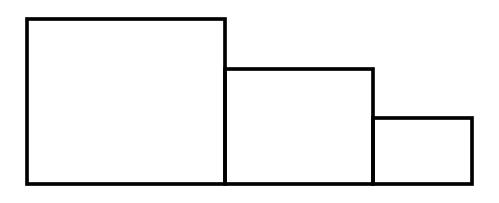
For a sports meet, a winners' stand comprising three wooden blocks is in the following form :
There are six different colours available to choose from and each of the three wooden blocks is to be painted such that no two of them has the same colour. In how many different ways can the winners' stand be painted?
Answer (a) & explanation
The stand can be painted in 120 ways (a). Step 1: the three blocks are different (first, second and third place stand at different heights). So swapping colours between blocks gives a new design; order matters. Step 2: the first block can take any of 6 colours. The second must differ, so it has 5 choices. The third has 4 left. Step 3: total = 6 × 5 × 4 = 120. Option (d), 36, and option (c), 66, do not follow any valid rule. Option (b), 81, would allow repeats, which the question forbids.
Tip: if items are distinct and no repeats are allowed, multiply the shrinking choices. This is a permutation, 6P3 = 120. If order did not matter, it would be 6C3 = 20.
Answer as per the official UPSC answer key.
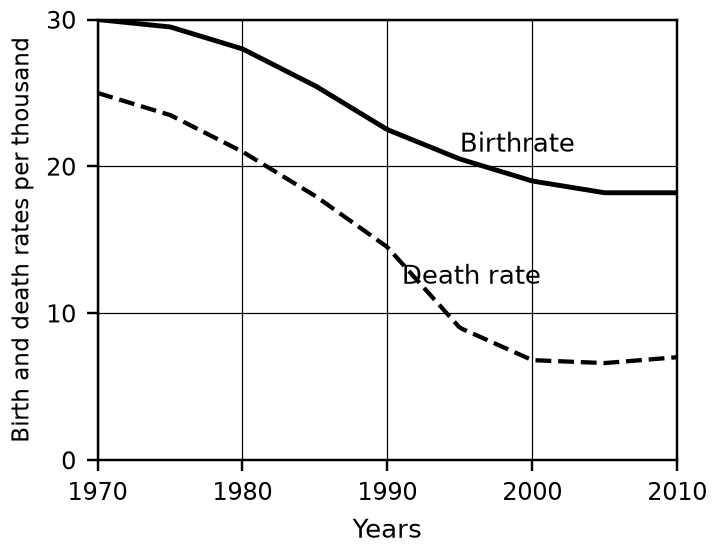
Directions for the following 2 (two) items : Consider the following graph in which the birthrate and death rate of a country are given, and answer the two items that follow.
Looking at the graph, it can be inferred that from 1990 to 2010
Answer (d) & explanation
The official answer is that population growth rate shows no trend (d). Step 1: growth rate = birth rate − death rate, the gap between the two lines. Step 2: read the graph. In 1990: about 22 − 14 = 8. In 2000: about 19 − 7 = 12. In 2010: about 18 − 7 = 11. Step 3: the gap first widens, then narrows slightly. It does not move steadily up (a) or down (b), and it is not flat (c). So UPSC's key says no trend.
Tip: never judge growth from one line alone. Natural growth rate is always the gap between births and deaths. India's own death rate fell faster than its birth rate for decades, which is why its population grew fast.
Some read the widening gap as 'increased' (a); the official answer is (d), as printed.
Answer as per the official UPSC answer key.
(Same graph as the question above.)
With reference to the above graph, consider the following statements considering 1970 as base year :
- 1. Population has stabilized after 35 years.
- 2. Population growth rate has stabilized after 35 years.
- 3. Death rate has fallen by 10% in the first 10 years.
- 4. Birthrate has stabilized after 35 years.
Which of the above are the most logical and rational statements that can be made from the above graph?
Answer (d) & explanation
Statements 2 and 4 are the logical ones (d). Step 1: 35 years after 1970 is 2005. By then both lines are almost flat. So the birth rate is steady (4), and the gap between the lines, the growth rate, is steady (2). Step 2: statement 1 says population has stabilised. But births are still above deaths, so the population keeps growing. 1 is wrong. Step 3: statement 3 says death rate fell 10% in 10 years. It went from about 25 to 21, a fall of 4 out of 25, roughly 16%. So 3 is wrong. Options (a), (b) and (c) fail.
Tip: a steady growth rate is not a steady population. A population stops growing only when births equal deaths.
Answer as per the official UPSC answer key.
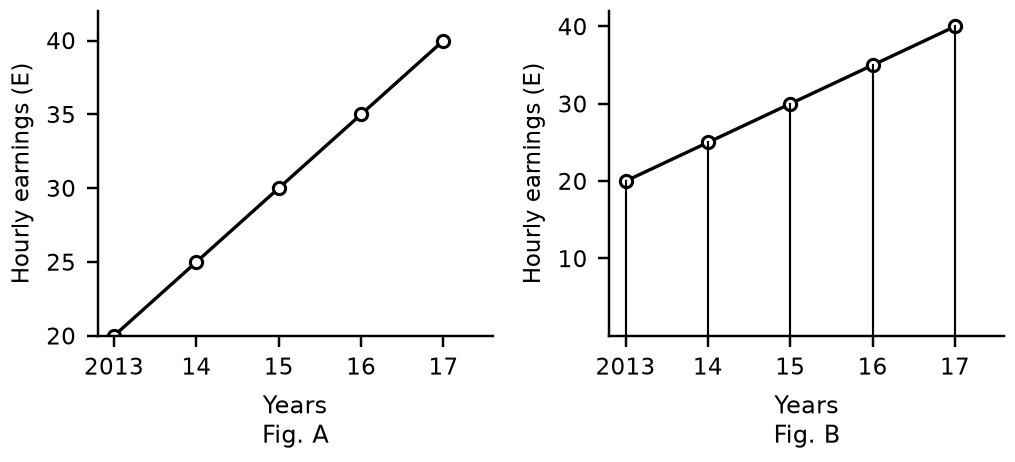
Average hourly earnings per year (E) of the workers in a firm are represented in figures A and B as follows :
From the figures, it is observed that the
Answer (c) & explanation
The slopes of the two graphs are the same (c). Step 1: read the points. Both figures show earnings of 20, 25, 30, 35 and 40 for 2013 to 2017. Step 2: only the scale of the side axis differs. That makes one line look steeper than the other, but the data are the same. Step 3: so the values (a), the range of 20 (b) and the rise of 5 per year (d) are identical in both. The slope, the rise per year, is the same. So (a), (b) and (d) are all wrong.
Tip: always read the numbers on the axes, not the look of the line. Changing the scale is a common trick to make growth look faster or slower.
Do not judge steepness by eye when the two axes are drawn to different scales.
Answer as per the official UPSC answer key.
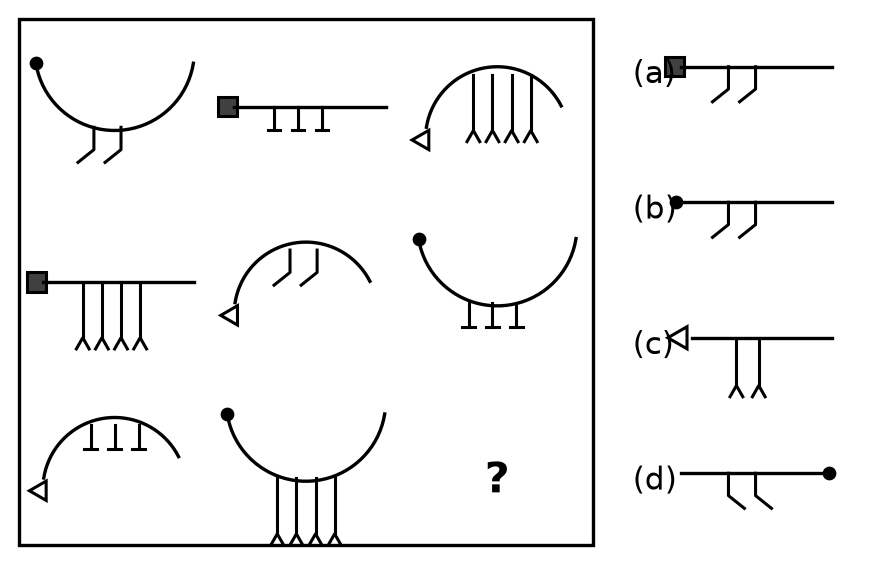
Consider the figures given below :
To fit the question mark, the correct answer is
Answer (a) & explanation
Figure (a) fits the question mark (a). Step 1: break each figure into two parts: a top (a curve with a dot, a straight line with a black square, or a half-curve with a triangle) and legs (2 bent legs, 3 short legs, or 4 forked legs). Step 2: in each row, every top and every type of legs appears exactly once. Step 3: row 3 already has the half-curve with 3 legs and the dotted curve with 4 legs. The missing pair is the square-ended line with 2 bent legs. That is figure (a). Options (b), (c) and (d) repeat a top or legs already in the row.
Tip: in 3 × 3 figure grids, split each figure into parts and check that each part appears once per row and column.
Answer as per the official UPSC answer key.
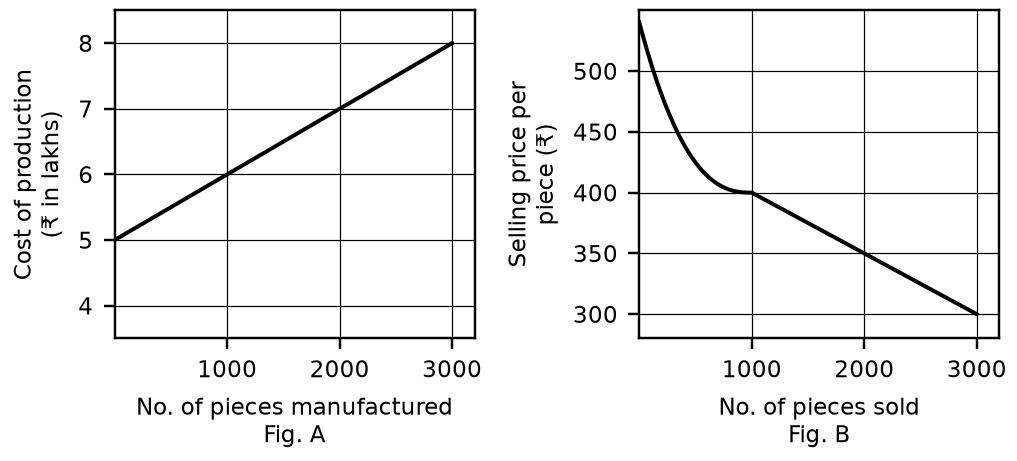
Consider the following figures A and B :
The manufacturing cost and projected sales for a product are shown in the above figures A and B respectively. What is the minimum number of pieces that should be manufactured to avoid a loss?
Answer (a) & explanation
The minimum number is 2000 pieces (a). Step 1: there is no loss when sales ≥ cost. Step 2: at 2000 pieces, Figure A gives a cost of ₹ 7 lakh. Figure B gives a price of ₹ 350 a piece, so sales = 2000 × 350 = ₹ 7 lakh. Cost equals sales, so there is no loss. Step 3: check a smaller number. At 1000 pieces, cost is ₹ 6 lakh but sales are 1000 × 400 = ₹ 4 lakh, a loss. So 2000 is the least. Options (b), (c) and (d) also avoid a loss, but they are not the minimum.
Tip: the break-even point is where cost equals revenue. When asked for the "minimum", stop at the first value that works.
Answer as per the official UPSC answer key.
A lift has the capacity of 18 adults or 30 children. How many children can board the lift with 12 adults?
Answer (b) & explanation
10 children can board with 12 adults (b). Step 1: the lift holds 18 adults, so 12 adults use 12/18 = 2/3 of its capacity. Step 2: the remaining space is 1/3 of the lift. Step 3: the full lift holds 30 children, so 1/3 of it holds 30 ÷ 3 = 10 children. Another way: 18 adults = 30 children, so 1 adult = 5/3 child. The 6 missing adults = 6 × 5/3 = 10 children. Option (a), 6, just subtracts 12 from 18. Options (c) and (d) do not fit.
Tip: in capacity questions, turn everything into a fraction of the whole, or into one common unit. Both ways give the answer in seconds.
Answer as per the official UPSC answer key.
A person bought a refrigerator worth ₹ 22,800 with 12·5% interest compounded yearly. At the end of first year he paid ₹ 8,650 and at the end of second year ₹ 9,125. How much will he have to pay at the end of third year to clear the debt?
Answer (d) & explanation
He must pay ₹ 11,250 at the end of the third year (d). Step 1: 12·5% = 1/8. So each year the amount owed is multiplied by 9/8, and then the payment is subtracted. Step 2: year 1: 22,800 × 9/8 = 25,650. Minus 8,650 leaves 17,000. Year 2: 17,000 × 9/8 = 19,125. Minus 9,125 leaves 10,000. Step 3: year 3: 10,000 × 9/8 = ₹ 11,250. This clears the debt. Option (b), ₹ 10,000, forgets the third year's interest. Options (a) and (c) do not fit.
Tip: change common percentages into fractions: 12·5% = 1/8, 20% = 1/5, 25% = 1/4. Multiplying by 9/8 is far quicker than working out 12·5% each time.
₹ 10,000 is the balance before the third year's interest.
Answer as per the official UPSC answer key.
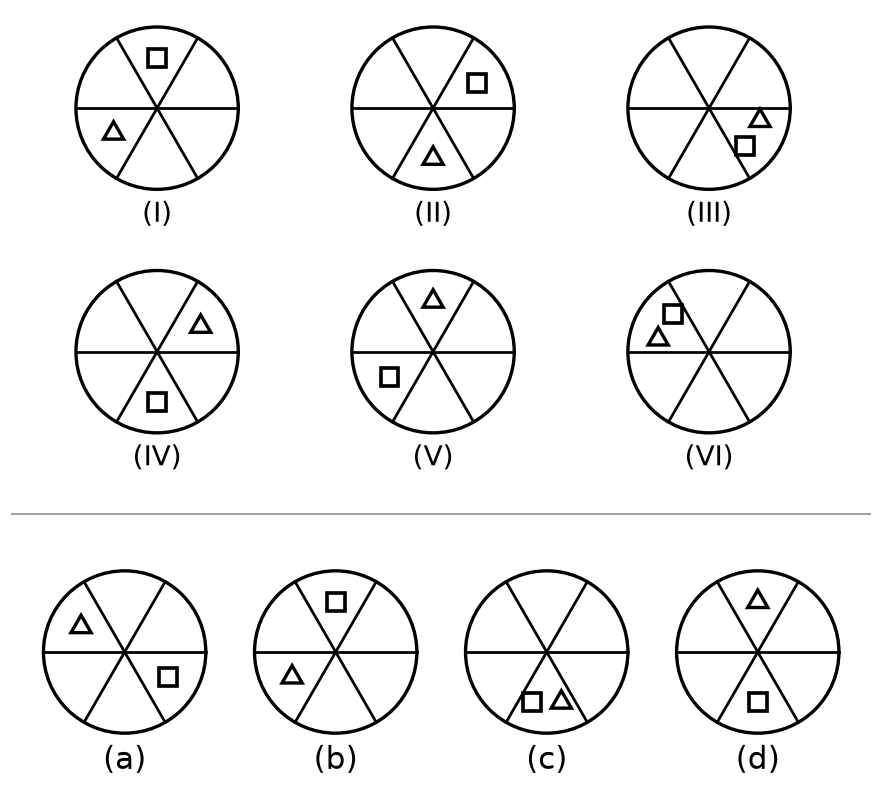
Consider the following figures :
In the figures (I) to (VI) above, some parts are shown to change their positions in regular directions. Following the same sequence, which of the figures given below will appear at (VII) stage?
Answer (b) & explanation
Figure (b) comes at stage VII (b). Step 1: track the square. It moves one part clockwise each step: top, upper-right, lower-right, bottom, lower-left, upper-left. After six moves it is back at the top. Step 2: track the triangle. It moves one part anticlockwise each step: lower-left, bottom, lower-right, upper-right, top, upper-left. Next it returns to lower-left. Step 3: so stage VII has the square at the top and the triangle at the lower-left. That is figure (b), the same as figure (I). Options (a), (c) and (d) put one shape in the wrong place.
Tip: follow one shape at a time. When a cycle has six positions, the seventh figure repeats the first.
Answer as per the official UPSC answer key.
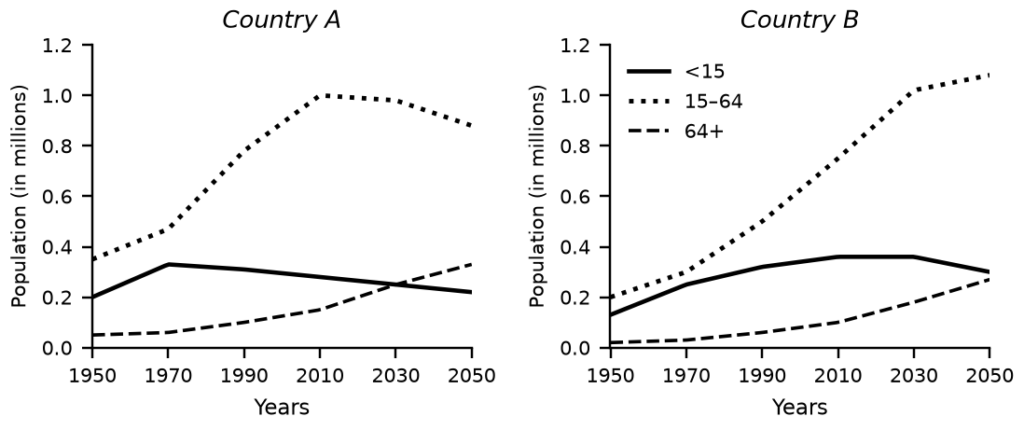
Consider the following graphs. The curves in the graphs indicate different age groups in the populations of two countries A and B over a period of few decades :
With reference to the above graphs, which of the following are the most logical and rational inferences that can be made?
- 1. Over the last two and a half decades, the dependency ratio for country B has decreased.
- 2. By the end of next two and a half decades, the dependency ratio of country A will be much less than that of country B.
- 3. In the next two decades, the work-force relative to its total population will increase in country B as compared to country A.
Select the correct answer using the code given below.
Answer (c) & explanation
1. Dependency ratio = (children under 15 + people over 64) ÷ working people (15–64).
2. Country B, last 25 years: the working group grew fast while the other two grew slowly. Ratio fell. 1 is right.
3. Country A, next 25 years: working group falls and the over-64 group rises, so A's ratio goes up. B's working group keeps rising. So A's ratio will not be 'much less' than B's. 2 is wrong.
4. Next 20 years: B's workers keep rising, A's start falling. 3 is right. Answer: 1 and 3 only.
Answer as per the official UPSC answer key.
Lakshmi, her brother, her daughter and her son are badminton players. A game of doubles is about to begin :
- (i) Lakshmi's brother is directly across the net from her daughter.
- (ii) Her son is diagonally across the net from the worst player's sibling.
- (iii) The best player and the worst player are on the same side of the net.
Who is the best player?
Answer (a) & explanation
The best player is Lakshmi's brother (a). Step 1: by clue (i), the brother and the daughter are on opposite sides. Case 1: the brother partners Lakshmi. The son is diagonally across from the brother, whose sibling is Lakshmi. So Lakshmi is the worst player, and by clue (iii) the best is her partner, the brother. Step 2: case 2: the brother partners the son. The son is diagonal to the daughter, whose sibling is the son. So the son is the worst, and the best is his partner, the brother. Step 3: both cases give the brother. Options (b), (c) and (d) fail.
Tip: when a puzzle has two possible set-ups, try both. If they give the same answer, you are done.
Answer as per the official UPSC answer key.
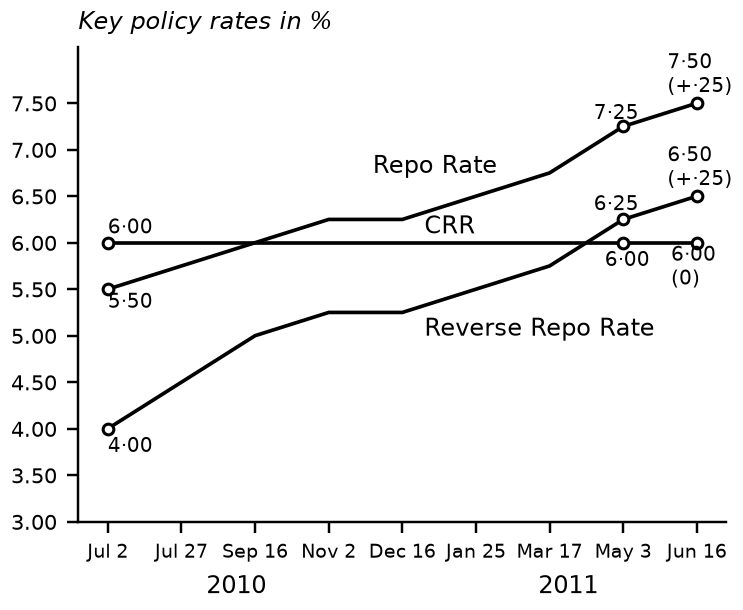
The graph given below indicates the changes in key policy rates made by the Central Bank several times in a year :
Which one of the following can be the most likely reason for the Central Bank for such an action?
Answer (d) & explanation
The likely reason is an anti-inflationary stance (d). Step 1: the graph shows the repo and reverse repo rates being raised again and again. Step 2: higher rates make loans costlier. People and firms then borrow and spend less. Less money chasing goods cools prices. Step 3: so repeated hikes signal a fight against inflation. Option (b), increasing liquidity, is the opposite; it needs rate cuts. Options (a) and (c) are not the main purpose of hiking policy rates.
Tip: rate hike = less money in the system = lower inflation. Rate cut = more money = growth push. In India, the RBI's Monetary Policy Committee sets the repo rate to keep CPI inflation near 4% (with a band of 2–6%).
Answer as per the official UPSC answer key.
Directions for the following 2 (two) items : The following table gives the GDP growth rate and Tele-density data of different States of a country in a particular year. Study the table and answer the two items that follow.
With reference to the above table, which of the following is/are the most logical and rational inference/inferences that can be made?
- 1. Higher per capita income is generally associated with higher Tele-density.
- 2. Higher GDP growth rate always ensures higher per capita income.
- 3. Higher GDP growth rate does not necessarily ensure higher Tele-density.
| States | Per capita income ($) | GDP growth rate (%) | Tele-density |
|---|---|---|---|
| State 1 | 704 | 9·52 | 70·27 |
| State 2 | 419 | 5·31 | 35·88 |
| State 3 | 254 | 10·83 | 50·07 |
| State 4 | 545 | 9·78 | 5·94 |
| State 5 | 891 | 10·8 | 76·12 |
| State 6 | 1077 | 11·69 | 77·5 |
| State 7 | 900 | 8·88 | 104·86 |
| State 8 | 395 | 5·92 | 6 |
| State 9 | 720 | 7·76 | 82·25 |
| State 10 | 893 | 9·55 | 96·7 |
| State 11 | 363 | 4·7 | 57·7 |
| State 12 | 966 | 7·85 | 63·8 |
| State 13 | 495 | 9·37 | 52·3 |
| State 14 | 864 | 5·46 | 97·9 |
| State 15 | 497 | 7·48 | 62·3 |
| State 16 | 777 | 7·03 | 93·8 |
| State 17 | 335 | 5·8 | 49·9 |
| State 18 | 599 | 7·49 | 47·84 |
Select the correct answer using the code given below.
Answer (c) & explanation
Inferences 1 and 3 are right (c). Step 1: richer states (like 7, 10, 14 and 16) mostly have high tele-density, and poorer ones (like 2 and 8) mostly have low. The word "generally" allows a few exceptions, so 1 holds. Step 2: statement 2 says high growth always means high income. But state 3 grows at 10·83% yet has the lowest income (254). So 2 fails. Step 3: state 4 grows at 9·78% but has a tele-density of only 5·94. So high growth does not always mean high tele-density. 3 holds. Options (a), (b) and (d) fail.
Tip: "generally" survives a few exceptions; "always" dies with one. Hunt for a single counter-example to test "always".
Words like 'always' fail with one counter-example; 'generally' only needs the overall pattern.
Answer as per the official UPSC answer key.
(Same table as the question above.)
With reference to the above table, the following assumptions have been made :
- 1. Nowadays, prosperity of an already high performing State cannot be sustained without making further large investments in its telecom infrastructure.
- 2. Nowadays, a very high Tele-density is the most essential condition for promoting the business and economic growth in a State.
Which of the above assumptions is/are valid?
Answer (d) & explanation
Neither assumption is valid (d). Step 1: the table shows data for one year only. It says nothing about what a state needs to keep its prosperity going in future. So assumption 1, about further large investments in telecom, cannot be drawn. Step 2: assumption 2 calls very high tele-density the most essential condition for growth. But state 4 grows fast with a very low tele-density. So 2 fails. Step 3: so options (a), (b) and (c) fail.
Tip: a one-year table cannot support claims about the future. And words like "most essential" need strong proof, which a single table rarely gives. Look for a data point that breaks the claim.
Answer as per the official UPSC answer key.
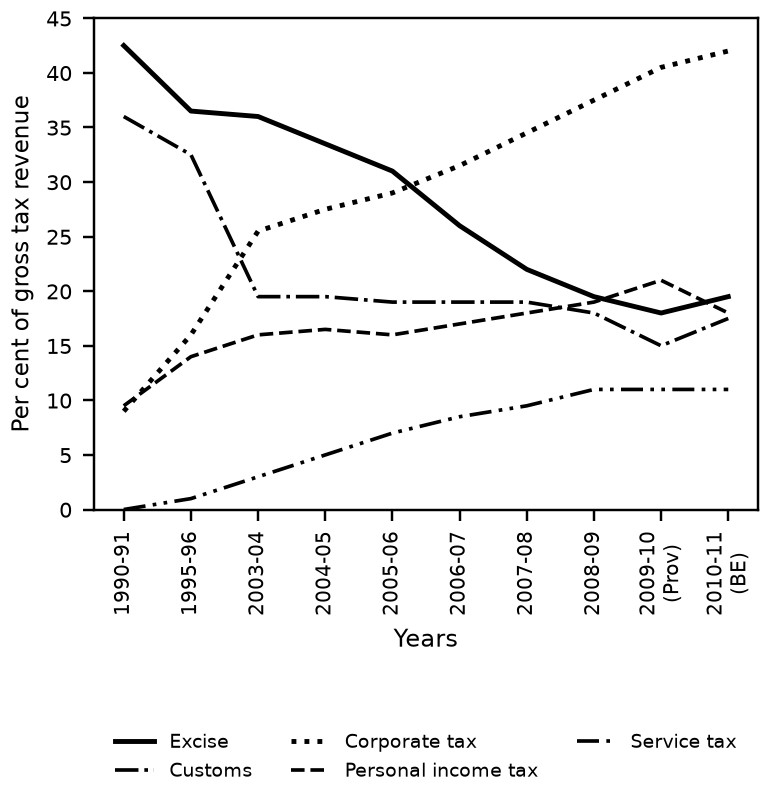
The following graph indicates the composition of our tax revenue for a period of two decades :
With reference to the above graph, which of the following is/are the most logical and rational inference/inferences that can be made?
- 1. During the given period, the revenue from Direct Taxes as percentage of gross tax revenue has increased while that of Indirect Taxes decreased.
- 2. The trend in the revenue from Excise Duty demonstrates that the growth of manufacturing sector has been negative during the given period.
Select the correct answer using the code given below.
Answer (a) & explanation
Only inference 1 is right (a). Step 1: in the graph, direct taxes (corporate tax and personal income tax) rise. Corporate tax goes from about 9% to about 42% of the total. Indirect taxes (excise and customs) fall. So 1 is correct. Step 2: statement 2 says the fall in excise shows negative manufacturing growth. But the graph shows excise as a share of total tax, not the size of manufacturing. A share can fall even when manufacturing grows, if other taxes grow faster. So 2 is wrong. Step 3: options (b), (c) and (d) fail.
Tip: a falling share is not a falling amount. Today, excise on most goods has been folded into GST, introduced in 2017.
Answer as per the official UPSC answer key.
If x – y = 8, then which of the following must be true?
- 1. Both x and y must be positive for any value of x and y.
- 2. If x is positive, y must be negative for any value of x and y.
- 3. If x is negative, y must be positive for any value of x and y.
Select the correct answer using the code given below.
Answer (d) & explanation
None of the three statements must be true (d). Step 1: statement 1 says both must be positive. But x = 2, y = −6 gives x − y = 8, with y negative. So 1 fails. Step 2: statement 2 says if x is positive, y must be negative. But x = 10, y = 2 works, with both positive. So 2 fails. Step 3: statement 3 says if x is negative, y must be positive. But y = x − 8, so if x is negative, y is even more negative. For example, x = −1, y = −9. So 3 fails too. Options (a), (b) and (c) fail.
Tip: to test "must be true", find one example that breaks it. Try a mix of positive, negative and zero values.
Answer as per the official UPSC answer key.
Read the passage
The quest for cheap and plentiful meat has resulted in factory farms where more and more animals are squeezed into smaller lots in cruel and shocking conditions. Such practices have resulted in many of the world’s health pandemics such as the avian flu. Worldwide, livestock are increasingly raised in cruel, cramped conditions, where animals spend their short lives under artificial light, pumped full of antibiotics and growth hormones, until the day they are slaughtered. Meat production is water-intensive. 15000 litres of water is needed for every kilogram of meat compared with 3400 litres for rice, 3300 litres for eggs and 255 litres for a kilogram of potatoes.
What is the most rational and crucial message given by the passage?
Answer (d) & explanation
The message is that industrial meat farming has an unsustainable environmental cost (d). Step 1: the passage links factory farming to pandemics and says one kilogram of meat needs about 15,000 litres of water. These point to a heavy, unsustainable cost. That is (d). Step 2: option (a) praises it as cheap protein for poor countries; the passage does not support this. Option (b) talks of laws against cruelty, but the passage cites no laws. Step 3: option (c) says it should be stopped immediately. That goes too far; the passage warns but does not demand an instant ban.
Tip: words like "immediately" or "only" make an option extreme. The best answer matches the passage's tone, which here is concern, not command.
Answer as per the official UPSC answer key.
Read the passage
A male tiger was removed from Pench Tiger Reserve and was relocated in Panna National Park. Later, this tiger trekked toward his home 250 miles away. The trek of this solitary tiger highlights a crisis. Many wildlife reserves exist as islands of fragile habitat in a vast sea of humanity, yet tigers can range over a hundred miles, seeking prey, mates and territory. Nearly a third of India’s tigers live outside tiger reserves, a situation that is dangerous for both human and animal. Prey and tigers can only disperse if there are recognized corridors of land between protected areas to allow unmolested passage.
Which of the following is the most rational and crucial message given by the passage?
Answer (b) & explanation
The message is that safe wildlife corridors are essential for conservation (b). Step 1: the passage calls reserves "islands of fragile habitat" and says tigers "can only disperse if there are recognized corridors". So linking reserves is the key point. That is (b). Step 2: option (c) asks for more reserves. The passage wants links between reserves, not more islands. Step 3: option (a) says conflict cannot be resolved; that is defeatist and not the author's view. Option (d), professional management, is not discussed.
Tip: an author's repeated image ("islands") often signals the problem; the fix they name is the message. India's tiger corridors, such as those linking Kanha and Pench, follow this idea.
Answer as per the official UPSC answer key.
Read the passage
A male tiger was removed from Pench Tiger Reserve and was relocated in Panna National Park. Later, this tiger trekked toward his home 250 miles away. The trek of this solitary tiger highlights a crisis. Many wildlife reserves exist as islands of fragile habitat in a vast sea of humanity, yet tigers can range over a hundred miles, seeking prey, mates and territory. Nearly a third of India’s tigers live outside tiger reserves, a situation that is dangerous for both human and animal. Prey and tigers can only disperse if there are recognized corridors of land between protected areas to allow unmolested passage.
With reference to the above passage, the following assumptions have been made :
- 1. The strategy of conservation of wildlife by relocating them from one protected area to another is not often successful.
- 2. India does not have suitable legislation to save the tigers, and its conservation efforts have failed which forced the tigers to live outside protected areas.
Which of the above assumptions is/are valid?
Answer (a) & explanation
Only assumption 1 is valid (a). Step 1: the passage tells of a relocated tiger who "trekked toward his home 250 miles away". UPSC's key reads this as showing that relocation often does not work, since animals try to return. So 1 holds. Step 2: assumption 2 says India lacks suitable laws and its efforts have failed. The passage never discusses legislation. India in fact has the Wild Life (Protection) Act, 1972 and Project Tiger. So 2 fails. Step 3: options (b), (c) and (d) fail.
Tip: an assumption must rest on something in the passage. A claim about laws, money or failure that the passage never mentions is not valid, however plausible it sounds.
Answer as per the official UPSC answer key.
All years by topic
Every question from 2011 to 2026, grouped by syllabus topic, with year-wise trends.