
Renewable Energy in India: Potential, Installed Capacity, 500 GW Target, Key Schemes (PM-KUSUM, PM Surya Ghar), Challenges and Way Forward (UPSC Notes + PYQs)
UPSC has already asked about this. Read the story with these questions in mind.
Why renewables matter for India
India is the world’s third-largest energy consumer and imports most of its crude oil and a large share of its gas. Coal still generates about three-quarters of its electricity. Renewables help in four ways: energy security (sunlight cannot be blockaded), climate commitments under the Paris Agreement, clean air, and jobs and industry, especially in manufacturing solar modules and wind turbines. Electricity demand is also rising quickly with air conditioning, electric vehicles and data centres, so new supply must come from somewhere.
Potential
| Source | Estimated potential | Strong regions |
|---|---|---|
| Solar | About 748 GWp (National Institute of Solar Energy), with most of India getting 4-7 kWh per sq m per day | Rajasthan, Gujarat, Ladakh, Maharashtra, Karnataka |
| Wind (onshore) | About 1,164 GW at 150 m hub height (NIWE) | Gujarat, Tamil Nadu, Karnataka, Rajasthan, Maharashtra |
| Offshore wind | Large zones identified off Gujarat and Tamil Nadu | Gulf of Khambhat, Gulf of Mannar |
| Large hydro | About 145 GW | Himalayan States, North-East |
| Small hydro (up to 25 MW) | About 21 GW | Himachal, Uttarakhand, Karnataka |
| Bioenergy | Tens of GW from surplus biomass and bagasse | Punjab, UP, Maharashtra |
Note that in India large hydro (above 25 MW) is counted under “non-fossil” but MNRE classifies only small hydro as “renewable”; since 2019 large hydro has also been allowed to count towards renewable purchase obligations.
Where India stands
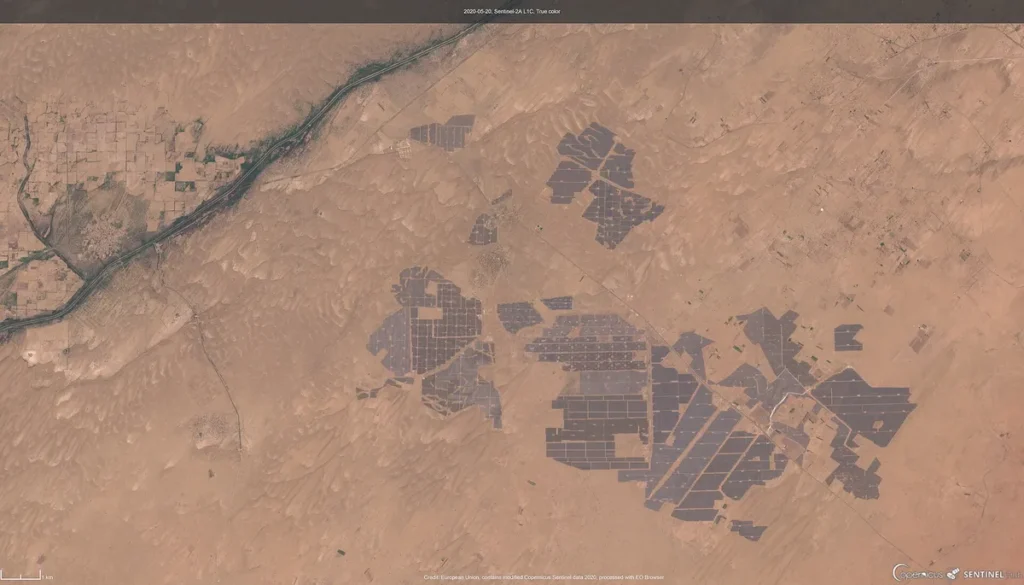
India’s non-fossil capacity (renewables, large hydro and nuclear) reached about half of total installed capacity in 2025, meeting the updated NDC target five years early. Solar capacity crossed 100 GW in early 2025, up from under 3 GW in 2014. India ranks among the top four countries in the world for installed renewable capacity. Large projects include the Bhadla solar park in Rajasthan (about 2.2 GW) and the Khavda renewable energy park in Gujarat’s Rann of Kutch, planned at 30 GW, which will be among the largest in the world. Generation is a different matter: because solar and wind run only when the sun shines or wind blows, their share in electricity generated is much lower than their share in capacity.
Key policies and schemes
- National Solar Mission (2010, under the National Action Plan on Climate Change): began with a 20 GW target, raised to 100 GW by 2022.
- Solar parks scheme: ready land and transmission for developers.
- PM-KUSUM (2019): solar pumps and small solar plants for farmers; farmers can sell surplus power.
- PM Surya Ghar: Muft Bijli Yojana (2024): rooftop solar for 1 crore households, with central subsidy and up to 300 units of free electricity a month.
- Green Energy Corridors: transmission lines to evacuate renewable power.
- Renewable Purchase Obligations (now Renewable Consumption Obligation under the Energy Conservation Act) on DISCOMs and large consumers.
- Waiver of inter-State transmission charges for projects commissioned by mid-2025, phased out afterwards.
- PLI for high-efficiency solar modules and the Approved List of Models and Manufacturers (ALMM) to build domestic manufacturing.
- Green Energy Open Access Rules (2022): consumers of 100 kW and above can buy green power directly.
- International Solar Alliance (launched by India and France at COP21, 2015; headquartered in Gurugram).
- Solar parksLand and transmission ready
- PM-KUSUMFarm pumps and plants
- PM Surya Ghar1 crore rooftops
- Green Energy CorridorsTransmission
- PLI and ALMMDomestic manufacturing
- Open accessDirect green purchase
Challenges
- Intermittency and storage: solar output collapses in the evening when demand peaks; battery and pumped storage are still small.
- Grid and transmission: the best sites are far from cities; lines take longer to build than solar plants.
- DISCOM finances: loss-making distribution companies delay payments and resist long-term contracts.
- Import dependence: China dominates polysilicon, wafers and cells; India builds modules but imports most cells.
- Land: large parks need land, sometimes in grasslands and habitats such as those of the Great Indian Bustard, whose power-line deaths reached the Supreme Court.
- Unsigned power purchase agreements: some auctioned capacity has struggled to find buyers.
- Recycling: end-of-life solar panels will become a large waste stream.
- Solar output falls to zero after sunset
- Demand peaks in the evening
- Storage capacity is small
- Coal plants must ramp up quickly
Uttar Pradesh angle
UP has high solar potential in Bundelkhand and the western districts. The UP Solar Energy Policy, 2022 targets 22 GW of solar by 2026-27, including rooftop and utility-scale projects, and the Bundelkhand region hosts large solar parks. Ayodhya has been developed as a model solar city. UP is also a large producer of bagasse-based power from its sugar mills.
Way forward
Pair every new solar and wind project with storage, use time-of-day tariffs to shift demand, expand pumped hydro, build domestic supply chains from polysilicon up, reform DISCOMs, plan offshore wind, and set up a recycling system for panels and batteries under EPR rules.
PYQ trend
Prelims asks schemes and terms: net metering (2016), IREDA (2015), PM Surya Ghar (2025), UDAY (2016). Mains GS-I 2025 asked the ecological and economic benefits of solar energy. GS-III often asks on energy security and the transition.
Renewable Energy: UPSC angle
For UPSC CSE
Prelims: schemes, institutions (IREDA, ISA, SECI), terms like net metering. Mains GS-III: energy security, transition, storage, manufacturing.
Renewable Energy UPSC PYQs (Prelims)
Questions UPSC has actually asked, from the official papers. Pick an option to check yourself.
Consider the following statements about 'PM Surya Ghar Muft Bijli Yojana' :
– I. It targets installation of one crore solar rooftop panels in the residential sector.
– II. The Ministry of New and Renewable Energy aims to impart training on installation, operation, maintenance and repairs of solar rooftop systems at grassroot levels.
– III. It aims to create more than three lakhs' skilled manpower through fresh skilling, and up-skilling, under scheme component of capacity building.
Which of the statements given above are correct?
PM Surya Ghar (February 2024, MNRE) aims at rooftop solar for one crore households, with up to 300 units of free power a month. Its capacity-building component trains people at the grassroots to install and maintain the systems, with a target of over three lakh skilled workers. All three come from the MNRE release. Answer as per the official UPSC key · Battle IAS PYQ bankAnswer (d) & why
‘Net metering’ is sometimes seen in the news in the context of promoting the
With net metering, a two-way meter records the electricity a rooftop solar owner sends to the grid and the electricity drawn from it. The consumer pays only for the net amount used. It encourages household solar and is central to schemes like PM Surya Ghar. Answer as per the official UPSC key · Battle IAS PYQ bankAnswer (a) & why
With reference to the Indian Renewable Energy Development Agency Limited (IREDA), which of the following statements is/are correct?
– 1. It is a Public Limited Government Company.
– 2. It is a Non-Banking Financial Company.
Select the correct answer using the code given below.
IREDA (1987), under the Ministry of New and Renewable Energy, is a public limited government company registered with the RBI as a Non-Banking Financial Company. It lends to renewable energy projects. It was listed on the stock exchanges in 2023. Answer as per the official UPSC key · Battle IAS PYQ bankAnswer (c) & why
Mains PYQs on this topic
Questions from the official UPSC Mains papers (2023-2026 in the Battle IAS Mains bank), newest first. Each links to a model answer.
- UPSC Mains 2025 · GS Paper I · Q6 · 10 marks
Explain briefly the ecological and economic benefits of solar energy generation in India with suitable examples.
Quick quiz
In India, small hydro projects are those up to
Projects up to 25 MW are classed as small hydro under MNRE.Answer (c)
The International Solar Alliance is headquartered in
ISA’s headquarters is in Gurugram, Haryana.Answer (b)
PM Surya Ghar Muft Bijli Yojana targets
Rooftop solar for one crore households.Answer (a)
FAQs
Is large hydro renewable in India?
Large hydro is counted as non-fossil. Since 2019 it is also treated as renewable for purchase obligations, though MNRE schemes cover only small hydro.
What is net metering?
A billing system in which a rooftop solar owner is credited for surplus power exported to the grid.
Why is storage needed?
Solar and wind are variable; storage shifts their output to times of high demand.
What is ALMM?
The Approved List of Models and Manufacturers, which limits government-linked projects to approved solar modules.
Which is India’s largest renewable park?
The Khavda park in Gujarat, planned at 30 GW.
Spotted an error? Tell us. We correct within 48 hours.
Image: Copernicus Sentinel-2, ESA, Wikimedia Commons, Attribution
How to use this in Mains
If asked: UPSC Mains 2025, GS-I: Explain briefly the ecological and economic benefits of solar energy generation in India with suitable examples.
Quote: “India is the world’s third-largest energy consumer and imports most of its crude oil and a large share of its gas.”
Use it: Use as the energy-security reason in your intro.
In the news

Pumped storage hydropower: India’s roadmap for 100 GW of ‘water batteries’ by 2035-36
A PIB backgrounder of 19 October 2026 explains how pumped storage projects (PSPs) will store solar and wind power for India’s grid. India runs 7.43 GW of pumped storage today, is building 15.87 GW more and has an assessed potential of 345.38 GW. A roadmap aims to add about 100 GW between 2025-26 and 2035-36.
19 Oct 2026
Oil companies bar sugar-based ethanol for 2026-27; maize incentive cut to ₹2.79 a litre
The oil marketing companies have kept sugar out of India’s ethanol programme for the coming year. The tender issued on 16 October 2026 seeks about 11 billion litres of ethanol for the 2026-27 supply year, but asks for none made from sugarcane juice, sugar syrup or B-heavy molasses, because the Government wants sugar diversion for ethanol cut to zero. Grain must now carry the load, and even the maize incentive has been cut. Read this as a live example of the food-versus-fuel trade-off.
18 Oct 2026
Metal-free porous catalyst could cut cost of zinc–air batteries and fuel cells
Scientists from S.N. Bose Centre Kolkata, INST Mohali and SRM University Amaravati made a metal-free porous organic catalyst, TTT-DHTD, for the oxygen reduction reaction in zinc-air batteries. It reached about 96% of commercial platinum's performance and stayed stable for 120 hours. Replacing platinum could cut the cost of zinc-air batteries and fuel cells.
7 Oct 2026
GOBARdhan Central Sector Scheme (₹23,731 crore) launched for compressed biogas
On 1 October 2026 the Petroleum Minister launched GOBARdhan, a Central Sector Scheme for compressed biogas (CBG) approved by the Cabinet on 6 August 2026 with ₹23,731 crore. It runs from 2026-27 to 2035-36 and aims to raise domestic CBG output nearly 10-fold to about 5 MMSCMD through assured offtake, a fixed price, capital aid and pipeline support.
1 Oct 2026