
UPSC Mains 2024 GS3 Q18: model answer
Flooding in urban areas is an emerging climate-induced disaster. Discuss the causes of this disaster. Mention the features of two such major floods in the last two decades in India. Describe the policies and frameworks in India that aim at tackling such floods.
What the question wants
Causes, two case floods, and India's policy framework.
How to structure it
Intro: urban flooding as a distinct disaster. Body: (1) climate causes; (2) man-made causes; (3) Mumbai 2005; (4) Chennai 2015; (5) policies and frameworks. Conclusion: sponge cities approach.
- 1(1) climate causes
- 2(2) man-made causes
- 3(3) Mumbai 2005
- 4(4) Chennai 2015
- 5(5) policies and frameworks
Model answer
Urban floods are different from river floods: they rise quickly from intense rain on sealed surfaces and can paralyse a city in hours.
- Extreme rainfall
- Encroached lakes and floodplains
- Choked old drains
- Concrete surfaces
- Poor reservoir release
Causes
- Climate: more frequent extreme rainfall events; cloudbursts and sea level rise in coastal cities.
- Encroachment on lakes, wetlands and floodplains.
- Old and choked drains, solid waste blocking them.
- Concrete surfaces reduce infiltration.
- Poor reservoir release coordination and weak forecasting.
Two major floods
- Mumbai, July 2005: about 944 mm of rain at Santacruz in 24 hours; Mithi river overflowed; over 1,000 deaths in Maharashtra; the city stopped for days. It led to the BRIMSTOWAD drainage upgrade.
- Chennai, December 2015: extreme rain in the north-east monsoon plus late release from Chembarambakkam reservoir; encroached lakes failed to absorb water; hundreds died and losses were huge.
Policies and frameworks
- NDMA Guidelines on Management of Urban Flooding (2010): a separate approach from riverine floods.
- Disaster Management Act, 2005 and National DM Plan.
- Standard Operating Procedure for urban flooding (MoHUA, 2017).
- AMRUT storm water drainage; Smart Cities Mission.
- Urban Flood Risk Mitigation Programme (2023) for seven big cities.
- Early warning systems like Chennai's C-FLOWS and Mumbai's IFLOWS-Mumbai.
Cities must learn to hold water, not just drain it: wetland restoration and sponge city design are the way forward.
Keywords, cases and data to drop in
Mumbai 2005 Chennai 2015 NDMA 2010 IFLOWS sponge cities
Where most answers lose marks
- Giving river floods as examples.
Fresh examples from current affairs
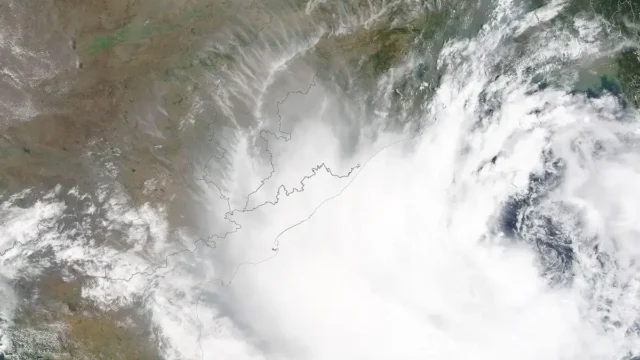
IMD launches a map-based Decision Support System for cyclone and marine warnings
On 12 October 2026 the India Meteorological Department dedicated a Cyclone Warning and Marine Weather Services Decision Support System to the nation. The WebGIS platform shows cyclone track, intensity, winds, rainfall, storm surge and district-wise warnings on one map for disaster managers and the public.
UPSC angle: Prelims: IMD, cone of uncertainty, storm surge. · Mains GS-III: early warning and disaster preparedness.
13 Oct 2026
India offers flood relief to Nepal; PM speaks to Nepal PM
On 26 August 2026 Prime Minister Narendra Modi spoke to Nepal's Prime Minister Balendra Shah and conveyed condolences on the loss of lives in floods in Nepal. He said India is ready to provide all possible humanitarian assistance, and that Indian teams are coordinating closely with Nepalese authorities on rescue and relief.
UPSC angle: Mains: India–Nepal water and flood cooperation.
26 Aug 2026
UNCCD COP17: India urges shift from drought response to drought resilience
At a ministerial dialogue on drought resilience at UNCCD COP17 in Ulaanbaatar, Mongolia, on 25 August 2026, India called for a shift from reactive drought relief to proactive, technology-enabled resilience. The Environment Minister said drought must be managed as a predictable, preventable risk, with preparedness over response and prevention over crisis management.
UPSC angle: Mains: Drought resilience strategies.
25 Aug 2026
India hosts 3rd BRICS ministerial on disaster risk reduction
Under India's BRICS Chairship 2026, NDMA hosted the 3rd BRICS Ministerial Meeting on Disaster Risk Reduction in New Delhi on 24 July 2026. Members unanimously adopted a BRICS Joint Statement on DRR and pledged to speed up the BRICS DRR Work Plan for 2025 to 2028.
UPSC angle: Prelims: Sendai; CDRI.
24 Jul 2026Learn the concept
Question text as printed in the official UPSC question paper: https://www.upsc.gov.in/sites/default/files/QP_CSM_2024_GenStud_III_03102024.pdf The model answer is original Battle IAS work; use it to learn structure, not to memorise.