
Second World War (1939-1945): Causes, Major Phases, Why the Allies Won, Consequences and Impact on India (UPSC Notes + PYQs)
UPSC has already asked about this. Read the story with these questions in mind.
Causes
- Versailles (1919): Germany lost territory and colonies, accepted war guilt and owed reparations; resentment fed nationalism.
- Great Depression (1929): unemployment and hunger helped Hitler (Chancellor from January 1933) and militarists in Japan.
- Fascist expansion: Japan in Manchuria (1931), Italy in Ethiopia (1935-36), Germany re-armed and reoccupied the Rhineland (1936), annexed Austria (1938).
- Failure of the League of Nations: no army, key powers absent or leaving.
- Appeasement: at Munich (September 1938) Britain and France let Germany take the Sudetenland; Hitler took the rest of Czechoslovakia in March 1939.
- Nazi-Soviet Pact (August 1939): removed the risk of a two-front war for Germany and secretly divided eastern Europe.
- Harsh Treaty of Versailles
- Great Depression
- Fascism and militarism
- Weak League of Nations
- Appeasement at Munich
- Nazi-Soviet Pact
Major phases
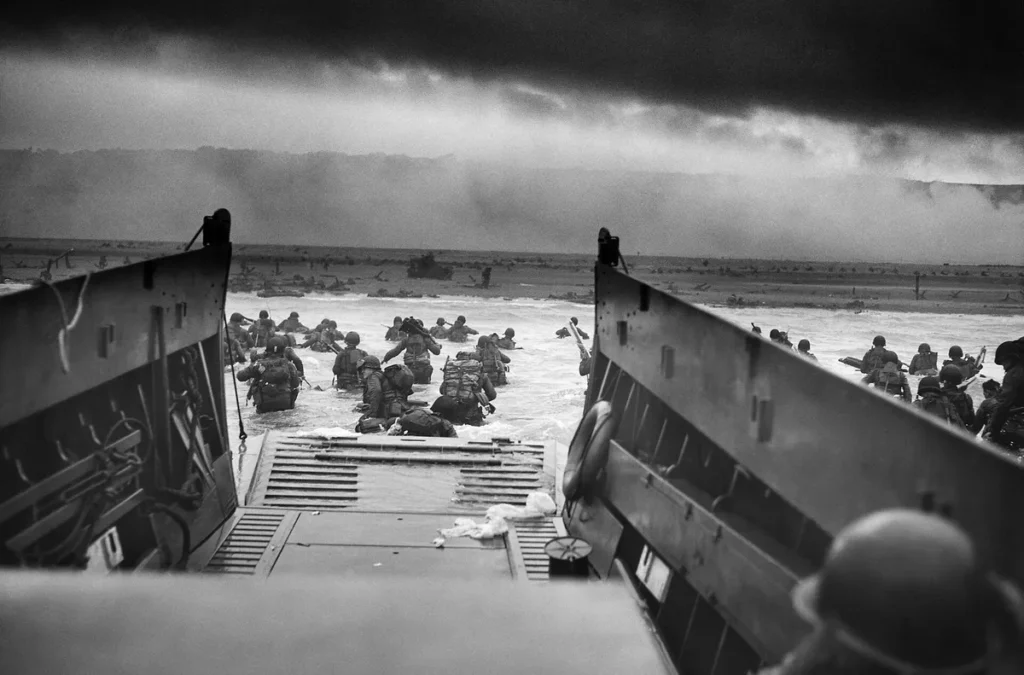
1939-41: Axis advances. Poland fell; in 1940 Germany overran Denmark, Norway, the Low Countries and France (Dunkirk evacuation). Britain held out in the Battle of Britain. 1941: the war goes global. Germany invaded the USSR (Operation Barbarossa, 22 June 1941); Japan attacked Pearl Harbor (7 December 1941), bringing the USA in. 1942-43: the turn. Midway (June 1942) checked Japan; El Alamein (October-November 1942) and Stalingrad (ended February 1943) broke Axis momentum. 1944-45: Allied victory. D-Day landings in Normandy (6 June 1944); Soviet advance from the east; Germany surrendered on 8 May 1945. The USA dropped atomic bombs on Hiroshima (6 August) and Nagasaki (9 August); Japan announced surrender on 15 August and signed on 2 September 1945.
Why the Allies won
Industrial power (US factories out-produced the Axis many times over), Soviet manpower and endurance, control of the seas, code-breaking (Enigma at Bletchley Park), and Axis mistakes such as invading the USSR before defeating Britain and declaring war on the USA.
Consequences for the world
- Over 60 million dead, including about six million Jews killed in the Holocaust.
- United Nations founded on 24 October 1945; Bretton Woods institutions (IMF, World Bank) agreed in July 1944.
- USA and USSR as superpowers; Europe divided; start of the Cold War.
- Nuremberg and Tokyo trials created the idea of individual responsibility for war crimes.
- Weakened colonial powers led to decolonisation in Asia and Africa.
- Universal Declaration of Human Rights (1948) and the Genocide Convention (1948).
India and the war
On 3 September 1939 Viceroy Linlithgow declared India at war without consulting Indian leaders. The Congress ministries resigned in protest in October-November 1939; the League celebrated “Deliverance Day”. Britain’s offers followed: the August Offer (1940), which Congress rejected, and the Cripps Mission (March 1942) offering dominion status after the war with the right of provinces to opt out, which Gandhi reportedly called a “post-dated cheque”. Congress then launched Individual Satyagraha (October 1940, Vinoba Bhave first) and the Quit India Movement (8 August 1942). Subhas Chandra Bose formed the Azad Hind government in Singapore on 21 October 1943 and led the INA with Japan; INA units fought around Imphal and Kohima in 1944.
India’s army grew to about 2.5 million, the largest volunteer army in history, fighting in North and East Africa, Italy and Burma; around 87,000 Indian servicemen died. India’s sterling balances rose sharply because Britain paid for supplies with IOUs. The Bengal famine of 1943 killed an estimated 2.1 to 3 million people, worsened by wartime policies, hoarding and the loss of Burmese rice.
- Sep 1939India declared at war by Viceroy
- Oct-Nov 1939Congress ministries resign
- Aug 1940August Offer
- Oct 1940Individual Satyagraha
- Mar 1942Cripps Mission
- Aug 1942Quit India
- 1943Bengal famine; Azad Hind government
- 1944Imphal and Kohima battles
How the war sped up independence
Britain ended the war bankrupt and dependent on US loans. The INA trials and the naval mutiny of 1946 showed that the loyalty of Indian soldiers could no longer be assumed. The Labour government wanted to leave. Within two years of the war’s end, India was independent and partitioned.
The war and the Indian economy
India paid heavily for the war. Britain bought Indian supplies on credit, building up sterling balances of over £1,300 million owed to India by 1945, financed partly by printing money. Prices rose sharply, and the Bengal famine of 1943, which killed about three million people, came from wartime hoarding, the loss of Burmese rice after Japan occupied Burma, a cyclone and the colonial government’s refusal to stop exports and import grain in time. Indian industry gained from war orders in steel, textiles and engineering, and the sterling balances later paid for imports after independence. The Bombay Plan of 1944, written by Indian industrialists, called for State-led planning, an idea that shaped the Planning Commission.
PYQ trend
Prelims asks India’s wartime politics: Cripps (2016), 8 August 1942 (2021), why Congress ministries resigned (2012). Mains GS-I has asked on the World Wars (2024, on the First World War and balance of power); a question on WWII causes or decolonisation is due.
World War 2: UPSC angle
For UPSC CSE
Prelims: India’s wartime events (August Offer, Cripps, Quit India, INA). Mains GS-I: causes and consequences of the World Wars, decolonisation, redrawal of national boundaries.
World War 2 UPSC PYQs (Prelims)
Questions UPSC has actually asked, from the official papers. Pick an option to check yourself.
The plan of Sir Stafford Cripps envisaged that after the Second World War
The Cripps offer (March 1942) promised India Dominion status after the war, with the right to leave the Commonwealth. An elected body would frame the constitution, and provinces could opt out. Gandhi called it a “post-dated cheque”. Congress rejected it, and Quit India followed. Answer as per the official UPSC key · Battle IAS PYQ bankAnswer (d) & why
With reference to 8th August, 1942 in Indian history, which one of the following statements is correct?
The AICC passed the Quit India resolution at Gowalia Tank, Bombay, on 8 August 1942, and Gandhi gave the call “Do or Die”. The leaders were arrested early on 9 August. The Congress ministries had resigned in October–November 1939, and Cripps came in March 1942. Answer as per the official UPSC key · Battle IAS PYQ bankAnswer (a) & why
The Congress ministries resigned in the seven provinces in 1939, because
In October 1939 the Congress ministries resigned in protest because the Viceroy had declared India a party to the Second World War without consulting Indians. None of the reasons given was the real cause. The Muslim League celebrated the resignations as a “Day of Deliverance”. Answer as per the official UPSC key · Battle IAS PYQ bankAnswer (d) & why
Mains PYQs on this topic
Questions from the official UPSC Mains papers (2023-2026 in the Battle IAS Mains bank), newest first. Each links to a model answer.
- UPSC Mains 2024 · GS Paper I · Q12 · 15 marks
How far is it correct to say that the First World War was fought essentially for the preservation of balance of power?
Quick quiz
The Munich Agreement (1938) allowed Germany to take
Appeasement.Answer (b)
The Azad Hind government was proclaimed in
21 October 1943.Answer (c)
The Cripps proposals offered India
With an opt-out for provinces.Answer (b)
FAQs
Why did Congress ministries resign in 1939?
Because India was taken into the war without consulting Indians and Britain would not state its war aims for India.
How many Indians served in WWII?
About 2.5 million, all volunteers.
What caused the Bengal famine of 1943?
A mix of crop loss, the fall of Burma, hoarding, wartime inflation and poor government response.
How did WWII lead to the UN?
Allied leaders planned a stronger body than the League; the UN Charter was signed at San Francisco in June 1945.
What was the August Offer?
A 1940 British offer of dominion status as the goal, an expanded Executive Council and a war advisory council; the Congress rejected it.
Spotted an error? Tell us. We correct within 48 hours.
Image: https://commons.wikimedia.org/wiki/File:Into_the_Jaws_of_Death_23-0455M_edit.jpg
How to use this in Mains
If asked: Analyse the impact of the Second World War on India's freedom struggle. (GS-I)
Quote: “On 3 September 1939 Viceroy Linlithgow declared India at war without consulting Indian leaders.”
Use it: Strong opener: India was dragged into war without consent, which led to the Congress ministries resigning.