
1% green jet fuel for international flights from 2027: India’s SAF plan and ICAO’s CORSIA
India is set to make 1% blending of Sustainable Aviation Fuel (SAF) compulsory for international flights from 2027, rising to 2% in 2028 and 5% in 2030, industry sources told The Hindu. The trigger is ICAO’s CORSIA, whose mandatory phase begins in January 2027. Indian airlines may need about 5 million tonnes of carbon credits a year, costing $50–75 million, while a full national SAF policy is still awaited.
- Blend 2027
- 1%
- Blend 2030
- 5%
- CORSIA mandatory
- 2027–2035
- Offset need
- ~5 MtCO₂ a year
India’s SAF mandate: what is planned?
Aviation is one of the hardest sectors to clean up, because planes cannot simply switch to batteries. That is why the world is betting on a cleaner liquid fuel, and India wants to be both user and supplier.
- Planned blending for international flights: 1% (2027), 2% (2028), 5% (2030); formal notice awaited (The Hindu, 22 Oct 2026).
- CORSIA’s mandatory phase begins in January 2027, about two months away.
- Indian airlines face an annual offset liability of about 5 million tonnes of CO₂; at $10–15 a credit, that is $50–75 million.
- Indian Oil’s Panipat refinery is ready for about 30,000 tonnes a year using used cooking oil.
What are SAF and CORSIA?
- SAF: jet fuel made from waste oils, crop residue, alcohol or green hydrogen; it is blended with normal jet fuel (ATF).
- CORSIA: Carbon Offsetting and Reduction Scheme for International Aviation, adopted by ICAO in 2016.
- Airlines must keep international flight emissions below 85% of 2019 levels, or offset the rest with SAF or eligible credits.
- Two voluntary phases (2021–26), then a mandatory phase (2027–35).
How do SAF targets compare?
| Market | Target | Start |
|---|---|---|
| India (planned) | 1% → 2% → 5% | 2027, 2028, 2030 |
| European Union | 2% → 6% | 2025, 2030 |
| United Kingdom | 2% → 10% | 2025, 2030 |
| Singapore | 1%, through a levy | 1 January 2027 |
Which legal and policy frameworks apply?
- Chicago Convention (1944) created ICAO, which sets global aviation standards.
- Paris Agreement Article 6 governs carbon markets; CORSIA credits need ‘authorisation’ from the host country.
- National Policy on Biofuels, 2018 (amended 2022) covers biofuel feedstocks and blending.
- Carbon Credit Trading Scheme, 2023 under the Energy Conservation Act, 2001 sets up India’s carbon market.
What are the challenges?
- No comprehensive national SAF policy yet on pricing, production and exports.
- SAF costs 2–5 times normal ATF; airlines want price parity.
- Used cooking oil is limited and Europe competes for it.
- Rules on carbon-credit eligibility and emissions reporting are unclear.
What should be done next?
- Notify the SAF mandate and a full policy before January 2027.
- Offer offtake guarantees and incentives for alcohol-to-jet and residue-based units.
- Allow SAF exports to make India a global supply hub.
- Build a credible carbon-credit authorisation system.
What can Prelims ask on aviation and climate?
- ICAO: UN agency, headquarters Montreal; Chicago Convention 1944.
- CORSIA: adopted 2016; baseline 85% of 2019 emissions.
- ICAO feasibility study: India could produce 14–33 million tonnes of SAF.
- SAF pathways: HEFA (oils and fats), alcohol-to-jet, Fischer-Tropsch.
- Panipat refinery: Indian Oil, Haryana.
How to write about aviation decarbonisation in Mains
Practice question (10 marks, 150 words): Sustainable Aviation Fuel offers India both a climate and an economic opportunity. Discuss. (GS-III)
- Intro: 1% SAF mandate from 2027; CORSIA.
- Climate need: hard-to-abate sector, offsets cost.
- Opportunity: feedstock, refineries, exports.
- Hurdles: cost, feedstock, policy gaps.
- Conclusion: notify policy, build supply, use carbon markets.
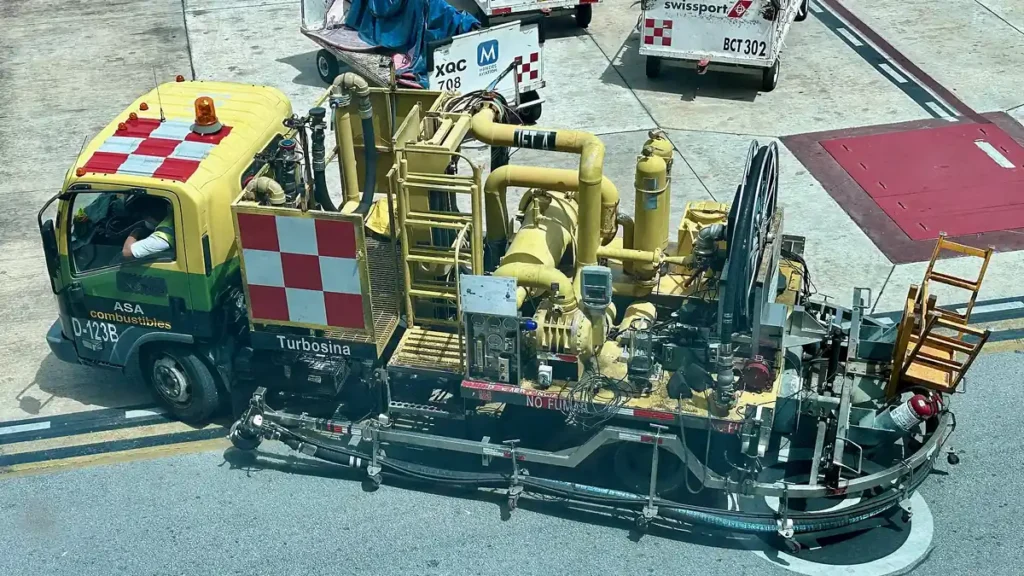
Image: An aircraft refuelling truck at an airport apron. Oleg Yunakov, Wikimedia Commons, CC BY-SA 4.0
How to use this in Mains
If asked: Discuss the challenges in decarbonising the aviation sector. (GS-III)
Quote: “As countries accelerate aviation decarbonisation, a supportive policy environment can help attract investment, strengthen domestic value chains.”
Use it: Use it to argue for a clear national SAF policy.
If asked: How can India turn agricultural residue into an energy asset? (GS-III)
Quote: “India looks to position itself as a global production and export hub, leveraging its potential access to used cooking oil, agricultural residues.”
Use it: Quote it and link to stubble burning and farm incomes.
Exam angle
Prelims: ICAO, CORSIA, SAF pathways, Panipat. · Mains GS-III: decarbonising aviation; biofuels.
Practice MCQs
Original practice questions (not PYQs).
CORSIA, recently in the news, is associated with
Answer (b) & explanation
CORSIA was adopted by ICAO in 2016 to cap growth in international aviation emissions.
Consider the following statements about CORSIA:
1. Its first two phases (2021–26) are voluntary.
2. Its mandatory phase covers 2027–2035.
3. It applies to domestic flights too.
How many of the statements given above are correct?
Answer (b) & explanation
Statements 1 and 2 are correct; CORSIA covers international flights only.
Sustainable Aviation Fuel can be produced from which of the following?
1. Used cooking oil
2. Agricultural residue
3. Ethanol
Select the correct answer using the code given below.
Answer (d) & explanation
All three are SAF feedstocks; ethanol is converted through the alcohol-to-jet route.
Questions students ask about this
What is the SAF blending plan?
1% for international flights from 2027, 2% from 2028 and 5% from 2030.
What is CORSIA?
ICAO’s global offsetting scheme for international aviation emissions.
Who produces SAF in India now?
Indian Oil’s Panipat refinery is ready for about 30,000 tonnes a year.
Why is SAF costly?
It currently costs 2–5 times normal jet fuel.
Keep studying
Go deeper
facts from cited sources only; faculty review pending