
Prasar Bharati at 29: why India’s public broadcaster still lacks the autonomy its law promised
Next story · 23 OctPLFS changes from January 2027: new stratum for platform workers and unpaid work questions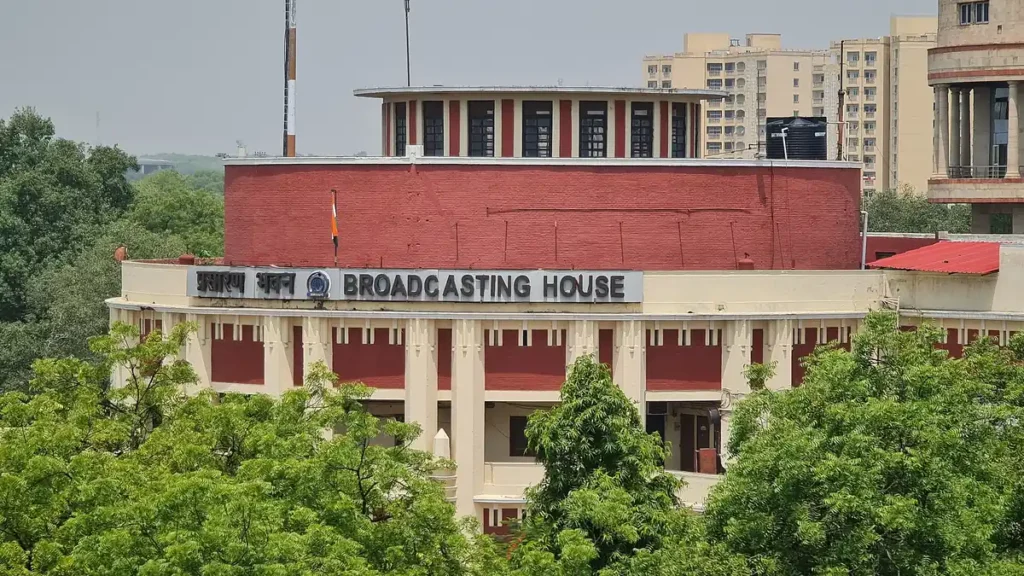
A lead article in The Hindu on 23 October 2026 argues that Prasar Bharati, set up to be a free public broadcaster, still works like a government department. The Prasar Bharati Act of 1990 came into force only in 1997, and its key safeguards, a parliamentary committee (Section 13) and a Broadcasting Council for complaints (Sections 14–15), were never set up, while Section 23 still lets the Centre give binding directions. For you, this is a neat case study of a law that promises autonomy but never builds the institutions that make it real.
- Law
- Prasar Bharati Act, 1990
- In force
- 1997
- Not set up
- Sections 13, 14, 15
- Govt power
- Section 23 directions
Prasar Bharati debate: what happened?
Think of a referee who is paid, appointed and instructed by one of the teams. That, says the article, is the problem with India’s public broadcaster.
- 23 Oct 2026: a lead article in The Hindu calls Prasar Bharati ‘a mouthpiece of the government of the day’.
- It notes that the 22-member parliamentary committee (Section 13) and the Broadcasting Council (Sections 14–15) have never been constituted.
- A 2021 manpower audit found almost half of the then 25,000 staff in engineering and under 20% in content, against about 70% content staff at the BBC.
- In August 2026 the government told the Lok Sabha it had received no formal complaints about the broadcaster’s autonomy in the previous year.
What is Prasar Bharati?
- A statutory autonomous body that runs All India Radio (Akashvani) and Doordarshan, under the Ministry of Information and Broadcasting.
- Its roots: the Chanda Committee (1966) and the B.G. Verghese Working Group (1977–78), which proposed a BBC-style autonomous corporation.
- The 1979 Bill lapsed; a new Bill, called ‘a charter of freedom’ under Article 19(1)(a), became the 1990 Act, enforced in 1997.
- Section 12 asks it to safeguard the citizen’s right to be informed ‘freely, truthfully and objectively’.
How does the law compare with practice?
| Provision | What the Act says | What happened |
|---|---|---|
| Section 10 | Recruitment board for free appointments | Nothing till July 2020 |
| Section 13 | 22-member committee of MPs to oversee it | Never constituted |
| Sections 14–15 | Broadcasting Council to hear complaints | Never set up |
| Section 23 | Centre may issue directions | Still used; funding via ministry grants |
What is the constitutional and legal angle?
- Article 19(1)(a): freedom of speech includes the citizen’s right to receive information.
- Secretary, Ministry of I&B v. Cricket Association of Bengal (1995): airwaves are public property; the Court asked for an independent public authority to control their use.
- Article 19(2): reasonable restrictions only on listed grounds, not to favour a government.
- UNESCO (2001): public broadcasting is neither commercial nor state-controlled.
What are the challenges?
- Funding depends on yearly ministry grants, so the Board is never truly independent.
- The Board has been filled mostly with serving or former bureaucrats.
- No complaint body means viewers have nowhere to go.
- Staff skewed to engineering leaves little room for quality content in a crowded digital market.
What should be done?
- Constitute the parliamentary committee and Broadcasting Council already in the Act.
- Give it a stable, rule-based fund, like a licence fee or a fixed share of revenue.
- Professionalise the Board and transfer assets and staff fully.
- Amend Section 23 so directions are limited to security and emergencies.
What can Prelims ask on Prasar Bharati?
- Prasar Bharati Act passed in 1990, in force from 1997.
- It runs AIR and Doordarshan; it is a statutory, not a constitutional, body.
- Cricket Association of Bengal case (1995): airwaves as public property.
- Public Service Broadcasting Day: 12 November (Gandhiji’s only visit to the AIR studio, 1947).
- Chanda Committee (1966) and Verghese Committee (1977–78) on broadcasting autonomy.
How to write about Prasar Bharati in Mains
Practice question (10 marks, 150 words): ‘Prasar Bharati has a law for autonomy but not the institutions that make autonomy real.’ Examine. (GS-II)
- Intro: 1990 Act, 1997 enforcement; the 2026 debate.
- Gaps: Sections 13–15 unimplemented; Section 23; funding.
- Constitutional basis: Article 19(1)(a), Cricket Association of Bengal.
- Reforms: committee, council, stable funds, professional Board.
- Conclusion: public, not state, broadcasting.
Image: Akashvani Bhawan (Broadcasting House), Parliament Street, New Delhi. Aloofmanish, Wikimedia Commons, CC BY-SA 4.0
How to use this in Mains
If asked: Discuss the role of public service broadcasting in a democracy. (GS-II)
Quote: “The broadcaster has the right to speak freely, and in return it owes the public accuracy, impartiality, and independence from both the market and the Ministry.”
Use it: Use it as your definition, then show where Prasar Bharati falls short.
If asked: Examine why statutory autonomy often fails in practice in India. (GS-II)
Quote: “Critical Sections 13, 14 and 15 of the Act remain unimplemented.”
Use it: Quote it as a clean example of a law not followed by institutions.
Exam angle
Prelims: Prasar Bharati Act 1990, Sections 13–15 and 23, Cricket Association of Bengal (1995). · Mains GS-II: autonomy of statutory bodies; media and democracy.
Practice MCQs
Original practice questions (not PYQs).
Consider the following statements about Prasar Bharati:
1. It was created by an Act of Parliament passed in 1990.
2. The Act came into force in 1990 itself.
3. It runs both All India Radio and Doordarshan.
Which of the statements given above are correct?
Answer (b) & explanation
The Act was passed in 1990 but enforced only in 1997. Prasar Bharati runs AIR and Doordarshan.
In which case did the Supreme Court hold that airwaves are public property?
Answer (b) & explanation
The 1995 Cricket Association of Bengal judgment held airwaves to be public property to be used for public good.
Public Service Broadcasting Day is observed in India on
Answer (b) & explanation
12 November marks Mahatma Gandhi’s only visit to the AIR studio in 1947, when he spoke to refugees at Kurukshetra.
Questions students ask about this
Is Prasar Bharati a constitutional body?
No. It is a statutory body under the Prasar Bharati Act, 1990.
Which sections of the Act were never implemented?
Section 13 (parliamentary committee) and Sections 14–15 (Broadcasting Council).
What does Section 23 allow?
It lets the Centre issue directions to Prasar Bharati.
Which committees first proposed autonomy?
The Chanda Committee (1966) and the B.G. Verghese Working Group (1977–78).
Keep studying
Go deeper
facts from cited sources only; faculty review pending