
₹1.04 crore of access and benefit-sharing money from crops shared with 27 States and 2 UTs
If a company profits from seeds your village saved for centuries, should your village get a share? The law says yes. The National Biodiversity Authority has given about ₹1.04 crore, paid by three seed companies, to the biodiversity boards of 27 States and two UTs, split by each State’s crop area. For you, it links the Biological Diversity Act, the Nagoya Protocol and the Kunming–Montreal Framework.
- Amount
- About ₹1.04 crore
- Recipients
- 27 SBBs + 2 UT councils
- Crops
- Bajra, jowar, maize, rice, bottle gourd
- Top share
- Uttar Pradesh, ₹10.36 lakh
Benefit-sharing payout: what happened?
- 24 Oct 2026: the National Biodiversity Authority (NBA) gave about ₹1.04 crore of access and benefit-sharing (ABS) money to 27 State Biodiversity Boards and two UT Biodiversity Councils.
- Who paid: Crystal Crop Protection Limited, Savannah Seeds Pvt. Ltd. and Nunhems India Pvt. Ltd., for using farm biological resources (plants and their genes).
- Crops: pearl millet (bajra), jowar, maize, rice and bottle gourd.
- Top States: Uttar Pradesh (₹10.36 lakh), Maharashtra (₹10.05 lakh), Madhya Pradesh (₹9.81 lakh) and Bihar (₹7.96 lakh).
Why an area-based formula?
No one knew which farmer saved which seed, so each State got a share by how much land grows the crop.
- The crops came through markets and traders, so the conserving communities could not be identified.
- Area figures came from the Unified Portal for Agricultural Statistics.
- Agriculture has brought about ₹87 crore in ABS money; the NBA has released over ₹204 crore so far.
Nagoya vs Cartagena: don’t mix them up
| Point | Nagoya Protocol | Cartagena Protocol |
|---|---|---|
| Subject | Access to genetic resources and benefit-sharing | Biosafety of living modified organisms (GM crops) |
| Adopted | 2010, Nagoya, Japan | 2000 |
| In force | 2014 | 2003 |
| Parent treaty | Convention on Biological Diversity | Convention on Biological Diversity |
What does Indian law say?
- Biological Diversity Act, 2002 (amended 2023): Section 21 covers fair and equitable benefit-sharing.
- Three tiers: NBA (2003, Chennai), State Biodiversity Boards, and local Biodiversity Management Committees (BMCs).
- NBA approval is needed before seeking patents on Indian biological resources; this checks biopiracy (patenting traditional knowledge without permission or payment).
- BMCs can charge collection fees and keep People’s Biodiversity Registers (village records of local plants, animals and know-how).
- Global link: CBD (1992), Nagoya Protocol (2010) and Target 13 of the Kunming–Montreal Framework (2022).
Why India cares: the turmeric and neem fights
Foreign patents were once granted on turmeric for healing wounds and on a neem-based fungicide, though Indians had used both for centuries. India got them cancelled (turmeric 1997, neem 2000). ABS rules aim to stop such biopiracy.
How does benefit-sharing work?
From a company’s use to a village fund
- A company applies to the NBA to use a biological resource.
- The NBA fixes benefit-sharing terms on mutually agreed terms.
- The company pays ABS money to the NBA.
- The NBA passes it to State boards, by community or by an area-based formula.
- The money funds conservation, ideally through local BMCs.
What should you note for the exam?
| Angle | What to note |
|---|---|
| Law | Biological Diversity Act 2002, amended 2023; Section 21 |
| Bodies | NBA (Chennai), SBBs, BMCs |
| Treaties | CBD, Nagoya, Cartagena, Kunming–Montreal Target 13 |
| Event | CBD COP17 in Yerevan, Armenia |
What are the challenges?
- Small sums: ₹1.04 crore over 29 boards is only a few lakh rupees each.
- Hard to trace: when crops come through traders, the conserving farmers stay unknown.
- Many BMCs are inactive, so money may not reach villages.
- Slow approvals tempt firms to dodge it.
What should be done?
- Pass money down to BMCs and update biodiversity registers.
- Quick online approvals so companies comply.
- Link ABS funds to seed banks and local varieties.
- Showcase India’s area-based model at CBD COP17 in Yerevan.
What can Prelims ask on benefit-sharing?
- Nagoya Protocol = access and benefit-sharing; Cartagena = biosafety.
- NBA: set up 2003, headquarters Chennai.
- BMCs can levy collection fees.
- Global Environment Facility: financial mechanism of the CBD.
- Chronology: Wild Life Act 1972, Project Tiger 1973, Project Elephant 1992, Biological Diversity Act 2002.
Probability in Prelims: Expect a statement question on Access and Benefit-Sharing: it comes from the Nagoya Protocol (2010); India runs it through the National Biodiversity Authority (Chennai) under the Biological Diversity Act, 2002, with Biodiversity Management Committees locally.
How to write about the Biological Diversity Act in Mains
Practice question (15 marks, 250 words): How is the Biological Diversity Act, 2002 helpful in the conservation of flora and fauna? (GS-III, 2018)
- Intro: the ₹1.04 crore ABS payout of October 2026.
- Body 1: the Act’s three-tier structure.
- Body 2: ABS: how it rewards conservers; the area-based model.
- Body 3: gaps: small sums, inactive BMCs, traceability.
- Way forward: empower BMCs, faster approvals, link to Kunming–Montreal targets.
Ready lines for your answer
If asked: How is the Biological Diversity Act, 2002 helpful in conservation of flora and fauna? (GS-III, 2018)
Quote: “Benefits arising from the utilisation of agricultural biological resources can be channelled towards biodiversity conservation and sustainable use.”
Use it: Use it to explain the purpose of ABS.
If asked: Discuss the aims of the Kunming–Montreal Global Biodiversity Framework and India’s commitments. (GS-III, 2026)
Quote: “Supports Target 13 of the Kunming–Montreal Global Biodiversity Framework, which calls for effective measures to ensure the fair and equitable sharing of benefits.”
Use it: Quote it to link India’s ABS practice to global targets.
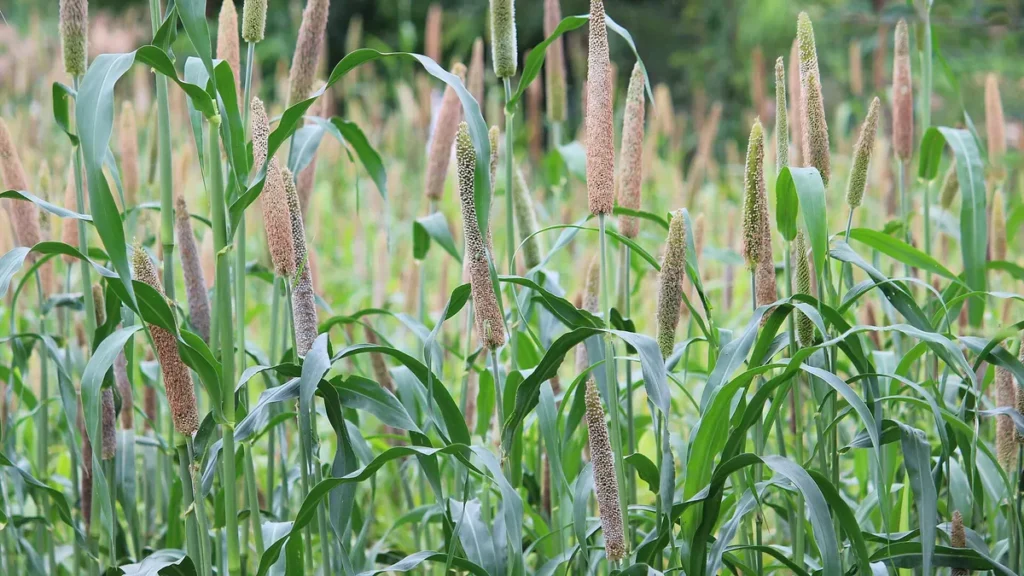
Image: A pearl millet (bajra) field with ripening ears in Tamil Nadu. Shanmugamp7, via Wikimedia Commons, CC BY-SA 3.0
Exam angle
Prelims: Biological Diversity Act, NBA, BMCs, Nagoya vs Cartagena, GEF. · Mains GS-III: biodiversity conservation; farmers’ rights.
Practice MCQs
Original practice questions (not PYQs).
Consider the following statements:
1. The National Biodiversity Authority is headquartered in Chennai.
2. The Cartagena Protocol deals with access and benefit-sharing.
3. The Biological Diversity Act, 2002 was amended in 2023.
Which of the statements given above are correct?
Answer (c) & explanation
Cartagena is on biosafety; benefit-sharing is the Nagoya Protocol.
In India, which body can levy collection fees for access to biological resources within its jurisdiction?
Answer (c) & explanation
BMCs in local bodies can levy collection fees and help meet Nagoya Protocol goals.
The financial mechanism for both the Convention on Biological Diversity and the UNFCCC is:
Answer (b) & explanation
The Global Environment Facility serves as the financial mechanism of the CBD and the UNFCCC.
Questions students ask about this
What is access and benefit-sharing (ABS)?
Anyone using India’s plants, animals or traditional knowledge for business must share part of the gain with those who conserved them.
How much ABS money was shared now?
About ₹1.04 crore, with 27 State Biodiversity Boards and two UT Biodiversity Councils.
Why was an area-based method used?
The crops came through markets, so the conserving communities could not be identified.
Which treaty governs benefit-sharing?
The Nagoya Protocol (2010) under the Convention on Biological Diversity.
Where is the National Biodiversity Authority?
Chennai; set up in 2003.
Official source: PIB, Ministry of Environment, Forest and Climate Change, 24 Oct 2026: Agricultural biological resources generate around ₹1.04 crore in ABS benefits