
How the humble salt marsh softens the ocean’s fury
A salt marsh is a coastal wetland covered with grasses that can live in salty water. A new study by Dutch researchers tested a real marsh against huge waves in a giant water tank and found that its roots held the soil together even when the plants were badly damaged. Read it to understand salt marshes, blue carbon and how nature can protect our coasts.
- Test tank
- 300 metres long
- Waves
- Up to 2 metres high
- Soil lost
- Only 7 mm
- India’s salt marshes
- About 290 sq km, largest in Gujarat
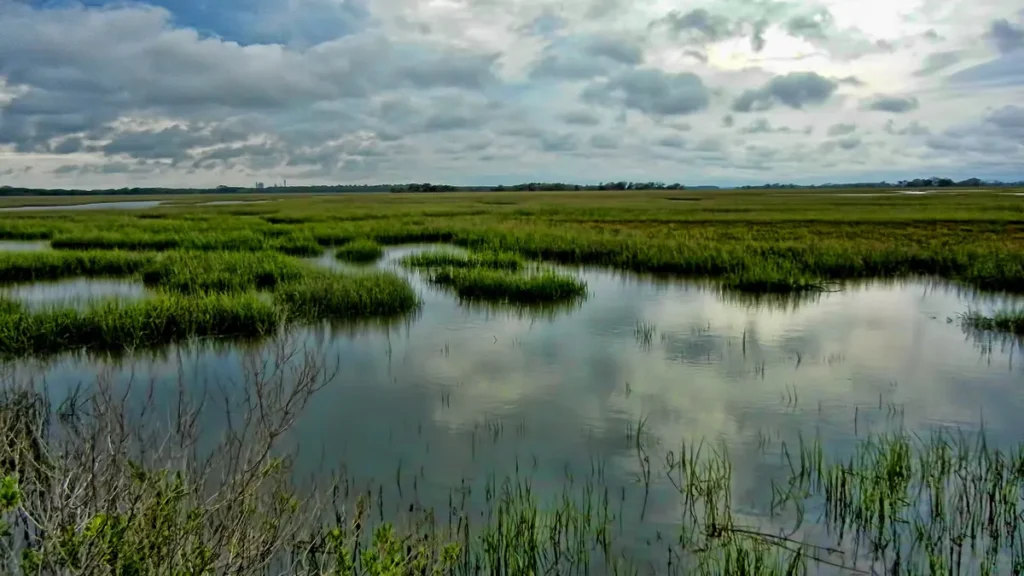
Salt marshes: what did the study find?
A concrete sea wall cracks and needs repair. A salt marsh repairs itself, grows with rising seas and stores carbon. Scientists now have strong proof of how well it handles big waves.
- Dutch researchers moved 306 sq metres of live salt marsh into a 300-metre-long water tank.
- They hit it with waves up to 2 metres high, like a strong storm.
- The plants lost 75–80% of their biomass (living plant material), yet the marsh surface fell by only 7 mm.
- The roots held the soil together even when the plants above were badly damaged.
- Waves lose power as they pass over the marsh and its plants, so less energy reaches the land behind.
What is a salt marsh?
A salt marsh is a coastal wetland that is flooded and drained by tides. Salt-tolerant grasses, herbs and low shrubs grow there. It usually forms in sheltered places like estuaries and lagoons.
Mangroves are trees that grow in warm, salty coasts; salt marshes are mostly grasses and are common where mangroves are fewer. Both slow down waves and trap mud.
Salt marshes, mangroves and seagrass beds store large amounts of carbon in their soil. This is called blue carbon. When they are destroyed, that carbon goes back into the air.
In India, salt marshes cover about 290 sq km (a 2020 study), with the largest in Gujarat, around the Gulf of Kutch. They are threatened by expanding aquaculture (fish and shrimp farms) and coastal building.
Nature’s coastal guards
| Ecosystem | What grows there | How it helps |
|---|---|---|
| Salt marsh | Salt-tolerant grasses | Slows waves, holds soil, stores carbon |
| Mangrove | Salt-tolerant trees | Breaks storm surges, nursery for fish |
| Seagrass | Underwater flowering plants | Calms water, stores carbon |
Which laws and plans apply?
- Coastal Regulation Zone Notification, 2019, under the Environment (Protection) Act, 1986: limits building on coasts.
- Wetlands (Conservation and Management) Rules, 2017.
- MISHTI (2023): scheme to plant mangroves along the coast.
- Ramsar Convention (1971): global treaty to protect wetlands.
Why does salt marshes matter?
| Angle | What to note |
|---|---|
| Disaster risk | Marshes reduce damage from storm waves and cyclones. |
| Climate | Blue carbon stores help fight climate change. |
| Cheap protection | Nature-based defences cost less to maintain than sea walls. |
| Livelihoods | Marshes support fish, birds and grazing. |
What are the problems with salt marshes?
- Shrimp farms and salt pans are eating into marshes.
- Ports and roads cut off tidal water flow.
- Rising seas may drown marshes that cannot move inland.
- Salt marshes get less attention than mangroves in policy.
What should be done next on salt marshes?
- Map and protect India’s salt marshes under wetland rules.
- Add salt marshes, not just mangroves, to coastal restoration plans.
- Combine marshes with sea walls (‘hybrid’ defences) in risky areas.
- Count blue carbon in India’s climate plans.
What can Prelims ask on salt marshes?
Prelims probability: Expect a question on coastal ecosystems: salt marshes, mangroves and seagrass store blue carbon; Gujarat has India’s largest salt marshes.
- Salt marsh: tidal coastal wetland with salt-tolerant grasses.
- Blue carbon: carbon stored by oceans and coastal ecosystems (mangroves, seagrass, salt marshes).
- India’s largest salt marshes: Gujarat (Gulf of Kutch); about 290 sq km in all.
- MISHTI: Mangrove Initiative for Shoreline Habitats and Tangible Incomes.
- Ramsar Convention: 1971, Ramsar, Iran.
How to write about salt marshes in Mains
Practice question (15 marks, 250 words): Nature-based solutions offer a sustainable way to protect India’s coasts from rising seas and storms. Discuss with reference to salt marshes and mangroves.
- Intro: study shows marsh roots hold soil under 2-metre waves.
- Benefits: wave reduction, blue carbon, low cost, livelihoods.
- Threats: aquaculture, building, sea level rise.
- Way forward: CRZ, wetland rules, MISHTI, hybrid defences.
- Conclusion: protect nature that protects us.
Ready lines for your answer
- The roots held the soil together even when the plants were badly damaged.
- A living shoreline grows with the sea; a concrete wall only waits to break.
Quotable data pointUnder 2-metre waves, the marsh surface fell only 7 mm though plants lost 75–80% of their biomass.
Photo: Trish Hartmann, CC BY 2.0, via Wikimedia Commons
Exam angle
Prelims: salt marsh, blue carbon, MISHTI, CRZ. · Mains GS-I: coastal geography; GS-III: disaster management and climate.
Practice MCQs
Original practice questions (not PYQs).
Which of the following is the most logical and rational inference that can be made from the passage?
Answer (a) & explanation
The passage says the roots held the soil even after the plants were damaged. The other options either overstate the results or contradict the warning in the last line.
'Blue carbon' refers to:
Answer (d) & explanation
Blue carbon is carbon stored by oceans and coastal ecosystems such as mangroves, seagrass and salt marshes.
Questions students ask about this
What is a salt marsh?
A coastal wetland flooded by tides, covered with grasses and plants that tolerate salt.
What did the study find?
Even after plants lost 75–80% of their biomass under 2-metre waves, the marsh surface fell only 7 mm because the roots held the soil.
What is blue carbon?
Carbon stored by oceans and coastal ecosystems such as mangroves, seagrass and salt marshes.
Where are India's largest salt marshes?
In Gujarat. India's salt marshes cover about 290 sq km in all.