
Cabinet clears ₹7,396-crore scheme to train panchayats
A village panchayat decides on roads, drains, water and schools, but many members get little training to plan or spend money well. The Union Cabinet has now approved the Pradhan Mantri Viksit Gram Swaraj Yojana, a ₹7,395.55 crore scheme for five years, to help panchayats plan better and use digital tools. Read it to revise the scheme, the 73rd Amendment and how village plans are made.
- Scheme
- Pradhan Mantri Viksit Gram Swaraj Yojana
- Cost
- ₹7,395.55 crore
- Period
- 2026-27 to 2030-31
- Reach
- About 32 lakh members and staff, 2.55 lakh panchayats
The new panchayat scheme: what happened?
Imagine being elected sarpanch with a budget of lakhs but no one to teach you how to make a plan, keep accounts or use a government portal. This scheme is meant to fill that gap.
- The Union Cabinet approved the Pradhan Mantri Viksit Gram Swaraj Yojana at a cost of ₹7,395.55 crore.
- It will run for five years, from 2026-27 to 2030-31.
- Who pays: the Centre gives ₹4,869.48 crore and the States ₹2,526.07 crore, so it is a Centrally Sponsored Scheme.
- It will reach about 32 lakh elected members and staff across 2.55 lakh panchayats and traditional local bodies.
- It is an upgraded Rashtriya Gram Swaraj Abhiyan (RGSA). Instead of separate training for each scheme, it will support “holistic” (all-round) village plans.
- About 2.55 lakh Gram Panchayat Development Plans will be prepared each year on the eGramSwaraj portal.
How do panchayats work, and why do they need training?
The 73rd Constitutional Amendment of 1992 gave panchayats constitutional status. It came into force on 24 April 1993, which is why 24 April is National Panchayati Raj Day.
It created a three-tier system in most States: village, block (intermediate) and district. It also reserved at least one-third of seats for women and seats for Scheduled Castes and Scheduled Tribes.
Article 243G lets States give panchayats powers over 29 subjects listed in the Eleventh Schedule, such as drinking water, roads and primary education. Every panchayat is expected to prepare a Gram Panchayat Development Plan (GPDP) each year.
But many panchayats depend on grants, have few staff and lack planning skills. The RGSA, launched in 2018, trained members; the new scheme builds on it with digital help and online audits.
Who pays for the scheme?
| Share | Amount | Note |
|---|---|---|
| Centre | ₹4,869.48 crore | Larger share |
| States | ₹2,526.07 crore | States add their part |
| Total | ₹7,395.55 crore | 2026-27 to 2030-31 |
Which laws and Articles apply?
- 73rd Amendment, 1992: Part IX of the Constitution (Articles 243 to 243O) on panchayats.
- Article 243G: powers and responsibilities of panchayats; Eleventh Schedule lists 29 subjects.
- Article 243I: the Governor sets up a State Finance Commission every five years to review panchayat finances.
- Article 243K: the State Election Commission conducts panchayat elections.
Why does the new panchayat scheme matter?
| Angle | What to note |
|---|---|
| Local planning | Better-trained members can make plans that fit their village. |
| Spending well | Training in accounts and audits reduces waste. |
| Digital tools | eGramSwaraj puts plans and spending online for anyone to see. |
| Women leaders | Many first-time women members gain skills and confidence. |
What are the problems with the new panchayat scheme?
- Panchayats still depend heavily on grants from above.
- States have not handed over all 29 subjects with funds, functions and staff.
- ‘Proxy’ leaders, such as husbands acting for elected women, weaken real power.
- Weak internet and few computer operators slow digital work in remote villages.
What should be done next on the new panchayat scheme?
- Give panchayats the ‘three Fs’: funds, functions and functionaries (staff).
- Train members in their own language, with refresher courses every year.
- Help panchayats raise their own income, such as property tax.
- Use social audits through the Gram Sabha to check spending.
What can Prelims ask on the new panchayat scheme?
Prelims probability: Expect a statement question on the Pradhan Mantri Viksit Gram Swaraj Yojana: ₹7,395.55 crore, 2026-27 to 2030-31, an upgrade of the Rashtriya Gram Swaraj Abhiyan, with plans on eGramSwaraj.
- PM Viksit Gram Swaraj Yojana: ₹7,395.55 crore; 2026-27 to 2030-31; upgrade of RGSA.
- Centrally Sponsored: Centre ₹4,869.48 crore, States ₹2,526.07 crore.
- 73rd Amendment, 1992; in force 24 April 1993 (National Panchayati Raj Day).
- Article 243I: State Finance Commission, set up by the Governor every five years.
- Eleventh Schedule: 29 subjects; GPDPs are uploaded on eGramSwaraj.
How to write about the new panchayat scheme in Mains
Practice question (15 marks, 250 words): Panchayats in India remain dependent on grants and lack the capacity to plan for local development. In the light of the newly approved Pradhan Mantri Viksit Gram Swaraj Yojana, discuss how capacity building and digital tools can make panchayats effective units of local governance.
- Intro: the new ₹7,395.55 crore scheme; 73rd Amendment’s promise.
- Problems: grants, weak devolution, few staff, low skills.
- How the scheme helps: holistic plans, training, eGramSwaraj, online audits.
- Other steps: three Fs, own revenue, Gram Sabha social audits.
- Conclusion: skilled panchayats make Gram Swaraj real.
Ready lines for your answer
- The scheme moves from scheme-by-scheme training to holistic village plans.
- Panchayats need funds, functions and functionaries, not just training.
Quotable data pointAbout 32 lakh elected members and staff across 2.55 lakh panchayats will be covered; 2.55 lakh GPDPs a year on eGramSwaraj.
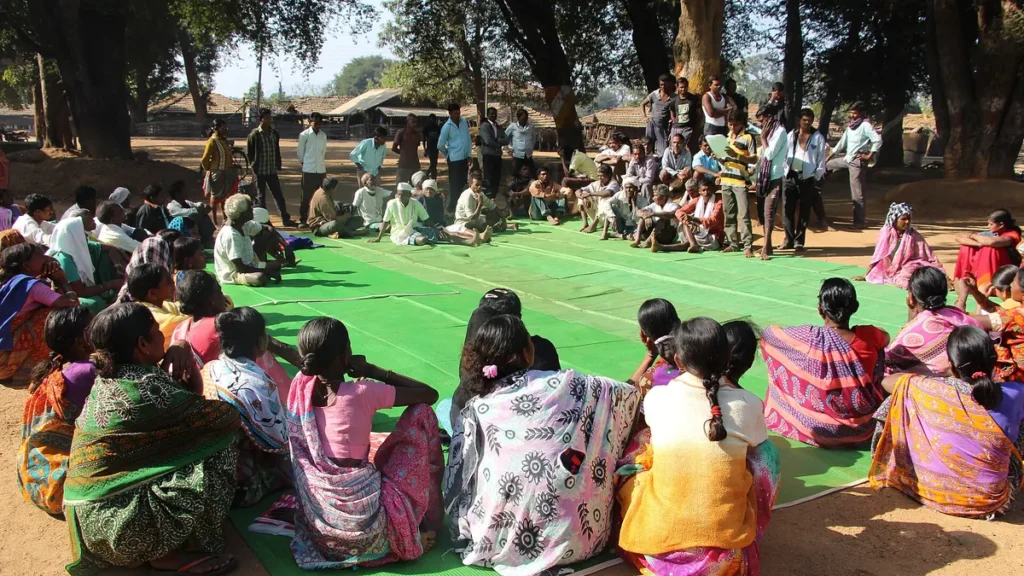
Photo: Mendhalekha, CC BY-SA 4.0, via Wikimedia Commons
Exam angle
Prelims: scheme facts, Articles 243G, 243I, 243K, Eleventh Schedule. · Mains GS-II: devolution, local governance, capacity building.
Practice MCQs
Original practice questions (not PYQs).
Consider the following statements:
1. The Pradhan Mantri Viksit Gram Swaraj Yojana will run from 2026-27 to 2030-31.
2. It is a Central Sector Scheme fully funded by the Centre.
3. It will pay a monthly stipend to elected panchayat members.
How many of the above statements are correct?
Answer (a) & explanation
Only statement 1 is correct. It is a Centrally Sponsored Scheme: the Centre gives ₹4,869.48 crore and the States ₹2,526.07 crore. Members get no stipend.
Under the Seventy-third Amendment, who constitutes the State Finance Commission that reviews the finances of panchayats?
Answer (d) & explanation
Article 243I: the Governor constitutes a State Finance Commission every five years.
Questions students ask about this
What is the Pradhan Mantri Viksit Gram Swaraj Yojana?
A ₹7,395.55 crore scheme approved by the Union Cabinet to train panchayats and help them plan and govern better, from 2026-27 to 2030-31.
Is it a Central Sector or Centrally Sponsored Scheme?
Centrally Sponsored. The Centre gives ₹4,869.48 crore and the States ₹2,526.07 crore.
Which scheme does it upgrade?
The Rashtriya Gram Swaraj Abhiyan (RGSA).
Where are village plans uploaded?
Gram Panchayat Development Plans are uploaded on the eGramSwaraj portal.