
Mineral exchanges to bring fair prices to India’s mining
Today most of India’s minerals are sold through private deals and auctions, so nobody knows the fair price and small miners often lose out. India now plans mineral exchanges: online markets where buyers and sellers trade real ore openly, starting with iron ore. Read it to revise the MMDR Act, the Indian Bureau of Mines and India’s critical minerals push.
- Law
- Section 18B, MMDR Act, 1957
- Rules
- Mineral Exchange Rules, 2026
- Regulator
- Indian Bureau of Mines
- First mineral
- Iron ore
Mineral exchanges: what is the plan?
A farmer selling wheat at an open mandi sees many bids and gets a fairer price than one selling quietly to a single trader. Mineral exchanges want to bring that open market to iron ore and other minerals.
- India’s minerals are mostly sold through private deals and auctions, so prices are not clear and small miners get a weak deal.
- Mineral exchanges will be online markets where buyers and sellers trade actual ore (physical delivery, not just paper bets).
- Iron ore will come first. Lithium, cobalt and rare earths may follow later.
- Section 18B of the Mines and Minerals (Development and Regulation) Act, 1957 allows trading through mineral exchanges. The Mineral Exchange Rules, 2026 give the details.
- The Indian Bureau of Mines (IBM) will register and regulate them, except for coal, lignite and atomic minerals.
- First players: PTC India plans a ₹65 crore exchange unit, and the Multi Commodity Exchange has set up a mineral exchange arm.
How is mining governed in India?
Minerals belong to the States, but Parliament makes the main law on how they are developed. That law is the MMDR Act, 1957. States grant mining leases and collect royalty.
In 2015, the law was changed so that mines are given only through auctions, to end favouritism. In 2023, it was amended again to let the Centre auction critical minerals such as lithium and to allow private exploration.
Critical minerals are those needed for batteries, electronics and clean energy, where supply is risky. India identified 30 of them in 2023 and launched the National Critical Mineral Mission in 2025.
The IBM, set up in 1948 under the Ministry of Mines and based in Nagpur, checks mining plans and keeps mineral data.
Private deal versus exchange
| Point | Private deal or auction | Mineral exchange |
|---|---|---|
| Price | Known only to the two sides | Open to all bidders |
| Small miners | Weak bargaining power | Many buyers on one platform |
| Records | Scattered | Every trade recorded |
Which laws and Articles apply?
- MMDR Act, 1957: main law on mining; Section 18B allows mineral exchanges.
- Mineral Exchange Rules, 2026: registration and working of exchanges.
- Seventh Schedule: Union List Entry 54 (regulation of mines in public interest) and State List Entry 23 (mines, subject to Union law).
- National Critical Mineral Mission (2025): secure supply of critical minerals.
Why does mineral exchanges matter?
| Angle | What to note |
|---|---|
| Price discovery | Open bids reveal a fair market price. |
| Small miners | Better access to buyers and fair deals. |
| Transparency | Recorded trades reduce under-reporting and illegal sales. |
| Critical minerals | A future market for lithium, cobalt and rare earths. |
What are the problems with mineral exchanges?
- Big buyers like steel makers may still dominate.
- Ore quality differs, so standard grades and testing are needed.
- Transport from mine to buyer can be costly and slow.
- A new market may see low trading at first.
What should be done next on mineral exchanges?
- Set clear quality grades and trusted testing labs.
- Link exchanges with rail and port logistics.
- Start with iron ore and add minerals step by step.
- Watch for price manipulation with strong rules from the IBM.
What can Prelims ask on mineral exchanges?
Prelims probability: Expect a statement question: Section 18B of the Mines and Minerals (Development and Regulation) Act, 1957 allows mineral exchanges, regulated by the Indian Bureau of Mines.
- Section 18B, MMDR Act, 1957: mineral exchanges.
- Regulator: Indian Bureau of Mines (Nagpur, Ministry of Mines); not for coal, lignite and atomic minerals.
- Rare earth elements: a group of 17 elements.
- India identified 30 critical minerals (2023); National Critical Mineral Mission launched 2025.
- MMDR amendments: 2015 (auctions), 2023 (critical minerals, exploration licences).
How to write about mineral exchanges in Mains
Practice question (15 marks, 250 words): Transparent price discovery is key to a fair and efficient mining sector. Discuss how mineral exchanges can transform India’s mining economy, and the challenges involved.
- Intro: Section 18B, Mineral Exchange Rules 2026, iron ore first.
- Benefits: price discovery, small miners, transparency, critical minerals market.
- Challenges: grading, logistics, big-buyer dominance, low liquidity.
- Way forward: standards, logistics links, phased expansion, strong regulation.
- Conclusion: open markets can make mining fairer.
Ready lines for your answer
- Mineral exchanges can do for ore what open mandis try to do for grain: reveal a fair price.
- Transparency in mining protects both State revenue and small miners.
Quotable data pointPTC India plans a ₹65 crore mineral exchange unit; the Multi Commodity Exchange has set up a mineral exchange arm.
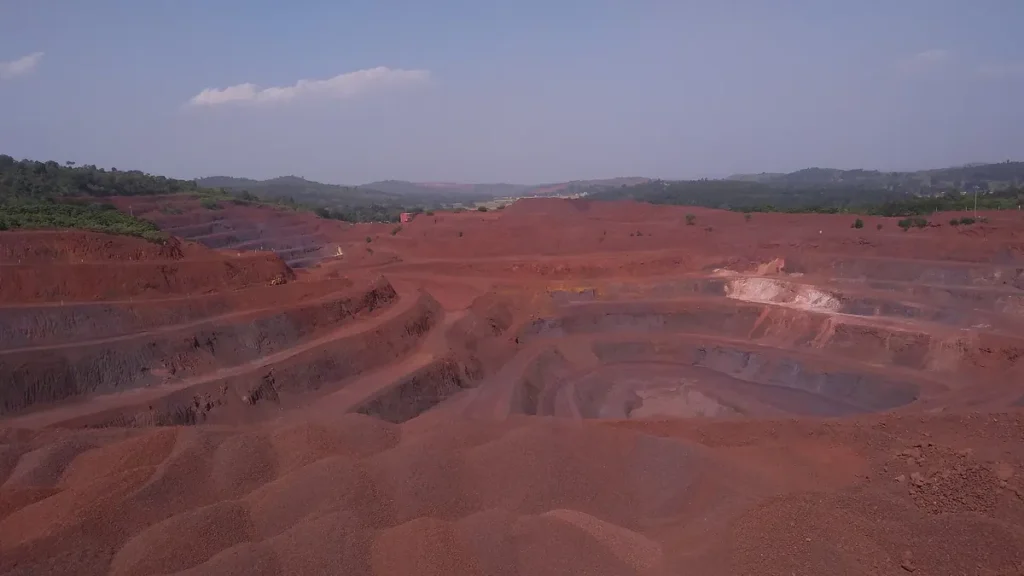
Photo: Bikashkumargiri1997, CC BY-SA 4.0, via Wikimedia Commons
Exam angle
Prelims: MMDR Act, IBM, critical minerals. · Mains GS-III: mining reforms, resource management, transparency.
Practice MCQs
Original practice questions (not PYQs).
Which body has been designated to register and regulate mineral exchanges for minerals other than coal, lignite and atomic minerals?
Answer (d) & explanation
The Indian Bureau of Mines, under the Ministry of Mines, registers and regulates mineral exchanges.
Consider the following statements:
1. Rare earth elements are a group of 17 elements.
2. India is resource-rich in all 30 critical minerals it has identified.
3. The National Critical Mineral Mission was launched in 2025.
How many of the above statements are correct?
Answer (b) & explanation
Statements 1 and 3 are correct. India imports many critical minerals such as lithium, nickel and cobalt.
Questions students ask about this
What is a mineral exchange?
An online market where buyers and sellers trade real mineral ore openly, so prices are clear.
Which law allows mineral exchanges?
Section 18B of the Mines and Minerals (Development and Regulation) Act, 1957.
Who regulates mineral exchanges?
The Indian Bureau of Mines, except for coal, lignite and atomic minerals.
Which mineral will be traded first?
Iron ore. Lithium, cobalt and rare earths may follow later.