
Maritime Law Reform in India: Indian Ports Act 2025, Carriage of Goods by Sea Act 2025, Merchant Shipping, Coastal Shipping and Bills of Lading Laws, Port Governance and Challenges (UPSC Notes + PYQs)
UPSC has already asked about this. Read the story with these questions in mind.
Old laws for a new sea
Around 95% of India’s trade by volume and about 70% by value travels by sea. Yet until 2025 the ships, cargo and ports that carry this trade were governed by laws written when steamships were new: the Bills of Lading Act of 1856, the Indian Ports Act of 1908, the Indian Carriage of Goods by Sea Act of 1925 and the Merchant Shipping Act of 1958. These laws did not speak of containers, digital documents, green fuels or private terminal operators. They also left the relationship between the Centre and coastal States vague, so that each State developed its non-major ports in its own way, sometimes in competition with the Centre’s major ports next door.
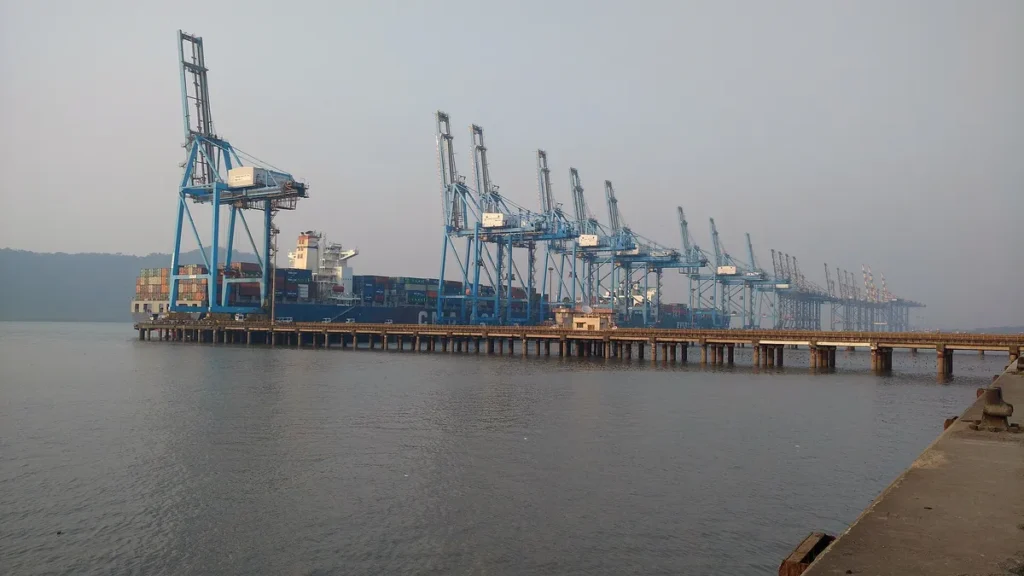
Under the Constitution, major ports fall in the Union List (Entry 27), while other ports are in the Concurrent List (Entry 31). India has 12 major ports under the Centre, with Vadhavan in Maharashtra being built as the 13th, and around 200 non-major ports managed by States through maritime boards. The Major Port Authorities Act, 2021 already modernised the governance of major ports. The 2025 package finished the job for the rest of the maritime system.
- Indian Ports ActReplaces 1908
- Carriage of Goods by SeaReplaces 1925
- Bills of LadingReplaces 1856
- Merchant and Coastal ShippingReplace 1958 Act
Indian Ports Act, 2025
- Replaces the Indian Ports Act, 1908; passed by Parliament in August 2025.
- Maritime State Development Council (MSDC): a statutory body chaired by the Union Minister for Ports, Shipping and Waterways, with State ministers as members. It prepares a national perspective plan so that port development is coordinated across States.
- MSDC membership: the ministers in charge of ports of each coastal State, Puducherry’s minister and the administrators of other coastal UTs, secretary-rank officers of the Navy and Coast Guard, and the Secretary of the Union Ports Ministry as Member Secretary.
- MSDC guidelines: the Council issues guidelines on tariff transparency and on collection and submission of port data.
- State Maritime Boards: given statutory recognition to administer non-major ports.
- Dispute resolution: each State must set up a Dispute Resolution Committee for disputes between non-major ports, concessionaires, port users and service providers.
- Pollution and safety: ports must comply with conventions such as MARPOL and the Ballast Water Convention, and prepare pollution control and disaster management plans, audited periodically by the Centre.
- Port officers: the conservator and health officer get powers of entry, inspection and penalty.
- 1Maritime State Development Council (Union Minister)
- 2National perspective plan
- 3State Maritime Boards run non-major ports
- 4Dispute resolution committees
- 5Pollution and safety compliance
The rest of the package
| New law (2025) | Replaced | Main change |
|---|---|---|
| Bills of Lading Act | Indian Bills of Lading Act, 1856 | Simpler language; clarifies rights of holders of the document of title to cargo |
| Carriage of Goods by Sea Act | Indian Carriage of Goods by Sea Act, 1925 | Keeps Hague-Visby Rules on carrier liability; lets the Centre issue rules and adapt to new conventions |
| Coastal Shipping Act | Part of Merchant Shipping Act, 1958 | Separate law to grow coastal shipping; licensing of foreign ships in coastal trade; national coastal shipping plan |
| Merchant Shipping Act | Merchant Shipping Act, 1958 | Modern registration, seafarer welfare, safety and pollution rules; wider ownership norms to grow the Indian fleet |
| Indian Ports Act | Indian Ports Act, 1908 | Centre-State coordination through MSDC; port governance |
Carriage of Goods by Sea in a nutshell
When a shipper in Chennai sends machinery to Singapore, the contract with the shipping line is evidenced by a bill of lading. If the cargo is damaged, who pays and how much? The Hague-Visby Rules, an international convention, answer this by setting the carrier’s duties, such as making the ship seaworthy and caring for cargo, and limits on its liability. India’s 1925 law already followed the Hague Rules. The 2025 Act keeps this base, simplifies the text and gives the Centre power to issue directions and amend the schedule, so that India can adopt newer rules like the Rotterdam Rules if it chooses.
India’s maritime picture
| Indicator | Status |
|---|---|
| Coastline | About 11,000 km after a 2025 re-measurement (earlier 7,516 km) |
| Major ports cargo | About 855 million tonnes in 2024-25 |
| Share of Indian ships in carrying Indian trade | Below 10% |
| Global shipbuilding share | Under 1% |
| Plans | Maritime India Vision 2030, Maritime Amrit Kaal Vision 2047, Sagarmala |
In September 2025 the Union Cabinet also approved a ₹69,725 crore package to revive shipbuilding and ship repair, including a Maritime Development Fund, because India pays tens of billions of dollars a year in freight to foreign shipping lines.
Why the reforms matter
- Ease of doing business: clear, modern laws cut disputes and give investors confidence.
- Cooperative federalism: the MSDC gives the Centre and coastal States a formal table to plan ports together, avoiding duplication.
- Logistics cost: better ports and coastal shipping can lower India’s logistics costs, which are high compared with peers, and support PM Gati Shakti.
- Blue economy and security: ports are both trade gates and strategic assets in the Indian Ocean, linked with SAGAR and the IMEC corridor.
- Green shipping: rules for pollution and new fuels prepare ports for green hydrogen and ammonia bunkering.
Concerns
- Centralisation: Kerala and Tamil Nadu, among other opposition-ruled coastal States, formally objected that the Act intrudes on their powers over non-major ports. Their main points: the MSDC is chaired by the Union Minister and its guidelines on tariffs and data could shape pricing and planning that State maritime boards now control; national perspective planning could override State port policies; and Kerala objected to the need for central approval for a significant change in a port’s ownership or control.
- Inspection powers: wide powers of entry and inspection for port officers come without matching safeguards, and there is no appeal against penalties levied by the conservator.
- Implementation: rules and plans under the new laws decide how much the reform achieves.
- Fleet and shipbuilding gap: laws alone will not create Indian ships; finance, yards and skilled labour are needed.
- Environment and fishers: port expansion can harm coasts, mangroves and fishing communities, as protests at Vizhinjam and Vadhavan showed.
- Seafarer welfare: issues of abandonment of crews and wage protection need strong enforcement.
- Small Indian fleet
- Little shipbuilding
- High logistics costs
- Old laws until 2025
Way forward
Frame rules quickly and in consultation with States and industry. Use the MSDC to plan hub ports and feeder ports as one network. Pair legal reform with finance for shipbuilding, ship ownership by Indian entities and coastal shipping incentives. Protect coastal ecology through strict environmental clearances and shoreline management. Train seafarers and port workers for automation and green fuels. Track results through clear indicators such as turnaround time, cost per container and share of Indian ships.
PYQ trend
Prelims asks about Sagarmala, major ports and new ports such as Vizhinjam. Mains GS-III asks about infrastructure, maritime security and sea trade; GS-II about Indian Ocean strategy.
Indian Ports Act 2025: UPSC angle
For UPSC CSE
Prelims: new Acts, constitutional entries, major ports. Mains GS-III: infrastructure, logistics, blue economy, maritime security; GS-II: Centre-State relations.
Indian Ports Act 2025 UPSC PYQs (Prelims)
Questions UPSC has actually asked, from the official papers. Pick an option to check yourself.
Consider the following statements with reference to the Sagarmala Programme of the Government of India :
– I. The Sagarmala Programme seeks to achieve port-led economic growth through cost-effective and sustainable coastal infrastructure.
– II. The success of the Sagarmala Programme is reflected in significant growth in coastal and inland waterway shipping, along with improved global port rankings.
– III. Sagarmala 2.0 aims to position India as a global maritime innovation hub aligned with Atmanirbhar Bharat and Viksit Bharat 2047 visions.
Which of the following relationships among the above statements is/are correct ?
– 1. Statement II validates the effectiveness of the strategies envisioned in statement I.
– 2. Statement III extends the objectives of statement I by embedding them into a future-oriented innovation framework.
– 3. Statement I contradicts statement III by focusing only on traditional infrastructure instead of modern innovation.
Select the answer using the code given below :
Sagarmala (2015, Ministry of Ports, Shipping and Waterways) aims at port-led development. Growth in coastal shipping and port rankings is evidence that it works (1). Sagarmala 2.0 builds on the same aim with innovation and shipbuilding (2). Building on an aim is not contradicting it, so 3 is wrong. Answer as per the official UPSC key · Battle IAS PYQ bankAnswer (b) & why
Consider the following pairs :
| Port | Well known as
| 1. Kamarajar Port | First major port in India registered as a company
| 2. Mundra Port | Largest privately owned port in India
| 3. Visakhapatnam Port | Largest container port in India
How many of the above pairs are correctly matched?
Kamarajar (Ennore) was the first major port set up as a company, not a port trust. Adani’s Mundra is the largest private port. India’s largest container port is Jawaharlal Nehru Port (Nhava Sheva), with Mundra close behind. Visakhapatnam is known for bulk cargo. Answer as per the official UPSC key · Battle IAS PYQ bankAnswer (b) & why
In what way(s) does the Vizhinjam International Seaport represent a structural shift in India's maritime trade and logistics policy ?
– 1. By functioning exclusively as a domestic cargo hub to reduce reliance on coastal shipping and eliminate the need for foreign collaborations.
– 2. By focusing primarily on passenger cruise tourism and heritage shipping to increase Kerala's profile as a maritime heritage destination.
– 3. By leveraging its natural deep draft and strategic location to reduce dependence on foreign trans-shipment ports, enhance revenue retention, and reposition India in regional maritime trade.
Select the answer using the code given below :
Vizhinjam (Kerala) is India’s first deep-water container trans-shipment port, built on a PPP model and opened in 2025. It sits close to the main East-West shipping lane and has a natural depth of about 18-20 m, so mother ships can call here instead of at Colombo, Singapore or Dubai. That keeps freight earnings at home. It is an international cargo port, not a domestic or cruise port. Answer as per the official UPSC key · Battle IAS PYQ bankAnswer (d) & why
Mains PYQs on this topic
Questions from the official UPSC Mains papers (2023-2026 in the Battle IAS Mains bank), newest first. Each links to a model answer.
- UPSC Mains 2025 · GS Paper III · Q20 · 15 marks
Why is maritime security vital to protect India’s sea trade ? Discuss maritime and coastal security challenges and the way forward.
Quick quiz
The Indian Ports Act, 2025 replaced an Act of
Indian Ports Act, 1908.Answer (b)
Ports other than major ports are in which list?
Concurrent List Entry 31.Answer (c)
The Maritime State Development Council is chaired by
Union Minister of Ports, Shipping and Waterways.Answer (b)
FAQs
What is the Indian Ports Act, 2025?
A law replacing the 1908 Act that sets up a statutory Maritime State Development Council, backs State Maritime Boards and lays down rules on port safety, pollution and disputes.
What does the Carriage of Goods by Sea Act, 2025 do?
It replaces the 1925 law on carrier liability for sea cargo, keeps the Hague-Visby Rules and lets the Centre adapt rules to new conventions.
What is the difference between major and non-major ports?
Major ports are under the Centre and governed by the Major Port Authorities Act, 2021; non-major ports are managed by State maritime boards.
Why did some States object?
Kerala, Tamil Nadu and others said the Union-chaired MSDC and its guidelines on tariffs and data, central planning and approval for ownership changes reduce State control over non-major ports.
Which other maritime laws were passed in 2025?
The Bills of Lading Act, the Coastal Shipping Act and the Merchant Shipping Act.
Spotted an error? Tell us. We correct within 48 hours.
Image: Ccmarathe, Wikimedia Commons, CC BY-SA 4.0
How to use this in Mains
If asked: UPSC Mains 2025, GS-III: Why is maritime security vital to protect India’s sea trade ? Discuss maritime and coastal security challenges and the way forward.
Quote: “Cooperative federalism: the MSDC gives the Centre and coastal States a formal table to plan ports together, avoiding duplication.”
Use it: Use it as a governance point: ports reform also needs Centre-State coordination.
In the news
UDAN turns 10: 687 routes, 1.72 crore flyers and a Rs 28,840 crore next phase
The Regional Connectivity Scheme UDAN (Ude Desh ka Aam Nagrik) completes ten years on 21 October 2026. A PIB backgrounder says it has operationalised 687 routes and 95 aerodromes and carried 1.72 crore passengers. Its next phase, launched on 4 July 2026, runs from 2026-27 to 2035-36 with Rs 28,840 crore for 100 airports, 200 helipads and airline support.
21 Oct 2026
21st Maritime State Development Council: first MSDC under the Indian Ports Act, 2025
The 21st Maritime State Development Council met in Mumbai on 13 October 2026. It was the first MSDC after the Indian Ports Act, 2025 (notified 15 May 2026) made the Council a statutory body. Members adopted Vision 2030 and 2047 targets and set March 2027 deadlines for One Nation One Port Process and Maritime Single Window integration.
13 Oct 2026
Sagarmanthan 2026: India pitches a “rules-based maritime order” and Maritime Amrit Kaal Vision 2047
The third Sagarmanthan: The Great Oceans Dialogue opened on 7 October 2026, organised by the Shipping Ministry with ORF. The PM's message called for a free, open, secure and rules-based maritime order. The minister presented Maritime Amrit Kaal Vision 2047, and an India-EU Green Shipping Corridor coalition was launched.
7 Oct 2026
Mumbai Port’s Jawahar Dweep declared India’s first plastic-free oil terminal
On 2 October 2026 the Mumbai Port Authority declared its Jawahar Dweep Marine Oil Terminal plastic-free, making it India's first plastic-free oil terminal. The Union Ports Minister marked it at the port's Swachhata Abhiyan on Gandhi Jayanti, honoured sanitation workers and dedicated the port's Oil Spill Response facilities to the nation.
2 Oct 2026