
United States challenged India’s sea claims thrice in a year
India and the United States are close naval partners, yet the US sends warships to test some of India’s sea rules. In 2025 it did this three times, the most in any year since 1991. Read it to revise Freedom of Navigation Operations, the zones under the Law of the Sea Convention and India’s Maritime Zones Act, 1976.
- Challenges
- 3 in financial year 2025
- Record
- Most since 1991
- India’s law
- Maritime Zones Act, 1976
- India’s rank
- 7th most challenged
The US sea challenges: what happened?
Two friends can still disagree on the rules of the road. At sea, the United States shows its disagreement by sailing a warship through waters where it thinks a country’s rules go too far.
- The United States carried out three Freedom of Navigation Operations (FONOPs) against India in financial year 2025, the highest since records began in 1991.
- It challenged India’s straight baselines around Lakshadweep.
- It challenged India’s rule that foreign navies need prior consent for military drills in India’s Exclusive Economic Zone (EEZ).
- It challenged India’s notice rules for ships carrying hazardous cargo.
- India gave no public reply. India is now the seventh most challenged country, ahead of Japan and the Philippines.
What are Freedom of Navigation Operations?
Under its Freedom of Navigation programme, the US military sails or flies through areas where it thinks a country claims more than international law allows. It does this against friends and rivals alike.
The rules of the sea are set by the United Nations Convention on the Law of the Sea (UNCLOS), 1982. India ratified it in 1995. The US follows most of its rules but has not ratified it.
India says foreign military exercises in its EEZ need its consent. The US says the EEZ gives a country rights over resources, not the power to stop military activity.
Straight baselines are lines drawn across the coast from which sea zones are measured. The US says India’s lines around Lakshadweep enclose too much sea. In 2021, a US destroyer sailed near Lakshadweep without consent, which India publicly objected to.
What are the sea zones under UNCLOS?
| Zone | Distance from baseline | Coastal country’s rights |
|---|---|---|
| Territorial sea | 12 nautical miles | Full sovereignty; foreign ships get innocent passage |
| Contiguous zone | 24 nautical miles | Customs, tax, immigration and health laws |
| Exclusive Economic Zone | 200 nautical miles | Rights over fish, oil, gas and other resources |
Which laws and Articles apply?
- Territorial Waters, Continental Shelf, Exclusive Economic Zone and Other Maritime Zones Act, 1976: India’s main law on sea zones.
- UNCLOS, 1982: India ratified it in 1995.
- Article 297: minerals and things of value in India’s territorial waters and EEZ belong to the Union.
- Continental shelf: up to 200 nautical miles, or more (up to 350) where the shelf extends.
Why does the US sea challenges matter?
| Angle | What to note |
|---|---|
| Law of the Sea | Tests how UNCLOS zones are read by different countries. |
| India–US ties | Shows that partners can still differ on legal rules. |
| Maritime security | India’s EEZ rules protect its coasts and islands. |
| Indo-Pacific | India’s stand affects its view of China’s claims too. |
What are the problems with the US sea challenges?
- India’s EEZ consent rule differs from the US reading of UNCLOS.
- The US has not ratified UNCLOS, yet uses it to judge others.
- Public disputes could hurt a close defence partnership.
- India must protect its claims without looking like China in the South China Sea.
What should be done next on the US sea challenges?
- Raise the issue quietly through naval and legal talks.
- Explain India’s legal position clearly in global forums.
- Keep strengthening India–US naval cooperation in other areas.
- Back a rules-based order at sea, applied equally to all.
What can Prelims ask on the US sea challenges?
Prelims probability: Expect a question on the Law of the Sea Convention zones: territorial sea 12, contiguous zone 24, Exclusive Economic Zone 200 nautical miles.
- UNCLOS zones: territorial sea 12, contiguous zone 24, EEZ 200 nautical miles.
- India’s Maritime Zones Act, 1976 sets baselines and EEZ rules.
- India ratified UNCLOS in 1995; the US has not ratified it.
- Freedom of Navigation Operations: three against India in 2025, the most since 1991.
- Article 297: resources of territorial waters and EEZ vest in the Union.
How to write about the US sea challenges in Mains
Practice question (15 marks, 250 words): Freedom of Navigation Operations by the United States reflect differences over the Law of the Sea even among close partners. Discuss with reference to India.
- Intro: three FONOPs against India in 2025.
- What was challenged: Lakshadweep baselines, EEZ consent rule, hazardous cargo notice.
- Legal debate: UNCLOS reading; US not a party.
- Impact on India–US ties and Indo-Pacific order.
- Conclusion: quiet diplomacy and a rules-based order for all.
Ready lines for your answer
- Partners at sea can still differ on the rules of the sea.
- A rules-based order must be applied equally to all.
Quotable data pointThree US challenges against India in financial year 2025, the highest since records began in 1991.
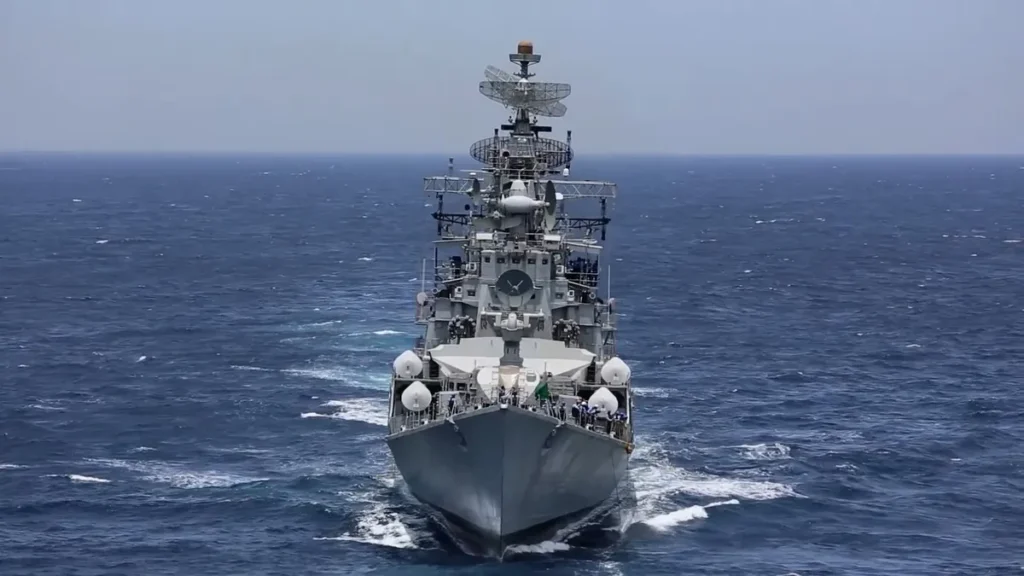
Photo: Indian Navy, GODL-India, via Wikimedia Commons
Exam angle
Prelims: UNCLOS zones, Maritime Zones Act 1976, Article 297, Lakshadweep. · Mains GS-II: India–US ties, Law of the Sea, Indo-Pacific.
Practice MCQs
Original practice questions (not PYQs).
Consider the following statements:
1. The territorial sea extends up to 12 nautical miles from the baseline.
2. In the contiguous zone, up to 24 nautical miles, a country can enforce customs and immigration laws.
3. A coastal country has rights over resources in its Exclusive Economic Zone up to 200 nautical miles.
How many of the above statements are correct?
Answer (c) & explanation
All three are correct under the Law of the Sea Convention. The United States has not ratified the Convention, yet runs Freedom of Navigation Operations.
India's rules on straight baselines and prior consent for foreign military drills in its Exclusive Economic Zone are set by which law?
Answer (b) & explanation
The Territorial Waters, Continental Shelf, Exclusive Economic Zone and Other Maritime Zones Act, 1976 sets these rules.
With reference to the United Nations Convention on the Law of the Sea (UNCLOS), consider the following statements:
1. India has ratified UNCLOS.
2. The United States has ratified UNCLOS.
Which of the statements given above is/are correct?
Answer (a) & explanation
India ratified UNCLOS in 1995. The United States has not ratified it.
Questions students ask about this
What is a Freedom of Navigation Operation?
A US military operation that sails or flies through areas where it thinks a country's sea claims go beyond international law.
How many times did the US challenge India in 2025?
Three times in financial year 2025, the most since records began in 1991.
Which Indian law sets India's sea zones?
The Territorial Waters, Continental Shelf, Exclusive Economic Zone and Other Maritime Zones Act, 1976.
How far does the Exclusive Economic Zone extend?
Up to 200 nautical miles from the baseline.