
Bullet train corridor to link Delhi with Lucknow and Varanasi
Railway Minister Ashwini Vaishnaw has said Prime Minister Narendra Modi approved the northern corridor of India’s bullet train network. It will run from Delhi through Agra, Kanpur, Lucknow, Ayodhya, Varanasi and Prayagraj, and go on to Patna, Siliguri and Guwahati. Delhi to Lucknow would take just over two hours. Read it to revise high-speed rail in India and what it means for Uttar Pradesh.
- Announced
- 31 October 2026, in Varanasi
- Uttar Pradesh stops
- Agra, Kanpur, Lucknow, Ayodhya, Varanasi, Prayagraj
- Delhi–Lucknow
- 2 hours 12 minutes
- Goes on to
- Patna, Siliguri, Guwahati
The northern bullet train corridor: what happened?
Today a fast train takes six to eight hours from Delhi to Lucknow. A bullet train would make it a day trip, changing how people in Uttar Pradesh travel for work, study and business.
- On 31 October 2026, Railway Minister Ashwini Vaishnaw said the Prime Minister has approved the northern corridor of the bullet train network.
- He announced it in Varanasi while flagging off the Vande Bharat Sleeper Express between Varanasi and New Delhi.
- The corridor will start in Delhi and connect Agra, Kanpur, Lucknow, Ayodhya, Varanasi, Prayagraj, Patna and Siliguri, and later extend to Guwahati.
- Expected travel times: Delhi–Agra 59 minutes, Delhi–Kanpur 1 hour 45 minutes, Delhi–Lucknow 2 hours 12 minutes, Lucknow–Varanasi 1 hour 21 minutes, and Delhi–Varanasi about 3.5 hours.
- The minister said construction will be fully Make in India and fares will be much lower than air tickets.
What is high-speed rail in India?
High-speed rail means trains that run at about 250 to 320 km per hour on special tracks, much faster than normal trains.
India’s first bullet train line is the Mumbai–Ahmedabad corridor, about 508 km long. It uses Japan’s Shinkansen technology and is built by the National High Speed Rail Corporation Limited (NHSRCL), with a soft loan from Japan.
A northern route through Uttar Pradesh links the State’s biggest cities and pilgrim centres, such as Ayodhya, Varanasi and Prayagraj.
Uttar Pradesh is also building expressways and freight corridors, so the bullet train adds a fast passenger link to this network.
How fast will the corridor be?
| Route | Bullet train time | Note |
|---|---|---|
| Delhi–Agra | 59 minutes | Tourism hub |
| Delhi–Lucknow | 2 hours 12 minutes | State capital |
| Lucknow–Varanasi | 1 hour 21 minutes | Eastern Uttar Pradesh |
| Delhi–Varanasi | About 3.5 hours | Full stretch in the State |
Which laws and Articles apply?
- Railways is a Union subject (Entry 22, Union List).
- Railways Act, 1989.
- Right to Fair Compensation and Transparency in Land Acquisition, Rehabilitation and Resettlement Act, 2013: land for the project.
- National Rail Plan (2030): target to raise railways’ share of freight and passengers.
Why does the northern bullet train corridor matter?
| Angle | What to note |
|---|---|
| Connectivity | Links the main cities and pilgrim centres of Uttar Pradesh. |
| Economy | Faster travel helps business, tourism and jobs. |
| Environment | Rail is cleaner than flying or driving. |
| Make in India | Construction to use Indian materials and workers. |
What are the problems with the northern bullet train corridor?
- Bullet trains are very costly to build.
- Land acquisition can face resistance and delays.
- The Mumbai–Ahmedabad line has taken many years, showing long timelines.
- Fares must stay affordable for the project to be used widely.
What should be done next on the northern bullet train corridor?
- Finish detailed project reports and costs quickly.
- Acquire land with fair compensation and consent.
- Link stations with metro, bus and normal rail.
- Use lessons from the Mumbai–Ahmedabad project.
What can Prelims ask on the northern bullet train corridor?
Prelims probability: Expect a question on high-speed rail: India’s first bullet train line is Mumbai–Ahmedabad (about 508 km), built with Japan’s Shinkansen technology by NHSRCL.
- First bullet train: Mumbai–Ahmedabad, about 508 km; Japan’s Shinkansen technology.
- NHSRCL builds high-speed rail in India.
- Northern corridor: Delhi–Agra–Kanpur–Lucknow–Ayodhya–Varanasi–Prayagraj–Patna–Siliguri–Guwahati.
- Railways: Union List subject.
- Delhi–Lucknow by bullet train: 2 hours 12 minutes.
How to write about the northern bullet train corridor in Mains
Practice question (UP PCS Mains GS-VI, 8 marks, 125 words): How can high-speed rail change the economy of Uttar Pradesh? Discuss with reference to the northern bullet train corridor.
- Intro: corridor approved; Uttar Pradesh stops.
- Benefits: travel time, tourism, business, jobs.
- Challenges: cost, land, delays, fares.
- Link with expressways and freight corridors.
- Conclusion: fast, affordable and well-connected rail.
Ready lines for your answer
- Speed shrinks distance and grows markets.
- High-speed rail must be fast, safe and affordable.
Quotable data pointDelhi–Varanasi by bullet train would take about 3.5 hours.
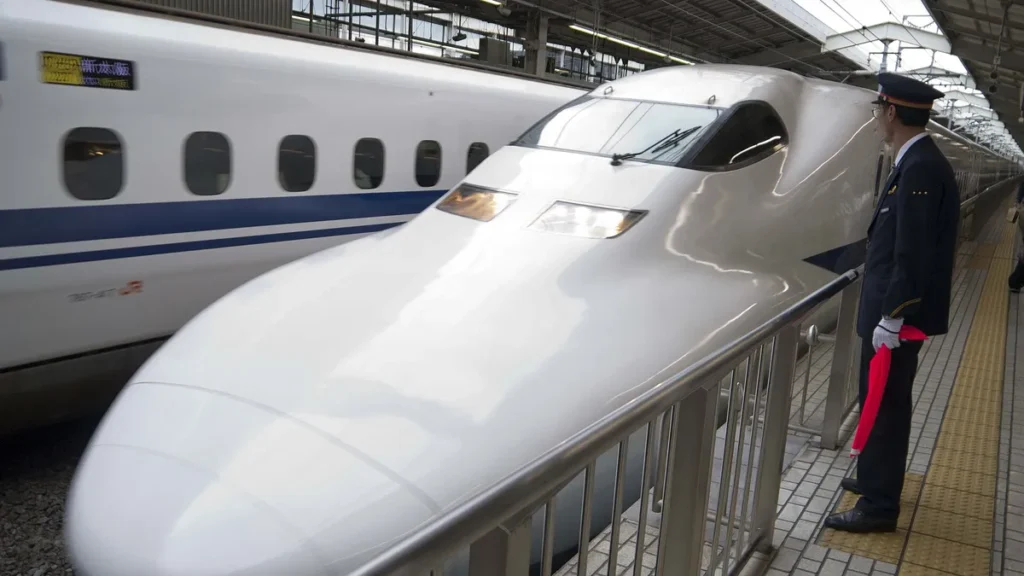
Photo: Bryan Ledgard, CC BY 2.0, via Wikimedia Commons
Exam angle
Prelims: high-speed rail, NHSRCL, Shinkansen. · Mains GS-III: infrastructure and transport.
Practice MCQs
Original practice questions (not PYQs).
India's first high-speed rail corridor, Mumbai–Ahmedabad, uses technology from:
Answer (c) & explanation
It uses Japan's Shinkansen technology and is built with a Japanese soft loan.
Which of the following cities is NOT on the proposed northern bullet train corridor as announced?
Answer (c) & explanation
The announced route is Delhi, Agra, Kanpur, Lucknow, Ayodhya, Varanasi, Prayagraj, Patna, Siliguri and Guwahati.
Railways is listed in which list of the Seventh Schedule?
Answer (a) & explanation
Railways is a Union List subject.
Questions students ask about this
Which cities of Uttar Pradesh will the northern bullet train corridor connect?
Agra, Kanpur, Lucknow, Ayodhya, Varanasi and Prayagraj, starting from Delhi.
How long will Delhi to Lucknow take by bullet train?
About 2 hours 12 minutes, according to the Railway Minister.
Who announced the approval?
Railway Minister Ashwini Vaishnaw, in Varanasi on 31 October 2026.
What is India's first bullet train line?
The Mumbai–Ahmedabad corridor, built with Japan's Shinkansen technology.