
Bihar independents face anti-defection test
Two independents who just won seats in the Bihar Legislative Council were welcomed into the Bharatiya Janata Party. The Opposition says this costs them their seats under the anti-defection law. Read it to revise the Tenth Schedule, the rules for independent and nominated members, and the role of the Chairman or Speaker.
- Members
- Bansidhar Brajwasi, Rahul Raj
- House
- Bihar Legislative Council
- Law
- Tenth Schedule
- Decides
- Acting Chairman Ram Bachan Rai
UPSC has already asked about this. Read the story with these questions in mind.
The Bihar MLC row: what happened?
An independent wins as an independent. If they can quietly join a party the next day, voters lose a say. That is why the law treats this as defection.
- Two newly elected independent members of the Bihar Legislative Council were welcomed into the Bharatiya Janata Party.
- Bansidhar Brajwasi won the Tirhut Graduates’ seat and Rahul Raj the Saran Teachers’ seat; both beat Janata Dal (United) candidates.
- Brajwasi said he joined after an assurance from Chief Minister Samrat Choudhary; Raj said he only offered support.
- The Opposition says an independent who joins a party loses the seat under the Tenth Schedule.
- The Rashtriya Janata Dal will petition Acting Chairman Ram Bachan Rai to disqualify both, or go to court.
What is the anti-defection law?
The Tenth Schedule was added to the Constitution by the 52nd Amendment in 1985 to stop legislators from switching sides for gain.
It covers both Houses of Parliament and of State Legislatures, including Legislative Councils like Bihar’s.
A party member is disqualified if they voluntarily give up party membership or defy the party whip. An independent is disqualified if they join any party after the election. A nominated member may join a party within six months of taking the seat.
The Speaker or Chairman decides these cases. In Kihoto Hollohan (1992), the Supreme Court upheld the law but said the decision can be reviewed by courts.
How does the law treat each member?
| Member | When disqualified | Note |
|---|---|---|
| Party member | Gives up membership or defies whip | Merger of two-thirds is an exception |
| Independent | Joins any party after election | No grace period |
| Nominated | Joins a party after six months | May join within six months |
Which laws and Articles apply?
- Tenth Schedule (52nd Amendment, 1985).
- Paragraph 2(2): independent member joining a party.
- Paragraph 2(3): nominated members, six-month window.
- Paragraph 6: Chairman or Speaker decides; open to judicial review (Kihoto Hollohan, 1992).
- Article 171: composition of Legislative Councils, including graduates’ and teachers’ seats.
Why does the Bihar MLC defection row matter?
| Angle | What to note |
|---|---|
| Voter trust | Voters chose an independent, not a party. |
| Presiding officer | Delays and bias in deciding petitions weaken the law. |
| Proof | Joining a party need not be formal; conduct can show it. |
| Upper House | The law applies to Councils too. |
What are the problems with the Bihar MLC defection row?
- Presiding officers often sit on petitions for long periods.
- The Chairman or Speaker usually belongs to a party, so neutrality is doubted.
- Members avoid formal joining and only ‘offer support’, which is hard to judge.
- The law limits free voting by members on most issues.
What should be done next on the Bihar MLC defection row?
- Fix a time limit for deciding disqualification petitions.
- Consider giving the decision to an independent body, such as the Election Commission.
- Use clear tests for when conduct counts as joining a party.
- Publish the reasons for every decision.
What can Prelims ask on the Bihar MLC defection row?
Prelims probability: Expect a question on the Tenth Schedule: an independent member is disqualified on joining a party; a nominated member may join within six months.
- Tenth Schedule: added by the 52nd Amendment, 1985.
- Independent member: disqualified on joining any party.
- Nominated member: may join a party within six months.
- Presiding officer decides; decision open to judicial review (Kihoto Hollohan, 1992).
- The law applies to Legislative Councils too.
How to write about the Bihar MLC defection row in Mains
Practice question (15 marks, 250 words): The anti-defection law has not stopped political defections. Examine with reference to independent members and the role of the presiding officer.
- Intro: Bihar MLCs case.
- Rules: party, independent and nominated members.
- Problems: delays, bias, informal joining.
- Reforms: time limit, independent authority.
- Conclusion: protect the voter’s mandate.
Ready lines for your answer
- A mandate given to an independent is not a ticket to switch.
- The referee must not be a player.
Quotable data pointTwo independent MLCs; one says he joined, one says he only offered support.
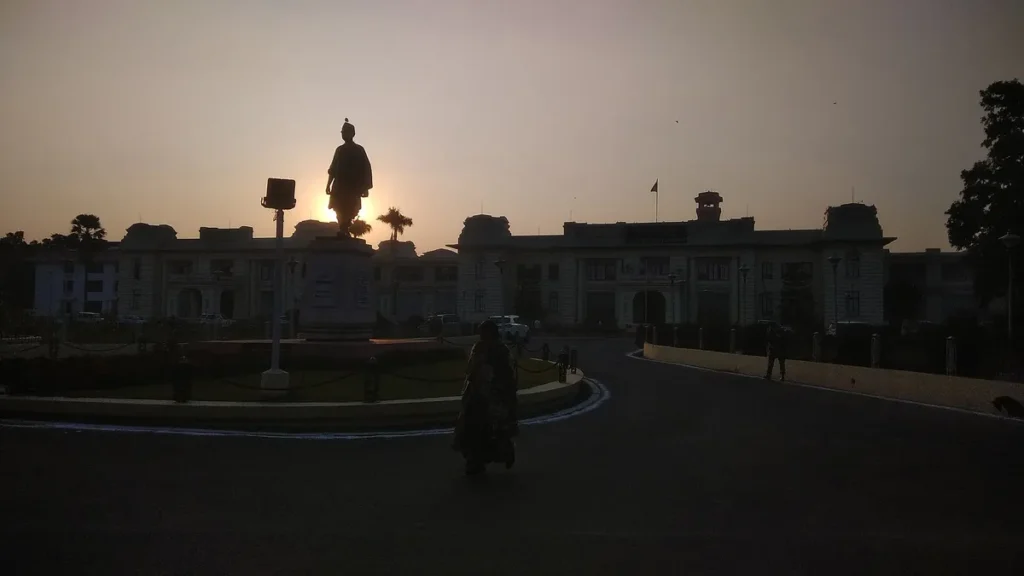
Photo: Innocentbunny, CC BY-SA 3.0, via Wikimedia Commons
Exam angle
Prelims: Tenth Schedule, independent and nominated members. · Mains GS-II: defection and presiding officers.
Practice MCQs
Original practice questions (not PYQs).
Under the Tenth Schedule of the Constitution, an independent member of a legislature is disqualified if he or she:
Answer (c) & explanation
Paragraph 2(2) of the Tenth Schedule disqualifies an independent member who joins any political party after being elected.
Consider the following statements:
1. The Tenth Schedule was added to the Constitution by the 52nd Amendment Act, 1985.
2. A nominated member may join a political party within six months of taking the seat without being disqualified.
3. The decision of the Speaker or Chairman on disqualification cannot be challenged in any court.
How many of the above statements are correct?
Answer (b) & explanation
Statements 1 and 2 are correct. In Kihoto Hollohan (1992) the Supreme Court held that the presiding officer's decision is open to judicial review.
Questions students ask about this
Can an independent member join a party?
No. Under the Tenth Schedule, an independent who joins any party after the election is disqualified.
Who decides disqualification under the Tenth Schedule?
The Chairman or Speaker of the House, and the decision can be reviewed by courts.
Does the law apply to Legislative Councils?
Yes. It applies to both Houses of Parliament and of State Legislatures.
Who are the two Bihar MLCs?
Bansidhar Brajwasi (Tirhut Graduates') and Rahul Raj (Saran Teachers').