
Diwali smoke pushes Lucknow AQI past 300
Heavy firecracker use on Diwali night pushed Lucknow’s Air Quality Index past 300, with Talkatora at 304 and Lalbagh at 283. Other Uttar Pradesh cities, including Kanpur, Ghaziabad, Noida and Varanasi, also recorded poor to very poor air on CPCB data. Read it to revise AQI bands and winter pollution in the Indo-Gangetic plain.
- Lucknow peak
- Talkatora AQI 304
- Lalbagh
- 283
- Kanpur (CPCB)
- About 221
- Noida / Ghaziabad (CPCB)
- 340 / 366
UP’s Diwali air: what happened?
The lamps went out. The smoke stayed — and Lucknow woke up gasping.
- Bhaskar English reported that Lucknow’s AQI crossed 300 on Diwali night; Talkatora recorded 304 and Lalbagh 283, with Aliganj also near 300.
- Elderly people and those with breathing problems were advised to take special care.
- Amar Ujala said Kanpur’s average AQI rose to about 220 after heavy firecracker use, up from 47 on 1 November.
- ABP Live cited CPCB figures showing Ghaziabad at 366, Noida at 340, Varanasi at 302, Greater Noida at 293 and Kanpur at 221.
- Fog and haze also covered several UP cities as night temperatures fell.
What is the AQI?
The Air Quality Index turns complex pollution data into one number people can understand.
Under CPCB classification: 0–50 good, 51–100 satisfactory, 101–200 moderate, 201–300 poor, 301–400 very poor, 401–500 severe.
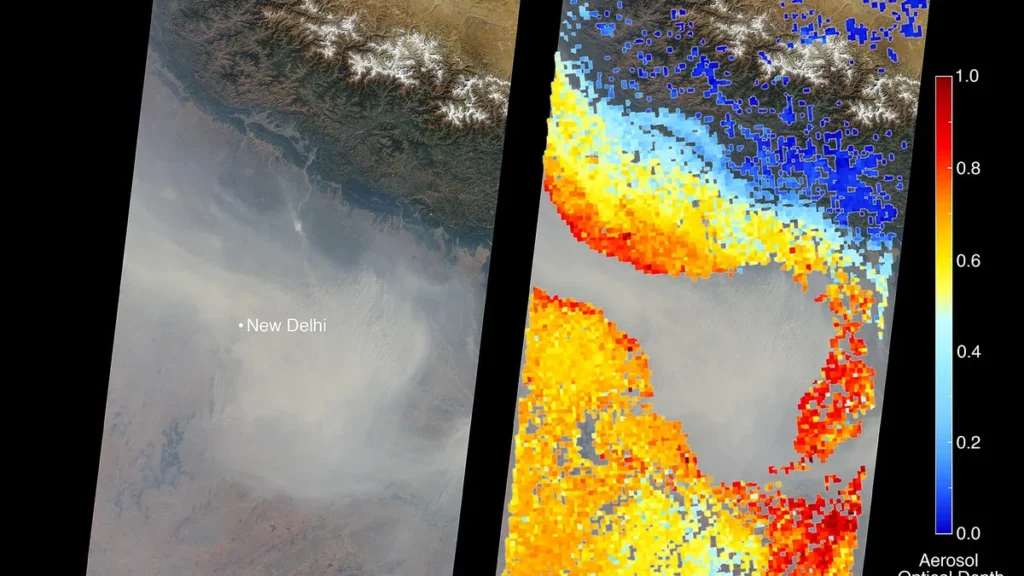
In the Indo-Gangetic plain, winter cold, low wind, farm fires and firecrackers often trap smoke near the ground.
Delhi-NCR uses the Graded Response Action Plan (GRAP); UP cities follow State and CPCB guidance.
CPCB colour code
| Range | Category |
|---|---|
| 0–50 | Good |
| 201–300 | Poor |
| 301–400 | Very poor |
| 401–500 | Severe |
Which laws and bodies apply?
- Air (Prevention and Control of Pollution) Act, 1981.
- Central Pollution Control Board and State Pollution Control Boards.
- Commission for Air Quality Management (CAQM) for Delhi-NCR, including adjoining UP districts.
- Supreme Court and NGT orders on firecrackers in past years.
Why does UP’s post-Diwali air matter?
| Angle | What to note |
|---|---|
| Health | Children and the elderly suffer first. |
| Governance | Tests enforcement of firecracker rules. |
| Geography | Indo-Gangetic winter inversion. |
| UP exams | Lucknow, Kanpur, NCR air quality. |
What are the problems with UP’s post-Diwali air?
- Firecracker bans are unevenly enforced.
- Farm-fire smoke adds to the Diwali spike.
- Monitoring stations differ, so figures can vary by source.
- Outdoor workers cannot easily avoid exposure.
What should be done next on UP’s post-Diwali air?
- Enforce green-cracker rules before the festival.
- Warn sensitive groups early with local AQI alerts.
- Cut farm fires with machines and incentives.
- Strengthen public transport and dust control all winter.
What can Prelims ask on UP’s post-Diwali air?
Prelims probability: High. AQI bands, CPCB and firecracker pollution are staple Prelims and UP Special facts.
- CPCB AQI: 301–400 = very poor.
- Talkatora (Lucknow) 304 on Diwali night 2026.
- Kanpur ~221; Ghaziabad 366; Noida 340 (CPCB, reported 9 Nov).
- Air Act: 1981.
- GRAP: Delhi-NCR graded emergency plan.
How to write about UP’s post-Diwali air in Mains
Practice question (15 marks, 250 words): Festive firecrackers turn winter air toxic in the Indo-Gangetic plain. Discuss causes and remedies with reference to Uttar Pradesh.
- Intro: Lucknow AQI past 300.
- Causes: crackers, weather, farm fires.
- Health and economic costs.
- Law: Air Act, CPCB, CAQM.
- Way forward: enforce, alert, reduce stubble.
Ready lines for your answer
- A festival of light should not leave a week of smoke.
- AQI is a warning light — only action turns it green.
Quotable data pointTalkatora 304; Lalbagh 283; CPCB: Ghaziabad 366, Noida 340, Kanpur 221.
Photo: NASA/GSFC/LaRC/JPL, MISR Team, Public domain, via Wikimedia Commons
Exam angle
Prelims: AQI bands, Air Act, CPCB. · Mains GS-III: pollution.
Practice MCQs
Original practice questions (not PYQs).
According to the Central Pollution Control Board, an Air Quality Index between 301 and 400 is classified as:
Answer (c) & explanation
CPCB bands: 201–300 poor, 301–400 very poor, 401–500 severe.
The Air (Prevention and Control of Pollution) Act was enacted in:
Answer (b) & explanation
The Air Act was enacted in 1981.
Questions students ask about this
What AQI did Talkatora record?
304, in the very poor band.
What does AQI 301–400 mean?
Very poor air quality on the CPCB scale.
Which law governs air pollution?
The Air (Prevention and Control of Pollution) Act, 1981.
Why is winter worse in UP?
Cold, low wind and extra smoke from firecrackers and farm fires trap pollution.
Did only Lucknow suffer?
No. Kanpur, Ghaziabad, Noida, Varanasi and others also recorded poor or very poor air.