
Lioness killed by train in Gujarat’s Junagadh
A lioness, aged between five and nine years, was killed on Saturday when a train hit her in Gujarat’s Junagadh district. It happened around 12.30 p.m. near a bridge on the Ozat river, close to Khambhalia village. She was trying to cross the tracks. The Junagadh–Chalala passenger train struck her, and she died on the spot, a forest officer said. Lions now roam far beyond the Gir forest, so railway lines and roads through their range are a growing danger. Read it to revise the Asiatic lion, the 2025 count, Schedule I and Project Lion.
- What happened
- A lioness aged 5–9 years was killed by a train on 14 November 2026
- Where
- Near a bridge on the Ozat river, close to Khambhalia village, Junagadh district
- Train
- The Junagadh–Chalala passenger, around 12.30 p.m.
- 2025 count
- 891 Asiatic lions in Gujarat
How was the lioness killed, and why does it matter?
A species that once survived in a single forest now dies on a railway track — a sign, in a bitter way, that the lion’s range has grown, and that the tracks have not kept up.
- A lioness, aged between five and nine years, was killed on Saturday, 14 November 2026, when a train hit her in Gujarat’s Junagadh district.
- It happened around 12.30 p.m. near a bridge on the Ozat river, close to Khambhalia village. She was trying to cross the tracks.
- The Junagadh–Chalala passenger train struck her, and she died on the spot, a forest officer said.
- Lions now roam far beyond the Gir forest, so railway lines and roads through their range are a growing danger.
Where does the Asiatic lion live, and what protects it?
The Asiatic lion (Panthera leo persica) now lives in the wild only in Gujarat, in and around Gir and the wider Saurashtra landscape. A census in 2025 counted 891 lions. The species is listed as Vulnerable on the IUCN Red List.
It is listed in Schedule I of the Wild Life (Protection) Act, 1972, the highest legal protection in Indian law. Killing or trading a Schedule I animal is a serious offence.
Project Lion is the Union’s dedicated programme for the species. It covers habitat, corridors, conflict with people, and the long-running debate on a second home outside Gujarat, so that a single epidemic or disaster cannot wipe out the only wild population.
The death on the Junagadh–Chalala line is not a one-off risk. As lions move farther from Gir, they cross roads, canals and railway lines that were not designed for a large carnivore. Tracks near river crossings, such as the Ozat, are particular pinch points.
Asiatic lion: facts examiners use
| Point | Detail |
|---|---|
| Only wild home | Gujarat — Gir and the wider Saurashtra range |
| 2025 count | 891 |
| Legal status | Schedule I, Wild Life (Protection) Act, 1972; IUCN Vulnerable |
| Programme | Project Lion; debate on a second home outside Gujarat |
Which laws and programmes apply?
- Wild Life (Protection) Act, 1972: the Asiatic lion is in Schedule I, the highest protection.
- Project Lion: the dedicated conservation programme for the species.
- IUCN Red List: the Asiatic lion is listed as Vulnerable.
- Railway and forest authorities share the duty to reduce collisions where tracks cut through lion range.
Why does the death of the lioness matter?
| Angle | What to note |
|---|---|
| Environment | A train kill is a conservation failure at the edge of a species that has only one wild home. |
| Polity | Schedule I and Project Lion show how law and a named programme are meant to work together. |
| Ethics | A growing range is a success until a track, a canal or a highway turns it into a trap. |
| Prelims | Only home in Gujarat; 891 in 2025; Schedule I; Vulnerable; Project Lion; second-home debate; Junagadh, Ozat, Gir. |
What are the problems with the death of the lioness?
- A single wild population in one State remains a risk, whatever the count of 891 suggests.
- Railway lines through expanding range still lack enough underpasses, fencing and slow-speed orders at known crossings.
- The second-home debate has run for years; delay keeps all the eggs in one basket.
- When lions move into farmland and village edges, conflict with people can turn public support into hostility.
What should be done next on the death of the lioness?
- Map and slow trains at known crossing points, especially river bridges such as the Ozat, and add underpasses where kills have occurred.
- Give forest and railway staff a joint protocol and a 24-hour contact point for sightings on the track.
- Move faster on a scientifically chosen second home, with local consent, so that one disaster cannot erase the species.
- Work with villages on the new range so that a lion in a field is a managed event, not a crisis.
What can Prelims ask on the death of the lioness?
Prelims probability: High. The Asiatic lion was asked in 2019 and its translocation in 2017. Testable facts: only home in Gujarat, 891 lions in 2025, Schedule I, Vulnerable status, Project Lion.
- The Asiatic lion’s only wild home is in Gujarat, in and around Gir and Saurashtra.
- 2025 census: 891 lions. IUCN status: Vulnerable.
- Schedule I of the Wild Life (Protection) Act, 1972; Project Lion.
- The second-home debate seeks a population outside Gujarat.
- The kill: 14 November 2026, Junagadh–Chalala passenger, near the Ozat river and Khambhalia village.
How to write about the death of the lioness in Mains
Practice question (15 marks, 250 words): The death of a lioness on a railway line in Junagadh has again raised questions about the conservation of the Asiatic lion. Discuss the status of the species and the measures needed as its range expands.
- Open with the 14 November kill on the Junagadh–Chalala line, near the Ozat river, and the fact that lions now roam beyond Gir.
- State the 2025 count of 891, the only wild home in Gujarat, Schedule I and Vulnerable status, and Project Lion.
- Explain why a single-State population is a risk, and why the second-home debate exists.
- Discuss railway and road collisions as a new threat at the edge of an expanding range.
- Close with practical steps: slow orders and underpasses, a joint railway–forest protocol, and faster work on a second home.
Ready lines for your answer
- A species can be growing in number and still be one train away from a preventable death.
- One home in one State is a success that remains a risk.
Quotable data point14 Nov 2026: lioness, 5–9 years, killed by the Junagadh–Chalala passenger near the Ozat river, Khambhalia village, around 12.30 p.m.; 2025 count 891; Schedule I; Project Lion.
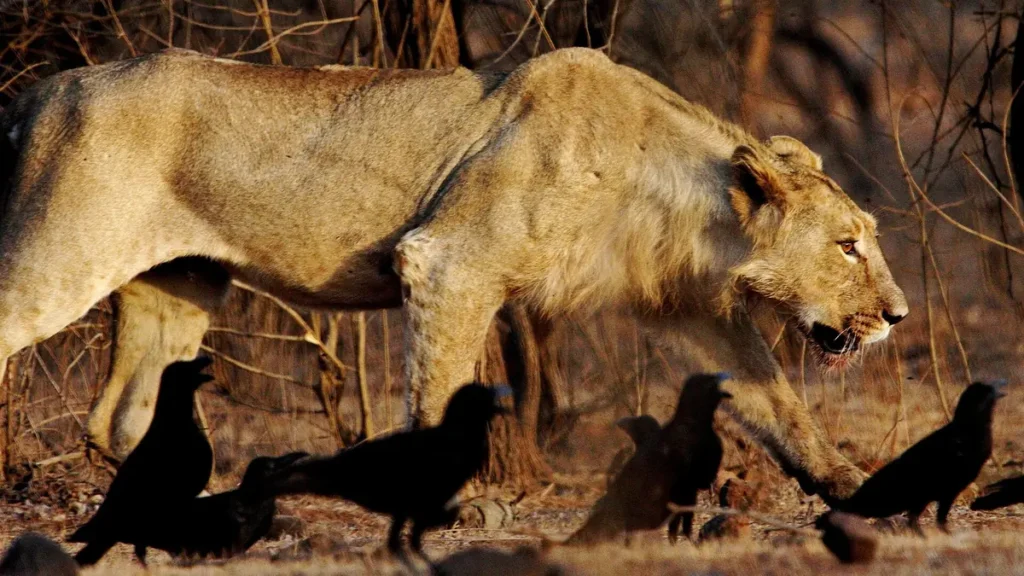
Photo: vaidyarupal, CC BY 2.0, via Wikimedia Commons
Exam angle
Prelims: only home in Gujarat, 891 in 2025, Schedule I, Vulnerable, Project Lion, second-home debate. · Mains GS-III: wildlife conservation and infrastructure conflict.
Practice MCQs
Original practice questions (not PYQs).
Which of the following statements about the Asiatic lion is correct?
Answer (b) & explanation
Wild Asiatic lions survive only in Saurashtra, Gujarat. They are listed as Vulnerable, and the 2025 count found 891 lions, up from 674 in 2020.
Questions students ask about this
What happened in Junagadh?
A lioness aged between five and nine years was killed on 14 November 2026 by the Junagadh–Chalala passenger train, near a bridge on the Ozat river close to Khambhalia village.
Where do Asiatic lions live in the wild?
Only in Gujarat, in and around the Gir forest and the wider Saurashtra landscape.
How many Asiatic lions were counted in 2025?
891.
What is the legal status of the Asiatic lion?
It is in Schedule I of the Wild Life (Protection) Act, 1972, and is listed as Vulnerable on the IUCN Red List.
What is Project Lion?
The Union’s dedicated programme for the Asiatic lion, covering habitat, corridors, conflict with people, and the debate on a second home outside Gujarat.