
Census portal briefly lists 287 ‘other’ religions
The online self-enumeration portal for Census 2027 went live on Monday for four States where elections are due in 2027: Uttar Pradesh, Uttarakhand, Goa and Punjab. Under the religion question, the “Others” drop-down box showed 287 options, including Sanatan, Sarna, Bishnoi, Balmiki, Shia, Sunni, Methodist and Pentecostal. Many were new names; some are sects of the six big religions. The box was removed later the same day, after The Hindu asked the Union Home Ministry about it. An official of the Registrar General says the usual seven choices remain: Hindu, Muslim, Christian, Sikh, Buddhist, Jain and Others. People can still write any other religion, as in earlier censuses. Residents can fill the form online till 30 November. Read it to revise the Census Act 1948, religion categories and the first digital census.
- Where it appeared
- Self-enumeration portal for Census 2027, live from Monday for Uttar Pradesh, Uttarakhand, Goa and Punjab
- What was shown
- 287 options under “Others”, including Sanatan, Sarna, Bishnoi, Balmiki, Shia, Sunni, Methodist and Pentecostal
- What happened next
- The drop-down was removed the same day after The Hindu asked the Union Home Ministry
- Official position
- The usual seven choices remain; people may still write any other religion; the form is open till 30 November
What appeared on the Census 2027 self-enumeration portal?
The first digital census opened its self-enumeration window for four poll-bound States. For a few hours, the “Others” box under religion was not a blank to fill in, but a list of 287 names.
- The online self-enumeration portal for Census 2027 went live on Monday for four States where elections are due in 2027: Uttar Pradesh, Uttarakhand, Goa and Punjab.
- Under the religion question, the “Others” drop-down box showed 287 options. They included Sanatan, Sarna, Bishnoi, Balmiki, Shia, Sunni, Methodist and Pentecostal. Many were new names; some are sects of the six big religions.
- The box was removed later the same day, after The Hindu asked the Union Home Ministry about it.
- An official of the Registrar General says the usual seven choices remain: Hindu, Muslim, Christian, Sikh, Buddhist, Jain and Others. People can write any other religion, as in earlier censuses. Another official says the list was only “predictive text” to help enumerators avoid spelling mistakes, and that how it showed up as a drop-down is being looked into. Residents can fill the form online till 30 November.
How does the Census record religion, and what is self-enumeration?
The Census is taken under the Census Act, 1948. Information collected is meant only for statistics and planning, and the law treats it as confidential. The Registrar General and Census Commissioner of India, under the Union Home Ministry, runs the exercise.
In earlier censuses, the religion question offered six named religions — Hindu, Muslim, Christian, Sikh, Buddhist and Jain — plus Others, where a person could write another faith. That is the official description of the seven choices that, the Registrar General’s official says, still stand.
Census 2027 is the first digital census. A Press Information Bureau release on 16 November 2026 said self-enumeration for Phase II (Population Enumeration) has begun in Goa, Punjab, Uttar Pradesh and the non-snow-bound areas of Uttarakhand, on the portal se.census.gov.in, in 16 Indian languages, with 40 notified questions. Residents can submit details online till 30 November 2026. House-to-house enumeration in these States and areas is scheduled from 1 December 2026 to 4 January 2027, with a revisional round from 5 to 9 January 2027, and a reference date of 00:00 hours on 5 January 2027.
Religion counts matter because they feed later debates on minority status, reservations and political mobilisation. Names such as Sarna or Sanatan are politically sensitive precisely because a drop-down can look like recognition, even if officials later call it a spelling aid.
The portal, the seven choices, and the official timetable
| Item | What to note |
|---|---|
| Self-enumeration window | Open till 30 November 2026 for the four early States, on se.census.gov.in |
| Usual religion choices | Hindu, Muslim, Christian, Sikh, Buddhist, Jain, and Others |
| What briefly appeared | 287 names under “Others”, then removed the same day |
| House-to-house follow-up | 1 December 2026 to 4 January 2027 in these States and areas, plus a revisional round |
| Legal frame | Census Act, 1948; first digital census |
Which laws and institutions apply?
- Census Act, 1948: the legal basis for the Census, including confidentiality of individual returns and their use only for statistics and planning.
- The Registrar General and Census Commissioner of India, under the Union Home Ministry, conducts the Census and runs the self-enumeration portal.
- The religion question has, in recent censuses, offered six named religions plus an “Others” write-in; the official line is that this structure has not changed.
- Articles 25 to 26 of the Constitution protect freedom of religion; the Census itself does not confer or take away a religion’s legal status, but its categories are watched closely.
Why does the Census portal religion list matter?
| Angle | What to note |
|---|---|
| Polity | A drop-down of 287 names, even if brief, looks like a change in how the State records faith, which is why it was politically sensitive in four poll-bound States. |
| Prelims | Census Act 1948, the seven usual choices, the Registrar General, self-enumeration till 30 November, and the first digital census. |
| Minorities and identity | Sarna, Sanatan and sect names such as Shia or Methodist sit at the edge of the six big religions; how they are recorded has later policy effects. |
| Process | Officials now say the list was predictive text for enumerators; how it became a public drop-down is itself a test of digital-census quality control. |
What are the problems with the Census portal religion list?
- A list of 287 names appeared on a public portal and was taken down the same day, which suggests the digital form was not checked carefully before it went live.
- Calling the list “predictive text” after the fact does not fully explain why it was shown as a drop-down that a resident could pick from.
- In four States heading into elections, even a brief change in the religion question can be read as a political signal, whether or not that was the intent.
- People who follow faiths outside the six named religions still have only a write-in box, and some groups have long wanted a named code of their own.
What should be done next on the Census portal religion list?
- The Registrar General should publish a clear note on what the religion question will look like for the rest of the Census, including in later States.
- If predictive text is used to avoid spelling mistakes, it should help the enumerator or the resident type a name, not appear as an official menu of 287 religions.
- Residents in the four early States still have until 30 November to file online, and should know that the seven usual choices, plus a write-in, are what the office now says apply.
- A first digital census will be judged not only by turnout, but by whether sensitive questions stay stable from one hour to the next.
What can Prelims ask on the Census portal religion list?
Prelims probability: Medium. Minority status was asked in 2011 and Census topics keep returning. The first digital census is fresh and politically sensitive. Testable facts: seven religion choices, Registrar General, self-enumeration till 30 November.
- Self-enumeration for Census 2027 opened for Uttar Pradesh, Uttarakhand, Goa and Punjab, and is open till 30 November 2026.
- A drop-down of 287 “other” religions appeared and was removed the same day.
- The official seven choices remain: Hindu, Muslim, Christian, Sikh, Buddhist, Jain and Others, with a write-in for any other religion.
- The Census is taken under the Census Act, 1948, by the Registrar General and Census Commissioner of India.
- Census 2027 is the first digital census; the official portal is se.census.gov.in.
How to write about the Census portal religion list in Mains
Practice question (15 marks, 250 words): The Census 2027 self-enumeration portal briefly displayed a long list of “other” religions. Discuss how the Census records religion and the issues this episode raises for a digital census.
- Open with the fact: 287 options under “Others” appeared on the portal for four poll-bound States and were removed the same day.
- State the usual seven choices and the write-in practice under the Census Act, 1948.
- Explain self-enumeration, the 30 November window, and that this is the first digital census.
- Note why religion categories are sensitive, including names such as Sarna and Sanatan.
- Close with the need for a stable, published question design and tighter quality control on a public portal.
Ready lines for your answer
- A drop-down can look like recognition, even when officials later call it a spelling aid.
- The first digital census will be judged by whether sensitive questions stay stable.
Quotable data pointCensus 2027 self-enumeration went live for Uttar Pradesh, Uttarakhand, Goa and Punjab; a 287-name “Others” list appeared and was removed the same day; seven usual choices remain; online filing till 30 November 2026.
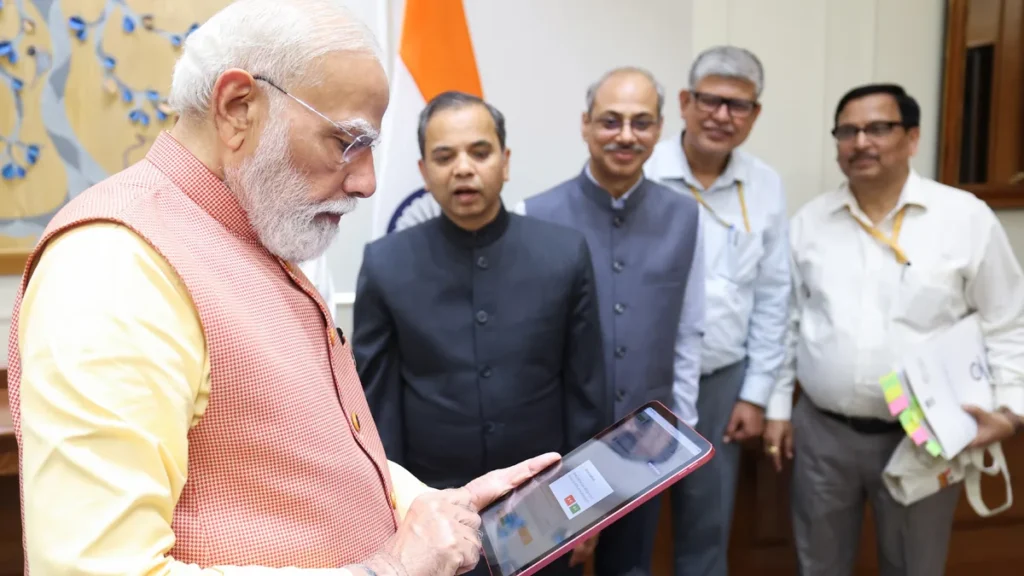
Photo: Prime Minister’s Office, GODL-India, via Wikimedia Commons
Exam angle
Prelims: Census Act 1948, the seven religion choices, the Registrar General, self-enumeration till 30 November, and the first digital census. · Mains GS-II: secularism, minority identity and the design of a digital census.
Practice MCQs
Original practice questions (not PYQs).
Which of these States was NOT among the four for which the Census 2027 self-enumeration portal opened on Monday?
Answer (d) & explanation
The portal opened for Uttar Pradesh, Uttarakhand, Goa and Punjab. The rest of the country follows in January 2027.
Consider the following statements:
1. The Census is conducted under the Census Act, 1948.
2. The self-enumeration portal for Census 2027 opened on Monday for all States and Union Territories.
3. The religion column in the Census offers nine named religions plus Others.
How many of the above statements are correct?
Answer (a) & explanation
Only statement 1 is correct. The portal opened for four States only, and the column has six named religions plus Others, seven choices in all.
Questions students ask about this
Which States saw the self-enumeration portal go live on Monday?
Uttar Pradesh, Uttarakhand, Goa and Punjab, where elections are due in 2027. Officially, self-enumeration in Uttarakhand is for non-snow-bound areas.
What appeared under the religion question?
The “Others” drop-down showed 287 options, including Sanatan, Sarna, Bishnoi, Balmiki, Shia, Sunni, Methodist and Pentecostal, and was removed the same day.
What are the usual seven religion choices?
Hindu, Muslim, Christian, Sikh, Buddhist, Jain, and Others. People can still write any other religion.
Till when can residents fill the form online?
Till 30 November 2026, on se.census.gov.in.
Which law governs the Census?
The Census Act, 1948. The Registrar General and Census Commissioner of India conducts it.