
India aims to be among the top 10 shipbuilding nations by 2030
Ports, Shipping and Waterways Minister Sarbananda Sonowal says India aims to be among the top 10 shipbuilding nations by 2030 and the top five by 2047. He spoke at the India Shipbuilding Investment Conclave in New Delhi, inviting global shipbuilders, shipping lines and banks. Nearly $10 billion could flow into five new coastal shipbuilding clusters: Dugarajapatnam in Andhra Pradesh, Kuchhadi in Gujarat, Dighi in Maharashtra, Kendrapada in Odisha and Thoothukudi in Tamil Nadu. The order book tops $1.7 billion across more than 150 ships, and exports make up over 80% of it. Identified domestic demand covers over 400 vessels, worth nearly $24 billion. Thirty foreign shipyards joined, including South Korea’s three largest. Cochin Shipyard and Damen signed an agreement, and the minister launched Naukosh, a digital portal for the industry. The pitch builds on an $8 billion shipbuilding financial package approved last year. Read it to revise the clusters, the order book and the Sagarmala context.
- The target
- Top 10 shipbuilding nations by 2030, and top five by 2047
- Five clusters
- Dugarajapatnam (Andhra Pradesh), Kuchhadi (Gujarat), Dighi (Maharashtra), Kendrapada (Odisha), Thoothukudi (Tamil Nadu); nearly $10 billion of possible investment
- Order book and demand
- More than 150 ships, over $1.7 billion, with exports over 80%; domestic demand of over 400 vessels, nearly $24 billion
- Other steps
- Naukosh portal launched; Cochin Shipyard and Damen signed an agreement; 30 foreign shipyards joined, including South Korea’s three largest
What did the shipbuilding conclave set out?
India wants a place among the world’s top ten shipbuilders by 2030. The offer on the table is five new coastal clusters, a growing export order book, and a new digital portal named Naukosh.
- Ports, Shipping and Waterways Minister Sarbananda Sonowal says India aims to be among the top 10 shipbuilding nations by 2030 and the top five by 2047.
- He spoke at the India Shipbuilding Investment Conclave in New Delhi, inviting global shipbuilders, shipping lines and banks. Nearly $10 billion could flow into five new coastal shipbuilding clusters.
- The clusters are Dugarajapatnam in Andhra Pradesh, Kuchhadi in Gujarat, Dighi in Maharashtra, Kendrapada in Odisha and Thoothukudi in Tamil Nadu.
- The order book tops $1.7 billion across more than 150 ships, and exports make up over 80% of it. Identified domestic demand covers over 400 vessels, worth nearly $24 billion. Thirty foreign shipyards joined, including South Korea’s three largest. Cochin Shipyard and Damen signed an agreement, and the minister launched Naukosh, a digital portal for the industry. The conclave builds on an $8 billion shipbuilding financial package approved last year.
Why is India pushing shipbuilding now?
India has a long coastline and a large shipping bill, but it has not been a top-rank shipbuilding nation. The new pitch is to build in India, for India and for the world: first fill a domestic order book, then hold on to export work that already makes up over 80% of the present $1.7 billion pipeline.
The five sites are described as greenfield clusters — new yards and supplier parks, not only expansions of old docks. The official list spreads them across five coastal States, which is also a test of cooperative federalism: land, approvals and policy have to move with the State governments, not only with the Union ministry.
The Sagarmala Programme is the wider ports and hinterland plan under the same ministry. Shipbuilding is one way to turn a ports programme into manufacturing, jobs and exports, rather than only into more cargo on the quay.
Naukosh, developed by the Directorate General of Maritime Administration, is meant to put policies, approvals, a directory of yards and investment information on one digital platform. A portal does not build a ship, but it is the government’s answer to a complaint that the sector is hard to enter and hard to navigate.
The 2030 target, the clusters, and the order book
| Item | What to note |
|---|---|
| Targets | Top 10 by 2030; top five by 2047 |
| Investment pitch | Nearly $10 billion into five greenfield coastal clusters |
| The five sites | Dugarajapatnam, Kuchhadi, Dighi, Kendrapada, Thoothukudi |
| Present order book | Over $1.7 billion, more than 150 ships, exports over 80% |
| Domestic demand identified | Over 400 vessels, nearly $24 billion; $8 billion financial package already approved |
Which policies and institutions apply?
- The Ministry of Ports, Shipping and Waterways hosted the conclave and is the nodal ministry for the five clusters and for Naukosh.
- Sagarmala is the flagship programme for port-led development, of which shipbuilding and coastal industrial clusters are a part.
- The Directorate General of Maritime Administration developed the Naukosh portal as a single digital window for the shipbuilding and ship-repair industry.
- An $8 billion shipbuilding financial package, approved last year, is the financing backdrop against which the new investment pitch was made.
Why does the shipbuilding target matter?
| Angle | What to note |
|---|---|
| Economy | A $1.7 billion order book, with exports already over 80%, is the proof the ministry is offering that India can build for the world, not only for its own fleet. |
| Prelims | Top 10 by 2030, the five cluster sites, Naukosh, the $1.7 billion order book, and the $8 billion package. |
| Federalism | Five coastal States have to deliver land and approvals if the clusters are to be more than a map. |
| Manufacturing | Shipbuilding sits at the meeting point of ports policy, heavy industry and skilled jobs, which is why it is being sold as a Make in India pillar. |
What are the problems with the shipbuilding target?
- A target of the top 10 by 2030 is only four years away; clusters still need land, yards, workers and actual orders, not only a conclave.
- An identified domestic demand of 400 vessels is not the same thing as funded orders; the $24 billion figure is an opportunity, not a booked pipeline.
- India’s present order book, at $1.7 billion, is still small beside the leading shipbuilding countries, even if exports already dominate it.
- A new portal and a memorandum of understanding, such as the one between Cochin Shipyard and Damen, will matter only if they turn into keels laid in the five clusters.
What should be done next on the shipbuilding target?
- The first test is whether the ten international delegations that were due to visit cluster sites convert talks into projects, as the minister said was now the priority.
- State governments will have to show that land, clearances and infrastructure at the five sites move at the speed investors were promised.
- Naukosh should be judged on whether a yard, a supplier or a lender can actually finish an approval or a partnership on the portal, not on the launch event.
- The $8 billion package and the new $10 billion cluster pitch need a public pipeline of sanctioned projects, so that the 2030 target can be tracked year by year.
What can Prelims ask on the shipbuilding target?
Prelims probability: Medium. The Sagarmala Programme was asked in 2026 and ports are a steady topic. The clusters, conclave and Korea link are fresh. Testable facts: top 10 by 2030, five cluster sites, $8 billion package.
- India aims to be among the top 10 shipbuilding nations by 2030 and the top five by 2047.
- Five greenfield clusters are planned: Dugarajapatnam, Kuchhadi, Dighi, Kendrapada and Thoothukudi.
- The present order book is over $1.7 billion across more than 150 ships, with exports over 80%.
- Nearly $10 billion could flow into the clusters; an $8 billion financial package was approved last year.
- The minister launched Naukosh, a digital portal; Cochin Shipyard and Damen signed an agreement.
How to write about the shipbuilding target in Mains
Practice question (15 marks, 250 words): India has set a target of joining the world’s top 10 shipbuilding nations by 2030. Discuss the strategy announced at the 2026 investment conclave and the challenges in meeting the target.
- Open with the 2030 and 2047 targets, and the nearly $10 billion cluster pitch.
- Name the five greenfield sites and the present $1.7 billion order book, including the export share.
- Place the push in the Sagarmala and $8 billion package context, and mention Naukosh and the Cochin Shipyard–Damen agreement.
- Distinguish identified domestic demand (over 400 vessels) from booked orders.
- Close with the need to convert site visits and announcements into actual yards, jobs and delivered ships by 2030.
Ready lines for your answer
- A target on a conclave stage is not yet a keel in the water.
- Five States must deliver land and approvals if the clusters are to be more than a map.
Quotable data pointTarget: top 10 by 2030, top five by 2047. Five clusters; nearly $10 billion possible investment. Order book over $1.7 billion, 150-plus ships, exports over 80%. Domestic demand over 400 vessels, nearly $24 billion. Naukosh launched; $8 billion package already approved.
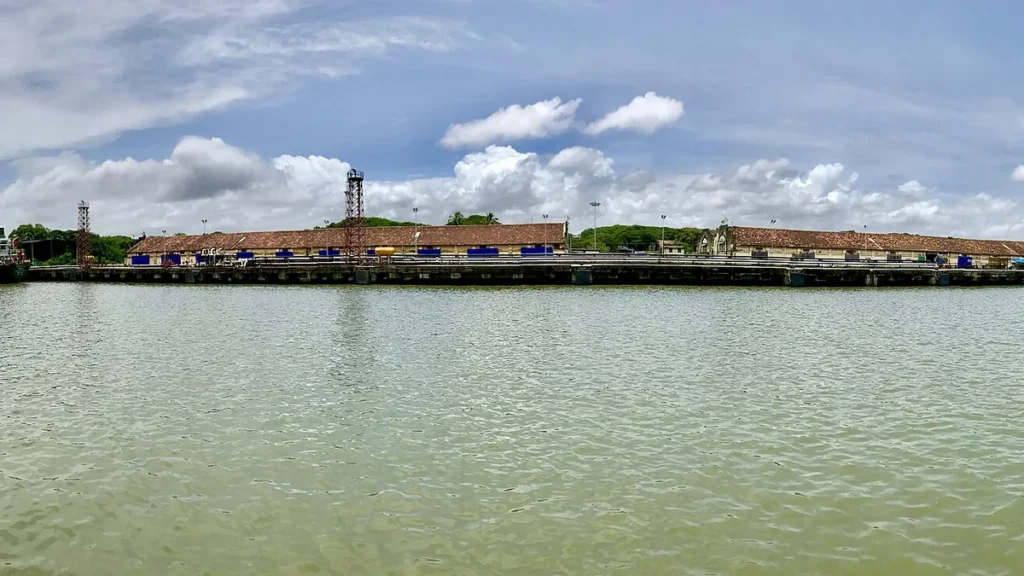
Photo: IM3847, CC BY-SA 4.0, via Wikimedia Commons
Exam angle
Prelims: top 10 by 2030, the five cluster sites, the $1.7 billion order book, Naukosh, and the $8 billion package. · Mains GS-III: port-led industrialisation, Sagarmala and manufacturing for export.
Practice MCQs
Original practice questions (not PYQs).
Which of these is NOT one of the five proposed greenfield coastal shipbuilding clusters?
Answer (a) & explanation
The five are Dugarajapatnam, Kuchhadi, Dighi, Kendrapada and Thoothukudi. Paradip is a major port, not one of the clusters.
Consider the following statements:
1. India aims to be among the top 10 shipbuilding nations by 2030 and the top five by 2047.
2. Exports account for more than 80% of the value of the active shipbuilding order book.
3. Naukosh is a satellite launched to track ships.
How many of the above statements are correct?
Answer (b) & explanation
Statements 1 and 2 are correct. Naukosh is a digital portal for the shipbuilding and ship repair industry.
Questions students ask about this
What is India’s shipbuilding target?
To be among the top 10 shipbuilding nations by 2030 and the top five by 2047.
Where are the five proposed clusters?
Dugarajapatnam in Andhra Pradesh, Kuchhadi in Gujarat, Dighi in Maharashtra, Kendrapada in Odisha and Thoothukudi in Tamil Nadu.
How large is the present order book?
Over $1.7 billion across more than 150 ships, with exports making up over 80% of that value.
What is Naukosh?
A digital portal for the shipbuilding and ship-repair industry, launched at the conclave, and developed by the Directorate General of Maritime Administration.
What financial package already exists?
An $8 billion shipbuilding financial package approved last year; the new pitch is nearly $10 billion of investment in the five clusters.