
Voyager 1 reaches one light-day from Earth today
The United States space agency’s Voyager 1 spacecraft will be one light-day from Earth today. A radio signal from Earth will take one full day to reach it. That is about 26 billion kilometres. It is the first human-made object to go this far. Voyager 1 was launched on 5 September 1977. Its twin, Voyager 2, was launched earlier, on 20 August 1977. Voyager 1 crossed into interstellar space, beyond the Sun’s bubble of particles, in 2012. Voyager 2 did so in 2018. Voyager 1 found a thin ring around Jupiter and five new moons of Saturn. Voyager 2 was the first craft to fly past Uranus and Neptune. Both carry a gold-plated disc with greetings in 55 languages. Ageing thrusters may soon end contact with Voyager 1. Read it to revise the light-year, the heliosphere and the Deep Space Network.
- The milestone
- Voyager 1 is one light-day from Earth today: a radio signal takes one full day to reach it, about 26 billion kilometres
- The launch
- Voyager 1 on 5 September 1977; its twin, Voyager 2, on 20 August 1977
- Interstellar space
- Voyager 1 crossed into it in 2012; Voyager 2 in 2018
- What they found
- Voyager 1: a thin ring around Jupiter and five new moons of Saturn. Voyager 2: first fly-past of Uranus and Neptune. Both carry a gold-plated disc with greetings in 55 languages
Why does one light-day from Earth matter for Voyager 1?
A day is an ordinary unit on Earth and an extraordinary one in space. When a message from home takes 24 hours to arrive, a spacecraft has gone farther than any other machine we have built.
- The United States space agency’s Voyager 1 spacecraft will be one light-day from Earth today. A radio signal from Earth will take one full day to reach it. That is about 26 billion kilometres. It is the first human-made object to go this far.
- Voyager 1 was launched on 5 September 1977. Its twin, Voyager 2, was launched earlier, on 20 August 1977.
- Voyager 1 crossed into interstellar space, beyond the Sun’s bubble of particles, in 2012. Voyager 2 did so in 2018. Voyager 1 found a thin ring around Jupiter and five new moons of Saturn. Voyager 2 was the first craft to fly past Uranus and Neptune.
- Both carry a gold-plated disc with greetings in 55 languages. Ageing thrusters may soon end contact with Voyager 1.
What is a light-day, and what did the two Voyagers actually do?
Light travels at about 300,000 kilometres a second. A light-year is the distance light covers in one year, and is the usual yardstick for stars. A light-day is the distance light covers in 24 hours — about 26 billion kilometres. Voyager 1 is not among the stars yet, but it is now so far that a radio command from Earth, travelling at the speed of light, needs a full day to arrive, and the reply needs another day to come back.
The two Voyagers were launched in 1977 to take advantage of a rare alignment of the outer planets. Voyager 2 went first, on 20 August; Voyager 1 followed on 5 September, on a faster path that let it reach Jupiter and Saturn sooner. Voyager 1 found a thin ring around Jupiter and five new moons of Saturn. Voyager 2 remains the only craft to have flown past Uranus and Neptune.
The Sun blows a bubble of charged particles, the heliosphere. The edge of that bubble, the heliopause, is where interstellar space begins. Voyager 1 crossed it in 2012, the first human-made object to do so; Voyager 2 followed in 2018. Both still talk, faintly, through NASA’s Deep Space Network, a set of large radio dishes used for distant spacecraft. Ageing thrusters on Voyager 1 may soon end that conversation.
The gold-plated disc, sometimes called the Golden Record, carries greetings in 55 languages, music and sounds of Earth. It is a message in a bottle, not a scientific instrument. For an examiner, the milestone, the two launch dates, the 2012 crossing, the planetary discoveries and the idea of a light-day are the facts that matter. Indian space questions will still turn on Indian missions; this story is about a basic idea in astronomy and a 49-year-old machine that has not yet gone silent.
Voyager 1 and Voyager 2
| Item | What to note |
|---|---|
| Launch | Voyager 2 on 20 August 1977; Voyager 1 on 5 September 1977 |
| Today’s milestone | Voyager 1 is one light-day, about 26 billion km, from Earth — a first for a human-made object |
| Interstellar space | Voyager 1 in 2012; Voyager 2 in 2018 |
| Planetary firsts | Voyager 1: a thin Jupiter ring and five new Saturn moons. Voyager 2: first fly-past of Uranus and Neptune |
| A shared cargo | A gold-plated disc with greetings in 55 languages; ageing thrusters may soon end contact with Voyager 1 |
Which ideas and institutions apply?
- A light-day is the distance light travels in 24 hours, about 26 billion kilometres; a light-year is the same idea, scaled to a year.
- The heliosphere is the Sun’s bubble of particles; interstellar space begins beyond its edge, the heliopause.
- The National Aeronautics and Space Administration of the United States operates the two Voyager spacecraft and the Deep Space Network that still hears them.
- There is no Indian statute in this story; the scientific ideas — light-speed communication lag, the heliosphere, and a fly-by mission — are what an Indian examination will test.
Why does Voyager 1’s one light-day milestone matter?
| Angle | What to note |
|---|---|
| Science | One light-day is a crisp way to teach the speed of light and the scale of the solar system’s outer edge. |
| Prelims | The 1977 launch dates, the 2012 and 2018 interstellar crossings, about 26 billion kilometres, and the gold-plated disc with 55 languages. |
| Exploration | Voyager 2’s fly-pasts of Uranus and Neptune have not been repeated by any later craft. |
| Limits | Ageing thrusters may soon end contact; a mission can outlive the hardware that still lets us talk to it. |
What are the problems with Voyager 1’s one light-day milestone?
- A light-day is still a tiny step compared with a light-year; the milestone should not be described as if Voyager 1 has reached the stars.
- The two craft are often mixed up: Voyager 2 launched first, but Voyager 1 went farther, sooner, and crossed into interstellar space first.
- Contact is already faint and may end; a silent spacecraft will still travel, but it will no longer be a mission we can command.
- Popular writing sometimes treats the gold-plated disc as the main payload; the science was in the instruments and the fly-pasts.
What should be done next on Voyager 1’s one light-day milestone?
- Readers should keep the units clear: a light-day for this milestone, a light-year for stars, and about 26 billion kilometres as the distance given today.
- The Deep Space Network will try to keep contact for as long as the thrusters and the power source allow.
- The unrepeated fly-pasts of Uranus and Neptune remain a case for later missions, by whatever country builds them.
- Examiners will ask the launch years, the 2012 crossing and the meaning of a light-day; those three should be learnt together.
What can Prelims ask on Voyager 1’s one light-day milestone?
Prelims probability: Medium. Light-years were asked in 2021 and the Voyager mission in 2014. The one light-day milestone is a crisp first. Testable facts: the 1977 launch, interstellar space in 2012, about 26 billion kilometres.
- Voyager 1 is one light-day from Earth today: a radio signal takes one full day to reach it, about 26 billion kilometres.
- Voyager 1 was launched on 5 September 1977; Voyager 2 was launched on 20 August 1977.
- Voyager 1 entered interstellar space in 2012; Voyager 2 in 2018.
- Voyager 1 found a thin ring around Jupiter and five new moons of Saturn; Voyager 2 was the first craft to fly past Uranus and Neptune.
- Both carry a gold-plated disc with greetings in 55 languages. Ageing thrusters may soon end contact with Voyager 1.
How to write about Voyager 1’s one light-day milestone in Mains
Practice question (15 marks, 250 words): Voyager 1 has become the first human-made object to reach a distance of one light-day from Earth. Explain the significance of this milestone and outline the scientific contribution of the two Voyager spacecraft.
- Open with the milestone: one light-day, about 26 billion kilometres, and a radio signal that now takes a full day to arrive.
- Distinguish a light-day from a light-year, and note that the craft is far, but not yet among the stars.
- Give the two launch dates and the 2012 and 2018 crossings into interstellar space, beyond the heliosphere.
- Recall the planetary discoveries: a thin Jupiter ring and five Saturn moons; the first fly-pasts of Uranus and Neptune.
- Close with the gold-plated disc, the Deep Space Network, and the risk that ageing thrusters may soon end contact.
Ready lines for your answer
- A day is how long the message now takes; 26 billion kilometres is how far it has to go.
- The first machine into interstellar space is still, just, a machine we can hear.
Quotable data point18 November 2026: Voyager 1 is one light-day from Earth, about 26 billion km; launched 5 September 1977 (Voyager 2 on 20 August 1977); entered interstellar space in 2012 (Voyager 2 in 2018).
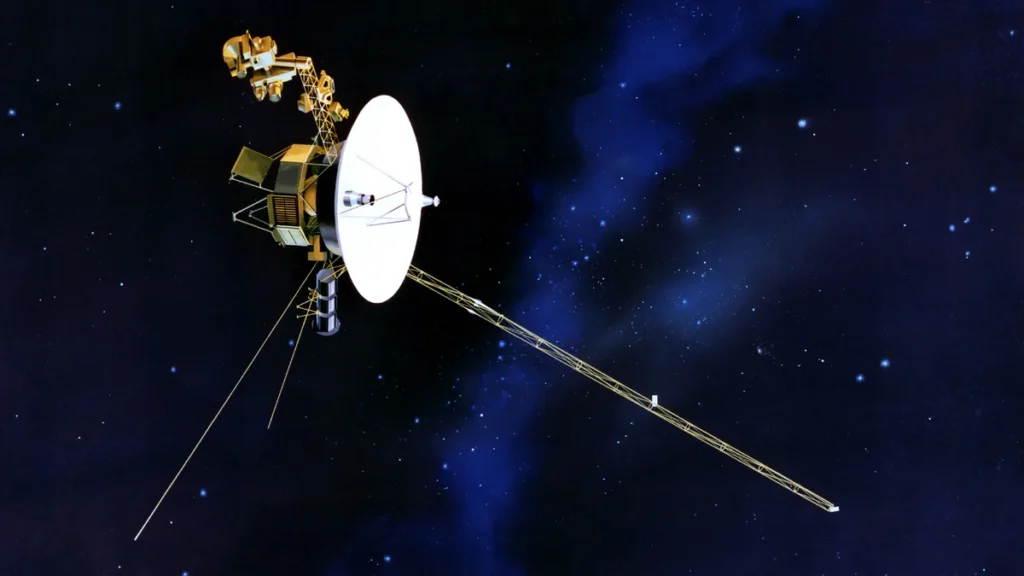
Photo: NASA/JPL, Public domain, via Wikimedia Commons
Exam angle
Prelims: one light-day as about 26 billion kilometres, the 1977 launch, interstellar space in 2012, and the gold-plated disc. · Mains GS-III: space exploration, the heliosphere and the limits of deep-space communication.
Practice MCQs
Original practice questions (not PYQs).
On 18 November 2026, Voyager 1 is set to be one light-day from Earth. This distance is about
Answer (c) & explanation
One light-day, the distance light travels in 24 hours, is about 26 billion kilometres. About 9.5 trillion kilometres is one light-year.
Consider the following statements:
1. Voyager 1 was launched before Voyager 2.
2. Voyager 1 entered interstellar space in 2018.
3. Voyager 1 was the first spacecraft to fly past Uranus and Neptune.
How many of the above statements are correct?
Answer (d) & explanation
None is correct. Voyager 2 was launched first (20 August 1977); Voyager 1 entered interstellar space in 2012; Voyager 2 was the first to fly past Uranus and Neptune.
Questions students ask about this
What is a light-day in this story?
It is the distance light travels in 24 hours, about 26 billion kilometres. A radio signal from Earth now takes one full day to reach Voyager 1.
When were the two Voyagers launched?
Voyager 2 on 20 August 1977, and Voyager 1 on 5 September 1977.
When did they enter interstellar space?
Voyager 1 in 2012, and Voyager 2 in 2018, after crossing the edge of the Sun’s bubble of particles.
What did they discover at the planets?
Voyager 1 found a thin ring around Jupiter and five new moons of Saturn. Voyager 2 was the first craft to fly past Uranus and Neptune.
What is on the gold-plated disc?
Greetings in 55 languages, along with music and sounds of Earth. Both spacecraft carry such a disc.