
India offers ₹15,000-crore package to flood-hit Nepal
Nepal Prime Minister Balendra Shah made his first official visit abroad to India and held talks with Prime Minister Narendra Modi in New Delhi on Monday. India announced a ₹15,000-crore package to help Nepal rebuild after the deadly August floods in the Bhotekoshi river. Of this, ₹11,500 crore is a rupee line of credit for energy projects, and ₹3,500 crore is direct grants for rebuilding. The two leaders flagged off the Sarayu-Kamala Express, the first passenger train between Ayodhya in Uttar Pradesh and Janakpur in Nepal. They opened a road bridge between Dharchula and Darchula, and laid stones for the 669 megawatt Lower Arun hydro project and a check post at Banbasa. Nepal will also get use of Deendayal (Kandla) and Paradip ports for its trade, and an offshore Indian Institute of Technology campus. On boundary issues, including Kalapani, the Foreign Secretaries were asked to keep working with a “forward-looking” approach. Read it to revise the open border, transit access, and why a railway between Ayodhya and Janakpur is more than a passenger service.
- The package
- ₹15,000 crore: ₹11,500 crore as a rupee line of credit for energy, and ₹3,500 crore as grants
- The train
- Sarayu-Kamala Express, the first passenger train between Ayodhya and Janakpur
- Power and roads
- Lower Arun hydro project, 669 megawatts; a road bridge between Dharchula and Darchula
- Ports
- Use of Deendayal (Kandla) and Paradip ports for Nepal’s trade
What did India and Nepal announce during the visit?
A first official visit, a flood-recovery package, a new passenger train and two ports for a landlocked neighbour: the talks in New Delhi tied relief to long-standing questions of transit, power and the border.
- Nepal Prime Minister Balendra Shah made his first official visit abroad to India. He held talks with Prime Minister Narendra Modi in New Delhi on Monday.
- India announced a ₹15,000-crore package to help Nepal rebuild after the deadly August floods in the Bhotekoshi river.
- Of this, ₹11,500 crore is a rupee line of credit for energy projects. The other ₹3,500 crore is direct grants for rebuilding.
- The two leaders flagged off the Sarayu-Kamala Express, the first passenger train between Ayodhya in Uttar Pradesh and Janakpur in Nepal.
- They opened a road bridge between Dharchula and Darchula, and laid stones for the 669 megawatt Lower Arun hydro project and a check post at Banbasa.
- Nepal will also get use of Deendayal (Kandla) and Paradip ports for its trade, and an offshore Indian Institute of Technology campus. On boundary issues, including Kalapani, the Foreign Secretaries were asked to keep working with a “forward-looking” approach.
Why do floods, trains, ports and a boundary question sit in the same visit?
Nepal is a landlocked neighbour with an open border with India. People, goods and worship have long moved across that border, and India has often been the first stop in a crisis. The August floods in the Bhotekoshi river made rebuilding, not only diplomacy, the immediate business of this visit.
A rupee line of credit is not a grant. The ₹11,500-crore slice is meant for energy projects and will have to be repaid on the terms of the credit. The ₹3,500-crore slice is direct grant money for rebuilding. Keeping those two figures distinct is the first exam habit.
The Sarayu-Kamala Express links Ayodhya, associated with Rama, and Janakpur, associated with Sita. For students of the State, it is also a cross-border railway that starts in Uttar Pradesh. A road bridge between Dharchula and Darchula, a check post at Banbasa, and the 669 megawatt Lower Arun hydro project sit in the same neighbourhood logic: roads, power and movement.
Access to Deendayal port at Kandla in Gujarat and Paradip port in Odisha matters because Nepal has no seacoast of its own. Transit through Indian ports is a long-standing part of the economic relationship.
The 1950 Treaty of Peace and Friendship still frames much of the official relationship, including the open border. Boundary questions, including Kalapani, were not claimed as settled in this visit. The Foreign Secretaries were asked to keep working, with a “forward-looking” approach.
What the visit announced, in figures
| Item | The fact |
|---|---|
| Total package | ₹15,000 crore |
| Line of credit | ₹11,500 crore, for energy projects, in rupees |
| Grants | ₹3,500 crore, for rebuilding |
| Lower Arun | 669 megawatts, foundation stone laid |
| Ports offered | Deendayal (Kandla) and Paradip |
Which treaties, routes and groupings are in play?
- The 1950 Treaty of Peace and Friendship between India and Nepal is the basic treaty still cited for the open border and close official ties.
- Nepal is landlocked. Transit to the sea through Indian ports is a regular part of the relationship; this visit names Deendayal (Kandla) and Paradip.
- India and Nepal are both members of the South Asian Association for Regional Cooperation and of the Bay of Bengal Initiative for Multi-Sectoral Technical and Economic Cooperation.
- Boundary questions, including Kalapani, are handled through official talks. This visit asked the Foreign Secretaries to keep working with a “forward-looking” approach; it did not itself announce a settlement.
Why does India’s ₹15,000-crore package and new links with Nepal matter?
| Angle | What to note |
|---|---|
| Prelims | ₹15,000 crore split into ₹11,500 crore credit and ₹3,500 crore grants; Ayodhya–Janakpur train; Lower Arun 669 megawatts; Kandla and Paradip. |
| GS-II: neighbourhood | A first official visit used relief, power, rail, roads and transit to set the tone of the relationship. |
| GS-II: borders | Kalapani was named, but the task was left to the Foreign Secretaries, with a “forward-looking” approach. |
| State angle | The railway starts in Ayodhya, in Uttar Pradesh, and the Banbasa check post sits on the State’s border geography. |
What are the problems with India’s ₹15,000-crore package and new links with Nepal?
- A line of credit is a loan, not a gift. The rebuilding will still depend on how quickly projects are actually taken up.
- A passenger train and a road bridge are useful only if they run reliably, and if people on both sides can use them without friction.
- Port access is a promise of transit. It does not, by itself, remove the costs and delays that a landlocked country can face.
- Boundary issues, including Kalapani, remain open. Asking officials to keep talking is not the same as a settlement.
What should be done next on India’s ₹15,000-crore package and new links with Nepal?
- Keep the package figures exact: ₹15,000 crore in all, ₹11,500 crore as a rupee line of credit, ₹3,500 crore as grants.
- Link the map: Ayodhya–Janakpur by train, Dharchula–Darchula by road, Banbasa as a check post, Lower Arun at 669 megawatts.
- Revise the older frame: the 1950 treaty, the open border, and why seaports matter to Nepal.
- Watch how the Foreign Secretaries take the Kalapani talks forward, without reading a settlement into this visit.
What can Prelims ask on India’s ₹15,000-crore package and new links with Nepal?
Prelims probability: High. Neighbourhood facts are asked often: India–Nepal border bridges in 2026, the Bay of Bengal grouping in 2025, and the Ramayana Circuit in Nepal in the the State paper in 2018. Testable facts: ₹15,000 crore, Sarayu-Kamala Express, Lower Arun 669 megawatts, Kandla and Paradip ports.
- India announced a ₹15,000-crore package after the August floods in the Bhotekoshi river: ₹11,500 crore as a rupee line of credit for energy, and ₹3,500 crore as grants.
- The Sarayu-Kamala Express is the first passenger train between Ayodhya in Uttar Pradesh and Janakpur in Nepal.
- The Lower Arun hydroelectric project, at 669 megawatts, is in Nepal; a foundation stone was laid during the visit.
- Nepal was offered use of Deendayal (Kandla) and Paradip ports for its trade.
- A road bridge was opened between Dharchula and Darchula, and a check post was marked at Banbasa.
- On boundary issues, including Kalapani, the Foreign Secretaries were asked to keep working with a “forward-looking” approach.
How to write about India’s ₹15,000-crore package and new links with Nepal in Mains
Practice question (15 marks, 250 words): India has announced a ₹15,000-crore package and new rail, road and port links with Nepal. Discuss how such measures shape India–Nepal relations, including transit and boundary questions.
- Open with the visit: Nepal’s Prime Minister Balendra Shah in New Delhi, and the August Bhotekoshi floods as the immediate context.
- Set out the money clearly: ₹15,000 crore, of which ₹11,500 crore is a rupee line of credit and ₹3,500 crore is grants.
- Add the links: the Sarayu-Kamala Express, the Dharchula–Darchula bridge, Lower Arun at 669 megawatts, and Kandla and Paradip ports.
- Place this in the older frame of the 1950 treaty, the open border and the needs of a landlocked neighbour.
- Close with Kalapani: named, not settled, and left to the Foreign Secretaries with a “forward-looking” approach.
Ready lines for your answer
- Relief, rails and ports are the visible part of a neighbourhood relationship; the border file still has to be worked through.
- A line of credit and a grant should not be added up in the mind as if they were the same kind of money.
Quotable data pointIndia–Nepal visit, reported 24 November 2026: ₹15,000-crore package (₹11,500 crore rupee credit for energy, ₹3,500 crore grants); Sarayu-Kamala Express; Lower Arun 669 MW; Deendayal (Kandla) and Paradip ports.
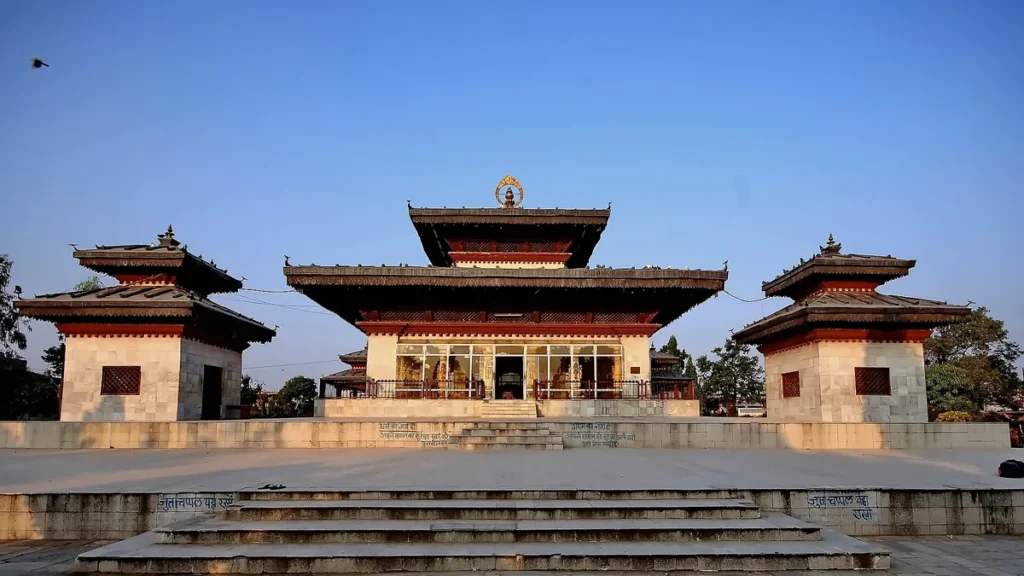
Photo: Rajesh Dhungana, CC BY-SA 4.0, via Wikimedia Commons
Exam angle
Prelims: ₹15,000 crore, the Sarayu-Kamala Express, Lower Arun at 669 megawatts, and Kandla and Paradip ports. · Mains GS-II: neighbourhood first, the 1950 treaty, the open border and unfinished boundary talks.
Practice MCQs
Original practice questions (not PYQs).
The Sarayu-Kamala Express, flagged off by the Prime Ministers of India and Nepal in November 2026, connects
Answer (d) & explanation
The Sarayu-Kamala Express is the first passenger train between Ayodhya in Uttar Pradesh and Janakpur in Nepal, linking the cities of Ram and Sita.
Consider the following statements:
1. Nepal shares a border with five Indian States.
2. The Lower Arun Hydroelectric Project is located in Nepal.
3. India's ₹15,000-crore package for Nepal is entirely in the form of grants.
How many of the above statements are correct?
Answer (b) & explanation
Statements 1 and 2 are correct. Of the package, ₹11,500 crore is a rupee line of credit for energy projects and ₹3,500 crore is grants.
Which of the following Indian ports were offered to Nepal for its transit cargo during the visit of Nepal's Prime Minister in November 2026?
Answer (a) & explanation
India agreed to give Nepal access to Deendayal port (Kandla, Gujarat) and Paradip port (Odisha) for transit cargo.
Questions students ask about this
How is the ₹15,000-crore package split?
₹11,500 crore is a rupee line of credit for energy projects, and ₹3,500 crore is direct grants for rebuilding.
What is the Sarayu-Kamala Express?
It is the first passenger train between Ayodhya in Uttar Pradesh and Janakpur in Nepal, flagged off during the visit.
Which ports was Nepal offered?
Deendayal port at Kandla, in Gujarat, and Paradip port, in Odisha.
What is the size of the Lower Arun project?
669 megawatts. A foundation stone was laid during the visit.
Was the Kalapani question settled?
No. The Foreign Secretaries were asked to keep working on boundary issues, including Kalapani, with a “forward-looking” approach.