
Winter Session skipped only four times in India’s history
Parliament usually meets for its Winter Session in November or December. This year no date has been announced yet. The Monsoon Session has not been formally closed, or prorogued, for over 100 days, and there is talk of a short special session for a delimitation Bill. The Winter Session has been skipped only four times. The first was during the Emergency in 1975. The next were in 1979, after the early dissolution of the Sixth Lok Sabha, and in 1984, after the assassination of Indira Gandhi. The last was in 2020, because of the COVID-19 pandemic. Article 85 does not fix a number of sessions. It only says the gap between two sessions cannot be more than six months. The Government has also studied past cases when the Rajya Sabha met while the Lok Sabha was not in session. Read it to revise summoning, prorogation, the President’s special address and why regular sittings matter.
- This year
- No date has yet been announced for a Winter Session
- Monsoon Session
- Has not been prorogued for over 100 days
- Skipped years
- Only four times: 1975, 1979, 1984 and 2020
- Article 85
- Does not fix the number of sessions; the gap cannot exceed six months
Why is the Winter Session in the news?
A Winter Session is usual. Skipping one is rare. This year no date has been announced, the Monsoon Session has still not been prorogued, and the record shows that this has happened only four times before.
- Parliament usually meets for its Winter Session in November or December. This year no date has been announced yet.
- The Monsoon Session has not been formally closed, or prorogued, for over 100 days. There is talk of a short special session for a delimitation Bill.
- The Winter Session has been skipped only four times. The first was during the Emergency in 1975.
- The next were in 1979, after the early dissolution of the Sixth Lok Sabha, and in 1984, after the assassination of Indira Gandhi.
- The last was in 2020, because of the COVID-19 pandemic.
- Article 85 does not fix a number of sessions. It only says the gap between two sessions cannot be more than six months. The Government has also studied past cases when the Rajya Sabha met while the Lok Sabha was not in session.
What does the Constitution actually require of a session?
India does not have a constitutional calendar that says Parliament must meet three times a year. The Budget, Monsoon and Winter Sessions are a convention. What the Constitution requires is narrower, and that is why this debate is so easy to get wrong in an exam.
Article 85 says the President summons each House of Parliament and may prorogue it, or dissolve the Lok Sabha. It also says that six months shall not intervene between the last sitting of one session and the first sitting of the next. If the Monsoon Session has not been prorogued, the clock and the politics of a new session both look different.
Prorogation ends a session. Adjournment only pauses a sitting. Dissolution ends the Lok Sabha itself. These three words are often mixed up, and they should not be. A House that has been adjourned can meet again in the same session; a House that has been prorogued starts a new session when it is summoned again.
Article 87 requires the President to address both Houses together at the commencement of the first session after a general election and at the commencement of the first session of each year. That special address is a constitutional event, not a courtesy.
The Government has also looked at past cases in which the Rajya Sabha met while the Lok Sabha was not in session. That is possible because the two Houses are summoned separately, even though they often sit in the same session window.
The four skipped Winter Sessions
| Year | The context given in the report |
|---|---|
| 1975 | During the Emergency |
| 1979 | After the early dissolution of the Sixth Lok Sabha |
| 1984 | After the assassination of Indira Gandhi |
| 2020 | Because of the COVID-19 pandemic |
Which Articles and conventions apply?
- Article 85 empowers the President to summon and prorogue each House, and to dissolve the Lok Sabha. The gap between two sessions cannot exceed six months.
- Three sessions a year — Budget, Monsoon and Winter — are a convention, not a rule written into the Constitution.
- Prorogation ends a session. It is done by the President on the advice of the Council of Ministers, not on the request of the presiding officer.
- Article 87 requires the President’s special address at the first session after a general election and at the first session of each year.
- The Rajya Sabha can be summoned even if the Lok Sabha is not then in session, because the two Houses are summoned separately.
Why does the missing Winter Session of Parliament matter?
| Angle | What to note |
|---|---|
| Prelims | Article 85 and the six-month gap; four skipped Winter Sessions in 1975, 1979, 1984 and 2020; three sessions as a convention. |
| GS-II: Parliament | Summoning, prorogation and the difference between ending a sitting and ending a session. |
| Accountability | Fewer sittings mean less time for questions, debates and committee work, and a greater temptation to use ordinances. |
| Article 87 | The President’s special address is required at the first session after a general election and at the first session of each year. |
What are the problems with the missing Winter Session of Parliament?
- No date has been announced yet. A late session is still possible; a skipped session is not yet a completed fact for 2026.
- If the Monsoon Session has not been prorogued, the procedural path to any new sitting is not the same as calling a fresh Winter Session in the usual way.
- A short special session for one Bill would not, by itself, replace a full Winter Session with question time and wider debate.
- Article 85 only caps the gap at six months. It does not guarantee adequate sitting days.
What should be done next on the missing Winter Session of Parliament?
- Keep the four years exact: 1975, 1979, 1984 and 2020, and the reason attached to each.
- Revise the words: summon, adjourn, prorogue, dissolve — and which of them ends a session.
- Remember that three sessions a year are a convention, while the six-month rule is in Article 85.
- Watch whether the Monsoon Session is prorogued, and whether a Winter Session or only a short special sitting is called.
What can Prelims ask on the missing Winter Session of Parliament?
Prelims probability: High. Sessions are asked often: summoning, three sessions and minimum days in 2020, and the President’s special address in the the State paper in 2021. Testable facts: Article 85 six-month rule, four skipped Winter Sessions (1975, 1979, 1984, 2020), Article 87 special address.
- No date has yet been announced for a Winter Session this year, and the Monsoon Session has not been prorogued for over 100 days.
- The Winter Session has been skipped only four times: 1975, 1979, 1984 and 2020.
- Article 85 does not fix the number of sessions. It only requires that the gap between two sessions not exceed six months.
- Three sessions a year are a convention, not a constitutional command.
- Prorogation is done by the President on the advice of the Council of Ministers.
- Article 87 provides for the President’s special address at the first session after a general election and at the first session of each year.
How to write about the missing Winter Session of Parliament in Mains
Practice question (15 marks, 250 words): Article 85 of the Constitution only requires that the gap between two sessions of Parliament should not exceed six months. In the light of the debate on the Winter Session, discuss why regular and adequate sittings of Parliament are important and suggest reforms.
- Open with the record: the Winter Session has been skipped only four times, in 1975, 1979, 1984 and 2020, and no date has been announced yet this year.
- State the rule: Article 85 does not fix the number of sessions; it only caps the gap at six months. Three sessions are a convention.
- Explain why sittings matter: questions, debates, committees, money and a check on ordinances.
- Note the present wrinkle: the Monsoon Session has not been prorogued for over 100 days, and there is talk of a short special session for a delimitation Bill.
- Close with reforms that students can fairly mention, such as a pre-announced calendar and a minimum number of sitting days, without inventing a figure the report does not give.
Ready lines for your answer
- A convention of three sessions is not the same thing as a constitutional duty.
- A House that does not sit cannot question, and a government that is not questioned is harder to hold to account.
Quotable data pointReported 24 November 2026: no Winter Session date announced; Monsoon Session not prorogued for over 100 days; Winter Session skipped only in 1975, 1979, 1984 and 2020; Article 85 six-month rule.
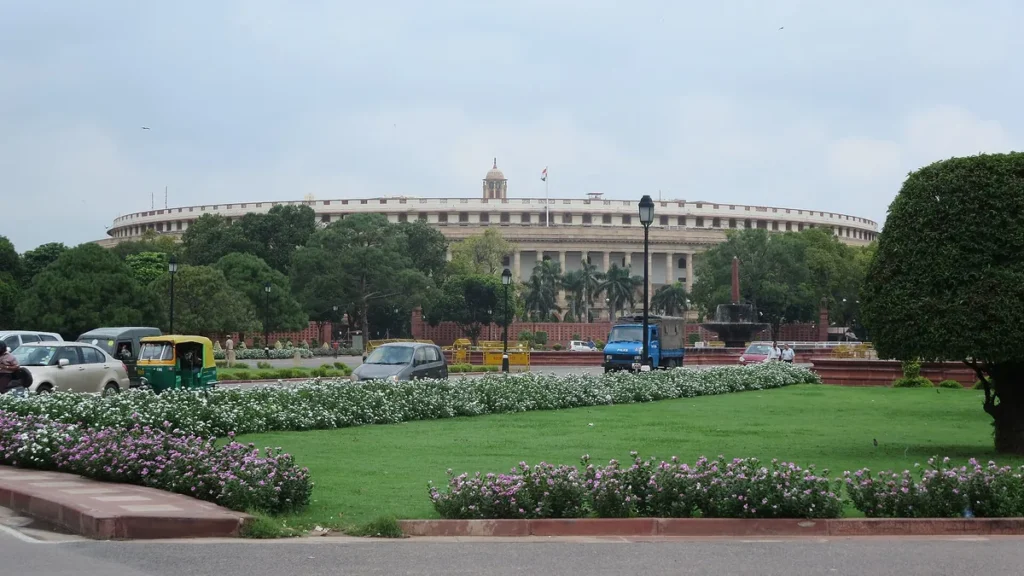
Photo: Nikhilb239, CC BY-SA 4.0, via Wikimedia Commons
Exam angle
Prelims: Article 85, the four skipped years, and the fact that three sessions are a convention. · Mains GS-II: why regular sittings matter for accountability, law-making and the use of ordinances.
Practice MCQs
Original practice questions (not PYQs).
Consider the following statements:
1. Article 85 requires that the gap between two sessions of Parliament should not exceed six months.
2. The Constitution prescribes three sessions of Parliament every year.
3. The President can prorogue a House only on the request of its presiding officer.
How many of the above statements are correct?
Answer (a) & explanation
Only statement 1 is correct. Three sessions are a convention, not a constitutional rule, and prorogation is done by the President on the advice of the Council of Ministers.
In which one of the following years was the Winter Session of Parliament held as usual?
Answer (c) & explanation
The Winter Session was skipped only in 1975 (Emergency), 1979, 1984 (after the assassination of Indira Gandhi) and 2020 (COVID-19 pandemic).
Questions students ask about this
How many times has the Winter Session been skipped?
Only four times: in 1975, 1979, 1984 and 2020.
What does Article 85 actually require?
It does not fix the number of sessions. It says the gap between two sessions cannot be more than six months.
Has a Winter Session date been announced this year?
No. The report says no date has been announced yet.
What is the status of the Monsoon Session?
It has not been formally closed, or prorogued, for over 100 days.
Are three sessions a year required by the Constitution?
No. Budget, Monsoon and Winter Sessions are a convention.