
UPSC Prelims 2024 · GS Paper I: Which one of the following shows a unique relationship with an insect that has…
Which one of the following shows a unique relationship with an insect that has coevolved with it and that is the only insect that can pollinate this tree ?
Answer (a) & explanation
The fig has a unique relationship with its fig wasp (a). Each fig species is pollinated by its own tiny fig wasp. The female wasp enters the closed fig, called a syconium, through a small opening, pollinates the flowers inside, and lays her eggs there. Her young grow inside the fig, and the new females fly off carrying pollen to another fig. Neither partner can complete its life cycle without the other. This one-to-one mutualism is a classic example of coevolution. Mahua (b), sandalwood (c) and silk cotton (d) are pollinated by many animals, such as bats, birds and insects.
Notice why figs matter: they fruit all year and feed many animals, so they are called keystone species in tropical forests. India's banyan and peepal are figs.
Answer as per the official UPSC answer key.
Related questions from other years
Which of the following statements in relation to NIRANTAR (National Institute for Research and Application of Natural Resources to Transform, Adapt and Build Resilience), a platform of institutions under the Ministry of Environment, Forest and Climate Change, is/are correct ?
- 1. Ecosystem Survey and Analysis is a vertical under this platform, the lead institute of which is Botanical Survey of India, Kolkata.
- 2. Research and Management of Ecosystem Service is a vertical under this platform, the lead institute of which is Central Zoo Authority, New Delhi.
- 3. Capacity Development Support is a vertical under this platform, the lead institute of which is Indian Institute of Forest Management, Bhopal.
Select the answer using the code given below :
Answer (b) & explanation
Statements 1 and 3 are correct (b). NIRANTAR groups the Environment Ministry's institutes into verticals. Statement 1 is right: Ecosystem Survey and Analysis is led by the Botanical Survey of India, Kolkata, with bodies like the FSI and ZSI. Statement 3 is right: Capacity Development Support is led by the Indian Institute of Forest Management, Bhopal. Statement 2 is wrong: Research and Management of Ecosystem Service is led by ICFRE, Dehradun; the Central Zoo Authority is only a member. So options (a), (c) and (d) fail.
Notice the purpose: pooling institutes avoids duplicate work and links research to climate adaptation and resilience. Other Ministry bodies include the Wildlife Institute of India (Dehradun) and GBPNIHE for the Himalaya.
the Central Zoo Authority does sit in that vertical, but as a member, not the lead.
Answer as per the official UPSC answer key.
Consider the following statements with reference to India’s response to climate change :
- I. India’s Long-Term Low Emission Development Strategy (LT-LEDS) is a crucial tool for achieving net-zero emissions by 2070.
- II. India’s 4th Biennial Update Report (BUR-4) submitted in December, 2024 recorded around 8% decrease in Greenhouse gas emissions in 2020 over 2019.
- III. Climate-resilient development necessarily depends on quick and short-term achievement of emission reduction targets.
Which of the following relationships among the above statements is/are correct ?
- 1. Statement I is empirically supported by statement II.
- 2. Statement III contradicts the approach implicit in statement I.
- 3. Statement I and statement III together establish the premise of long-term sustainability.
Select the answer using the code given below :
Answer (b) & explanation
Relationships 1 and 2 are correct (b). Relationship 1 is right: the LT-LEDS (2022) lays out India's path to net zero by 2070, and BUR-4 reported a fall of about 7.9% in 2020 emissions over 2019, real data in line with that path. Relationship 2 is right: Statement III wants quick, short-term cuts, while the LT-LEDS is a long, gradual plan, so III contradicts I. Relationship 3 is wrong: two contradicting statements cannot together set a premise. So options (a), (c) and (d) fail.
Notice the cause of the 2020 fall: the COVID-19 lockdowns, not a lasting trend. India's updated NDC (2022) targets cutting emissions intensity of GDP by 45% from 2005 levels by 2030. Biennial Transparency Reports now replace BURs.
"together establish" sounds positive, but two statements that clash cannot form one premise.
Answer as per the official UPSC answer key.
With respect to the Western Hoolock Gibbons, which of the following statements is/are correct ?
- 1. A Sanctuary in North-east India is home to this ape species listed as Endangered in the International Union for Conservation of Nature (IUCN) Red List.
- 2. They have specialized brachiation and can easily swing between trees.
- 3. They possess a strong and heavy build like gorillas, yet are remarkably agile tree climbers.
Select the answer using the code given below :
Answer (b) & explanation
Statements 1 and 2 are correct (b). Statement 1 is right: India's only ape, the western hoolock gibbon, is Endangered on the IUCN Red List and gives its name to the Hollongapar Gibbon Sanctuary in Assam. Statement 2 is right: gibbons move by brachiation, swinging arm over arm through the canopy. Statement 3 is wrong: they are "lesser apes", slim and light, about 6–9 kg, nothing like a heavy gorilla. So options (a), (c) and (d) fail.
Notice their habits: they live in pairs with their young and sing loud duets at dawn. They are found south of the Brahmaputra in the North-East. Rail lines cutting through Hollongapar have raised concern, and canopy bridges were proposed to help them cross.
Answer as per the official UPSC answer key.
Which of the following best explain(s) the rationale for protecting mangrove ecosystems in the context of climate resilience ?
- 1. Mangroves reduce tidal energy and store freshwater, making them ideal sites for paddy cultivation in saline estuarine belts.
- 2. Their salt-sensitive roots filter seawater, making mangroves key to converting coastal land into freshwater aquaculture zones.
- 3. By withstanding tidal surges and offering biomass resources, mangroves function both as natural bio-shields and livelihood bases for rural communities.
Select the answer using the code given below :
Answer (d) & explanation
Only statement 3 explains the rationale (d). Statement 3 is right: by withstanding tidal surges and cyclones, mangroves act as natural bio-shields, and they offer biomass, such as fish, crabs, honey and fuel, for coastal villages. Statement 1 is wrong: mangroves do not store fresh water for paddy. Statement 2 is wrong: they are salt-tolerant, not salt-sensitive. Clearing them for farms or aquaculture ponds is exactly what harms them. So options (a), (b) and (c) fail.
Notice the proof: mangroves cut deaths in the 1999 Odisha super-cyclone and the 2004 tsunami. They also store much blue carbon. India's largest mangrove forest is the Sundarbans; the MISHTI scheme (2023) aims to plant more along the coast.
statement 2 says "salt-sensitive". Mangroves live in salt water because they tolerate it.
Answer as per the official UPSC answer key.
In the news since
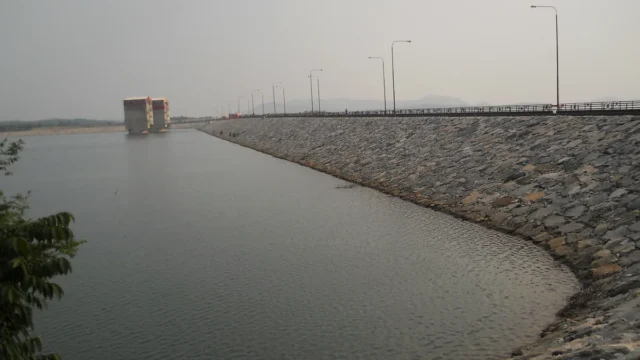
Pumped storage hydropower: India’s roadmap for 100 GW of ‘water batteries’ by 2035-36
A PIB backgrounder of 19 October 2026 explains how pumped storage projects (PSPs) will store solar and wind power for India’s grid. India runs 7.43 GW of pumped storage today, is building 15.87 GW more and has an assessed potential of 345.38 GW. A roadmap aims to add about 100 GW between 2025-26 and 2035-36.
19 Oct 2026
NBA shares Rs 1.19 crore with 29 State Biodiversity Boards from use of crop genetic resources
On 17 October 2026 the National Biodiversity Authority (NBA) said it had shared ₹1.19 crore with 29 State Biodiversity Boards and one UT Biodiversity Council. The money came from seed companies that used Indian maize, rice, pearl millet and cotton for research and commercial hybrids. As the crops were bought from markets and the original holders could not be traced, the amount was split in proportion to each State’s cultivation area. The release comes two days before the CBD COP 17 opens in Yerevan.
18 Oct 2026
Oil companies bar sugar-based ethanol for 2026-27; maize incentive cut to ₹2.79 a litre
The oil marketing companies have kept sugar out of India’s ethanol programme for the coming year. The tender issued on 16 October 2026 seeks about 11 billion litres of ethanol for the 2026-27 supply year, but asks for none made from sugarcane juice, sugar syrup or B-heavy molasses, because the Government wants sugar diversion for ethanol cut to zero. Grain must now carry the load, and even the maize incentive has been cut. Read this as a live example of the food-versus-fuel trade-off.
18 Oct 2026