
CAQM reviews stubble-burning hotspots in Amritsar and Tarn Taran
UPSC has already asked about this. Read the story with these questions in mind.
A CAQM team visited Amritsar and Tarn Taran, two Punjab hotspots of paddy stubble burning, on 9-10 October 2026 and reviewed crop residue machinery, baler supply chains and control rooms. CAQM flying squads are deployed in 18 Punjab districts from 1 October to 30 November 2026 to check burning during harvest.
- Body
- CAQM
- Law
- CAQM Act, 2021
- Visited
- Amritsar, Tarn Taran
- Flying squads
- 18 Punjab districts
Stubble burning and CAQM: what happened?
Every October paddy harvest leaves straw in fields, and burning it adds to winter smog over Delhi-NCR. CAQM, the statutory body for NCR air quality, now goes to the hotspot districts itself.
- A CAQM team led by Member (Technical) Dr S.D. Attri visited Amritsar and Tarn Taran (Punjab), identified hotspots of paddy stubble burning, during the harvest season [PIB].
- It reviewed in-situ and ex-situ stubble management, timely availability of Crop Residue Management (CRM) machines and IEC campaigns with district officials; field visits on 9–10 Oct 2026 [PIB].
What are in-situ and ex-situ management?
- In-situ: straw is managed in the field itself, for example mixed into soil using Crop Residue Management (CRM) machines.
- Ex-situ: straw is baled and taken away for use elsewhere, for example as boiler fuel in industry. Amritsar has linked farmers and aggregators to industries with boilers.
Where does CAQM get its powers?
- CAQM was set up under the Commission for Air Quality Management in National Capital Region and Adjoining Areas Act, 2021, and issues statutory directions to States, pollution control boards and districts.
Why does Stubble burning and CAQM matter?
- Environment: Stubble burning is a major cause of winter air pollution in NCR (PIB).
- Governance: Field visits plus flying squads add enforcement to incentives.
What can Prelims ask on Stubble burning and CAQM?
- CAQM: statutory body under the 2021 Act.
- In-situ vs ex-situ straw management.
- Flying squads in 18 Punjab districts (1 Oct-30 Nov 2026).
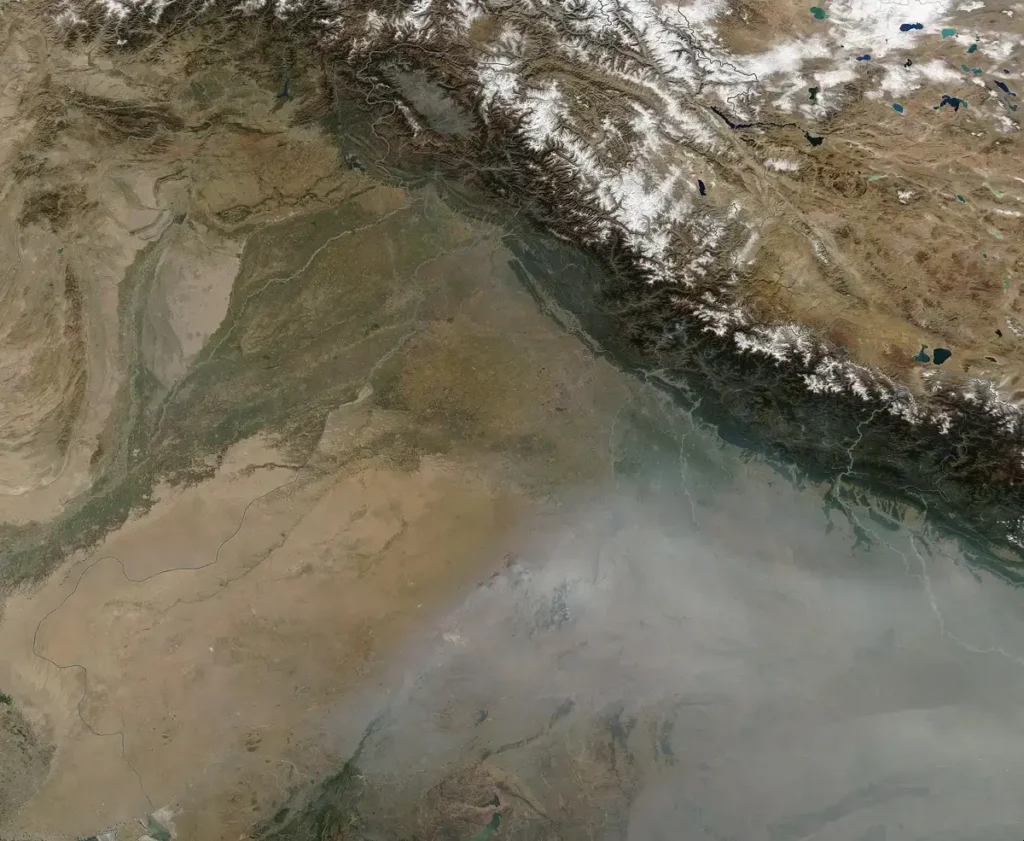
Image: https://commons.wikimedia.org/wiki/File:Fires_in_India_(MODIS_2020-10-28).jpg
How to use this in Mains
If asked: Despite many measures, stubble burning continues. Analyse the reasons and suggest solutions. (GS-III)
Quote: “In-situ: straw is managed in the field itself, for example mixed into soil using Crop Residue Management (CRM) machines.”
Use it: Use it to explain in-situ options, then contrast with ex-situ baling for industry boilers.
Exam angle
Prelims: CAQM, in-situ/ex-situ. · Mains GS-III: air pollution, crop residue.
Practice MCQs
Original practice questions (not PYQs).
Using paddy straw bales as boiler fuel in industry is an example of
Answer (b) & explanation
Ex-situ means the straw is removed from the field and used elsewhere.
The Commission for Air Quality Management in NCR and Adjoining Areas was set up under
Answer (c) & explanation
CAQM is a statutory body under the CAQM Act, 2021.
Questions students ask about this
What is CAQM?
The Commission for Air Quality Management in NCR and Adjoining Areas, a statutory body set up under a 2021 Act to deal with air pollution in the region.
What is ex-situ stubble management?
Collecting paddy straw, usually as bales, and using it outside the field, for example as boiler fuel in industries.
Where are CAQM flying squads deployed in 2026?
In 18 Punjab districts from 1 October to 30 November 2026.
Keep studying
Go deeper
Official source: PIB, MoEFCC: CAQM reviews stubble burning prevention in Amritsar and Tarn Taran, 10 Oct 2026
facts from cited sources only; faculty review pending