
UPSC Mains 2026 GS3 Q18: model answer
"Community participation is the cornerstone of effective disaster management". Analyse this statement with suitable examples from India. Also discuss the challenges to community participation and measures to strengthen it.
What the question wants
Analyse (agree with nuance) using Indian examples; challenges; measures.
How to structure it
Intro: communities are the first responders. Body: examples across the disaster cycle; limits; challenges; measures. Conclusion: from relief to resilience.
- 1Examples across the disaster cycle
- 2Limits
- 3Challenges
- 4Measures
Model answer
In most disasters the first rescuers are neighbours, not the NDRF. The Sendai Framework and the Disaster Management Act, 2005 treat communities as partners in preparedness, response and recovery.
- 1Prepare: village plans, drills, Aapda Mitra
- 2Warn: local-language alerts
- 3Respond: first rescue by neighbours
- 4Recover: owner-driven reconstruction
- 5Learn: feed back into district plans
Repeats: the last stage feeds back into the first
Indian evidence
- Odisha: village volunteers, locally run shelters and drills evacuated over a million before Phailin (2013) and Fani (2019), with few deaths compared with 1999.
- Tsunami Ready: UNESCO recognised Venkatraipur and Noliasahi (2020).
- Kerala 2018: fishermen's boats rescued thousands.
- Aapda Mitra volunteers in flood-prone districts.
- Owner-driven rebuilding after Bhuj (2001) beat contractor colonies.
Not enough alone: communities cannot build embankments or run warning satellites. Participation complements state capacity.
Challenges: top-down district plans; migration leaving the elderly and women exposed; caste and gender bias in relief; volunteer fatigue; warnings not in local languages.
Measures
- Village plans approved in gram sabhas, funded via the 15th Finance Commission's mitigation window.
- Training and insurance for Aapda Mitras; NCC, NSS networks.
- Women's SHGs running shelters and relief.
- Local-language mobile alerts via the Common Alerting Protocol.
- School drills.
Odisha's own numbers make the point: about 10,000 deaths in the 1999 super cyclone, and a few dozen in Fani twenty years later, with the same coastline and a trained village network in between.
The statement holds if 'cornerstone' means foundation, not the whole building.
Keywords, cases and data to drop in
DM Act 2005 Sendai Framework 2015-2030 Odisha model (Phailin 2013, Fani 2019) Tsunami Ready villages (UNESCO 2020) Aapda Mitra owner-driven reconstruction (Bhuj 2001) Common Alerting Protocol 15th FC mitigation fund community-based DRR
Where most answers lose marks
- Agreeing fully without the limits; 'analyse' needs both sides.
- Using only one example.
- Measures that do not name any institution or scheme.
Fresh examples from current affairs
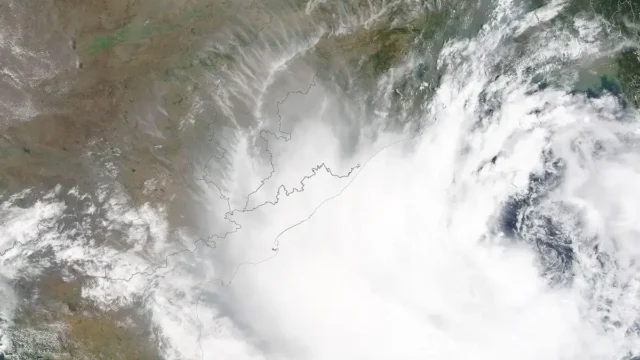
IMD launches a map-based Decision Support System for cyclone and marine warnings
On 12 October 2026 the India Meteorological Department dedicated a Cyclone Warning and Marine Weather Services Decision Support System to the nation. The WebGIS platform shows cyclone track, intensity, winds, rainfall, storm surge and district-wise warnings on one map for disaster managers and the public.
UPSC angle: Prelims: IMD, cone of uncertainty, storm surge. · Mains GS-III: early warning and disaster preparedness.
13 Oct 2026
India offers flood relief to Nepal; PM speaks to Nepal PM
On 26 August 2026 Prime Minister Narendra Modi spoke to Nepal's Prime Minister Balendra Shah and conveyed condolences on the loss of lives in floods in Nepal. He said India is ready to provide all possible humanitarian assistance, and that Indian teams are coordinating closely with Nepalese authorities on rescue and relief.
UPSC angle: Mains: India–Nepal water and flood cooperation.
26 Aug 2026
UNCCD COP17: India urges shift from drought response to drought resilience
At a ministerial dialogue on drought resilience at UNCCD COP17 in Ulaanbaatar, Mongolia, on 25 August 2026, India called for a shift from reactive drought relief to proactive, technology-enabled resilience. The Environment Minister said drought must be managed as a predictable, preventable risk, with preparedness over response and prevention over crisis management.
UPSC angle: Mains: Drought resilience strategies.
25 Aug 2026
India hosts 3rd BRICS ministerial on disaster risk reduction
Under India's BRICS Chairship 2026, NDMA hosted the 3rd BRICS Ministerial Meeting on Disaster Risk Reduction in New Delhi on 24 July 2026. Members unanimously adopted a BRICS Joint Statement on DRR and pledged to speed up the BRICS DRR Work Plan for 2025 to 2028.
UPSC angle: Prelims: Sendai; CDRI.
24 Jul 2026Learn the concept
Question text as printed in the official UPSC question paper: https://www.upsc.gov.in/sites/default/files/QP-CSM-26-010926-GENERAL-STUDIES-PAPER-III.pdf The model answer is original Battle IAS work; use it to learn structure, not to memorise.