
UPSC Mains 2026 GS4 Q5a: model answer
Usually schools, working in remote areas, do not fully comply with government regulations. However, if the rules are enforced strictly, it would lead to most schools closing down. How should an administrator strike a balance between enforcement of rules and educational rights of children?
What the question wants
Show the dilemma (rule of law vs Article 21A), then a graded approach that protects children while raising standards.
How to structure it
Intro: the dilemma. Body: principles; practical steps. Conclusion.
- 1Principles
- 2Practical steps
Model answer
The administrator faces a clash between the rule of law and the right to education under Article 21A and the RTE Act, 2009. Closing schools would punish the very children the rules exist to protect.
Principles
- The purpose of regulation is children's safety and learning, not the rule for its own sake.
- Separate non-negotiable rules (building safety, child protection, no corporal punishment) from developmental ones (playground size, library, teacher qualifications).
Balanced approach
- Enforce safety rules strictly and immediately.
- Give time-bound improvement plans for the rest, with support.
- Help schools comply: Samagra Shiksha funds, teacher training, cluster resource centres, CSR.
- If a school must close, ensure every child is moved to another school with transport, as RTE's neighbourhood norm requires.
- Publish progress to the community and School Management Committees.
Rules should lift schools up, not shut them down. Firm on safety, flexible on infrastructure, and always guided by the child's best interest.
Keywords, cases and data to drop in
Article 21A RTE Act graded compliance best interest of the child School Management Committee
Where most answers lose marks
- Choosing strict closure or ignoring rules entirely
- No practical steps
Fresh examples from current affairs

NMC withdraws MSMER-2023: medical colleges lose the fixed penalty rulebook, annual disclosure stays
The National Medical Commission (NMC) has de-notified the Maintenance of Standards of Medical Education Regulations, 2023 (MSMER-2023) by a notification dated 14 October 2026, published in the Gazette on 16 October. Its fixed penalties, including seat cuts and fines of up to ₹5 lakh for false records, go with it. The Annual Disclosure Report stays.
UPSC angle: Prelims: NMC Act 2019, autonomous boards, Concurrent List Entry 25. · Mains GS-II: regulation of medical education.
19 Oct 2026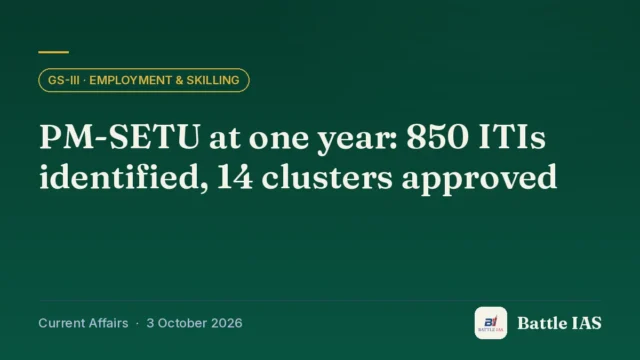
PM-SETU at one year: 850 ITIs identified, 14 clusters approved
PM-SETU, launched on 4 October 2025 to upgrade 1,000 Government ITIs through a hub-and-spoke model, has identified 850 ITIs and approved 14 ITI clusters worth ₹3446 crore in its first year. The scheme has a ₹60,000 crore outlay shared by the Centre, States and industry, and also upgrades five NSTIs.
UPSC angle: Prelims: PM-SETU expansion; hub-and-spoke. · Mains: Making ITIs industry-relevant.
3 Oct 2026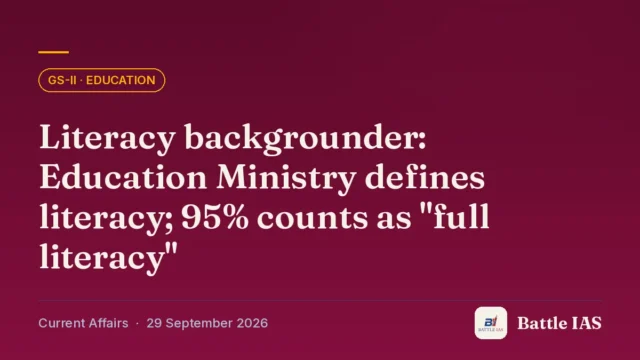
Literacy backgrounder: Education Ministry defines literacy; 95% counts as “full literacy”
A PIB backgrounder of 29 September 2026 says the Education Ministry has, for the first time, defined literacy as reading, writing and computing with comprehension, plus life skills like digital and financial literacy. A State or UT at 95 per cent counts as fully literate. PLFS 2025 puts India's literacy rate at 81.1 per cent.
UPSC angle: Prelims: 95% threshold; new definition components.
29 Sep 2026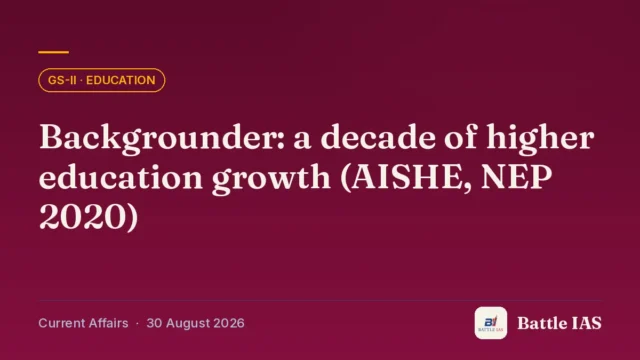
Backgrounder: a decade of higher education growth (AISHE, NEP 2020)
A PIB backgrounder of 30 August 2026 uses AISHE data to show a decade of change in higher education. Between 2014-15 and 2023-24 universities rose from 760 to 1,289, enrolment from 3.42 crore to 4.50 crore, and GER from 23.7 to 30 per cent. Female GER reached 31.2 per cent, ahead of male GER.
UPSC angle: Prelims: AISHE; NEP GER target.
30 Aug 2026Learn the concept
Question text as printed in the official UPSC question paper: https://www.upsc.gov.in/sites/default/files/QP-CSM-26-010926-GENERAL-STUDIES-PAPER-IV.pdf The model answer is original Battle IAS work; use it to learn structure, not to memorise.