
Land Reforms in India: Zamindari Abolition, Tenancy Reform, Ceilings, Bhoodan, and Land Records Modernisation (UPSC Notes + PYQs)
UPSC has already asked about this. Read the story with these questions in mind.
- Prelims 2019With reference to land reforms in independent India, which one of the following statements is correct?Solve it below ↓
- Mains 2023 · GS3State the objectives and measures of land reforms in India. Discuss how land ceiling policy on landholding can be considered as an effective reform…See model answer →
The colonial base
Permanent Settlement (Bengal, 1793) created zamindars; ryotwari (Madras, Bombay) dealt with cultivators directly; mahalwari (North-West Provinces, Punjab) settled with village bodies. By 1947 intermediaries covered about 40% of the area, and tenants paid rents of half the crop or more.
What was done
- Zamindari abolition: UP’s Zamindari Abolition and Land Reforms Act, 1950 was a model; the First Amendment (1951) and the Ninth Schedule protected such laws from court challenge.
- Tenancy reform: regulate rent, give security of tenure, confer ownership. Kerala’s 1969 amendment and West Bengal’s Operation Barga (1978) registered sharecroppers.
- Ceilings: first-round laws in the 1960s, national guidelines in 1972; only about 2-3% of cultivated land was declared surplus, and less was actually distributed.
- Consolidation of scattered plots: successful in Punjab, Haryana and western UP.
Voluntary efforts
Vinoba Bhave began the Bhoodan movement at Pochampalli in Telangana in 1951 and later Gramdan. Over 40 lakh acres were pledged, but much was uncultivable or never transferred.
Why ceilings failed
Benami and fictitious transfers, family-based exemptions, delays in courts, landed elites dominating State politics, and poor land records. The 2019 Prelims tested how ceiling laws treated family units and exemptions.
The new agenda
- Digital India Land Records Modernisation Programme (DILRMP): computerised records, cadastral maps, a Unique Land Parcel ID (Bhu-Aadhaar).
- SVAMITVA (2020): drone mapping of inhabited village land to give property cards.
- Model Agricultural Land Leasing Act (2016): legal leasing to protect owners and tenants.
- Conclusive titling, a long-pending goal.
Land Reforms: UPSC angle
For UPSC CSE
Prelims: settlement systems, Operation Barga, Bhoodan origin, Ninth Schedule, SVAMITVA. Mains GS-III: land reforms and productivity, land records, leasing.
Land Reforms UPSC PYQs (Prelims)
Questions UPSC has actually asked, from the official papers. Pick an option to check yourself.
With reference to land reforms in independent India, which one of the following statements is correct?
Land reforms aimed to give land to the tiller and to the landless by abolishing intermediaries, fixing ceilings and distributing surplus land. Ceiling laws were first fixed on individual holdings and later (1972 guidelines) on family holdings, so (a) is too narrow. Plantations, orchards and some other lands were exempted from ceilings, so (d) is wrong. Answer as per the official UPSC key · Battle IAS PYQ bankAnswer (b) & why
The demand for the Tebhaga Peasant Movement in Bengal was for
In the Tebhaga movement (1946-47), led by the Kisan Sabha, sharecroppers (bargadars) demanded that the jotedar’s share be cut from half to one-third (tebhaga means “three shares”). Answer as per the official UPSC key · Battle IAS PYQ bankAnswer (a) & why
Mains PYQs on this topic
Questions from the official UPSC Mains papers (2023-2026 in the Battle IAS Mains bank), newest first. Each links to a model answer.
- UPSC Mains 2024 · GS Paper III · Q3 · 10 marks
What were the factors responsible for the successful implementation of land reforms in some parts of the country? Elaborate.
- UPSC Mains 2023 · GS Paper III · Q4 · 10 marks
State the objectives and measures of land reforms in India. Discuss how land ceiling policy on landholding can be considered as an effective reform under economic criteria.
Quick quiz
Operation Barga was launched in
1978, registering sharecroppers.Answer (b)
The Bhoodan movement began at
1951.Answer (b)
Which amendment created the Ninth Schedule?
1951.Answer (a)
FAQs
Which part of land reform was most successful?
Abolition of intermediaries (zamindari).
Why did ceiling laws fail?
Benami transfers, exemptions, weak records and political resistance.
What is SVAMITVA?
A scheme to survey inhabited village land with drones and give owners property cards.
What is Bhu-Aadhaar?
A 14-digit Unique Land Parcel Identification Number under DILRMP.
Spotted an error? Tell us. We correct within 48 hours.
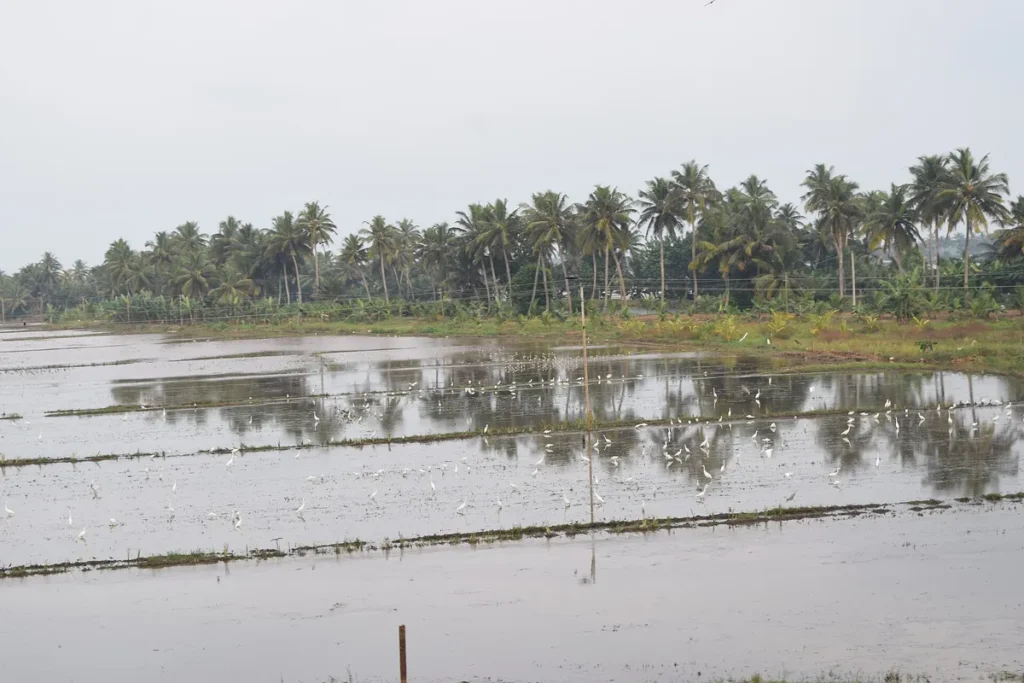
Image: KannanVM, Wikimedia Commons, CC BY-SA 4.0
How to use this in Mains
If asked: UPSC Mains 2024, GS-III: What were the factors responsible for the successful implementation of land reforms in some parts of the country? Elaborate.
Quote: “Benami and fictitious transfers, family-based exemptions, delays in courts, landed elites dominating State politics, and poor land records.”
Use it: Use as the reasons for failure in some States, then contrast with Kerala and West Bengal.
In the news
Pumped storage hydropower: India’s roadmap for 100 GW of ‘water batteries’ by 2035-36
A PIB backgrounder of 19 October 2026 explains how pumped storage projects (PSPs) will store solar and wind power for India’s grid. India runs 7.43 GW of pumped storage today, is building 15.87 GW more and has an assessed potential of 345.38 GW. A roadmap aims to add about 100 GW between 2025-26 and 2035-36.
19 Oct 2026
China to impose export controls on tunnel boring machines from 18 November: what it means for India
On 19 October 2026 China’s Commerce Ministry announced export controls on tunnel boring machines (TBMs) and related items from 18 November, calling them clearly dual-use. India imports TBMs for metro, rail and border tunnels and has faced customs delays on Chinese machines since 2024. China also announced controls on some drones.
19 Oct 2026
Kufri Jamunia: ICAR-CPRI’s purple potato to fight hidden hunger
A PIB backgrounder of 18 October 2026 puts the spotlight on Kufri Jamunia, a purple-fleshed potato bred by ICAR’s Central Potato Research Institute and released in 2024. It has nearly twice the Vitamin C of a common potato and several times more zinc and iron, along with antioxidants called anthocyanins. The idea is clever: instead of asking people to change what they eat, make the food they already eat more nutritious. That is biofortification.
18 Oct 2026
Oil companies bar sugar-based ethanol for 2026-27; maize incentive cut to ₹2.79 a litre
The oil marketing companies have kept sugar out of India’s ethanol programme for the coming year. The tender issued on 16 October 2026 seeks about 11 billion litres of ethanol for the 2026-27 supply year, but asks for none made from sugarcane juice, sugar syrup or B-heavy molasses, because the Government wants sugar diversion for ethanol cut to zero. Grain must now carry the load, and even the maize incentive has been cut. Read this as a live example of the food-versus-fuel trade-off.
18 Oct 2026