
Centre–State Relations in India: Legislative, Administrative and Financial (UPSC Notes + PYQs)
UPSC has already asked about this. Read the story with these questions in mind.
- Prelims 2016The Parliament of India acquires the power to legislate on any item in the State List in the national interest if a resolution to…Solve it below ↓
- Mains 2024 · GS2What changes has the Union Government recently introduced in the domain of Centre-State relations? Suggest measures to be adopted to build the trust between…See model answer →
Background
The Constitution divides power between the Union and the States in three fields: law-making, administration and money. The scheme borrows heavily from the Government of India Act, 1935, including its three lists of subjects, but tilts the balance towards the Centre. The framers had just seen Partition and wanted a Union strong enough to hold the country together. Over the decades, coalition politics, regional parties, economic liberalisation and GST have repeatedly shifted that balance, which is why Centre-State relations remain one of the most asked themes in GS Paper II.
Legislative relations (Articles 245–255)
The Seventh Schedule divides subjects into Union, State and Concurrent Lists (Art. 246). Residuary power is with Parliament (Art. 248). Parliament can make laws on a State List subject:
- Art. 249: if the Rajya Sabha resolves, by two-thirds of members present and voting, that it is in the national interest (valid one year, renewable).
- Art. 250: during a National Emergency.
- Art. 252: if two or more State legislatures request it (the law applies to those States and others that adopt it).
- Art. 253: to implement international treaties.
In a Concurrent List conflict, Union law prevails (Art. 254), unless a State law reserved for and assented to by the President. The 42nd Amendment (1976) moved five subjects, including education and forests, from the State to the Concurrent List.
- 1Rajya Sabha resolution in national interest (Art. 249)
- 2National Emergency (Art. 250)
- 3Request of two or more States (Art. 252)
- 4Implementing a treaty (Art. 253)
- 5President's Rule in the State (Art. 356)
Administrative relations (Articles 256–263)
States must exercise executive power so as to comply with Union laws (Art. 256). The Union can direct States on matters such as communications of national importance and protection of railways (Art. 257). Art. 262 lets Parliament provide for adjudicating inter-State river water disputes. Art. 263 provides for the Inter-State Council, set up in 1990 on the Sarkaria Commission’s recommendation. All India Services (Art. 312) also link the two levels.
Financial relations (Articles 268–293)
The Union has the more buoyant taxes; States have bigger spending responsibilities, a “vertical fiscal imbalance”. The fix is constitutional sharing: Union taxes are shared with States (Art. 270) on the recommendation of the Finance Commission (Art. 280, every five years). States also receive statutory grants-in-aid (Art. 275) and discretionary grants (Art. 282). Since 2017, the GST Council (Art. 279A) jointly decides GST rates. State borrowing is governed by Art. 293.
Commissions on Centre–State relations
| Body | Year | Key ideas |
|---|---|---|
| Administrative Reforms Commission (first) | 1966 | Report on Centre–State relations; Inter-State Council |
| Rajamannar Committee (Tamil Nadu) | 1969 | Greater State autonomy |
| Sarkaria Commission | 1983 (report 1988) | Sparing use of Art. 356, Inter-State Council, Governor norms |
| Punchhi Commission | 2007 (report 2010) | Fixed tenure for Governors, localised emergency, cooperative federalism |
- Inter-State CouncilArticle 263
- Finance CommissionArticle 280
- GST CouncilArticle 279A
- Zonal CouncilsStates Reorganisation Act, 1956
- NITI Aayog Governing CouncilExecutive resolution, 2015
How Centre–State relations changed after 1990
Coalition governments at the Centre from 1989, economic liberalisation from 1991, and the Bommai judgment (1994) curbing misuse of Art. 356 increased the weight of States. The 73rd and 74th Amendments (1992) added a third tier. The GST (2017) pooled sovereignty in a shared council. Recent friction points include Governors and State Bills, use of central agencies, divisible-pool size, and cesses and surcharges that are not shared with States.
The three lists
| List | Original entries | Examples |
|---|---|---|
| Union List (List I) | 97 | Defence, foreign affairs, banking, atomic energy, railways |
| State List (List II) | 66 | Police, public order, public health, agriculture, land |
| Concurrent List (List III) | 47 | Criminal law, marriage, education, forests, electricity |
The 42nd Amendment (1976) moved five subjects from the State List to the Concurrent List: education, forests, weights and measures, protection of wild animals and birds, and administration of justice (constitution of courts other than the Supreme Court and High Courts). On a conflict in a Concurrent subject, Union law prevails (Article 254), unless a State law reserved for the President has received assent.
When Parliament can legislate on State subjects
- Article 249: Rajya Sabha resolution, by two-thirds of members present and voting, in the national interest (valid one year, renewable).
- Article 250: during a National Emergency.
- Article 252: when two or more State legislatures request it.
- Article 253: to implement international treaties and agreements.
- Article 356: during President’s Rule in a State.
Flashpoints today
- Governors: delays in assent to Bills and disputes over government formation.
- Central agencies: several States have withdrawn general consent for the CBI, which works under the Delhi Special Police Establishment Act, 1946.
- Money: rising cesses and surcharges that stay outside the divisible pool, and conditions attached to centrally sponsored schemes.
- Borrowing: Article 293 requires States indebted to the Centre to get its consent before borrowing.
- All India Services: disputes over deputation of IAS and IPS officers.
Way forward
The Sarkaria and Punchhi reports already contain a workable agenda: regular meetings of the Inter-State Council, consultation with States before legislating on Concurrent subjects, sparing use of Article 356, and a larger untied share of revenue. Bodies such as the GST Council and the Governing Council of NITI Aayog show that joint decision-making can work when it is institutionalised rather than left to political goodwill.
Centre-state Relations: UPSC angle
For UPSC CSE
Prelims: article-to-power matching (249, 252, 253, 263, 280, 282), Seventh Schedule shifts. Mains GS-II: fiscal federalism, Finance Commission criteria, GST Council as a model, commissions’ recommendations, recent disputes.
Centre-state Relations UPSC PYQs (Prelims)
Questions UPSC has actually asked, from the official papers. Pick an option to check yourself.
The Parliament of India acquires the power to legislate on any item in the State List in the national interest if a resolution to that effect is passed by the
Under Art. 249, Parliament can legislate on a State List item if the Rajya Sabha passes a resolution by a two-thirds majority of members present and voting. Answer as per the official UPSC key · Battle IAS PYQ bankAnswer (d) & why
Which one of the following statements is correct as per the Constitution of India ?
Inter-State quarantine is a Union List subject. Inter-State trade and commerce, inter-State migration and corporation tax are also Union subjects, so options (a), (b) and (d) are wrong. Answer as per the official UPSC key · Battle IAS PYQ bankAnswer (c) & why
With reference to India, consider the following :
– I. The Inter-State Council
– II. The National Security Council
– III. Zonal Councils
How many of the above were established as per the provisions of the Constitution of India?
Asks which bodies are constitutional or statutory. The Inter-State Council is constitutional (Art. 263); Zonal Councils are statutory; the NSC is executive. Answer as per the official UPSC key · Battle IAS PYQ bankAnswer (a) & why
Mains PYQs on this topic
Questions from the official UPSC Mains papers (2023-2026 in the Battle IAS Mains bank), newest first. Each links to a model answer.
- UPSC Mains 2025 · GS Paper II · Q14 · 15 marks
Examine the evolving pattern of Centre-State financial relations in the context of planned development in India. How far have the recent reforms impacted the fiscal federalism in India?
- UPSC Mains 2024 · GS Paper II · Q13 · 15 marks
What changes has the Union Government recently introduced in the domain of Centre-State relations? Suggest measures to be adopted to build the trust between the Centre and the States and for strengthening federalism.
- UPSC Mains 2023 · GS Paper II · Q13 · 15 marks
Account for the legal and political factors responsible for the reduced frequency of using Article 356 by the Union Governments since mid 1990s.
Quick quiz
Parliament can legislate on a State subject to implement an international treaty under
Art. 253.Answer (c)
The Inter-State Council was set up in 1990 on the recommendation of the
Set up by Presidential order under Art. 263.Answer (b)
Which Article provides for the Finance Commission?
Art. 280; Art. 270 deals with sharing, 275 with grants.Answer (c)
FAQs
What are the three types of Centre–State relations?
Legislative (Art. 245–255), administrative (Art. 256–263) and financial (Art. 268–293).
When can Parliament make laws on State List subjects?
Under Articles 249 (Rajya Sabha resolution), 250 (National Emergency), 252 (consent of two or more States), 253 (treaties) and during President’s Rule (Art. 356).
What is the role of the Finance Commission in Centre–State relations?
It recommends how Union tax revenue is shared between the Union and States and among States, and principles for grants-in-aid.
What did the Sarkaria Commission recommend?
Among other things, sparing use of Article 356, a permanent Inter-State Council and norms for appointing Governors.
Is the Inter-State Council a constitutional body?
Its basis is constitutional (Article 263), but it was established by a Presidential order in 1990.
Which Article deals with repugnancy between Union and State laws?
Article 254. Union law prevails in a Concurrent subject, unless the State law was reserved for and received the assent of the President.
What is the divisible pool?
The pool of central taxes, excluding cesses, surcharges and cost of collection, that is shared with States on the recommendation of the Finance Commission.
Spotted an error? Tell us. We correct within 48 hours.
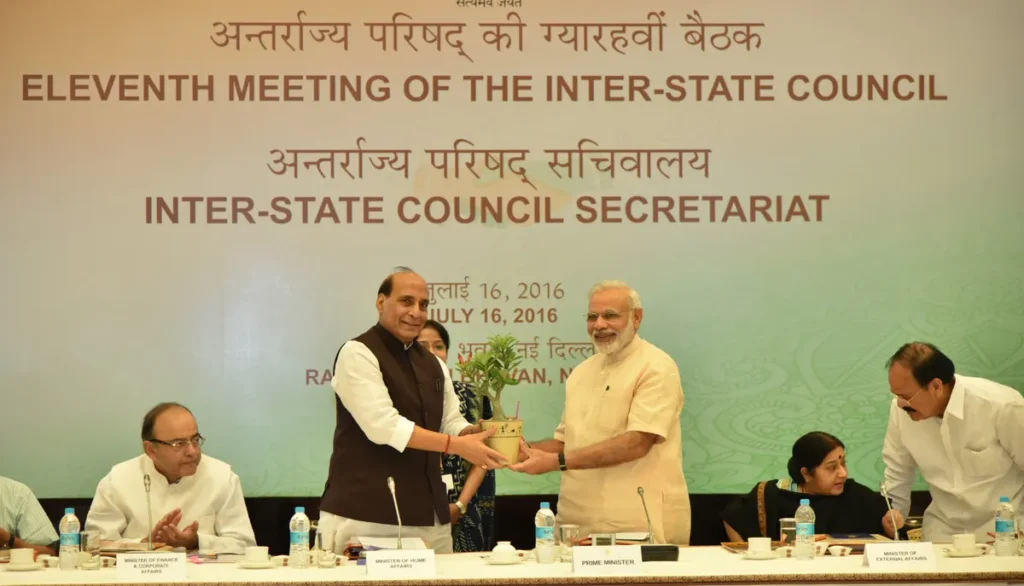
Image: Prime Minister's Office, Government of India, Wikimedia Commons, GODL-India
How to use this in Mains
If asked: UPSC Mains 2025, GS-II: Examine the evolving pattern of Centre-State financial relations in the context of planned development in India. How far have the recent reforms impacted the fiscal federalism in India?
Quote: “The Union has the more buoyant taxes; States have bigger spending responsibilities, a “vertical fiscal imbalance”.”
Use it: Use as the core point on fiscal imbalance.
In the news

Supreme Court: no prior approval under Section 17A needed to probe a bribe demand
In a judgment of 16 October 2026, a Supreme Court Bench of Justices S.V.N. Bhatti and N.V. Anjaria held that investigating a bribe demand by a public servant does not need prior approval under Section 17A of the Prevention of Corruption Act. Asking for a bribe, the court said, is not part of discharging official duties.
19 Oct 2026
CCPA acts against online sale of explosives: 3,940 sellers delisted from seven platforms
The Central Consumer Protection Authority (CCPA) said on 19 October 2026 that 3,940 sellers of regulated explosives such as ammonium nitrate, picric acid and PETN have been delisted from seven online platforms after its action. It has fined Dial4Trade and ExportersIndia ₹10 lakh per order, and other cases are under hearing or investigation.
19 Oct 2026
India to host 61st CIML meeting on legal metrology in New Delhi, 26–28 October
India will host the 61st meeting of the International Committee of Legal Metrology (CIML) for the first time, in New Delhi from 26 to 28 October 2026. The Department of Consumer Affairs is organising it with the International Organization of Legal Metrology (OIML), and more than 100 delegates are expected, PIB said on 19 October.
19 Oct 2026
NMC withdraws MSMER-2023: medical colleges lose the fixed penalty rulebook, annual disclosure stays
The National Medical Commission (NMC) has de-notified the Maintenance of Standards of Medical Education Regulations, 2023 (MSMER-2023) by a notification dated 14 October 2026, published in the Gazette on 16 October. Its fixed penalties, including seat cuts and fines of up to ₹5 lakh for false records, go with it. The Annual Disclosure Report stays.
19 Oct 2026