
Chorbagan pandal stampede in Kolkata kills 19: what went wrong and how crowds should be managed
Next story · 17 OctKhet Bachao Abhiyan: Centre reviews 22 October to 30 November farm campaign with States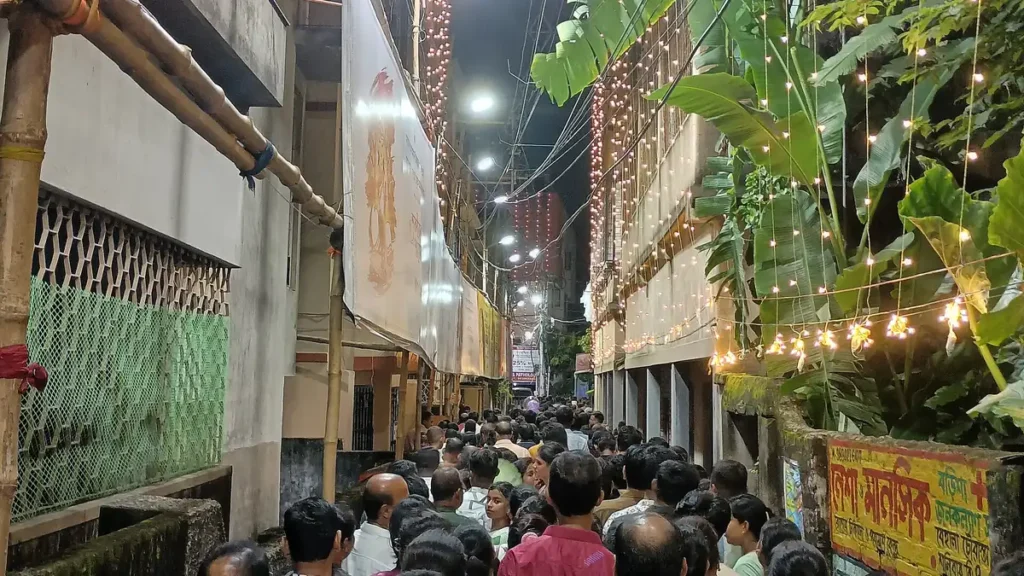
Nineteen people were killed and about 25 injured in a stampede at the Chorbagan Sarbojanin Durga Puja pandal in north Kolkata on the evening of 17 October 2026, during Saptami. According to police and the FIR, sudden heavy rain, weak crowd control and an announcement that the pandal could collapse set off the panic. Seven people have been arrested, and West Bengal has set up a six-member SIT.
- Deaths
- 19
- Injured
- About 25
- Arrests
- 7
- SIT report
- Within 3 months
Chorbagan stampede: what happened?
Most stampedes are not caused by a crowd being ‘unruly’. They happen when too many people are packed into a space with too few ways out, and then something sudden happens. Chorbagan is a painful reminder of that pattern.
- The FIR says heavy rain between 7 and 7.30 pm and an organiser’s warning that the pandal could collapse caused people to jostle (ThePrint).
- Police said the gates and approach road were narrow, staff were too few and announcements were confusing (The Hindu).
- The case was filed under BNS Sections 105, 110 and 3(5); those arrested include organisers, private security staff and a contractor.
- CM Suvendu Adhikari announced ₹25 lakh and a Group D job for each bereaved family. The SIT is headed by retired judge Justice Anindita Roy Saraswati (HT, 21 Oct).
Why do crowd crushes happen?
- When crowd density goes above about five people per square metre, people lose control of their movement.
- Most deaths are from compressive asphyxia, not trampling alone; post-mortems here found traumatic asphyxia.
- Common triggers include rumours, sudden rain, a fall or a blocked exit.
- India’s recent cases include Hathras (2024), the Maha Kumbh and New Delhi railway station (2025) and Bengaluru’s stadium (2025).
What is the SIT examining?
| Area | Questions |
|---|---|
| Trigger | What set off the first surge; was capacity exceeded? |
| Arrangements | Gates, entry and exit plans, permissions |
| Response | Organisers, police, hospitals, fire services, KMC, CESC |
| Prevention | Measures for congested north Kolkata lanes |
Which laws and guidelines apply?
- Disaster Management Act, 2005: NDMA, SDMAs and DDMAs plan for and respond to disasters.
- NDMA guide ‘Managing Crowds at Events and Venues of Mass Gathering’ (2014).
- BNSS Section 163: the power to issue urgent prohibitory orders, used here until 20 October.
- ‘Police’ and ‘public order’ are State List subjects (Entries 1 and 2).
What are the gaps?
- Crowd plans are often informal; police said ‘everything was handled verbally’.
- Safe-capacity estimates are rarely done or enforced for pandals.
- Police are often concentrated at VIP entrances, as locals alleged here.
- After each disaster, inquiries come but lessons are rarely made binding.
What should be done next?
- Make crowd plans, capacity limits and separate exits a condition of permission.
- Use CCTV and density sensors with a clear alert-and-hold system.
- Train volunteers and keep calm, scripted public announcements.
- Turn NDMA guidance into enforceable State rules.
What can Prelims ask?
- NDMA: chaired by the Prime Minister, under the Disaster Management Act, 2005.
- BNSS Section 163 replaced CrPC Section 144.
- BNS Section 105: culpable homicide not amounting to murder.
- Police and public order: State List.
How to write about crowd disasters in Mains
Practice question (10 marks, 150 words): Stampedes at mass gatherings are a recurring tragedy in India. Analyse the causes and suggest an institutional framework to prevent them. (GS-III)
- Intro: Chorbagan stampede, 19 dead, 17 Oct 2026.
- Causes: density, narrow exits, rain, panic announcement.
- Framework: DM Act, NDMA 2014 guide, State police powers.
- Gaps: informal plans, VIP focus, weak follow-up.
- Conclusion: capacity limits, exits, trained staff, binding rules.
Image: Visitors crowd a lane during Durga Puja in Kolkata (representative image). Snehangshu36, Wikimedia Commons, CC BY-SA 4.0
How to use this in Mains
If asked: What are the main causes of stampedes in India? (GS-III)
Quote: “There was no clear plan to manage the large number of visitors, and everything was handled verbally.”
Use it: Quote the police officer, then list design and planning failures.
If asked: How should inquiries into disasters be designed? (GS-III)
Quote: “The team will examine the sequence of events leading to the stampede, including the circumstances that triggered the initial crowd surge, the number of people present at the venue and whether the gathering exceeded its assessed safe capacity.”
Use it: Use it to argue for fact-finding that leads to binding rules.
Exam angle
Prelims: NDMA, BNSS 163, BNS 105. · Mains GS-III: crowd management and disaster governance.
Practice MCQs
Original practice questions (not PYQs).
Under the Bharatiya Nagarik Suraksha Sanhita, 2023, the power to issue urgent prohibitory orders (earlier Section 144 CrPC) is in
Answer (c) & explanation
Section 163 BNSS replaced Section 144 CrPC.
The National Disaster Management Authority is chaired by the
Answer (b) & explanation
Under the DM Act, 2005, the Prime Minister chairs NDMA.
In most crowd crushes, the main cause of death is
Answer (b) & explanation
Pressure on the chest stops breathing; post-mortems in Chorbagan found traumatic asphyxia.
Questions students ask about this
What happened at Chorbagan?
A stampede at a Durga Puja pandal in north Kolkata on 17 October 2026 killed 19 people.
What caused it?
According to the FIR and police: sudden rain, poor crowd control, narrow gates and a warning that the pandal might collapse.
Who is investigating?
A six-member SIT headed by retired judge Justice Anindita Roy Saraswati, along with police, CID and STF teams.
What relief was announced?
₹25 lakh and a Group D government job for each bereaved family.
Keep studying
Go deeper
facts from cited sources only; faculty review pending