
Aditya-L1’s VELC produces Doppler velocity images of the solar corona
Scientists at the Indian Institute of Astrophysics (IIA), Bengaluru, have produced Doppler velocity images of the solar corona using the Visible Emission Line Coronagraph (VELC) on Aditya-L1. The images show whether coronal plasma is moving towards or away from us, and can help track whether a coronal mass ejection (CME) is heading for Earth. The method has been published in the Astrophysical Journal.
- Mission
- Aditya-L1
- Payload
- VELC
- Built by
- IIA, Bengaluru
- Orbit
- Halo orbit around L1
Aditya-L1’s new images: what happened?
Remember the railway platform lesson from school? The whistle sounds higher as the train comes in and lower as it leaves. IIA scientists used the same Doppler idea, with light instead of sound, to tell which way the Sun’s hot plasma is moving.
- 20 Oct 2026: IIA reported Doppler velocity images of the corona made from VELC data (The Hindu).
- Positive velocity means plasma moving away from the observer; negative means moving towards.
- The images can show CME movement along the Sun–Earth line, which was not available until now.
- VELC Principal Investigator Prof. R. Ramesh said only VELC can currently make such images.
What is Aditya-L1?
- India’s first solar observatory mission, launched by PSLV-C57 on 2 September 2023.
- It orbits the first Lagrange point (L1), about 1.5 million km from Earth towards the Sun.
- From L1 it watches the Sun without eclipses or occultations.
- VELC is its largest payload; it blocks the Sun’s disc to study the faint corona.
How does Doppler imaging compare with ordinary coronagraph images?
| Point | Ordinary coronagraph image | Doppler velocity image |
|---|---|---|
| Shows | Where the plasma is in the sky | How fast it moves towards or away |
| CME direction | Hard to judge for Earth-bound events | Line-of-sight motion is visible |
| Needs | Imaging | Spectroscopy of emission lines |
| Use | Structure of the corona | Space weather warnings |
Which constitutional and legal provisions apply?
- Union List Entry 66: coordination and standards in scientific and technical institutions.
- Department of Space oversees ISRO; IIA is an autonomous body under the Department of Science and Technology.
- Indian Space Policy 2023 encourages sharing of space data with researchers.
- Outer Space Treaty, 1967, to which India is a party, guides peaceful use of space.
How does a Doppler image reveal a CME’s direction?
From coronal light to a warning
- VELC blocks the bright solar disc
- Spectrograph records coronal emission lines
- Line shifts give plasma speed and direction
- Software builds a velocity map
- Earth-bound CMEs flagged early
Why does this matter?
| Angle | What to note |
|---|---|
| Space weather | CMEs can disturb satellites, GPS and power grids. |
| Indian science | A unique capability from an Indian payload. |
| Data sharing | Processed images to be shared with scientists. |
| Institutions | ISRO–IIA collaboration on science payloads. |
What are the challenges?
- Turning research images into routine forecasts needs operational systems.
- Space weather models need data from many missions.
- India has few trained solar physicists and data scientists.
- One spacecraft at L1 gives only one viewing angle.
What should be done next?
- Build an Indian space weather service using Aditya-L1 data.
- Combine VELC data with other solar missions for better forecasts.
- Train more researchers through open data and student programmes.
- Protect Indian satellites with early CME alerts.
What can Prelims ask on Aditya-L1?
- Launched by PSLV-C57 on 2 September 2023.
- Placed in a halo orbit around Sun–Earth L1.
- VELC was built by the Indian Institute of Astrophysics, Bengaluru.
- Corona: the Sun’s outermost layer, visible in a total solar eclipse.
- Doppler effect: shift in wavelength due to relative motion.
How to write about space weather in Mains
Practice question (10 marks, 150 words): What is space weather? Explain how Aditya-L1 can help India protect its space assets. (GS-III)
- Intro: CMEs and solar storms; satellite and grid risks.
- Aditya-L1: L1 vantage, seven payloads, VELC.
- New result: Doppler velocity images of the corona.
- Gaps: forecasting systems, skilled people.
- Way out: national space weather service, data sharing.
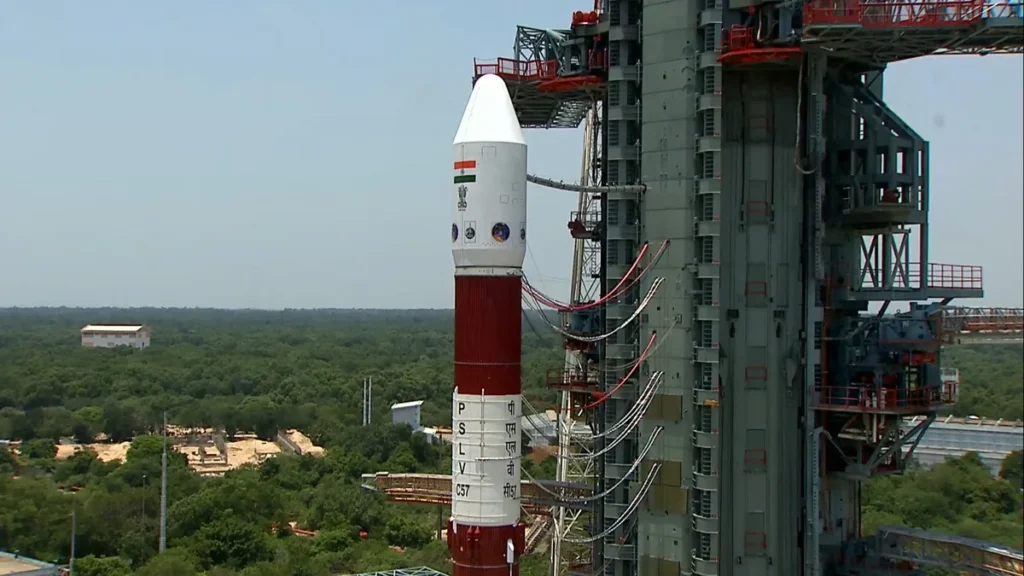
Image: PSLV-C57 with Aditya-L1 on the launch pad at Sriharikota, 2 September 2023. ISRO, Wikimedia Commons, CC BY 3.0
How to use this in Mains
If asked: Discuss the significance of India’s solar mission Aditya-L1. (GS-III)
Quote: “The Doppler velocity images of the solar corona are unique (VELC Principal Investigator, as reported).”
Use it: Use it to show the mission’s original scientific value, beyond just reaching L1.
If asked: How can space weather threaten critical infrastructure? Suggest measures. (GS-III)
Quote: “Because CMEs can disrupt near-Earth space, it is important to infer their direction of propagation from the Sun as they erupt.”
Use it: Quote it to link solar physics with satellites and power grids; then suggest early-warning systems.
Exam angle
Prelims: Aditya-L1, L1 point, VELC, CMEs, Doppler effect. · Mains GS-III: space science and protecting space assets.
Practice MCQs
Original practice questions (not PYQs).
Consider the following statements about Aditya-L1:
1. It was launched by PSLV-C57.
2. It orbits the Sun–Earth L2 point.
3. Its VELC payload was developed by the Indian Institute of Astrophysics.
How many of the statements given above are correct?
Answer (b) & explanation
Statements 1 and 3 are correct. Aditya-L1 is at L1, between Earth and the Sun, not L2.
In a Doppler velocity image of the solar corona, a negative velocity indicates plasma that is
Answer (b) & explanation
IIA scientists said negative velocity means motion towards the observer; positive means away.
A coronal mass ejection (CME) is best described as
Answer (b) & explanation
CMEs are huge clouds of plasma and magnetic field; Earth-bound ones can cause geomagnetic storms.
Questions students ask about this
What has Aditya-L1 achieved now?
Its VELC data has been used to make Doppler velocity images of the solar corona.
Why are these images useful?
They show whether plasma, such as in a CME, is moving towards Earth.
Who made the images?
Scientists at the Indian Institute of Astrophysics, Bengaluru.
Where is Aditya-L1?
In a halo orbit around L1, about 1.5 million km from Earth.
Keep studying
Go deeper
Official source: ISRO: Aditya-L1 mission page
facts from cited sources only; faculty review pending