
AI face checks in VB-G RAM G: upgraded NMMS app to stop fake attendance in the rural jobs scheme
UPSC has already asked about this. Read the story with these questions in mind.
Rural Development Minister Shivraj Singh Chouhan launched an upgraded National Mobile Monitoring System (NMMS) app on 23 October 2026 for attendance under VB-G RAM G, the rural jobs scheme that replaced MGNREGA. Built with help from IIT Madras, it adds AI-based face verification, liveness detection and anti-tampering checks, after complaints of fake attendance and wages paid in other people’s names. The big exam question is simple: can technology stop leakages without shutting out genuine workers?
- App
- NMMS, upgraded
- Tech support
- IIT Madras
- Person-days
- ~46 crore since 1 July
- Centre’s 2026-27 share
- ₹95,692 crore
NMMS upgrade: what happened?
A worker’s photo at the worksite is meant to prove he was there. But a photo of a photo proves nothing, and that is the gap this upgrade tries to close.
- 23 Oct 2026: the upgraded app adds Google Play Integrity, device-level security, safeguards against cloning and tampering, and liveness detection.
- Misuse seen so far (The Hindu): ‘photo-to-photo capturing’, the same photo in several muster rolls, and different faces in morning and afternoon photos.
- An AI photo de-duplication module flags repeated photos; the wage list and Fund Transfer Order are then withheld until checked.
- Offline attendance is allowed where there is no network, with an exception route for elderly workers and persons with disabilities.
What is VB-G RAM G?
- The Viksit Bharat-Guarantee for Rozgar and Ajeevika Mission (Gramin), which replaced the Mahatma Gandhi National Rural Employment Guarantee scheme.
- It has run in all rural areas from 1 July 2026.
- So far: work at 31.23 lakh sites in over 2.41 lakh gram panchayats, for 3.65 crore workers from 2.89 crore households (PIB).
- Total provision for 2026-27, including States’ share, exceeds ₹1.51 lakh crore.
What changes with the new app?
| Check | Before | Now |
|---|---|---|
| Face authentication | From March 2026 | AI verification tuned for regions |
| Live person? | Not tested | Liveness detection |
| Tampered phones | Weak checks | Play Integrity, anti-cloning |
| No network | Attendance missed | Offline capture, upload later |
What is the constitutional and legal angle?
- Article 41 (DPSP): the State shall make effective provision for securing the right to work.
- Article 21: the Supreme Court has read the right to livelihood into the right to life (Olga Tellis, 1985).
- Article 243G: panchayats plan and carry out schemes of economic development.
- Digital Personal Data Protection Act, 2023: workers’ face data must be processed only for a lawful, stated purpose.
What are the challenges?
- Exclusion errors: older workers, worn faces or poor light can fail face checks.
- Weak mobile networks in remote villages.
- Privacy risks in storing face data of crores of workers.
- Wage delays if flagged entries are not cleared quickly.
What should be done?
- Time-bound review of every flagged entry, so honest workers are paid on time.
- Strong social audits by gram sabhas alongside technology.
- Clear data-protection rules and limited retention of face data.
- Publish State-wise data on rejections and fixes.
What can Prelims ask on VB-G RAM G and NMMS?
- VB-G RAM G replaced MGNREGA; it runs in all rural areas from 1 July 2026.
- NMMS: the app used to record worksite attendance with geo-tagged photos.
- Face authentication was added in March 2026.
- Liveness detection checks that a real, live person is in front of the camera.
- e-Measurement Book records work as measured by engineers; wages go through DBT.
How to write about technology in welfare schemes in Mains
Practice question (10 marks, 150 words): ‘Technology can plug leakages in welfare schemes, but it can also exclude the poor.’ Discuss with reference to AI-based attendance in the rural jobs scheme. (GS-II)
- Intro: the 23 October 2026 NMMS upgrade.
- Body 1: problems it targets: fake attendance, ghost workers.
- Body 2: risks: exclusion, network gaps, privacy.
- Body 3: safeguards: offline mode, exception route, social audits.
- Conclusion: technology plus community oversight.
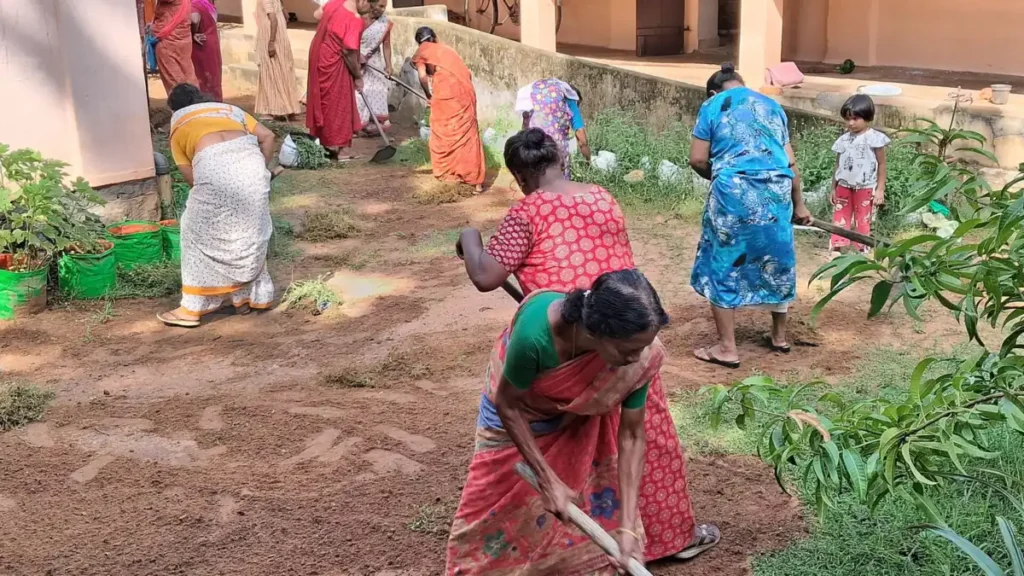
Image: Women workers clearing land under the rural employment guarantee scheme in Kollam, Kerala, 2025. Fotokannan, Wikimedia Commons, CC BY-SA 4.0
How to use this in Mains
If asked: Examine the role of e-governance in improving welfare delivery. (GS-II)
Quote: “Technology must strengthen accountability without allowing genuine workers to be denied their entitlements because of connectivity or technical problems.”
Use it: Use it as the balanced core of your answer.
If asked: Discuss the challenges in implementing rural employment programmes. (GS-II)
Quote: “Employment would be provided to those who need it, but corruption and irregularities would not be tolerated.”
Use it: Quote it to state the government’s twin goal.
Exam angle
Prelims: VB-G RAM G, NMMS, liveness detection, DBT. · Mains GS-II: e-governance, transparency and accountability in welfare schemes.
Practice MCQs
Original practice questions (not PYQs).
Consider the following statements about the upgraded NMMS app:
1. It was developed with technical support from IIT Madras.
2. It does not allow attendance to be recorded without network connectivity.
3. It uses liveness detection to check that a real person is in front of the camera.
Which of the statements given above are correct?
Answer (b) & explanation
Offline attendance is allowed where there is no network and can be uploaded later.
Which Directive Principle asks the State to make effective provision for securing the right to work?
Answer (b) & explanation
Article 41 covers the right to work, to education and to public assistance in certain cases.
In the rural jobs scheme, wages are calculated on the basis of:
Answer (b) & explanation
PIB says wages are based on the e-Measurement Book, followed by Direct Benefit Transfer.
Questions students ask about this
What is the NMMS app?
The National Mobile Monitoring System app records attendance at rural jobs scheme worksites.
What is new in the upgraded version?
AI face verification, liveness detection, device-level security and anti-cloning safeguards.
What if there is no network at the worksite?
Attendance can be recorded offline and uploaded later.
What happens if the AI flags a repeated photo?
The wage list and Fund Transfer Order are withheld until checks are done.
Keep studying
Go deeper
Official source: PIB, 23 Oct 2026: Shri Shivraj Singh Chouhan Launches Enhanced NMMS App Version with Advanced Security Features for VB-G RAM G
facts from cited sources only; faculty review pending