
Jal Jeevan Mission (Har Ghar Jal): Functional Household Tap Connections, 55 LPCD, Funding Pattern, Community Ownership, Water Quality, Progress and Challenges (UPSC Notes + PYQs)
UPSC has already asked about this. Read the story with these questions in mind.
From the village well to the kitchen tap
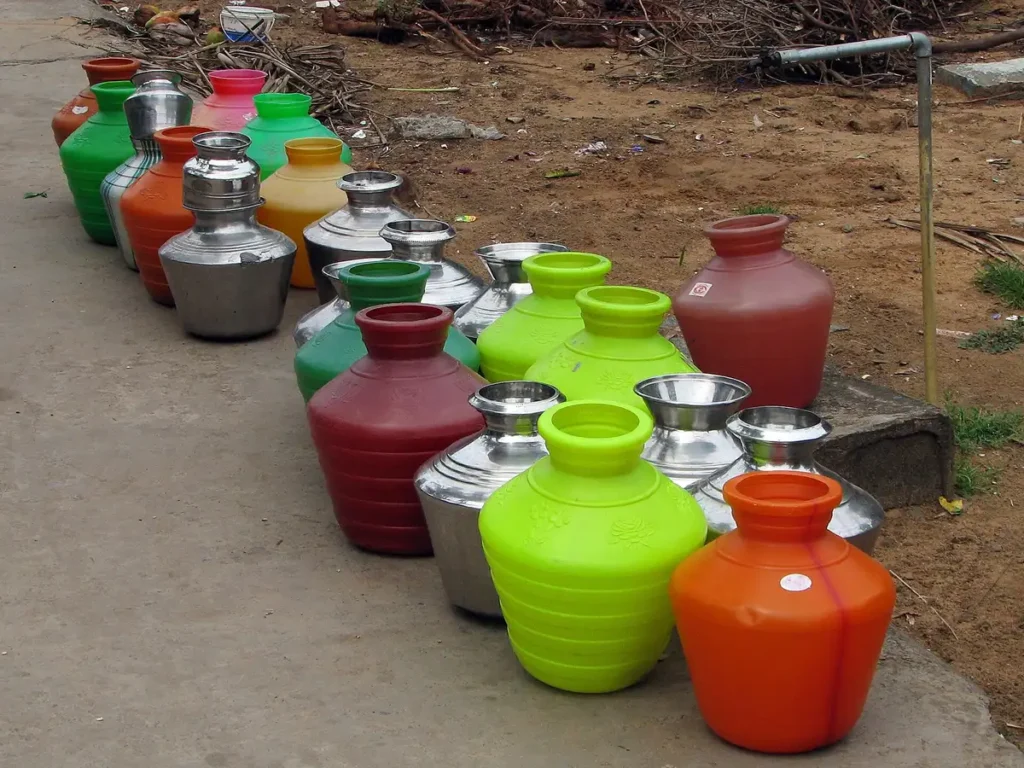
For generations, fetching water has been the work of women and girls in rural India. Surveys found that in many villages women walked several kilometres a day and spent hours queuing at handpumps or wells. Water from these sources was often contaminated: arsenic in the Ganga-Brahmaputra plains, fluoride in Rajasthan, Telangana and parts of Karnataka, iron in the North-East, and bacterial contamination nearly everywhere. Diarrhoea, still a leading cause of child deaths, is largely a water and sanitation disease.
Earlier programmes, such as the Accelerated Rural Water Supply Programme (1972) and the National Rural Drinking Water Programme (2009), measured success by how many habitations were “covered” by a source, usually a handpump or a public stand-post. A village counted as covered even if water was scarce, unsafe or far away. The Jal Jeevan Mission changed the unit of success from the habitation to the household, and from a source to a functional tap at home.
Key features
- Launch: announced on 15 August 2019 under the Ministry of Jal Shakti, Department of Drinking Water and Sanitation.
- Goal: a Functional Household Tap Connection (FHTC) for every rural household. “Functional” means adequate quantity (at least 55 litres per capita per day), prescribed quality (BIS standard IS 10500) and regular, long-term supply.
- Deadline: originally 2024; the Union Budget 2025-26 extended it to 2028 with a focus on quality and maintenance.
- Funding: total estimated outlay about ₹3.6 lakh crore at launch. Centre-State sharing: 90:10 for Himalayan and North-Eastern States, 100% central for Union Territories without legislature, and 50:50 for other States.
- Priority: quality-affected areas, drought-prone and desert areas, SC/ST majority villages, Aspirational Districts and Sansad Adarsh Gram Yojana villages.
- QuantityAt least 55 litres per person per day
- QualityBIS IS 10500
- RegularityLong-term, reliable supply
- At homeTap inside the premises
Community at the centre
JJM is designed as a bottom-up programme. Each village forms a Village Water and Sanitation Committee or Paani Samiti, a sub-committee of the gram panchayat with at least 50% women members and representation of weaker sections. The committee prepares a Village Action Plan, contributes to capital cost (5%, or 10% in some areas, in cash, kind or labour) and collects user charges to run and maintain the system.
Five women in every village are trained to test water using Field Test Kits. Over two thousand water testing laboratories have been set up or upgraded and opened to the public. Villages that reach full coverage hold a gram sabha to declare themselves Har Ghar Jal. By October 2025, eleven States and UTs had 100% rural tap coverage: Goa, Andaman and Nicobar Islands, Dadra and Nagar Haveli and Daman and Diu, Haryana, Telangana, Puducherry, Gujarat, Himachal Pradesh, Punjab, Mizoram and Arunachal Pradesh.
- 1Gram panchayat forms Paani Samiti
- 2Village Action Plan prepared
- 3Community contribution and construction
- 4Women test water with Field Test Kits
- 5Gram sabha certifies Har Ghar Jal
Progress in numbers
| Indicator | August 2019 | Late 2025 |
|---|---|---|
| Rural households with tap water | 3.23 crore (about 17%) | over 15.72 crore (October 2025) |
| Schools and anganwadis with tap water | Few | Lakhs, under a special 100-day campaign in 2020 |
| States/UTs with 100% rural tap coverage | None | 11 |
A WHO assessment estimated that safely managed drinking water for all households could avert about 4 lakh diarrhoeal deaths and save about 5.5 crore hours a day, mostly of women, otherwise spent collecting water. Other studies link tap water to lower child mortality and higher female labour participation.
Links with other water efforts
- Swachh Bharat Mission (Grameen) Phase II: greywater and faecal sludge management, so that new water supply does not create new waste problems.
- Atal Bhujal Yojana: community groundwater management in water-stressed blocks.
- Jal Shakti Abhiyan: Catch the Rain: rainwater harvesting before the monsoon.
- AMRUT 2.0: tap water for all urban households, the urban counterpart of JJM.
- Amrit Sarovars: rejuvenating ponds in every district for recharge.
Challenges
- Functionality: a tap is not the same as water. Independent assessments found that a notable share of connections did not supply 55 litres daily, regularly and of safe quality.
- Source sustainability: about 85% of rural drinking water comes from groundwater, which is falling in many States. Without recharge, pipes may run dry.
- Water quality: geogenic contamination such as arsenic, fluoride and uranium needs treatment plants and surface-water schemes.
- Operation and maintenance: panchayats often lack money and skilled plumbers; user charges are low or not collected.
- Quality of construction: complaints of poor pipes, leaks, delays and irregularities in contracts have surfaced in several States.
- Fiscal strain: States with large remaining coverage, such as Kerala, West Bengal and Rajasthan, face a heavy share of cost.
- Climate stress: heatwaves and erratic rainfall increase demand while reducing supply.
- Falling groundwater
- Weak operation and maintenance
- Contaminated sources
- Poor construction
Way forward
Shift focus from counting connections to measuring service: daily quantity, pressure, hours of supply and quality, using sensor-based monitoring, as some States have piloted. Protect sources through recharge structures and conjunctive use of surface and groundwater. Train local youth as plumbers, electricians and pump operators under skilling schemes. Give Paani Samitis untied funds and clear rights to collect fair user charges. Ensure transparent contracts and social audits. Integrate drinking water with the larger plan for river basins and climate adaptation. The real test of Har Ghar Jal is whether water flows reliably in 2035, not whether a tap was fitted in 2025.
PYQ trend
Prelims has asked about drinking water contaminants such as arsenic and fluoride. Mains GS-I and GS-III ask about groundwater depletion, freshwater crises and alternative technologies for clean water.
Jal Jeevan Mission: UPSC angle
For UPSC CSE
Prelims: mission norms, funding pattern, contaminants. Mains GS-II: government schemes, local governance; GS-I/III: water resources, groundwater, health.
Jal Jeevan Mission UPSC PYQs (Prelims)
Questions UPSC has actually asked, from the official papers. Pick an option to check yourself.
Which of the following can be found as pollutants in the drinking water in some parts of India?
– 1. Arsenic
– 2. Sorbitol
– 3. Fluoride
– 4. Formaldehyde
– 5. Uranium
Select the correct answer using the codes given below.
Groundwater in India is contaminated with arsenic (Bengal, Bihar), fluoride (Rajasthan, Andhra, Telangana) and uranium (Punjab and other states). Sorbitol is a sugar substitute and formaldehyde an industrial chemical; neither is a known drinking-water contaminant here. Answer as per the official UPSC key · Battle IAS PYQ bankAnswer (c) & why
Mains PYQs on this topic
Questions from the official UPSC Mains papers (2023-2026 in the Battle IAS Mains bank), newest first. Each links to a model answer.
- UPSC Mains 2024 · GS Paper III · Q15 · 15 marks
The world is facing an acute shortage of clean and safe freshwater. What are the alternative technologies which can solve this crisis? Briefly discuss any three such technologies citing their key merits and demerits.
- UPSC Mains 2023 · GS Paper I · Q5 · 10 marks
Why is the world today confronted with a crisis of availability of and access to freshwater resources?
Quick quiz
Under JJM, the minimum service level is
55 litres per capita per day.Answer (b)
The Centre-State funding ratio under JJM for Himalayan and North-Eastern States is
90:10.Answer (c)
Which of these States had 100% rural tap coverage by October 2025?
Goa is among the 11 fully covered States/UTs.Answer (b)
FAQs
What is the Jal Jeevan Mission?
A central mission launched in 2019 to give every rural household a functional tap connection with safe, adequate and regular drinking water.
What is a Functional Household Tap Connection?
A home tap that supplies at least 55 litres per person per day, of BIS IS 10500 quality, on a regular basis.
What is a Paani Samiti?
A village water and sanitation committee of the gram panchayat, with at least half women members, that plans, runs and maintains the village water system.
Why was the deadline extended?
Coverage was incomplete by 2024 and quality and maintenance needed attention, so the mission was extended to 2028.
What is the urban counterpart of JJM?
AMRUT 2.0, which aims at tap water for all urban households.
Which contaminants are common in rural drinking water?
Arsenic in the Ganga-Brahmaputra plains, fluoride in parts of Rajasthan, Telangana and Karnataka, iron in the North-East, nitrate from fertilisers, and bacteria almost everywhere.
Spotted an error? Tell us. We correct within 48 hours.
Image: McKay Savage from London, UK, Wikimedia Commons, CC BY 2.0
How to use this in Mains
If asked: Has the Jal Jeevan Mission ensured water security, or only tap connections? Examine. (GS-II/III)
Quote: “Functionality: a tap is not the same as water.”
Use it: A crisp line to open the challenges part; then add groundwater and quality concerns.
In the news
Khet Bachao Abhiyan: Centre reviews 22 October to 30 November farm campaign with States
On 17 October 2026 Union Agriculture Minister Shivraj Singh Chouhan reviewed preparations for the Khet Bachao Abhiyan with agriculture ministers of 11 States and UTs. The campaign runs from 22 October to 30 November 2026. About 4,150 teams of Krishi Vigyan Kendra and ATMA staff, with over 12,000 scientists and officials, plan around 1.5 lakh meetings with farmers on soil health, crop residue, balanced fertiliser use and key schemes.
17 Oct 2026
PM Dhan-Dhaanya Krishi Yojana at one year: Gaya, Nagaur and Umaria top the ranking
PM Dhan-Dhaanya Krishi Yojana (PMDDKY) completed its first year on 11 October 2026. At a national conference in New Delhi the next day, Gaya, Nagaur and Umaria were ranked the best-performing districts. The scheme covers 100 lagging farm districts and pulls 36 Central schemes of 11 Ministries into one district plan.
13 Oct 2026
Pulses Mission at one year: output 274 lakh tonnes, imports down 31%
The Mission for Aatmanirbharta in Pulses, launched on 11 October 2025 with ₹11,440 crore till 2030-31, completed one year. Output rose to 274.09 lakh tonnes in 2025-26 and imports fell 31.52% in value. The aim is 350 lakh tonnes by 2030-31, backed by assured purchase of tur, urad and masoor.
11 Oct 2026
PM Dhan-Dhaanya Krishi Yojana completes one year: 100 aspirational agricultural districts
PM Dhan-Dhaanya Krishi Yojana, launched on 11 October 2025, completed one year. It targets 100 aspirational agricultural districts chosen for low productivity, low cropping intensity and low farm credit, and joins 36 Central schemes of 11 ministries. The districts' average score rose from 18.85 in April 2026 to 46.89 in August 2026.
10 Oct 2026