
₹10,000-crore push to make shipping containers in India
Almost every steel box that carries India’s goods by ship is made abroad. The Union Cabinet has approved the Container Manufacturing Promotion Scheme, worth ₹10,000 crore, to make shipping containers in India and raise yearly output about ten times. Read it to revise the scheme’s numbers, what a TEU is and why containers matter for trade.
- Scheme
- Container Manufacturing Promotion Scheme
- Money
- ₹10,000 crore
- Period
- 2027-28 to 2039-40
- Capacity goal
- 70,000 to 7.5 lakh TEU a year
The container scheme: what happened?
During the COVID-19 years, Indian exporters had orders but no empty containers to ship them in, and freight costs shot up. A country that trades so much cannot depend on others for the box itself.
- The Union Cabinet approved the Container Manufacturing Promotion Scheme with ₹10,000 crore.
- Almost all shipping containers India uses are made abroad today.
- It will run from 2027-28 to 2039-40: three years to build factories, then ten years of production support.
- The goal is to raise capacity from about 70,000 to 7.5 lakh twenty-foot equivalent units (TEU) a year, about ten times.
- Support: 3% interest help on loans (₹859 crore), and ₹8,891 crore of per-container help to close the cost gap with imports.
- Domestic content (parts made in India) must rise from 70% to 90%.
What is a TEU, and why make containers at home?
A shipping container is a standard steel box that moves from ship to train to truck without unloading the goods inside. This made world trade much cheaper.
A TEU, or twenty-foot equivalent unit, is the standard measure: one 20-foot container is one TEU, and a 40-foot container is two TEUs.
China makes the vast majority of the world’s containers. When supply chains break, as they did during the pandemic, countries without their own factories suffer shortages and high prices.
The scheme links to Make in India and the Maritime Amrit Kaal Vision 2047, India’s long-term plan for ports, shipping and shipbuilding.
Where the ₹10,000 crore goes
| Part | Amount | Purpose |
|---|---|---|
| Interest help | ₹859 crore | 3% interest support on loans for factories |
| Per-container help | ₹8,891 crore | Closes the cost gap with imports |
| Timeline | 2027-28 to 2039-40 | 3 years to build, 10 years of support |
Which policies apply?
- Make in India (2014): the national push to manufacture at home.
- Maritime Amrit Kaal Vision 2047: long-term plan for ports, shipping and shipbuilding.
- Sagarmala Programme (2015): port-led development.
- Major Port Authorities Act, 2021: governs India’s major ports.
Why does the container scheme matter?
| Angle | What to note |
|---|---|
| Self-reliance | Fewer imports of a key trade input. |
| Trade costs | Local supply can cut shortages and freight shocks. |
| Jobs | Steel, painting and assembly work in new factories. |
| Strategic | Less dependence on one country in a crisis. |
What are the problems with the container scheme?
- Chinese makers have huge scale and low costs, so India must close a big price gap.
- Steel prices in India are often higher than abroad.
- Long support (till 2039-40) means long subsidy costs.
- Demand may fall if world trade slows.
What should be done next on the container scheme?
- Locate factories near ports and steel plants to cut costs.
- Link support to output and quality, not just capacity.
- Build Indian container leasing companies that buy local boxes.
- Review the scheme midway and phase out support as costs fall.
What can Prelims ask on the container scheme?
Prelims probability: Expect a question on the Container Manufacturing Promotion Scheme: ₹10,000 crore, 2027-28 to 2039-40, capacity from 70,000 to 7.5 lakh twenty-foot equivalent units.
- Container Manufacturing Promotion Scheme: ₹10,000 crore; 2027-28 to 2039-40.
- Capacity: about 70,000 to 7.5 lakh TEU a year.
- TEU = twenty-foot equivalent unit; a 40-foot box = 2 TEU.
- Domestic content: 70% rising to 90%.
- Largest container port: Jawaharlal Nehru Port (Navi Mumbai); largest private port: Mundra.
How to write about the container scheme in Mains
Practice question (15 marks, 250 words): Self-reliance in critical trade infrastructure is vital for India’s export ambitions. Discuss the significance and challenges of the Container Manufacturing Promotion Scheme.
- Intro: ₹10,000 crore scheme; near-total import dependence.
- Significance: supply security, lower freight shocks, jobs, Make in India.
- Challenges: cost gap with China, steel prices, long subsidy, demand risk.
- Way forward: port-side clusters, output-linked support, leasing firms.
- Conclusion: owning the box strengthens India’s trade.
Ready lines for your answer
- India wants to raise container capacity about ten times, from 70,000 to 7.5 lakh TEU a year.
- The country that makes the box has power over the trade it carries.
Quotable data point₹8,891 crore of the ₹10,000 crore goes as per-container help to close the cost gap with imports.
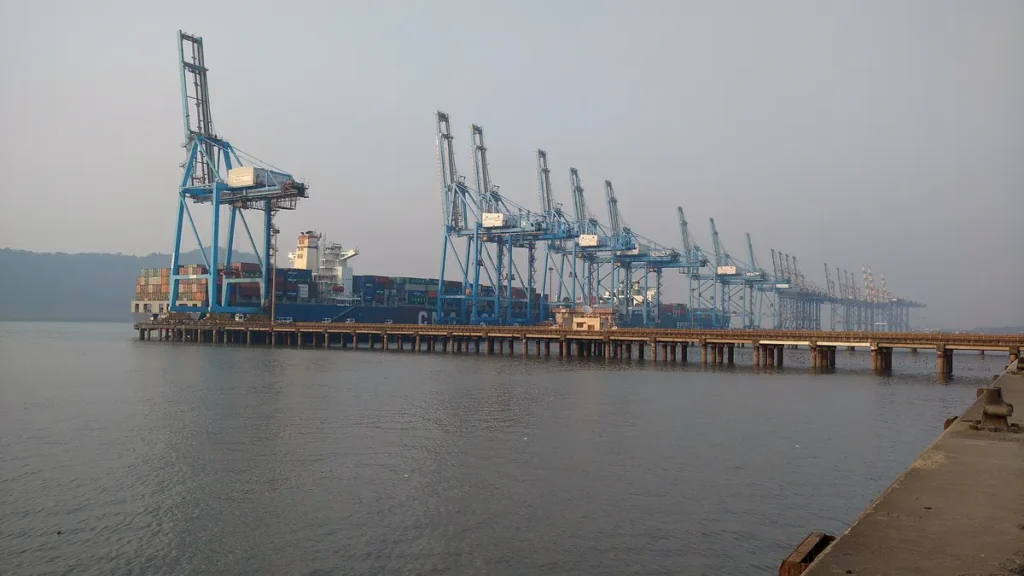
Photo: Ccmarathe, CC BY-SA 4.0, via Wikimedia Commons
Exam angle
Prelims: scheme numbers, TEU, major ports. · Mains GS-III: manufacturing, logistics, import substitution.
Practice MCQs
Original practice questions (not PYQs).
The Container Manufacturing Promotion Scheme aims to raise India's yearly container-making capacity to about how many twenty-foot equivalent units?
Answer (c) & explanation
Capacity is to rise from about 70,000 to 7.5 lakh twenty-foot equivalent units a year.
Which is India's largest container port?
Answer (a) & explanation
Jawaharlal Nehru Port in Navi Mumbai is the largest container port. Mundra is the largest privately owned port; Kamarajar was the first major port registered as a company.
Questions students ask about this
What is the Container Manufacturing Promotion Scheme?
A ₹10,000 crore scheme approved by the Union Cabinet to build shipping container factories in India and support production.
What is a TEU?
A twenty-foot equivalent unit, the standard size measure for containers. A 40-foot container equals two TEUs.
How much will capacity rise?
From about 70,000 to 7.5 lakh TEU a year, roughly ten times.
How long will the scheme run?
From 2027-28 to 2039-40: three years to build factories and ten years of production support.