
Court strikes down Karnataka law that saved ‘corrupt’ hiring
Can a State Assembly pass a law that simply cancels a court’s judgment? The Supreme Court has said no. It struck down a 2022 Karnataka law that tried to save officers selected in 2011 through a recruitment the courts had found corrupt. Read it to revise separation of powers, judicial review, validation laws and State Public Service Commissions.
- Bench
- Justices J.B. Pardiwala and K. Vinod Chandran
- Law struck down
- Karnataka validation Act, 2022
- Posts
- 362 gazetted posts, 2011 batch
- Applicants
- 1,38,307
The Karnataka validation law: what happened?
Imagine studying for years for a State civil services exam, only to find that marks were fixed for others. Courts cancelled such a selection in Karnataka. Then the State passed a law to save it. Now the Supreme Court has had the last word.
- In 2011, the Karnataka Public Service Commission (KPSC) selected officers for 362 top (gazetted) posts.
- A Criminal Investigation Department probe found “gross manipulations” in the marking of answer scripts. Courts cancelled the selection.
- In 2022, Karnataka passed the Karnataka Civil Services (Validation of Selection and Appointment of 2011 Batch Gazetted Probationers) Act, 2022 to save those appointments.
- A Bench of Justices J.B. Pardiwala and K. Vinod Chandran has now declared that law unconstitutional.
- The Court called the selection “corrupt” and “blatantly nepotistic” and said the legislature “does not have the power to nullify the judgments”.
What is a validation law, and where is the line?
A validation law is passed to ‘save’ an action that a court has found illegal. Legislatures often use them, for example to save a tax that a court struck down.
The Supreme Court has long said a legislature can remove the basis of a judgment. That means it can change the law on which the judgment rested, so the same result would not follow. This idea comes from the Prithvi Cotton Mills case of 1969.
But a legislature cannot simply say that a judgment will not apply, or overrule a court’s finding of fact. That would make the legislature a court, which breaks the separation of powers.
Separation of powers and judicial review are part of the basic structure of the Constitution, which even a constitutional amendment cannot destroy.
What may a legislature do after a judgment?
| Action | Allowed? | Why |
|---|---|---|
| Change the law the judgment rested on | Yes | Removes the basis of the judgment |
| Say a judgment shall not apply | No | Directly overrules the court |
| Save a selection found to be corrupt | No | Overturns a finding of fact; breaks separation of powers |
Which laws and Articles apply?
- Article 50: the State shall separate the judiciary from the executive (a Directive Principle).
- Articles 32 and 226: courts’ power of judicial review through writs.
- Articles 315 to 323: Public Service Commissions. Article 316: the Governor appoints members of a State Commission.
- Article 317: a member of a State Public Service Commission can be removed by the President after a Supreme Court inquiry.
Why does the Karnataka validation law matter?
| Angle | What to note |
|---|---|
| Separation of powers | A legislature cannot act as a court of appeal. |
| Rule of law | A judgment cannot be wiped out by a simple law. |
| Fair recruitment | Protects honest candidates in public exams. |
| Public Service Commissions | Shows why their independence and honesty matter. |
What are the problems with the Karnataka validation law?
- Recruitment scams damage trust in State Public Service Commissions.
- Long court cases leave both selected and rejected candidates unsure for years.
- Governments may use validation laws to protect favoured people.
- Honest candidates in the cancelled list may also suffer.
What should be done next on the Karnataka validation law?
- Use coded answer sheets, digital marking and recorded evaluation in public exams.
- Choose Public Service Commission members on clear merit-based rules.
- Enforce the Public Examinations (Prevention of Unfair Means) Act, 2024 and similar State laws.
- Finish recruitment cases quickly so that careers are not stuck.
What can Prelims ask on the Karnataka validation law?
Prelims probability: Expect a question on judicial review and validation laws: a legislature may remove the basis of a judgment but cannot directly overrule it.
- A legislature may remove the basis of a judgment but cannot directly overrule it.
- Separation of powers and judicial review are part of the basic structure.
- Article 50: separation of judiciary from executive (Directive Principle).
- Article 316: State Public Service Commission members appointed by the Governor.
- Article 317: removal of a State Public Service Commission member by the President after a Supreme Court inquiry.
How to write about the Karnataka validation law in Mains
Practice question (15 marks, 250 words): A legislature may remove the basis of a judgment, but it cannot overrule the judgment itself. Examine this principle in the light of the Supreme Court’s decision on Karnataka’s 2022 validation law.
- Intro: 2011 KPSC selection, CID findings, 2022 validation law.
- Principle: removing the basis of a judgment vs overruling it.
- Link to separation of powers and basic structure.
- Lessons for Public Service Commissions and fair recruitment.
- Conclusion: courts guard both the Constitution and honest candidates.
Ready lines for your answer
- A legislature may change the law, but it cannot overrule a court's finding.
- Clean recruitment is the first test of good governance.
Quotable data point1,38,307 people applied for 362 gazetted posts in the 2011 KPSC recruitment.
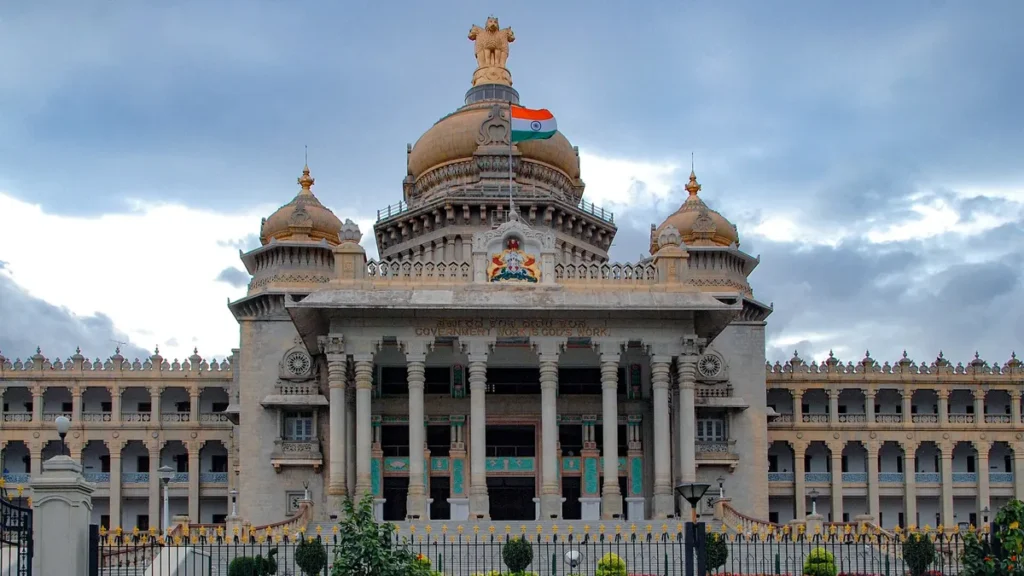
Photo: Moheen Reeyad, CC BY-SA 4.0, via Wikimedia Commons
Exam angle
Prelims: validation laws, Articles 50, 316, 317, basic structure. · Mains GS-II: separation of powers, judicial review, integrity of recruitment bodies.
Practice MCQs
Original practice questions (not PYQs).
Members of a State Public Service Commission are appointed by the Governor. Who can remove them?
Answer (c) & explanation
Under Articles 315 to 323, members are appointed by the Governor but can be removed only by the President.
Consider the following statements:
1. A legislature can pass a law simply declaring that a court's judgment shall not apply.
2. A legislature can remove the basis of a judgment by changing the underlying law.
3. Separation of powers in India is as strict as in the United States.
How many of the above statements are correct?
Answer (a) & explanation
Only statement 2 is correct. A validation law must cure the defect the court found; it cannot simply overrule the verdict. India's separation of powers is not strict, but it is part of the basic structure.
Questions students ask about this
Which Karnataka law did the Supreme Court strike down?
The Karnataka Civil Services (Validation of Selection and Appointment of 2011 Batch Gazetted Probationers) Act, 2022.
Why was it struck down?
Because it tried to nullify court judgments that had cancelled a corrupt selection. A legislature cannot directly overrule a court.
Can a legislature ever pass a validation law?
Yes. It can change the underlying law so that the basis of a judgment is removed, but it cannot simply declare a judgment ineffective.
Who can remove a member of a State Public Service Commission?
The President, after an inquiry by the Supreme Court in cases of misbehaviour (Article 317).