
Economists say frequent polls hurt investment
India holds elections to the Lok Sabha and the State Assemblies at different times, so some election is almost always on. A Joint Parliamentary Committee is studying two Bills to hold them together. Economists have now told it that frequent polls cost far more than the money spent on voting and discourage private investment. Read it to revise simultaneous elections and the Model Code of Conduct.
- Committee
- Joint Parliamentary Committee
- Chair
- P.P. Chaudhary, MP
- Bill
- Constitution (129th Amendment) Bill, 2024
- Experts heard
- Economic Advisory Council to the PM
Simultaneous elections: what happened?
Every few months, some State goes to the polls. Supporters of ‘One Nation, One Election’ say this constant campaign mode slows governance and investment. Critics say it would weaken federalism.
- The Joint Parliamentary Committee on simultaneous elections, chaired by Member of Parliament P.P. Chaudhary, met economists from the Prime Minister’s Economic Advisory Council on Friday.
- They included Council chairman S. Mahendra Dev, member Shamika Ravi and part-time member Pami Dua.
- Dr. Dev said uncertainty around general elections makes companies cut capital spending.
- Dr. Ravi flagged the effect on low-income families and on Centre–State coordination, and said the economic cost of separate polls is more than the accounting cost.
What are simultaneous elections?
Simultaneous elections mean holding Lok Sabha and all State Assembly elections at the same time. India did this in 1951-52, 1957, 1962 and 1967. The cycle broke after some Assemblies and the Lok Sabha were dissolved early.
A High Level Committee headed by former President Ram Nath Kovind recommended simultaneous polls in 2024, with local body polls within 100 days after.
Two Bills were introduced in December 2024: the Constitution (129th Amendment) Bill and the Union Territories Laws (Amendment) Bill. They were sent to a Joint Parliamentary Committee.
During elections, the Model Code of Conduct limits new government schemes and announcements. It has no law behind it; it comes from a consensus among parties and is enforced by the Election Commission.
Separate vs simultaneous polls
| Point | Separate polls | Simultaneous polls |
|---|---|---|
| Frequency | Some election almost every year | Once in five years |
| Model Code | Often in force somewhere | In force once in five years |
| Concern | Cost, policy pauses | Federalism, early dissolution |
Which laws and Articles apply?
- Article 83(2) and Article 172(1): five-year terms of the Lok Sabha and State Assemblies.
- Proposed Article 82A: to link the terms of Assemblies with the Lok Sabha.
- Article 324: the Election Commission conducts elections.
- Article 368: amendment procedure; the Bill needs a special majority.
Why does simultaneous elections matter?
| Angle | What to note |
|---|---|
| Cost | Fewer elections mean lower spending and less disruption. |
| Governance | Less time under the Model Code of Conduct. |
| Federalism | Critics fear State issues get drowned in national campaigns. |
| Investment | Economists link poll uncertainty to lower private investment. |
What are the problems with simultaneous elections?
- If a government falls midway, a fresh election may break the cycle again.
- Regional parties fear national issues will dominate.
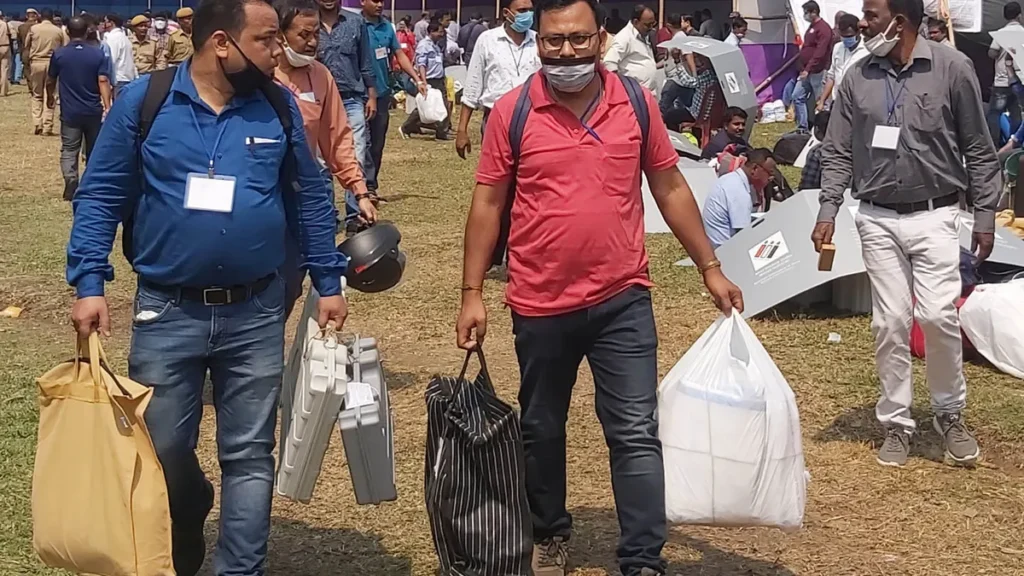
- Huge numbers of EVMs and staff are needed at once.
- The change needs wide political agreement and constitutional amendments.
What should be done next on simultaneous elections?
- Build broad agreement among parties and States.
- Set clear rules for what happens if a House is dissolved early.
- Prepare enough EVMs, VVPATs and staff in advance.
- Study the effects on federalism and voter behaviour carefully.
What can Prelims ask on simultaneous elections?
Prelims probability: Expect a statement question on what lapses when the Lok Sabha is dissolved, and on the Model Code of Conduct having no legal backing.
- Simultaneous polls were held in 1951-52, 1957, 1962 and 1967.
- Model Code of Conduct has no legal backing.
- Constitution (129th Amendment) Bill, 2024: simultaneous elections; proposes Article 82A.
- Kovind Committee reported in 2024.
- When the Lok Sabha is dissolved, Bills pending in the Lok Sabha lapse.
How to write about simultaneous elections in Mains
Practice question (15 marks, 250 words): ‘One Nation, One Election’ may reduce costs and policy paralysis but raises concerns for federalism. Critically examine.
- Intro: JPC hearing; economists on investment.
- Arguments for: cost, governance, investment.
- Concerns: federalism, early dissolution, logistics.
- Way forward: consensus, clear rules, preparation.
- Conclusion: reform with safeguards for States.
Ready lines for your answer
- Fewer elections can mean more governance.
- Reform must protect the voice of the States.
Quotable data pointSimultaneous elections were last held in 1967; the 129th Amendment Bill was introduced in December 2024.
Photo: Election Commission of India, GODL-India, via Wikimedia Commons
Exam angle
Prelims: 129th Amendment Bill, Article 82A, MCC, 1967. · Mains GS-II: electoral reforms, federalism.
Practice MCQs
Original practice questions (not PYQs).
Consider the following statements:
1. Lok Sabha and State Assembly elections were held together until 1967.
2. The Model Code of Conduct is backed by a law passed by Parliament.
3. The Constitution (129th Amendment) Bill, 2024 is about the Goods and Services Tax.
How many of the above statements are correct?
Answer (a) & explanation
Only statement 1 is correct. The Model Code of Conduct has no law behind it, and the 129th Amendment Bill is about simultaneous elections.
Questions students ask about this
What are simultaneous elections?
Holding Lok Sabha and all State Assembly elections at the same time.
When were simultaneous elections last held in India?
In 1967. They were also held in 1951-52, 1957 and 1962.
Is the Model Code of Conduct backed by law?
No. It comes from consensus among political parties and is enforced by the Election Commission.
Which Bill deals with simultaneous elections?
The Constitution (129th Amendment) Bill, 2024, now with a Joint Parliamentary Committee.