
Aditya-L1 shows solar eruptions swell unevenly
India’s solar observatory Aditya-L1 has given a new view of a coronal mass ejection, a huge burst of hot gas from the Sun. The burst did not grow like a round bubble, as scientists believed. It swelled unevenly, which can change how fast it reaches Earth. Read it to revise Aditya-L1, Lagrange point 1 and space weather.
- Observatory
- Aditya-L1
- Instrument
- VELC coronagraph
- Event studied
- 5 August 2024
- Team
- Indian Institute of Astrophysics
The Aditya-L1 finding: what happened?
A solar storm can knock out satellites and power grids. Knowing exactly when it will hit Earth is a big deal, and Aditya-L1 just made that sum harder and better.
- Scientists of the Indian Institute of Astrophysics studied an eruption from 5 August 2024.
- They used the Visible Emission Line Coronagraph, the main one of Aditya-L1’s seven instruments.
- The eruption swelled unevenly instead of growing like a round bubble.
- The same event was also seen by the United States’ Solar Dynamics Observatory.
What is a coronal mass ejection?
A coronal mass ejection is a huge cloud of hot, charged gas thrown out from the Sun’s outer layer, the corona.
When it hits Earth, it can disturb satellites, GPS, radio and power grids. This is called space weather.
Aditya-L1 sits near Lagrange point 1, about 1.5 million km from Earth, where it can watch the Sun without any eclipse.
How the instrument saw it
| Step | What happens |
|---|---|
| Light | Green light from iron gas at about 1.8 million Kelvin |
| Shift | Colour shifts as gas moves |
| Towards us | Light shifts one way |
| Away from us | Light shifts the other way |
Which laws and Articles apply?
- Aditya-L1: launched by ISRO on PSLV-C57 in 2023.
- Orbit: halo orbit around Lagrange point 1.
- Indian Institute of Astrophysics: under the Department of Science and Technology.
- Seven payloads, including VELC and SUIT.
Why does the Aditya-L1 finding matter?
| Angle | What to note |
|---|---|
| Science | Changes how we model solar storms. |
| Space weather | Better arrival-time forecasts. |
| Security | Protects satellites and grids. |
| Prestige | India’s first solar observatory in space. |
What are the problems with the Aditya-L1 finding?
- Uneven swelling makes forecasts harder.
- One event is a small sample.
- Needs data from many observatories.
- Space weather alerts in India are still new.
What should be done next on the Aditya-L1 finding?
- Study many more eruptions.
- Combine Aditya-L1 data with other missions.
- Build an Indian space weather warning system.
- Train more solar scientists.
What can Prelims ask on the Aditya-L1 finding?
Prelims probability: Expect a question on Aditya-L1 (Lagrange point 1) or the effects of solar storms on Earth.
- Aditya-L1: at Lagrange point 1.
- L1 is about 1.5 million km from Earth.
- VELC: main payload of Aditya-L1.
- Launched on PSLV-C57.
- Solar storms can disturb satellites, GPS and power grids.
How to write about the Aditya-L1 finding in Mains
Practice question (15 marks, 250 words): Discuss the significance of Aditya-L1 for understanding space weather and protecting critical infrastructure.
- Intro: new CME finding.
- What CMEs are.
- Effects on Earth.
- Aditya-L1’s role.
- Conclusion: science for safety.
Ready lines for your answer
- To protect Earth, first understand the Sun.
- Aditya-L1 turns sunlight into early warning.
Quotable data pointVELC is the main one of Aditya-L1's seven instruments.
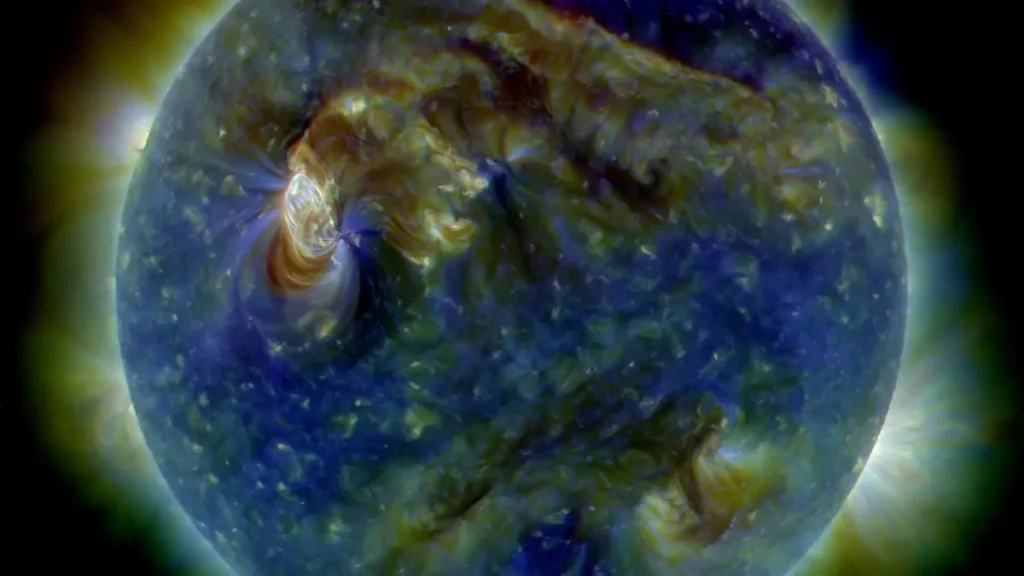
Photo: NASA/SDO/AIA, Public domain, via Wikimedia Commons
Exam angle
Prelims: Aditya-L1, L1 point, CMEs. · Mains GS-III: space technology.
Practice MCQs
Original practice questions (not PYQs).
Consider the following statements: Which of the statements given above are correct?
Answer (a) & explanation
Statements 1 and 2 are correct. Aditya-L1, launched on 2 September 2023, is India's first space-based solar observatory; Chandrayaan missions study the Moon.
Consider the following: Which of the above can be caused by strong solar storms reaching Earth?
Answer (c) & explanation
Solar storms can disturb satellite navigation, power grids and radio links and cause auroras. They do not cause earthquakes.
Questions students ask about this
What did Aditya-L1 find?
That a coronal mass ejection swelled unevenly, not like a round bubble.
Which instrument was used?
The Visible Emission Line Coronagraph (VELC).
Where is Aditya-L1 placed?
Near Lagrange point 1, about 1.5 million km from Earth.
Why does this matter?
Uneven swelling can change a solar storm's arrival time at Earth.