
Delhi sees worst pre-Diwali air in eight years; Stage-III curbs on
Delhi’s 24-hour Air Quality Index (AQI) touched 382 — ‘very poor’ and the worst pre-Diwali air in eight years. The Commission for Air Quality Management has put Stage-III of the Graded Response Action Plan (GRAP) in force across the National Capital Region. Read it to revise AQI, GRAP and the sources of smog.
- Delhi AQI
- 382 (very poor)
- Plan in force
- GRAP Stage-III
- Stubble share
- About 7.9% of fine dust
- Work from home
- Up to 50%
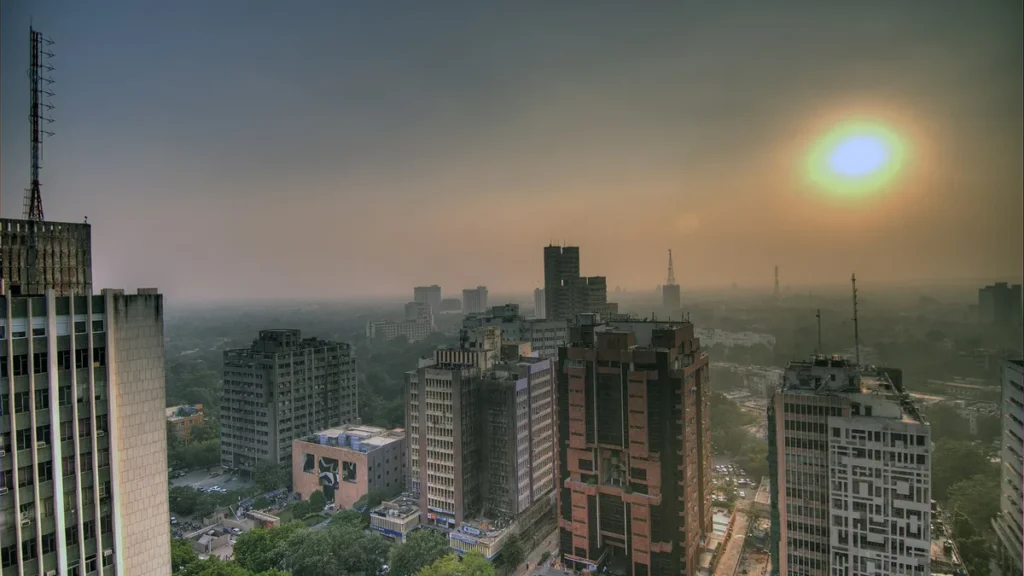
Delhi’s air: what happened?
Diwali has not even come, and Delhi’s air is already the worst in eight years.
- Delhi’s 24-hour AQI was 382, in the ‘very poor’ band.
- The Commission for Air Quality Management (CAQM) brought in GRAP Stage-III across the NCR.
- Older BS-III petrol and BS-IV diesel light vehicles are banned in Delhi, Gurugram, Faridabad, Sonipat, Ghaziabad and Gautam Buddha Nagar.
- Schools go hybrid up to Class V; offices can have up to 50% work from home; dust-raising construction is stopped.
- Stubble burning made up about 7.9% of fine particulate matter (PM2.5).
How does Delhi fight smog?
AQI turns pollution data into one number from 0 to 500. 301–400 is ‘very poor’ and above 400 is ‘severe’.
GRAP is a step-by-step plan with four stages. Each stage adds stricter curbs as AQI worsens.
In winter, cold still air traps dust, vehicle smoke, industry fumes and stubble smoke close to the ground.
GRAP stages
| Stage | AQI level |
|---|---|
| Stage I | Poor (201–300) |
| Stage II | Very poor (301–400) |
| Stage III | Severe (401–450) |
| Stage IV | Severe+ (above 450) |
Which laws and Articles apply?
- Commission for Air Quality Management in NCR and Adjoining Areas Act, 2021: set up CAQM.
- Air (Prevention and Control of Pollution) Act, 1981.
- National Clean Air Programme (2019): city action plans to cut particulate pollution.
- Article 21: the right to life includes clean air (courts have said so).
Why does Delhi’s air crisis matter?
| Angle | What to note |
|---|---|
| Health | Smog hurts lungs and heart. |
| Economy | Bans hit work and building. |
| Governance | CAQM coordinates many States. |
| Prelims | AQI pollutants and GRAP stages. |
What are the problems with Delhi’s air crisis?
- Curbs come only after the air is already bad.
- Many sources; stubble is only one part.
- Enforcement on dust and vehicles is weak.
- Daily-wage workers lose income during bans.
What should be done next on Delhi’s air crisis?
- Act early with forecasts, not after AQI peaks.
- Clean public transport and electric buses.
- Pay farmers to manage stubble without fire.
- Year-round control of dust and industry.
What can Prelims ask on Delhi’s air crisis?
Prelims probability: High — Air Quality Index gases are classic Prelims; Stage-III curbs and stubble share are crisp current facts.
- AQI pollutants: PM10, PM2.5, NO2, SO2, CO, O3, NH3, lead (8).
- GRAP has four stages.
- CAQM set up by a 2021 Act.
- Very poor = 301–400.
- Stubble share this time: about 7.9%.
How to write about Delhi’s air crisis in Mains
Practice question (15 marks, 250 words): Delhi’s winter smog needs year-round action, not emergency curbs. Discuss.
- Intro: AQI 382 and Stage-III.
- Sources: vehicles, dust, industry, stubble.
- GRAP: strengths and limits.
- Way forward: early warning, transport, farmers.
- Conclusion: clean air as a daily job.
Ready lines for your answer
- Emergency curbs treat the fever, not the illness.
- Clean air needs action in all twelve months.
Quotable data pointDelhi AQI 382; stubble about 7.9% of PM2.5.
Photo: wili hybrid, CC BY 2.0, via Wikimedia Commons
Exam angle
Prelims: AQI pollutants, GRAP, CAQM. · Mains GS-III: pollution and governance.
Practice MCQs
Original practice questions (not PYQs).
Delhi’s 24-hour average Air Quality Index before Diwali in the 7 November 2026 reports was about:
Answer (c) & explanation
The 24-hour average Air Quality Index hit 382, described as very poor — the worst pre-Diwali air in eight years.
Under Graded Response Action Plan Stage-III as reported, which vehicles face a private-use ban in Delhi and named National Capital Region districts?
Answer (b) & explanation
Stage-III bans Bharat Stage-III petrol and Bharat Stage-IV diesel light motor vehicles in Delhi and in Gurugram, Faridabad, Sonipat, Ghaziabad and Gautam Buddha Nagar.
On the day Stage-III was invoked, stubble burning’s share of Delhi’s fine particulate matter was reported around:
Answer (b) & explanation
Reports put the stubble contribution at about 7.9 percent of fine particulate matter that day; transport was a larger in-city share.
Consider the following atmospheric gases: 1. Carbon dioxide 2. Carbon monoxide 3. Nitrogen dioxide 4. Sulfur dioxide 5. Methane. Which are normally considered in calculating the Air Quality Index in Indian cities?
Answer (b) & explanation
UPSC Prelims 2016: carbon monoxide, nitrogen dioxide and sulfur dioxide are among the gases usually counted — not carbon dioxide or methane.
Questions students ask about this
What was Delhi's AQI?
382, in the 'very poor' band — the worst pre-Diwali air in eight years.
What is GRAP Stage-III?
The third step of Delhi-NCR's anti-pollution plan, with bans on older vehicles and construction dust.
How much did stubble burning add?
About 7.9% of fine particulate matter.
Who runs GRAP?
The Commission for Air Quality Management.