
Why the Siang dam plan faces protests
The Siang Upper Multipurpose Project is a proposed 11,000 to 11,200 megawatt dam on the Siang, the name of the Brahmaputra in Arunachal Pradesh. The Adi community says at least 40 villages would be hit and 27 would go under water, and protests have been tense since October. The government says the dam’s 9.2 billion cubic metres of storage would cut floods and guard against sudden water releases from China’s planned 60,000 megawatt Medog dam upstream. Read it to revise the Brahmaputra system, big-dam trade-offs and tribal rights.
- Capacity
- 11,000 to 11,200 megawatts
- Builder
- National Hydroelectric Power Corporation
- Villages
- At least 40 hit; 27 to go under water
- Storage
- 9.2 billion cubic metres
Siang dam protests: what happened?
A dam can protect a valley from floods — and drown the same valley’s homes and fields. The Siang project is that dilemma in its sharpest form.
- The Siang Upper Multipurpose Project is a proposed dam on the Siang in Arunachal Pradesh, to be built by the National Hydroelectric Power Corporation (NHPC), with 11,000 to 11,200 MW capacity.
- The Adi community says at least 40 villages would be hit and 27 would be submerged, with paddy fields, orange orchards and burial grounds.
- Villagers say their consent for the first study was taken under pressure. Protests have turned tense since October.
- Four activists held under a State preventive detention law were freed on 7 November and say the protest will go on.
- The government says the dam will store water, cut floods in Arunachal and Assam and create jobs. Its main reason is China’s planned 60,000 MW Medog dam upstream.
Which river is the Siang?
The Brahmaputra rises in Tibet as the Yarlung Tsangpo. It makes a sharp U-turn near the peak Namcha Barwa and enters India in Arunachal Pradesh as the Siang (also called Dihang). After the Dibang and Lohit join it, it flows into Assam as the Brahmaputra, and in Bangladesh it is called the Jamuna.
China’s Medog (Motuo) dam is planned at this Great Bend. India worries that a dam upstream could hold back water in the dry season or release a sudden flood. A big Indian reservoir downstream could act as a cushion.
The Adi are a major tribe of the Siang valley. Under the Forest Rights Act, 2006, the gram sabha’s consent is needed before forest land used by tribal communities is diverted.
Two dams on one river
| Item | Siang Upper (India) | Medog (China) |
|---|---|---|
| Capacity | 11,000 to 11,200 MW | About 60,000 MW |
| Location | Siang valley, Arunachal Pradesh | Great Bend of the Yarlung Tsangpo, Tibet |
| Main stated aim | Storage, flood cushion, power | Power |
Which laws and rules apply?
- Forest Rights Act, 2006: gram sabha consent before forest land diversion.
- Environment Impact Assessment and forest clearances before a big dam.
- Right to Fair Compensation and Transparency in Land Acquisition, Rehabilitation and Resettlement Act, 2013.
- Article 371H: the Governor of Arunachal Pradesh has a special responsibility for law and order in the State.
Why does the Siang dam matter?
| Angle | What to note |
|---|---|
| Geography | Brahmaputra’s names, U-turn and tributaries. |
| Environment | Dams in a quake-prone, fragile Himalayan valley. |
| Society | Displacement of the Adi community and their consent. |
| Prelims | Siang = Brahmaputra in Arunachal; Adi tribe; Medog dam. |
What are the problems with the Siang dam?
- Submergence of homes, farms and burial grounds of the Adi.
- Claims that consent was taken under pressure weaken trust.
- The region is earthquake-prone, so dam safety is a serious concern.
- Big reservoirs can change the river’s flow and fish life downstream.
What should be done next on the Siang dam?
- Hold free, fair and informed consultations with every affected village.
- Publish full studies on safety, ecology and downstream effects.
- Offer land-for-land and fair rehabilitation before any work.
- Keep river-data sharing talks with China going.
What can Prelims ask on the Siang dam?
Prelims probability: High. The Brahmaputra system is a favourite (2011 U-turn, 2016 tributaries). Fresh: protests over an 11,000-megawatt plan. Testable facts: Siang is the Brahmaputra’s name in Arunachal Pradesh, the Adi community, China’s Medog dam.
- Brahmaputra: Yarlung Tsangpo in Tibet, Siang in Arunachal, Jamuna in Bangladesh.
- U-turn near Namcha Barwa (the Great Bend).
- Dibang and Lohit join the Siang to form the Brahmaputra.
- Adi: major tribe of the Siang valley.
- Forest Rights Act, 2006: gram sabha consent for forest diversion.
How to write about the Siang dam in Mains
Practice question (15 marks, 250 words): Large dams in the Himalaya promise security and power but carry social and ecological costs. Examine with reference to the Siang Upper Multipurpose Project.
- Intro: 11,000 MW project; Adi protests; China’s Medog dam.
- Benefits: storage, flood cushion, power, strategic reason.
- Costs: displacement, consent, seismic risk, ecology.
- Legal checks: Forest Rights Act, land acquisition law, clearances.
- Way forward: genuine consent, transparency, data sharing with China.
Ready lines for your answer
- A dam built without the valley’s consent stores resentment along with water.
- Water security upstream cannot come at the cost of people downstream.
Quotable data point11,000–11,200 MW, 9.2 billion cubic metres storage; at least 40 villages hit, 27 submerged; China’s Medog about 60,000 MW.
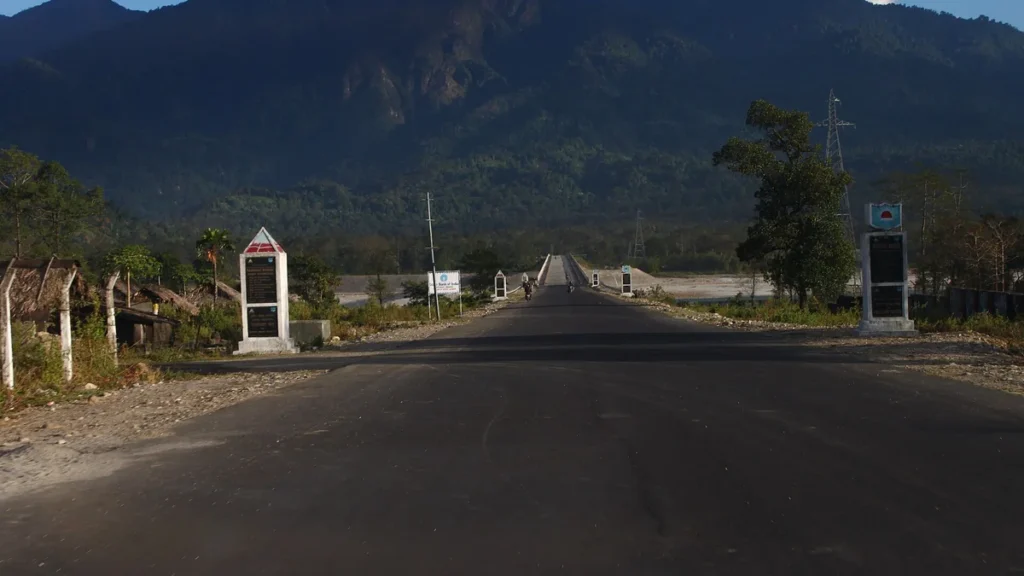
Photo: Anu007bora, CC BY-SA 4.0, via Wikimedia Commons
Exam angle
Prelims: Brahmaputra names, U-turn, tributaries, Adi tribe, Medog dam. · Mains GS-I/III: big dams, displacement and water security.
Practice MCQs
Original practice questions (not PYQs).
In Arunachal Pradesh, the Brahmaputra river is known as the:
Answer (b) & explanation
It is called the Yarlung Tsangpo in Tibet, the Siang or Dihang in Arunachal Pradesh, the Brahmaputra in Assam and the Jamuna in Bangladesh. The Subansiri is a tributary.
Consider the following statements:
1. The Siang Upper Multipurpose Project is to be built by the National Hydroelectric Power Corporation.
2. The Siang Upper Multipurpose Project has already received environment and forest clearance.
3. China's Medog dam is planned in Myanmar.
How many of the above statements are correct?
Answer (a) & explanation
Only statement 1 is correct. The project is only at the pre-feasibility report stage, and the Medog dam is planned in Tibet, China, upstream of Arunachal Pradesh.
Questions students ask about this
Is the Siang the same as the Brahmaputra?
Yes. It is called the Yarlung Tsangpo in Tibet, the Siang in Arunachal Pradesh and the Brahmaputra in Assam.
Why does India want this dam?
Mainly as a cushion against China’s planned Medog dam upstream. Its 9.2 billion cubic metres of storage could absorb sudden releases and cut floods.
Who is protesting and why?
The Adi community. They say at least 40 villages would be hit and 27 submerged, including fields, orchards and burial grounds.
What does the Forest Rights Act say about such projects?
Before forest land used by tribal communities is diverted, the gram sabha must give its consent after its rights are settled.
What is the Great Bend?
The sharp U-turn the river takes around Namcha Barwa in Tibet before entering India. China’s Medog dam is planned there.