
UP policy offers up to 35% subsidy for green jet fuel plants
Uttar Pradesh has published the Uttar Pradesh Sustainable Aviation Fuel (SAF) Production Promotion Policy 2026, posted by Invest UP on 12 November 2026. It offers capital subsidy of 15% to 35% (highest in Bundelkhand and Purvanchal), land subsidy of up to 80%, stamp duty relief, 100% net State GST reimbursement for ten years and a ten-year electricity duty exemption to plants making at least 30 kilolitres of SAF a day. Read it to revise what green jet fuel is, which crop wastes can make it and India’s blending targets.
- Minimum plant size
- 30 kilolitres of SAF a day
- Capital subsidy
- 15% to 35% of eligible investment
- Nodal agency
- State New and Renewable Energy Development Agency
- India’s targets
- 1% SAF by 2027, 2% by 2028 (international flights)
Green jet fuel policy: what happened?
Planes cannot run on batteries for long flights yet. So the cleanest option today is to change what goes into their tanks — and the State wants to make that fuel from its crop waste and used cooking oil.
- Uttar Pradesh has published the Sustainable Aviation Fuel (SAF) Production Promotion Policy 2026, posted by Invest UP on 12 November 2026. It was issued under the State’s executive power in Article 162.
- Only plants dedicated to SAF, making at least 30 kilolitres a day, are eligible. Projects are grouped as large (₹200–500 crore), mega (₹500–1,500 crore) and ultra-mega (above ₹1,500 crore).
- Capital subsidy: 15% in Gautam Buddha Nagar and Ghaziabad, 25% in the rest of the west and central regions, and 35% in Bundelkhand and Purvanchal, capped at ₹150 crore, ₹450 crore or ₹1,000 crore by project size.
- Other help: land subsidy of 50% to 80%, stamp duty relief, 100% net State GST reimbursement for ten years, 5% interest subsidy and a ten-year electricity duty exemption.
- The State New and Renewable Energy Development Agency will approve and pay the incentives.
What is sustainable aviation fuel?
Sustainable aviation fuel is jet fuel made from non-petroleum sources such as crop waste, used cooking oil, waste fats or ethanol. It is a drop-in fuel, meaning it can be mixed with normal jet fuel and used in today’s planes without changing engines.
The policy says aviation makes about 2.5% to 3% of the world’s carbon dioxide emissions, and SAF can cut life-cycle emissions by up to 80%. But it can cost up to five times more than normal jet fuel, which is why incentives matter.
Uttar Pradesh has a strong base: it grows the most sugarcane in India, is the second-largest ethanol producer after Maharashtra, and has huge amounts of paddy straw, wheat straw and bagasse. India has set indicative SAF targets of 1% by 2027 and 2% by 2028 for international flights.
Capital subsidy by region
| Region | Capital subsidy |
|---|---|
| Gautam Buddha Nagar and Ghaziabad | 15% |
| Rest of the west and central regions | 25% |
| Bundelkhand and Purvanchal | 35% |
| Land subsidy (west to Purvanchal/Bundelkhand) | 50% to 80% |
Which rules and goals apply?
- Article 162: the State’s executive power, under which the policy was issued.
- India’s indicative SAF blending targets: 1% by 2027 and 2% by 2028 for international flights.
- ICAO’s CORSIA: the global aviation scheme to offset and cut carbon emissions.
- State bioenergy and ethanol policies, which this policy builds on.
Why does the green jet fuel policy matter?
| Angle | What to note |
|---|---|
| Environment | Shows how aviation can cut emissions without new planes. |
| Agriculture | Crop waste gets a market, which can reduce stubble burning. |
| Economy | Brings green investment, mostly to poorer regions with higher subsidy. |
| Prelims | Drop-in fuel, 30 kilolitres a day, 1% by 2027 and 2% by 2028. |
What are the problems with the green jet fuel policy?
- SAF costs up to five times more than normal jet fuel.
- India’s targets are only indicative, so airlines are not yet bound to buy.
- Collecting crop waste and used cooking oil at scale is hard.
- Technology for some routes is new and costly.
What should be done next on the green jet fuel policy?
- Seek long-term purchase deals with airlines and oil companies.
- Build village-level collection of straw and bagasse.
- Set up a used-cooking-oil collection system in cities.
- Back research with universities to cut production costs.
What can Prelims ask on the green jet fuel policy?
Prelims probability: Medium. Sustainable aviation fuel and biofuels are fresh themes, and State policies are asked in the State exam. Testable facts: 30 kilolitres a day minimum, capital subsidy of 15% to 35%, India’s indicative targets of 1% by 2027 and 2% by 2028.
- Policy: Uttar Pradesh Sustainable Aviation Fuel Production Promotion Policy 2026.
- Eligibility: dedicated SAF plants of at least 30 kilolitres a day.
- Capital subsidy 15% to 35%; highest in Bundelkhand and Purvanchal.
- SAF is a drop-in fuel; can cut life-cycle emissions by up to 80%.
- India’s indicative targets: 1% by 2027, 2% by 2028 for international flights.
How to write about the green jet fuel policy in Mains
Practice question (15 marks, 250 words): Sustainable aviation fuel can help decarbonise aviation and raise farm incomes. Discuss its potential and challenges in India, with reference to the State’s new SAF policy.
- Intro: State SAF policy 2026; India’s 1% and 2% targets.
- What SAF is: drop-in fuel from waste and biomass.
- Gains: lower emissions, crop-waste market, green jobs.
- Challenges: cost, supply chains, indicative targets.
- Way forward: offtake deals, collection systems, research.
Ready lines for your answer
- The cleanest plane today is an old plane with a new fuel.
- Crop waste burnt is pollution; crop waste processed is fuel.
Quotable data pointState SAF policy 2026: 30 KLPD minimum, 15%–35% capital subsidy, 10-year SGST and electricity duty relief; India 1% SAF by 2027, 2% by 2028.
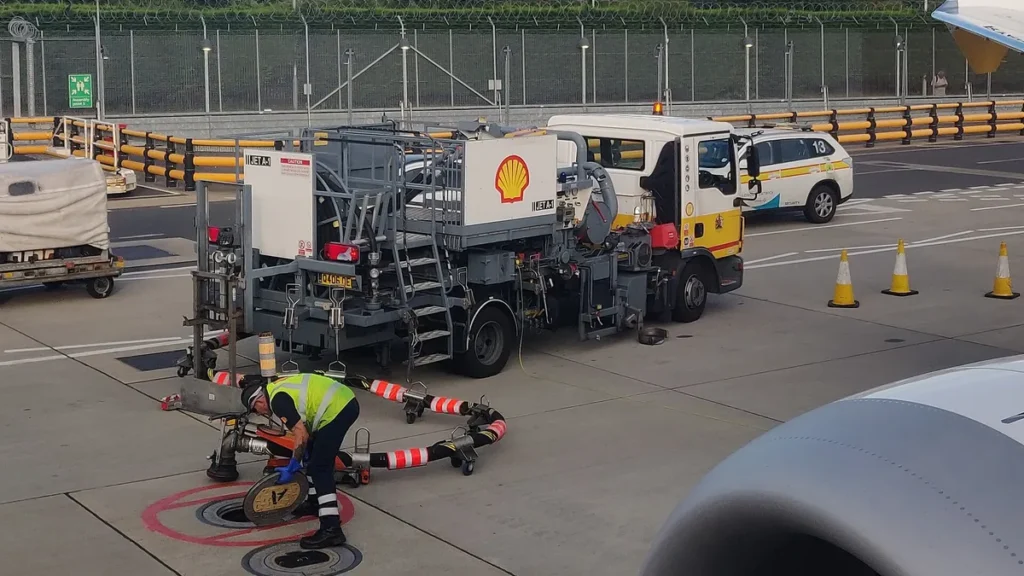
Photo: Tim Sheerman-Chase, CC BY 2.0, via Wikimedia Commons
Exam angle
Prelims: SAF as drop-in fuel, 1% by 2027 and 2% by 2028, CORSIA. · Mains GS-III: decarbonising aviation and biofuels.
Practice MCQs
Original practice questions (not PYQs).
Consider the following statements about sustainable aviation fuel (SAF):
1. It is a drop-in fuel that can be blended with conventional jet fuel and used in existing aircraft.
2. India has set indicative SAF blending targets of 1% by 2027 and 2% by 2028 for international flights.
3. It can be made only from edible vegetable oils.
Which of the statements given above are correct?
Answer (a) & explanation
SAF is a drop-in fuel and India’s indicative targets are 1% by 2027 and 2% by 2028 for international flights. Statement 3 is wrong: SAF can be made from crop waste, used cooking oil, waste fats, municipal waste and ethanol.
Under the State’s Sustainable Aviation Fuel Production Promotion Policy 2026, which regions get the highest rate of capital subsidy?
Answer (b) & explanation
Bundelkhand and Purvanchal get 35% capital subsidy, the rest of the west and central regions 25%, and Gautam Buddha Nagar and Ghaziabad 15%.
Questions students ask about this
What is sustainable aviation fuel in simple words?
Jet fuel made from things like crop waste, used cooking oil or ethanol instead of crude oil. It can be mixed with normal jet fuel and used in today’s planes.
Who can get incentives under the policy?
Plants dedicated to making SAF with a capacity of at least 30 kilolitres a day, as new, expansion or diversification projects.
Why is the subsidy higher in Bundelkhand and Purvanchal?
To pull investment into the State’s less industrialised regions. They get 35% capital subsidy against 15% in Gautam Buddha Nagar and Ghaziabad.
What are India’s SAF targets?
Indicative targets of 1% SAF by 2027 and 2% by 2028 for international flights.
How can this help farmers?
Paddy straw, wheat straw and bagasse can become raw material for SAF, giving farmers a buyer for crop waste instead of burning it.
Who runs the policy?
The State New and Renewable Energy Development Agency approves and pays the incentives.