
Lonar crater named a global geological heritage site
The Lonar Lake impact crater in Buldhana district of Maharashtra is now on a world list of key geological sites. It is part of the third set of 100 sites chosen by the International Union of Geological Sciences. The crater was made when a meteorite struck the Earth at very high speed. It is about 1.88 km wide and, according to the Ministry of Mines, about 12,000 years old. It is rare because it formed in basalt, the dark volcanic rock of the Deccan Traps, and is one of only five known craters of this kind on Earth. A salty, alkaline lake fills its centre. The Geological Survey of India sent the proposal. The new list covers sites in 47 countries, including Mount Fuji in Japan and the fjords of Norway. Read it to revise the Deccan Traps, impact craters of India and salt lakes.
- Where
- Buldhana district, Maharashtra
- Size and age
- About 1.88 km wide; about 12,000 years old
- Rock type
- Basalt of the Deccan Traps
- Who listed it
- International Union of Geological Sciences, third 100 sites
UPSC has already asked about this. Read the story with these questions in mind.
- Mains 2023 · GS3Comment on the National Wetland Conservation Programme initiated by the Government of India and name a few India’s wetlands of international importance included in…See model answer →
- Mains 2018 · GS3What is wetland? Explain the Ramsar concept of ‘wise use’ in the context of wetland conservation. Cite two examples of Ramsar sites from India.See model answer →
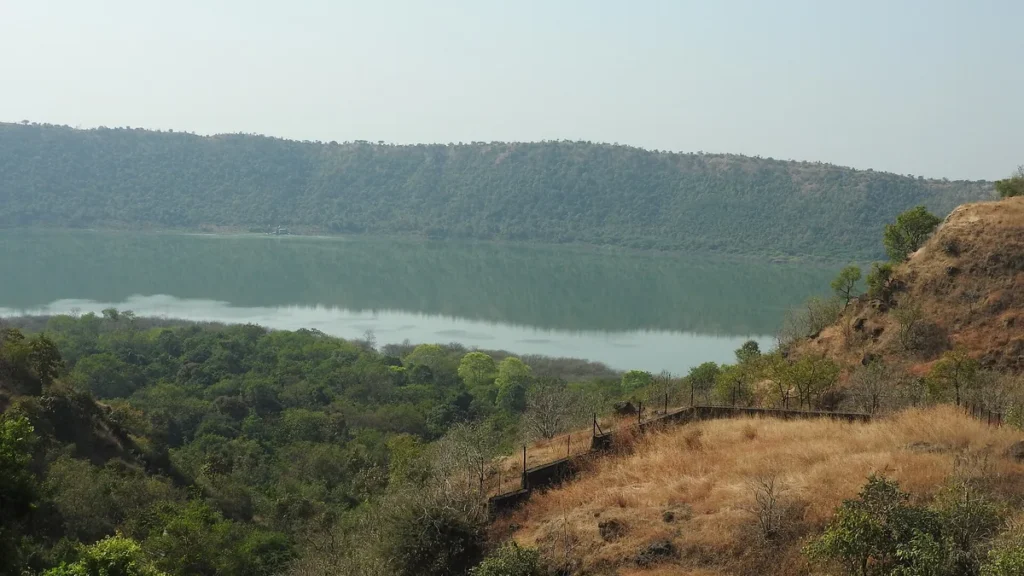
Lonar crater on a world heritage geology list: what happened?
Most lakes are carved by rivers or ice. Lonar was punched into the Deccan plateau by a meteorite, and the world geology body has now put that scar on its global list.
- The Lonar Lake impact crater in Buldhana district of Maharashtra is now on a world list of key geological sites. It is part of the third set of 100 sites chosen by the International Union of Geological Sciences.
- The crater was made when a meteorite struck the Earth at very high speed. It is about 1.88 km wide and, according to the Ministry of Mines, about 12,000 years old.
- It is rare because it formed in basalt, the dark volcanic rock of the Deccan Traps. It is one of only five known craters of this kind on Earth.
- A salty, alkaline lake fills its centre.
- The Geological Survey of India sent the proposal. The new list covers sites in 47 countries, including Mount Fuji in Japan and the fjords of Norway.
Why is a crater in basalt so unusual?
The Deccan Traps are a vast pile of basaltic lava that poured out about 65 million years ago, covering much of western and central India. A meteorite crater in this rock is rare, which is why Lonar is compared with only a handful of basaltic impact sites on Earth.
The lake in the crater is saline and alkaline. Lonar is also a Ramsar site, recognised as a wetland of international importance. That ecological tag is separate from the new IUGS geological listing.
India has other impact structures too, including Dhala in Madhya Pradesh and Ramgarh in Rajasthan. Lonar is among the youngest and best preserved.
Lonar at a glance
| Feature | Detail |
|---|---|
| Location | Buldhana, Maharashtra |
| Width and age | About 1.88 km; about 12,000 years |
| Rock | Basalt of the Deccan Traps |
| Lake | Salty and alkaline; also a Ramsar wetland |
Which bodies and protections matter?
- International Union of Geological Sciences: selects Geological Heritage Sites for outstanding scientific value.
- Geological Survey of India, under the Ministry of Mines, proposed the site.
- Ramsar Convention: Lonar is also listed as a wetland of international importance.
- State and local protection is still needed; an IUGS listing is recognition, not a legal shield by itself.
Why does the Lonar listing matter?
| Angle | What to note |
|---|---|
| Geography | A clear example of an impact landform in Deccan basalt. |
| Environment | A saline-alkaline crater lake that is also a Ramsar wetland. |
| Heritage | Shows India’s geoheritage work through the Geological Survey. |
| Prelims | Buldhana, 1.88 km, ~12,000 years, five basaltic craters, Dhala and Ramgarh. |
What are the problems with the Lonar listing?
- An IUGS listing does not automatically add legal protection.
- Tourism pressure and pollution can harm a small crater lake.
- The scientific age and impact evidence still need careful conservation of outcrops.
- Other Indian craters are less well known and can be neglected.
What should be done next on the Lonar listing?
- Back the listing with local protection and visitor management.
- Use the site to teach impact geology and the Deccan Traps in schools and colleges.
- Keep the lake’s salinity and shoreline free of untreated waste.
- Document and protect other Indian impact structures such as Dhala and Ramgarh.
What can Prelims ask on the Lonar listing?
Prelims probability: High. A crisp place-and-landform fact of the kind the exam likes (salt lakes asked in 2021). Fresh: global listing. Testable facts: meteorite crater in basalt, Buldhana district, Ramsar site, Dhala and Ramgarh craters.
- Lonar: meteorite crater in Buldhana, Maharashtra, about 1.88 km wide and about 12,000 years old.
- Formed in Deccan Trap basalt; one of five known basaltic hypervelocity craters on Earth.
- Saline-alkaline lake; also a Ramsar site.
- IUGS third 100 Geological Heritage Sites, covering 47 countries.
- Other Indian craters: Dhala (Madhya Pradesh) and Ramgarh (Rajasthan).
How to write about the Lonar listing in Mains
Practice question (15 marks, 250 words): The Lonar Lake impact crater has been named a global geological heritage site. Explain how it was formed and discuss the significance of such listings for conservation and education in India.
- Intro: IUGS third 100 and GSI’s proposal.
- Formation: hypervelocity meteorite in Deccan basalt; 1.88 km, ~12,000 years.
- Features: saline-alkaline lake, ejecta, rarity among basaltic craters.
- Significance: science, education, tourism, Ramsar overlap.
- Way forward: legal protection and careful visitor use.
Ready lines for your answer
- A lake can be a scar left by a stone from space, not only by a river.
- A world list is a spotlight; protection still has to be done at home.
Quotable data pointLonar crater, Buldhana: ~1.88 km, ~12,000 years, basalt of the Deccan Traps; IUGS third 100 sites in 47 countries.
Photo: Dhruva Punde, CC BY-SA 4.0, via Wikimedia Commons
Exam angle
Prelims: Lonar in Buldhana, Deccan basalt, Ramsar, Dhala and Ramgarh. · Mains GS-I: landforms and geoheritage.
Practice MCQs
Original practice questions (not PYQs).
Lonar Lake, a meteorite impact crater recently listed among global geological heritage sites, is in which district?
Answer (a) & explanation
Lonar Lake is in Buldhana district of Maharashtra.
Consider the following statements:
1. Lonar crater was formed in basalt rock of the Deccan Traps.
2. Lonar Lake is a Ramsar site.
3. Dhala and Ramgarh are other impact craters in India.
How many of the above statements are correct?
Answer (c) & explanation
All three are correct. Lonar became a Ramsar site in 2020; Dhala is in Madhya Pradesh and Ramgarh in Rajasthan.
Questions students ask about this
Where is the Lonar crater?
In Buldhana district of Maharashtra.
How was it formed?
A meteorite struck the Deccan basalt at very high speed, leaving a crater about 1.88 km wide.
How old is it?
About 12,000 years, according to the Ministry of Mines, making it one of the younger well-preserved impact craters.
Who put it on the world list?
The International Union of Geological Sciences, in its third set of 100 Geological Heritage Sites. The Geological Survey of India sent the proposal.
Is Lonar also a Ramsar site?
Yes. The salty, alkaline lake is recognised as a wetland of international importance, which is separate from the new geology listing.