
New centre to gene-edit fruits and vegetables
The head of the Indian Council of Agricultural Research, Dr M.L. Jat, opened a Centre of Excellence for Genome Editing in Horticultural Crops in Bengaluru on 15 November. It is at the Indian Institute of Horticultural Research and has a Biosafety Level-2 laboratory. A farmers’ advanced training centre was also opened. Dr Jat asked scientists to build India’s own genetic resources for this research. Farmers spoke about coping with El Niño through mulching, sprinklers, mixed cropping and related practices. Read it to revise genome editing, Cas9, the 2022 exemption, edited rice varieties and the Genetic Engineering Appraisal Committee.
- What was opened
- Centre of Excellence for Genome Editing in Horticultural Crops, with a Biosafety Level-2 laboratory, and a farmers’ advanced training centre
- Where and when
- Indian Institute of Horticultural Research, Bengaluru, on 15 November 2026
- Who opened it
- Dr M.L. Jat, Secretary, Department of Agricultural Research and Education, and Director General of the Indian Council of Agricultural Research
- The scientific call
- Scientists were asked to build India’s own genetic resources for this research
UPSC has already asked about this. Read the story with these questions in mind.
What was opened in Bengaluru, and why does it matter?
A pair of molecular scissors can change a crop without bringing in a gene from another species. India has now given horticulture its own centre to try that work, under a biosafety laboratory, in Bengaluru.
- The head of the Indian Council of Agricultural Research, Dr M.L. Jat, opened a Centre of Excellence for Genome Editing in Horticultural Crops in Bengaluru on 15 November.
- It is at the Indian Institute of Horticultural Research and has a Biosafety Level-2 laboratory. A farmers’ advanced training centre was also opened.
- Dr Jat asked scientists to build India’s own genetic resources for this research.
- Farmers spoke about coping with El Niño through mulching, sprinklers and mixed cropping, and related climate-resilient practices such as border cropping and green manuring.
What is genome editing, and how is it regulated in India?
Genome editing is a set of tools that can cut and alter a precise place in a plant’s own DNA. The best-known tool is Cas9, often described as molecular scissors, used in the CRISPR-Cas9 method. Unlike many older genetically modified crops, some edited plants contain no DNA from another species.
In 2022, India exempted certain site-directed nuclease edits — those that do not introduce foreign DNA — from the full genetically modified organism clearance process. The Genetic Engineering Appraisal Committee, under the Environment Ministry, remains the main regulator for genetic engineering. In 2025, genome-edited rice varieties were a widely reported Indian first in this field.
A Biosafety Level-2 laboratory is a contained workspace with extra controls, used when the work needs more care than an ordinary bench but is not the highest-risk class. Placing one at a horticulture centre is meant to let scientists edit fruits and vegetables under those controls.
The wider legal frame includes the Environment (Protection) Act, 1986, under which the genetic-engineering rules sit, and the Indian Council of Agricultural Research as the national umbrella for this new centre. The call to build India’s own genetic resources is a reminder that editing tools are of little use if the plant collections and the data behind them are borrowed.
The Bengaluru opening at a glance
| Item | What to note |
|---|---|
| Centre | Centre of Excellence for Genome Editing in Horticultural Crops, with a Biosafety Level-2 laboratory |
| Also opened | Farmers’ advanced training centre, at the same institute |
| Institute | Indian Institute of Horticultural Research, Bengaluru; opened on 15 November 2026 |
| Regulation to revise | 2022 exemption for certain edits without foreign DNA; Genetic Engineering Appraisal Committee; Environment (Protection) Act, 1986 |
Which rules and bodies apply?
- Environment (Protection) Act, 1986: the parent law under which India’s genetic-engineering rules have been framed.
- Genetic Engineering Appraisal Committee: the main regulator for genetic engineering, under the Environment Ministry.
- The 2022 exemption: certain site-directed nuclease edits that do not introduce foreign DNA were taken out of the full genetically modified organism clearance process.
- Indian Council of Agricultural Research and the Department of Agricultural Research and Education: the parent bodies for the new Bengaluru centre.
Why does the genome-editing centre matter?
| Angle | What to note |
|---|---|
| Science and technology | A new horticulture centre is a clean way to revise Cas9, biosafety levels and the difference between gene editing and older genetic modification. |
| Agriculture | Fruits and vegetables, climate-resilient traits and El Niño practices connect a laboratory to a farmer’s field. |
| Prelims | Cas9 as scissors, the 2022 exemption, the 2025 edited rice, the Genetic Engineering Appraisal Committee, the 1986 Act, Biosafety Level-2. |
| Atmanirbhar science | The call to build India’s own genetic resources is about who owns the libraries that editing tools will cut. |
What are the problems with the genome-editing centre?
- A new centre and a laboratory do not, by themselves, produce a variety that a farmer can plant; years of trials still sit between an inauguration and a seed packet.
- The 2022 exemption is still debated: supporters call it proportionate, critics want closer watch even when no foreign DNA is added.
- Without a strong Indian collection of genetic resources, the centre could end up dependent on tools and libraries developed elsewhere.
- Climate-resilient advice such as mulching and sprinklers helps only if it travels beyond the farmers who could already attend an inauguration in Bengaluru.
What should be done next on the genome-editing centre?
- Set public, time-bound research targets for the centre — which fruits and vegetables, which traits, and when a farmer might see a result.
- Invest in Indian genetic-resource libraries and data, so that editing work is not only a borrowed toolkit.
- Keep the biosafety rules transparent, including how the 2022 exemption is used and reviewed.
- Link the farmers’ training centre to a wider extension network, so that El Niño practices and any future edited varieties travel together.
What can Prelims ask on the genome-editing centre?
Prelims probability: High. Cas9 was asked in 2019 and the appraisal committee in 2015. Fresh centre and climate-resilient crops. Testable facts: Cas9 as scissors, 2022 exemption, 2025 edited rice, the 1986 Act.
- Centre of Excellence for Genome Editing in Horticultural Crops, with a Biosafety Level-2 laboratory, opened on 15 November 2026 at the Indian Institute of Horticultural Research, Bengaluru, by Dr M.L. Jat, Director General of the Indian Council of Agricultural Research.
- A farmers’ advanced training centre was opened on the same visit. Scientists were asked to build India’s own genetic resources.
- Genome editing: tools such as Cas9 (CRISPR-Cas9) that cut a precise place in a plant’s DNA. Some edits add no foreign DNA.
- 2022 exemption: certain site-directed nuclease edits without foreign DNA were taken out of the full genetically modified organism process. Genetic Engineering Appraisal Committee is the main regulator. Environment (Protection) Act, 1986.
- Genome-edited rice varieties were reported in 2025. Farmers at the event discussed El Niño practices such as mulching, sprinklers and mixed cropping.
How to write about the genome-editing centre in Mains
Practice question (15 marks, 250 words): India has opened a new centre for genome editing in horticultural crops. Explain what genome editing is, how it is regulated, and what conditions will decide whether such a centre helps farmers.
- Open with the 15 November Bengaluru inauguration: a Centre of Excellence with a Biosafety Level-2 laboratory, and a farmers’ training centre, at the Indian Institute of Horticultural Research.
- Explain genome editing and Cas9, and how some edits differ from older genetically modified crops because they add no foreign DNA.
- State the 2022 exemption, the role of the Genetic Engineering Appraisal Committee, and the Environment (Protection) Act, 1986, and mention the 2025 edited rice.
- Note the call to build India’s own genetic resources, and the El Niño practices discussed by farmers.
- Close with the tests that remain: time-bound traits, transparent biosafety, Indian libraries, and extension beyond the inauguration day.
Ready lines for your answer
- A pair of molecular scissors is only as useful as the library of plants it can cut.
- An inauguration is not a variety; a farmer will judge the centre by a seed, not by a plaque.
Quotable data point15 Nov 2026, ICAR-IIHR Bengaluru: Centre of Excellence for Genome Editing in Horticultural Crops with BSL-2 lab, and a farmers’ advanced training centre, inaugurated by Dr M.L. Jat, DG ICAR; call to build India’s own genetic resources; farmers discussed El Niño practices (mulching, sprinklers, mixed cropping).
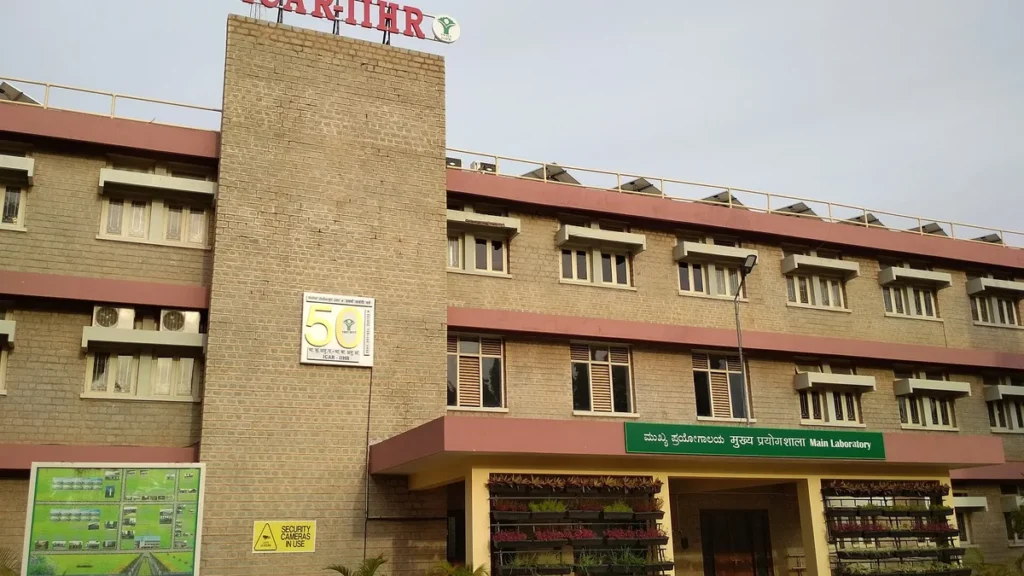
Photo: Gutam2000, CC BY-SA 4.0, via Wikimedia Commons
Exam angle
Prelims: Cas9, 2022 exemption, 2025 edited rice, Genetic Engineering Appraisal Committee, 1986 Act, Biosafety Level-2. · Mains GS-III: biotechnology in farming and climate-resilient horticulture.
Practice MCQs
Original practice questions (not PYQs).
In which year did India exempt genome-edited plants that carry no foreign genes from the rules for genetically modified organisms?
Answer (c) & explanation
The exemption came in 2022; India released its first two genome-edited rice varieties in May 2025.
Consider the following statements:
1. Genome editing always inserts a gene from another species into a plant.
2. The Genetic Engineering Appraisal Committee works under the Environment (Protection) Act, 1986.
3. India released its first genome-edited rice varieties in 2015.
How many of the above statements are correct?
Answer (a) & explanation
Only statement 2 is correct. Genome editing makes exact changes to a plant's own genes, often without foreign genes; the first edited rice varieties came in 2025.
Questions students ask about this
What was opened in Bengaluru, and when?
A Centre of Excellence for Genome Editing in Horticultural Crops, with a Biosafety Level-2 laboratory, and a farmers’ advanced training centre, at the Indian Institute of Horticultural Research, on 15 November 2026.
Who inaugurated it?
Dr M.L. Jat, Secretary, Department of Agricultural Research and Education, and Director General of the Indian Council of Agricultural Research.
What is Cas9?
A widely used genome-editing tool, often called molecular scissors, in the CRISPR-Cas9 method. It can cut a precise place in a plant’s DNA.
What happened in 2022 and in 2025?
In 2022, India exempted certain edits that do not introduce foreign DNA from the full genetically modified organism clearance process. In 2025, genome-edited rice varieties were reported.
Which body regulates genetic engineering in India?
The Genetic Engineering Appraisal Committee, under the Environment Ministry, within the frame of the Environment (Protection) Act, 1986.